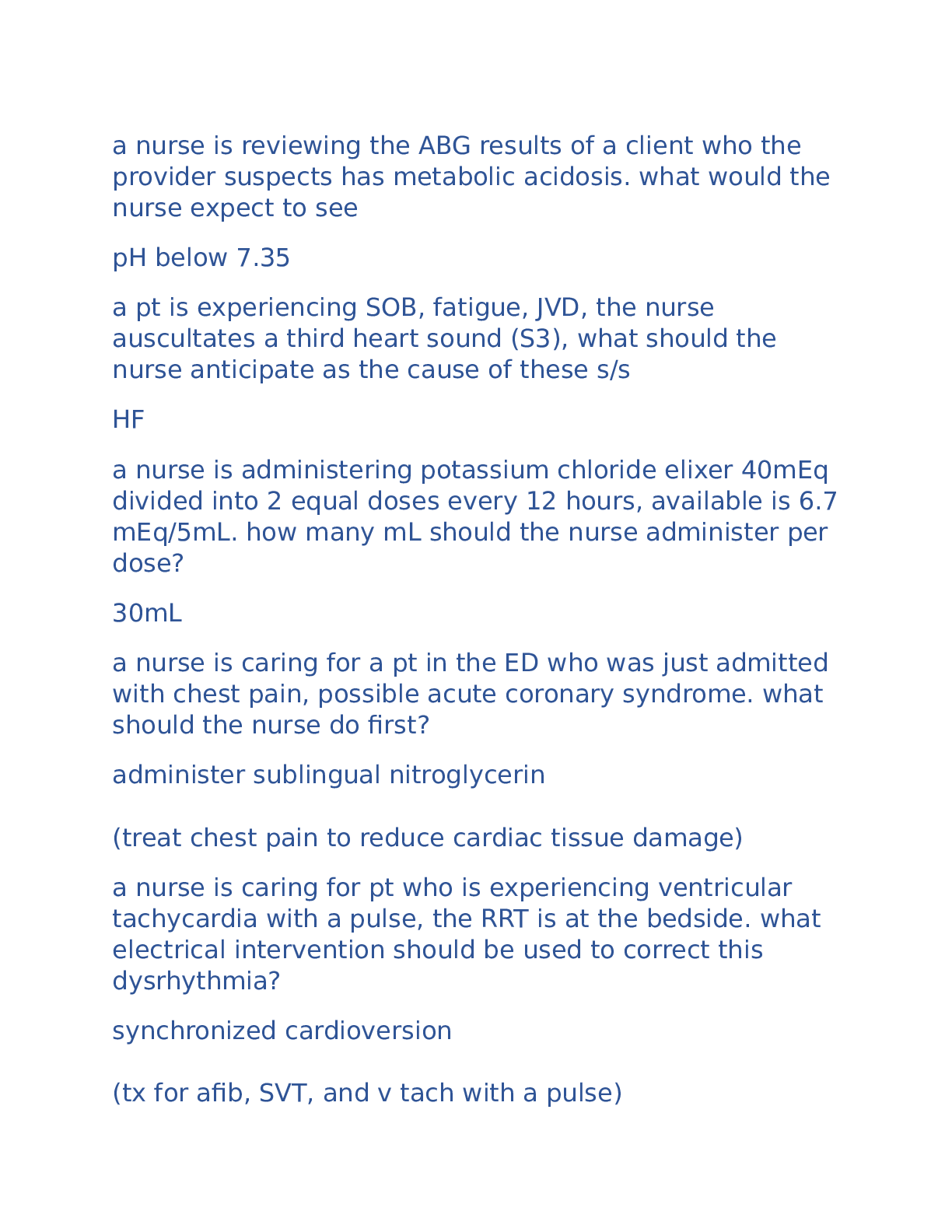
A client seeks care for low back pain of 2 weeks' duration. Which assessment finding suggests a herniated intervertebral
disk?
1. Pain radiating down the posterior
thigh
2. Back pain when the knees are
flexed
3. At
...
A client seeks care for low back pain of 2 weeks' duration. Which assessment finding suggests a herniated intervertebral
disk?
1. Pain radiating down the posterior
thigh
2. Back pain when the knees are
flexed
3. Atrophy of the lower leg muscles
4. Homans' sign
Correct Answer: 1 Your Answer: 1
RATIONALES: A herniated intervertebral disk may compress the spinal nerve roots, causing sciatic nerve inflammation that results in pain radiating
down the leg. Slight knee flexion should relieve, not precipitate, low back pain. If nerve root compression remains untreated, weakness or paralysis
of the innervated muscle group may result; lower leg atrophy may occur if muscles aren't used. Homans' sign is more typical of phlebothrombosis.
The nurse is teaching a client with osteomalacia how to take prescribed vitamin D supplements. The nurse stresses the importance of taking only
the prescribed amount because high doses of vitamin D can be toxic. Early signs and symptoms of vitamin D toxicity include:
1. GI upset and metallic
taste.
2. dry skin, hair loss, and inflamed mucous
membranes.
3. flushing and orthostatic hypotension.
4. sensory neuropathy and difficulty maintaining
balance.
Correct Answer: 1 Your Answer: 1
RATIONALES: GI upset and metallic taste are early signs and symptoms of vitamin D toxicity. Such toxicity also may cause headache, weakness,
renal insufficiency, renal calculi, hypertension, arrhythmias, muscle pain, and conjunctivitis. Dry skin, hair loss, and inflamed mucous membranes
suggest vitamin A toxicity. Flushing and orthostatic hypotension (effects of vasodilation) may result from nicotinic acid and nicotinamide supplements,
used to correct niacin deficiency. Sensory neuropathy and difficulty maintaining balance suggest pyridoxine toxicity.
A client with osteoarthritis tells the nurse she is concerned that the disease will prevent her from doing her chores. Which suggestion should the nurse
offer?
1. "Do all your chores in the morning, when pain and stiffness are least
pronounced."
2. "Do all your chores after performing morning exercises to loosen
up."
3. "Pace yourself and rest frequently, especially after
activities."
4. "Do all your chores in the evening, when pain and stiffness are least
pronounced."
Correct Answer: 3 Your Answer: 3
RATIONALES: A client with osteoarthritis must adapt to this chronic and disabling disease, which causes deterioration of the joint cartilage. The most
common symptom of the disease is deep, aching joint pain, particularly in the morning and after exercise and weight-bearing activities. Because rest
usually relieves the pain, the nurse should instruct the client to rest frequently, especially after activities, and to pace herself during daily activities.
Option 1 is incorrect because the pain and stiffness of osteoarthritis are most pronounced in the morning. Options 2 and 4 are incorrect because the
client should pace herself and take frequent rests rather than doing all chores at once.
1
A 51-year-old client with Paget's disease comes to the hospital and complains of difficulty urinating. The emergency department physician consults
urology. What would the nurse suspect is the most likely cause of the client's urination problem?
1. Renal calculi
2. Urinary tract
infection
3. Benign prostatic hyperplasia
4. Dehydration
Correct Answer: 1 Your Answer: 1
RATIONALES: Renal calculi commonly occur with Paget's disease, causing pain and difficulty when urinating. A urinary tract infection (UTI)
commonly causes fever, urgency, burning, and hesitation with urination. Benign prostatic hyperplasia is common in men older than age 50; however,
because the client has Paget's disease, the nurse should suspect renal calculi, not benign prostatic hyperplasia. Dehydration causes a decrease in
urine production, not a problem with urination.
A common bone disease that usually affects middle-aged and elderly people. It's marked by inflammation of the bones, softening and thickening of the
bones, excessive bone destruction, and unorganized bone repair; the result is bowing of the long bones. The cause
[Show More]






















.png)



 Chamberlain College Of Nursing (100 Correct Q & A.png)