Exam (elaborations) Nursing ALS Final Exam Graded Best Study Guide Score A.
Document Content and Description Below
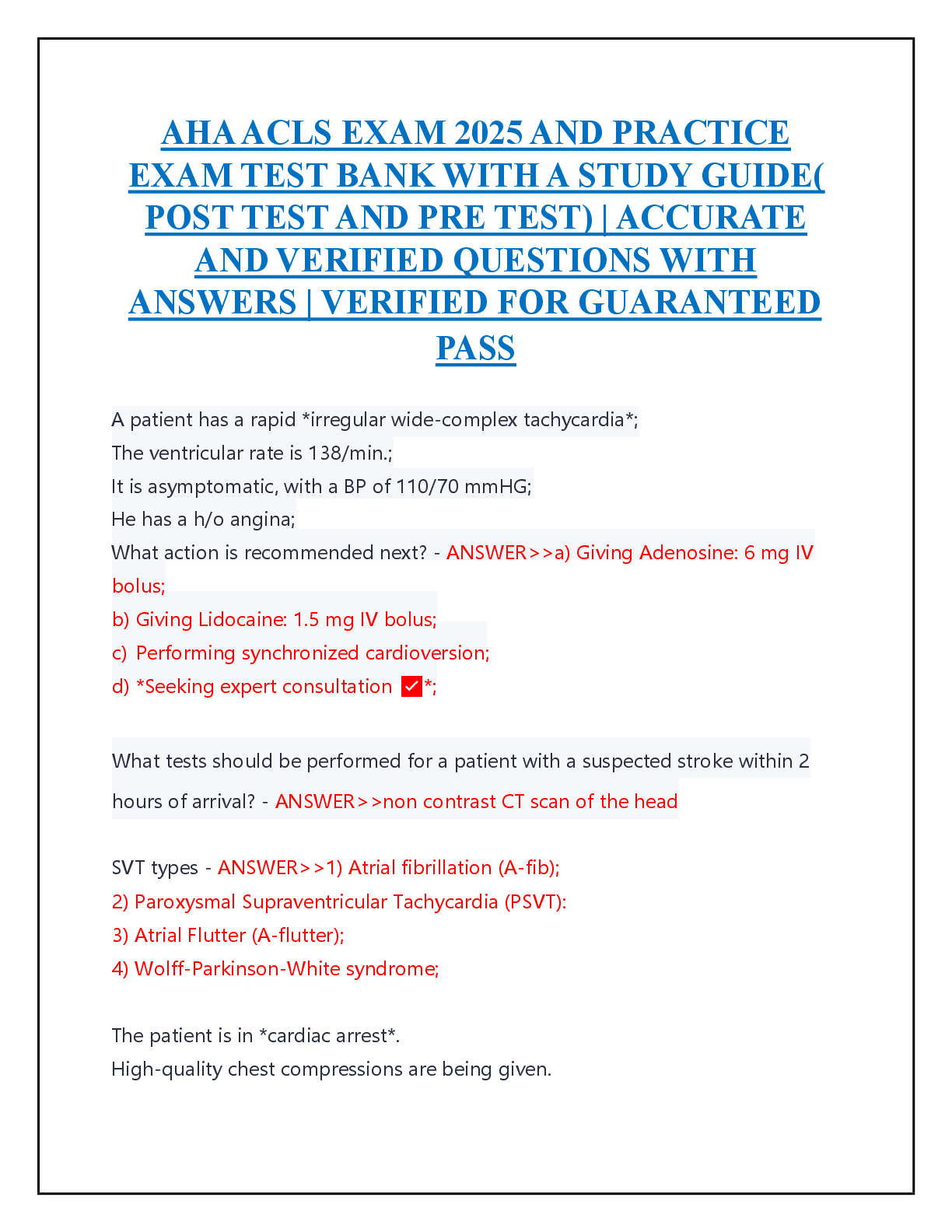
Exam (elaborations) Nursing ALS Final Exam Graded Best Study Guide Score A. The stroke team is assessing a patient with a suspected stroke. The patient is alert and able to carry on a conversation, although the patient h
...
[Show More]
Last updated: 3 years ago
Preview 1 out of 18 pages
Instant download

Buy this Document to get the Full Access Instantly
Provided by Students Who Aced it
We Verify Document Content to Gurantee Accuracy
Reviews( 0 )
Document information
Connected school, study & course
About the document
Uploaded On
Mar 11, 2022
Number of pages
18
Written in
All

Additional information
This document has been written for:
Uploaded
Mar 11, 2022
Downloads
0
Views
149
Topic Tags
Recommended For You
Get more on EXAM »
$100.5
996 Pages
ATI TEAS 7 | 4 Versions for Reading, Math, Science, English, A...


$19
635 Pages