Student Exploration: Chemical Equations
Vocabulary: Avogadro’s number, chemical equation, chemical formula, chemical reaction,
coefficient, combination, combustion, conservation of matter, decomposition, double
replac
...
Student Exploration: Chemical Equations
Vocabulary: Avogadro’s number, chemical equation, chemical formula, chemical reaction,
coefficient, combination, combustion, conservation of matter, decomposition, double
replacement, molar mass, mole, molecular mass, molecule, product, reactant, single
replacement, subscript
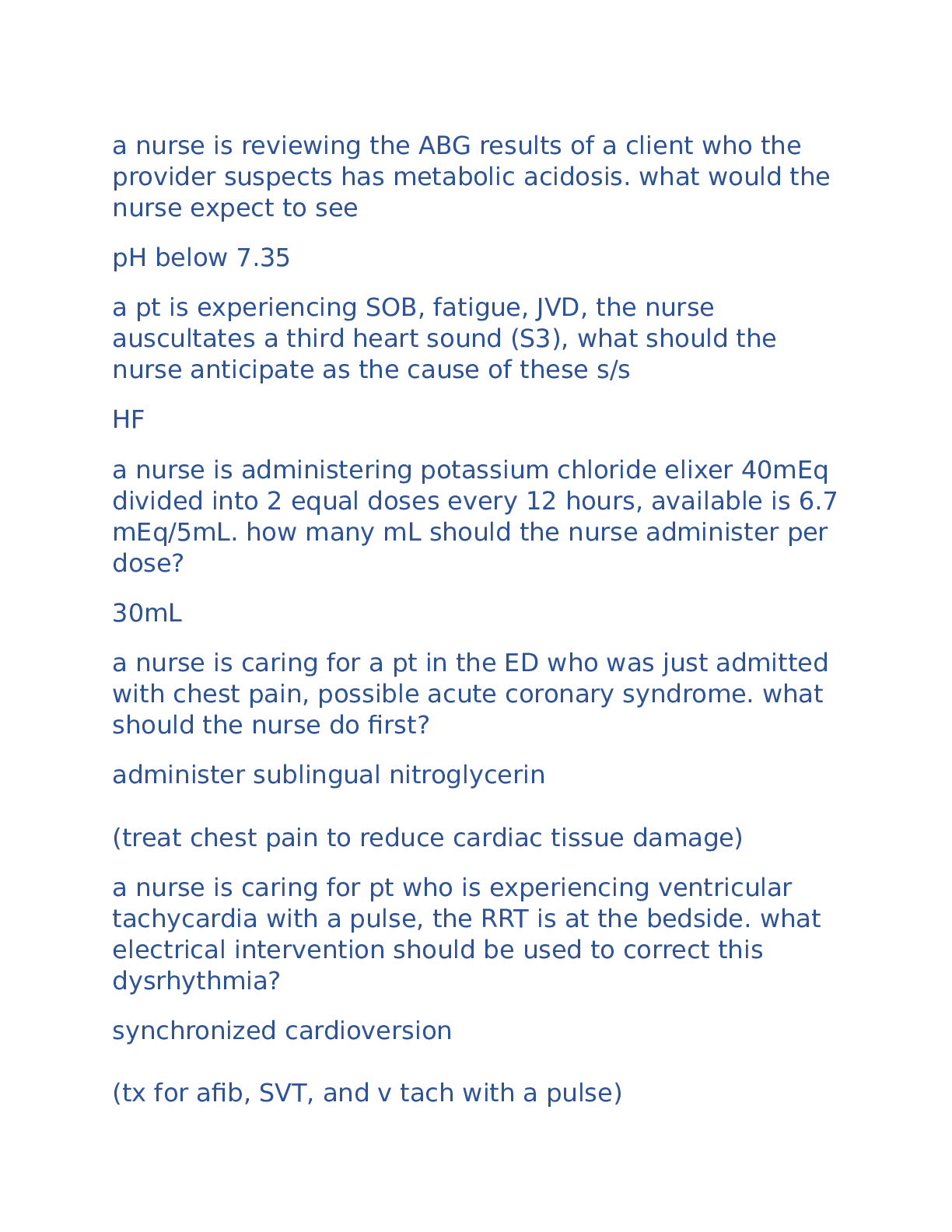
Prior Knowledge Questions (Do these BEFORE using the Gizmo.)
1. A candle is placed on one pan of a balance, and an equal weight is placed on the other pan.
What would happen if you lit up the candle and waited for a while? The candle that is lit up
would be lifted higher on the balance than an object with an equal weight. This would occur
because the candle made of wax would begin to melt due to the flame and shrink and candle as
well as lower the candle’s weight in the process.
2. Suppose the candle was placed in a large, sealed jar that allowed it to burn for several
minutes before running out of oxygen. The candle and jar are balanced by an equal weight.
In this situation, what would happen if you lit up the candle and waited? The candle in a jar
would become lighter than the object of equal weight on the other side of the scale. The energy
derived from the candle’s flame would be concealed into the lid of the jar. As the energy is
concealed to the top of the jar, it would lighten the candle.
Gizmo Warm-up
Burning is an example of a chemical reaction. The law of conservation of matter states that
no atoms are created or destroyed in a chemical reaction. Therefore, a balanced chemical
equation will show the same number of each type of atom on each side of the equation.
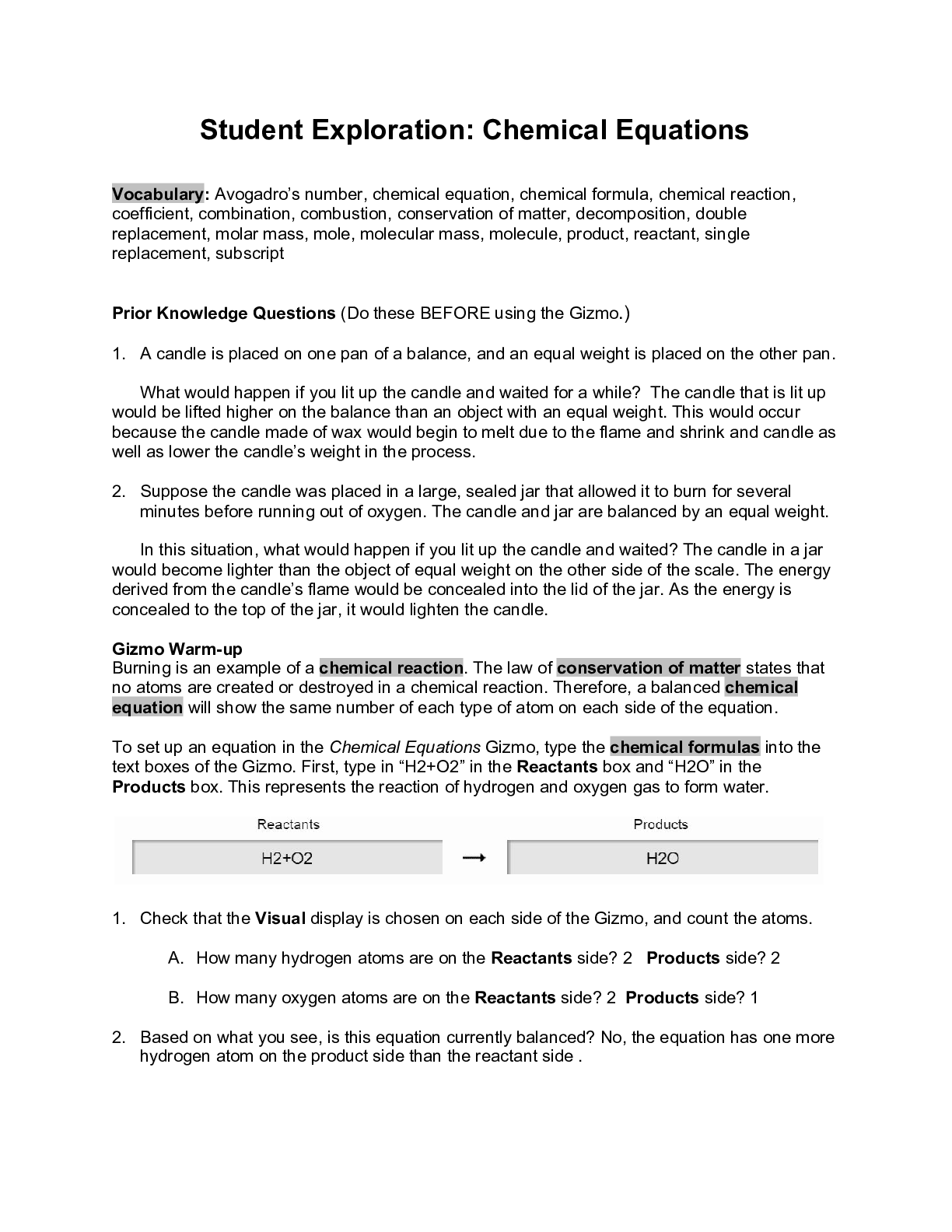
To set up an equation in the Chemical Equations Gizmo, type the chemical formulas into the
text boxes of the Gizmo. First, type in “H2+O2” in the Reactants box and “H2O” in the
Products box. This represents the reaction of hydrogen and oxygen gas to form water.
[Show More]



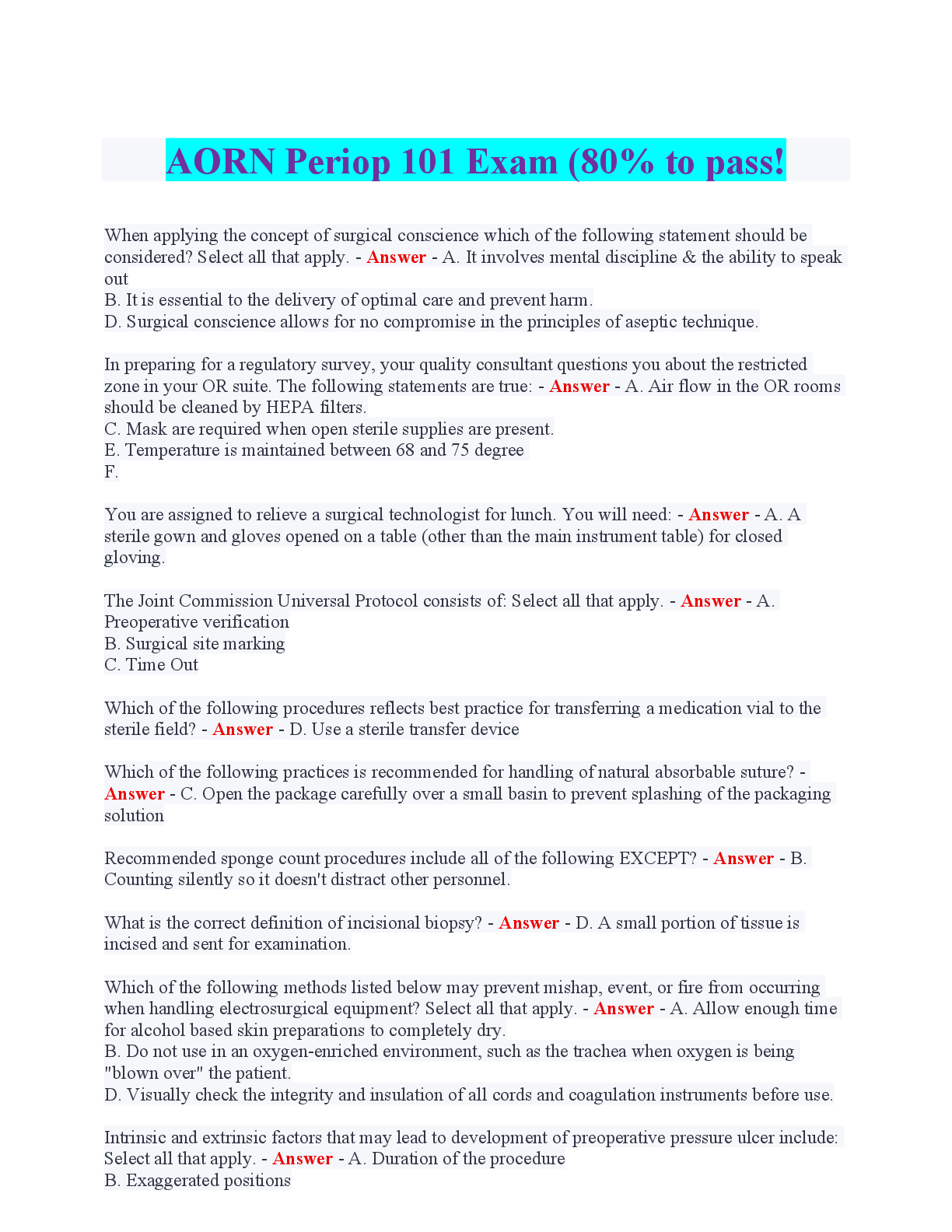
![Preview of AORN PERIOP 101 FINAL EXAM 2026 QUESTIONS AND VERIFIED ANSWERS [LATEST UPDATE]](https://browseimages.nyc3.digitaloceanspaces.com/paper-images/2026/04/07/sGJvJ3aH2026-04-07-04-5869d464cbba16f.png)


.png)



 Chamberlain College Of Nursing (100 Correct Q & A.png)