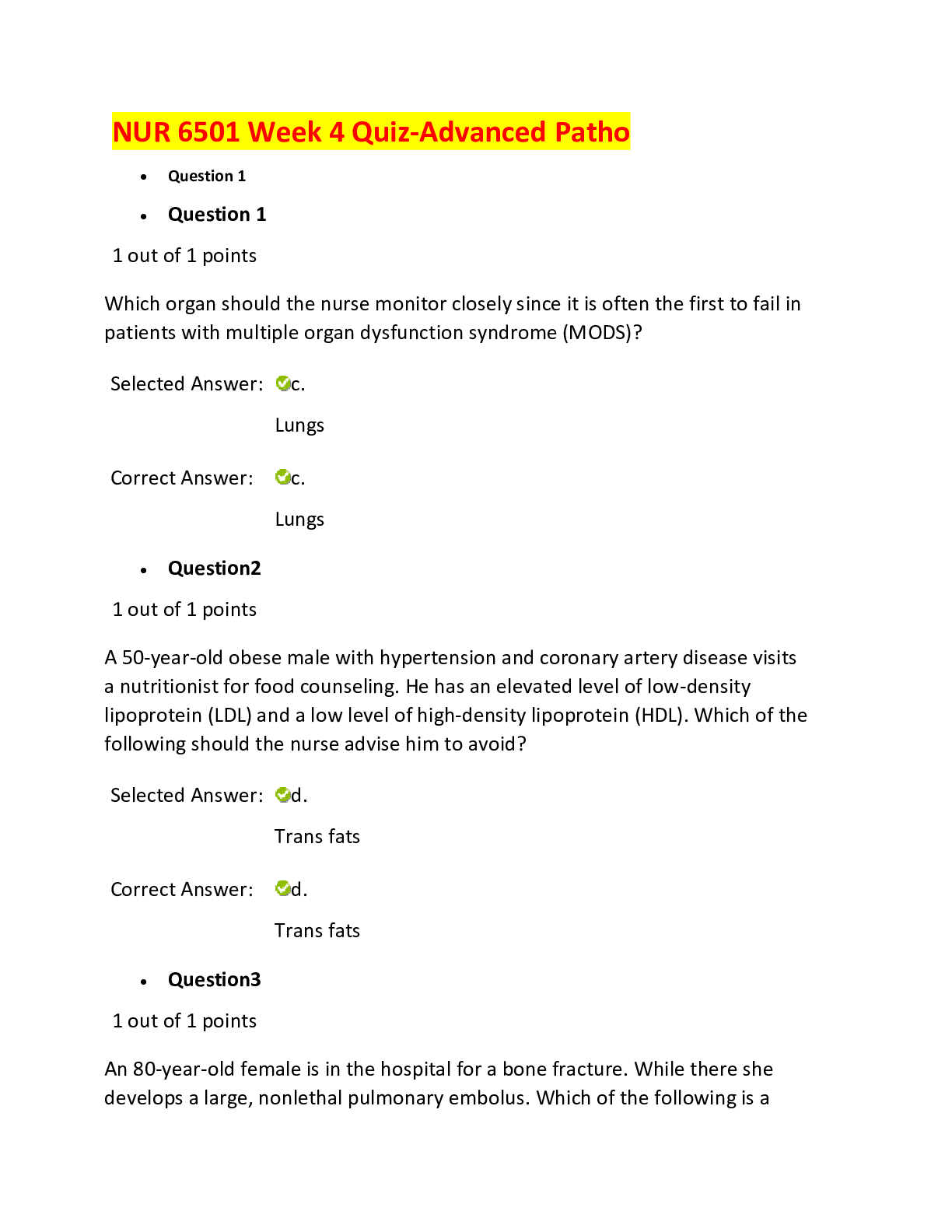
Which organ should the nurse monitor closely since it is often the first to fail in patients with multiple organ dysfunction syndrome (MODS)?
• Question2
1 out of 1 points
A 50-year-old obese male with hy
...
Which organ should the nurse monitor closely since it is often the first to fail in patients with multiple organ dysfunction syndrome (MODS)?
• Question2
1 out of 1 points
A 50-year-old obese male with hypertension and coronary artery disease visits a nutritionist for food counseling. He has an elevated level of low-density lipoprotein (LDL) and a low level of high-density lipoprotein (HDL). Which of the following should the nurse advise him to avoid?
• Question3
1 out of 1 points
An 80-year-old female is in the hospital for a bone fracture. While there she develops a large, nonlethal pulmonary embolus. Which of the following is a direct result of the obstruction to pulmonary blood flow?
• Question4
1 out of 1 points
A 56-year-old male is diagnosed with coronary artery disease. Which of the following modifiable risk factors would the nurse suggest the patient change?
• Question5
1 out of 1 points
Which characteristic changes should the nurse keep in mind while caring for a patient with left heart failure? As left heart failure progresses:
• Question 6
1 out of 1 points
A 50-year-old male visits the cardiologist for an EKG. Results indicate that he has no PR interval and a variable QRS rate with rhythm irregularity. Which of the following is the most likely diagnosis to be recorded on the chart?
• Question 7
1 out of 1 points
A 54-year-old male is diagnosed with left bundle branch block. Which of the following structures would not receive an electrical impulse?
• Question 8
1 out of 1 points
A 60-year-old male is diagnosed with cerebral aneurysm. Where does the nurse suspect the cerebral aneurysm is located?
• Question 9
1 out of 1 points
A 28-year-old female presents with severe chest pain and shortness of breath. She is diagnosed with pulmonary embolism, which most likely originated from the:
• Question 10
1 out of 1 points
A 50-year-old male is diagnosed with orthostatic hypotension. Which of the following symptoms would he most likely experience?
• Question 11
1 out of 1 points
A nurse monitors the patient for _____ when rapid onset of malignant hypertension results.
• Question 12
1 out of 1 points
A 50-year-old male is diagnosed with pulmonary embolism (PE). Which of the following symptoms most likely occurred before treatment?
• Question 13
1 out of 1 points
A 52-year-old male is diagnosed with primary hypertension. He has no other health problems. Present treatment would cause the nurse to anticipate administering which drug to the patient?
• Question 14
1 out of 1 points
A 65-year-old female presents to the emergency department reporting difficulty swallowing and shortness of breath. A CT scan would most likely reveal an aneurysm in the:
• Question 15
1 out of 1 points
A 65-year-old male is transported to the ER for chest pain. An electrocardiogram reveals a prolonged QRS interval. What is the nurse monitoring when the nurse observes the QRS complex on the electrocardiogram? The QRS complex reflects:
• Question 16
1 out of 1 points
While planning care for a patient with superior vena cava syndrome (SVCS), which principle should the nurse remember? SVCS is a progressive _____ of the superior vena cava (SVC) that leads to venous distention of the upper extremities and head.
• Question 17
1 out of 1 points
Which of the following patients is at highest risk for developing pulmonary embolism (PE)?
• Question 18
1 out of 1 points
A 50-year-old female presents with a low heart rate and low blood pressure. She is given an intravenous (IV) infusion of fluids. The increase in atrial distension results in:
• Question 19
1 out of 1 points
A 51-year-old male is at the health clinic for an annual physical exam. After walking from the car to the clinic, he developed substernal pain. He also reported discomfort in his left shoulder and his jaw, lasting 2 to 3 minutes and then subsiding with rest. He indicates that this has occurred frequently over the past few months with similar exertion. The nurse suspects he is most likely experiencing:
• Question 20
0 out of 1 points
Many valvular stenosis and regurgitation disorders in adults have a common etiology. Which of the following conditions should alert the nurse that the patient may have both types of valve dysfunction?
• Question 21
1 out of 1 points
A 30-year-old Caucasian female was recently diagnosed with primary hypertension. She reports that she eats fairly well, usually having red meat and potatoes daily. She also reports that her father has hypertension as well. A nurse determines which of the following risk factors is most likely associated with this diagnosis?
• Question 22
1 out of 1 points
A 68-year-old female is experiencing left heart failure. Physical exam reveals elevated blood pressure. The nurse understands this is most likely caused by:
• Question 23
1 out of 1 points
Most cases of combined systolic and diastolic hypertension have no known cause and are documented on the chart as _____ hypertension.
• Question 24
1 out of 1 points
A 35-year-old male presents with pulmonary hypertension. Testing reveals he is in right heart failure. Which of the following is the most likely diagnosis the nurse will see listed on the chart?
• Question 25
1 out of 1 points
A 50-year-old male with a 30-year history of smoking was diagnosed with bronchogenic cancer. He developed edema and venous distention in the upper extremities and face. Which of the following diagnosis will the nurse observe on the chart?
• Question 26
1 out of 1 points
A 5-year-old female is found to have hypertension during three separate visits to her primary care provider. The nurse would expect tests to suggest that the hypertension is secondary to:
• Question 27
1 out of 1 points
An 82-year-old female was admitted to the hospital with confusion and severe hypotension. Her body’s compensatory mechanisms are increased heart rate, vasoconstriction, and movement of large volumes of interstitial fluid to the vascular compartment. What kind of shock does the nurse suspect the patient is experiencing?
• Question 28
1 out of 1 points
Which of the following findings in the patient with Raynaud disease would indicate a need for further teaching?
• Question 29
1 out of 1 points
A 65-year-old male presents for a routine checkup. A blood pressure check reveals a systolic pressure of 160 mm Hg and a diastolic pressure of 70 mm Hg. Which of the following is the most likely cause of this type of pressure elevation?
• Question 30
1 out of 1 points
A 60-year-old male undergoes surgery for a bone fracture. Which of the following nursing measures would be most effective for preventing pulmonary embolism (PE) in this patient?
[Show More]