Gastroenterology HA-24-11-13 Hospitals & Asylums
Hospitals & Asylums
Gastroenterology HA-24-11-13
Let food be thy medicine and medicine be thy food.
Hippocrates
I. Anatomy and physiology
A. Digestive system
...
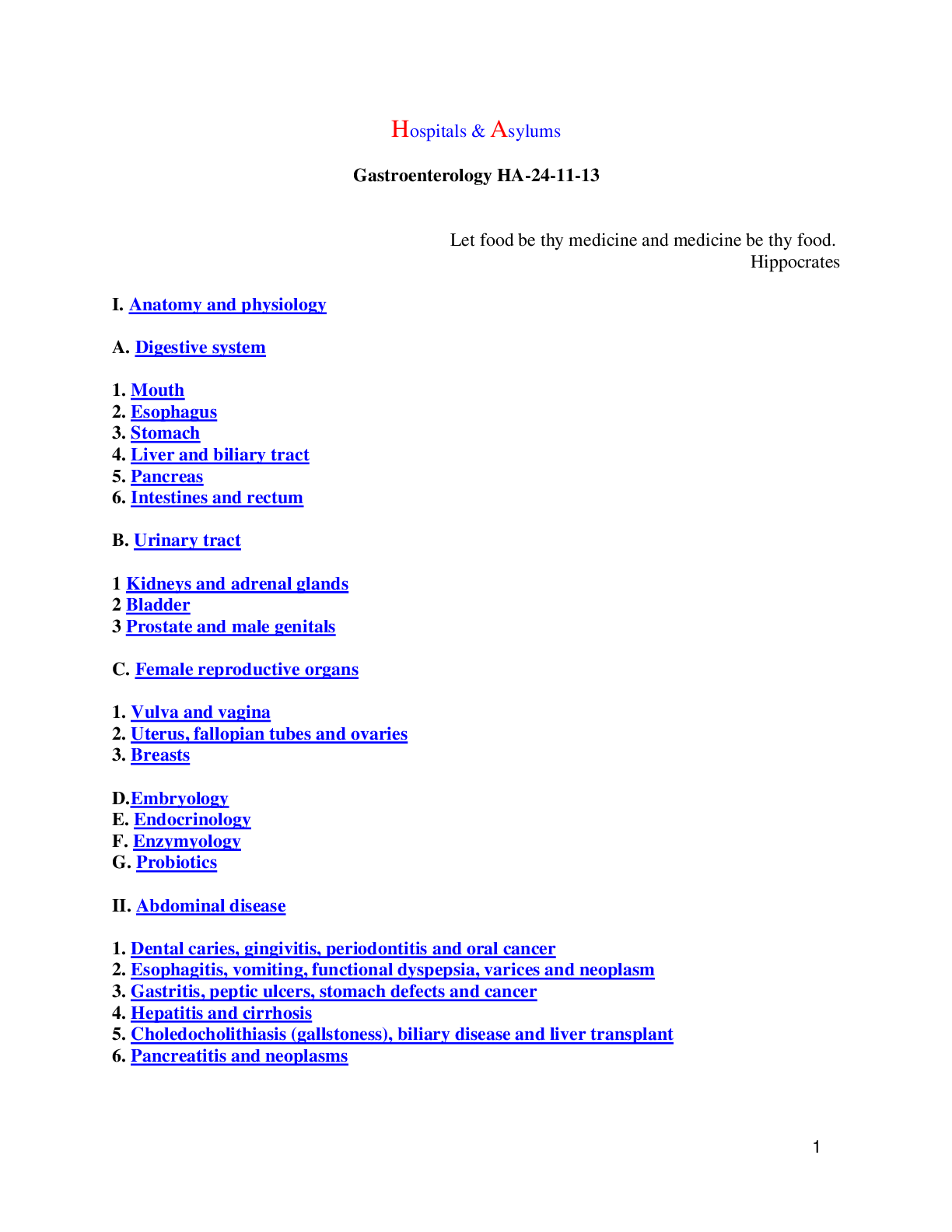
Gastroenterology HA-24-11-13 Hospitals & Asylums
Hospitals & Asylums
Gastroenterology HA-24-11-13
Let food be thy medicine and medicine be thy food.
Hippocrates
I. Anatomy and physiology
A. Digestive system
1. Mouth
2. Esophagus
3. Stomach
4. Liver and biliary tract
5. Pancreas
6. Intestines and rectum
B. Urinary tract
1 Kidneys and adrenal glands 2 Bladder
3 Prostate and male genitals
C. Female reproductive organs
1. Vulva and vagina
2. Uterus, fallopian tubes and ovaries
3. Breasts
D. Embryology
E. Endocrinology
F. Enzymyology
G. Probiotics
II. Abdominal disease
1. Dental caries, gingivitis, periodontitis and oral cancer
2. Esophagitis, vomiting, functional dyspepsia, varices and neoplasm
3. Gastritis, peptic ulcers, stomach defects and cancer
4. Hepatitis and cirrhosis
5. Choledocholithiasis (gallstoness), biliary disease and liver transplant
6. Pancreatitis and neoplasms
7. Diabetes mellitus and endocrine disorders
8. Gastroenteritis, hemorrhoids, constipation and diarrhea
9. Malabsorption, post-infectious diarrhea, gluten and lactose intolerance
10. Irritable bowel disease and neoplasm
11. Urinary tract obstruction and infection
12. Urinary stone disease
13. Kidney disease, failure and transplant
14. Neoplasm of the urinary tract and male genitalia
15. Gynecology
16. Gynecologic neoplasm
17. Sexually transmitted disease
18. Abdominal birth defect
III. Maternity
1. Pregnancy
2. Labor
3. Heritable disorders
4. Pediatrics
IV. Treatment
1. Toxicology
2. Diagnosis
3. Surgery
4. Medicine
5. Nutrition
6. Exercise
Charts
I.A. Digestive tract
I.A.1. Oral cavity and salivary glands
I.A.2. Esophagus
I.A.3. Stomach
I.A.4. Biliary system
I.A.5. Large and small intestine in relation with the abdominal organs
I.A.5.1. Cross-section of the lumen of the small intestine
I.A.5.2. Enzymes found in the intestine
I.B. Male and Female Genitourinary Tracts.
I.B.1. Kidney
I.B.2. Bladder
I.B.3. Prostate and male genitalia
I.C. Female reproductive organs
I.C.1. Female external genitalia
I.C.2. Uterus and ovaries
I.C.3. Mammary gland
I.D. Critical Periods in Human Fetal Development
I.E.1. Endocrine glands in the human head and neck and their hormones
I.E.2. Hormones secreted by the hypothalamus
I.E.3. Hormones secreted by the anterior pituitary lobe (adenohypophysis)
I.E.4. Hormones Secreted by the posterior pituitary lobe (neurohypophysis)
I.E.5 .Hormones secreted by the pineal body (epiphysis)
I.E.6. Hormones secreted by the thyroid gland
I.E.7. Hormones secreted by the parathyroid glands
I.E.8. Hormones secreted by the thymus overlying the heart
I.E.9. Endocrine glands in the abdomen and their hormones
I.E.10. Hormones secreted by the adrenal cortex
I.E.11. Hormones secreted by the adrenal medulla
I.E.12. Hormones secreted by the kidneys
I.E.13. Hormones secreted by the stomach
I.E.14. Hormones secreted by the duodenum
I.E.15. Hormones secreted by the liver
I.E.16. Hormones secreted by the pancreas
I.E.17. Reproductive endocrine glands and their hormones
I.E.18. Hormones secreted by the testes
I.E.19. Hormones secreted by the ovarian follicle and corpus luteum
I.E.20. Hormones secreted by the placenta (when pregnant)
I.E.21. Hormones secreted by the uterus (when pregnant)
I.E.22. Hormones secreted by adipose tissue
I.E.23. Hormones secreted by the skin
I.E.24. Hormones secreted by the bone marrow
I.F. Enzyme classification
I.G. Health Benefits of 13 Highly Studied Probiotic Strains
II.1. Measurement of severity of periodontal condition
II.2. Staging for Esophageal Cancer
II.4.1. Drug induced and toxin-induced hepatic injury
II.4.2. Hepatitis virus
II.5.1. Distinguishing features of disorders associated with biliary cirrhosis
II.5.2. Indication for liver transplantation
II.6. Type I and II diabetes
II.7.1. Bristol stool chart II.7.2.Common gastrointestinal viruses
II.7.3. Major causes of bacterial enterocolitis
II.10.1. Estimated number of North Americans affected by digestive disorders II-10.2. Drugs used in managing IBS
II-10.3. Colon Cancer Staging II-10.4. Staging for Anal Cancer
II.11.1. Antimicrobials often used in urology (other than metronidazole)
II.11.2. Drugs for microorganisms found in infections of the urinary and genital tracts
II.14. Drugs useful in urological malignancy
II.15. Contraceptive Rates in the First Year of Use in the United States
II.16.1 Staging System for Breast Cancer
II.16.2 Chemotherapy Regimens for Breast Cancer
II.16.3 Staging for Cervical Cancer
II.16.4 Combination Chemotherapy for Cervical Carcinoma
II.16.5 Staging for Carcinoma of the Ovary
II.16.6 Survival Rates for Combination Chemotherapy Regimens for Ovarian Cancer II..16.7 Staging for Carcinoma of the Endometrium
II.16.8 Staging for Cancer of Vulva
II.16.9 Staging of Gestational Trophoblastic Neoplasms
II.17.1. Seven classes of Retroviral Medicine
II.17.2. Common AIDS Symptoms and Medicine
III.1.1. Hematologic Laboratory Values in Pregnancy
III.3.1. Recommended Uniform Screening Panel for Core Heritable Conditions
III.3.2. Recommended Uniform Screening Panel Secondary Conditions
III.3.3. Reported Teratogenic Effects from Drug Exposure on the Fetus
III.4.1. Child Development Milestones
III.4.2. WHO and CDC weight-for-age measurements for girls aged <24 months
III.4.3. WHO and CDC weight-for-age measurements for boys aged <24 months
III.4.4. WHO and CDC length/stature-for-age measurements for girls aged <5 yrs
III.4.5. WHO and CDC length/stature-for-age measurements for boys aged <5 yrs
III.4.6. Girls Ages 2 to 20 Stature and Weight for Age
III.4.7. Boys Ages 2 to 20 Stature and Weight for Age
IV.1. Reported Teratogenic Effects from Drug Exposure on the Fetus
IV.3. A grafted (transplanted) kidney
IV.4. Helping Medication and Probiotics Work Together
IV.5.1. Estimated Calories Needed by Inactive People, by Age and Gender
[Show More]