When disclaiming an opinion due to a client-imposed scope limitation, an auditor should indicate
in a separate paragraph why the audit did not comply with generally accepted auditing standards.
The auditor should also
...
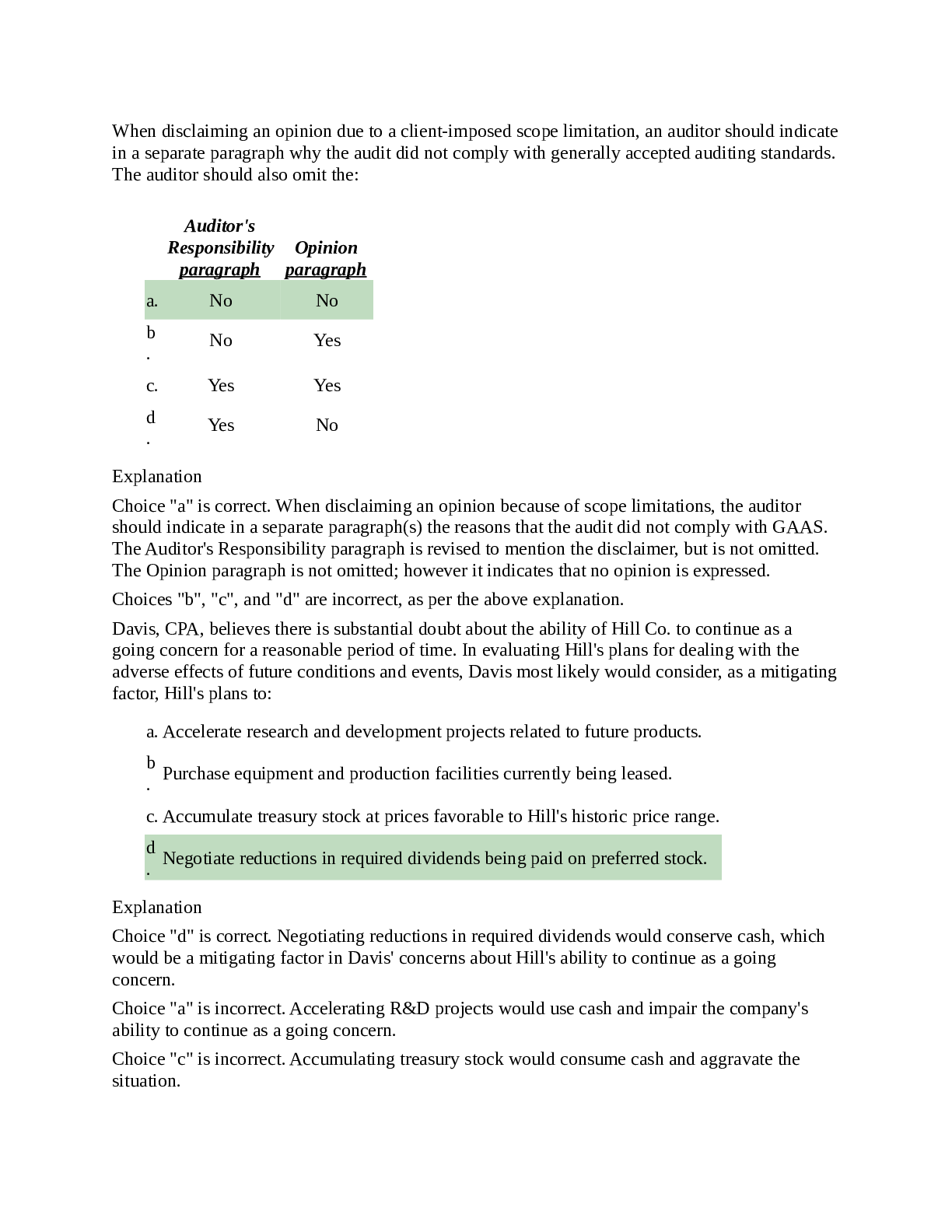
When disclaiming an opinion due to a client-imposed scope limitation, an auditor should indicate
in a separate paragraph why the audit did not comply with generally accepted auditing standards.
The auditor should also omit the:
Auditor's
Responsibility
paragraph
Opinion
paragraph
a. No No
b
.
No Yes
c. Yes Yes
d
.
Yes No
Explanation
Choice "a" is correct. When disclaiming an opinion because of scope limitations, the auditor
should indicate in a separate paragraph(s) the reasons that the audit did not comply with GAAS.
The Auditor's Responsibility paragraph is revised to mention the disclaimer, but is not omitted.
The Opinion paragraph is not omitted; however it indicates that no opinion is expressed.
Choices "b", "c", and "d" are incorrect, as per the above explanation.
Davis, CPA, believes there is substantial doubt about the ability of Hill Co. to continue as a
going concern for a reasonable period of time. In evaluating Hill's plans for dealing with the
adverse effects of future conditions and events, Davis most likely would consider, as a mitigating
factor, Hill's plans to:
a. Accelerate research and development projects related to future products.
b
.
Purchase equipment and production facilities currently being leased.
c. Accumulate treasury stock at prices favorable to Hill's historic price range.
d
.
Negotiate reductions in required dividends being paid on preferred stock.
Explanation
Choice "d" is correct. Negotiating reductions in required dividends would conserve cash, which
would be a mitigating factor in Davis' concerns about Hill's ability to continue as a going
concern.
Choice "a" is incorrect. Accelerating R&D projects would use cash and impair the company's
ability to continue as a going concern.
Choice "c" is incorrect. Accumulating treasury stock would consume cash and aggravate the
situation.
Choice "b" is incorrect. Purchasing equipment that is currently leased would use cash and impair
the company further.
A limitation on the scope of an audit sufficient to preclude an unmodified opinion will usually
result when management:
a.
Refuses to disclose in the notes to the financial statements related party transactions
authorized by the Board of Directors.
b
.
Does not provide the auditor with an engagement letter specifying the responsibilities of
both the entity and the auditor.
c.
Is unable to obtain audited financial statements supporting the entity's investment in a
foreign subsidiary.
d
.
Fails to correct a significant deficiency in internal control communicated to those charged
with governance after the prior year's audit.
Explanation
Choice "c" is correct. Restrictions on the scope of the audit, such as the timing of the work, the
inability to obtain sufficient appropriate audit evidence, or an inadequacy in the accounting
records, may require the auditor to qualify or disclaim an opinion. Inability to obtain audited
financial statements supporting the entity's investment in a foreign subsidiary is such a restriction
on the scope of the audit.
Choice "a" is incorrect. Client refusal to disclose related party transactions in the notes to the
financial statements is a GAAP problem, not a scope problem. For a GAAP problem, the auditor
must either issue a qualified or adverse opinion.
Choice "b" is incorrect. The auditor sends an engagement letter to the client, not vice versa.
Choice "d" is incorrect. Management may choose not to correct a significant deficiency in
internal control if the cost of correcting the condition outweighs the benefit.
In which of the following situations would an auditor ordinarily choose between expressing an
"except for" qualified opinion or an adverse opinion?
a.
The auditor is asked to report only on the entity's balance sheet and not on the other basic
financial statements.
b
.
The financial statements fail to disclose information that is required by generally accepted
accounting principles.
c.
The auditor did not observe the entity's physical inventory and is unable to become
satisfied as to its balance by other auditing procedures.
d
.
Events disclosed in the financial statements cause the auditor to have substantial doubt
about the entity's ability to continue as a going concern.
Explanation
Choice "b" is correct. Failure to disclose information that is required by GAAP is a departure
from GAAP. Departures from GAAP result in a qualified or an adverse opinion.
Choice "c" is incorrect. If the auditor is unable to observe physical inventory and is unable to
become satisfied through alternative means, that is a scope limitation. Scope limitations result in
either a qualified opinion or a disclaimer of opinion.
Choice "a" is incorrect. The auditor can report on one financial statement and not the others. This
does not preclude issuance of an unmodified opinion.
Choice "d" is incorrect. If, after considering identified conditions and events and management's
plans, the auditor concludes that substantial doubt about the entity's ability to continue as a going
concern for a reasonable period of time remains, the audit report should include an emphasis-ofmatter paragraph (after the opinion paragraph in the unmodified report) to reflect that conclusion.
How does an auditor make the following representations when issuing the auditor's report on
comparative financial statements under U.S. auditing standards?
Obtaining
evidence
that
is sufficient
and
appropriate
Consistent
application
of
accounting
principles
a. Explicitly Implicitly
b
.
Implicitly Implicitly
c. Explicitly Explicitly
d
.
Implicitly Explicitly
Explanation
Choice "a" is correct. Explicitly - Implicitly.
Under U.S. auditing standards, the auditor explicitly states in the Auditor's Responsibility
paragraph of the opinion: "We believe that the audit evidence we have obtained is sufficient and
appropriate to provide a basis for our audit opinion." Consistency is implied in the auditor's
report.
Choices "c", "b", and "d" are incorrect, as per above explanation.
An auditor was unable to obtain sufficient appropriate audit evidence concerning certain
transactions due to an inadequacy in the entity's accounting records. The auditor would choose
between issuing a(an):
a. Qualified opinion and an unmodified opinion with an emphasis-of-matter paragraph.
b
.
Disclaimer of opinion and a qualified opinion.
c. Unqualified opinion with an emphasis-of-matter paragraph and an adverse opinion.
d
.
Adverse opinion and a disclaimer of opinion.
Explanation
Choice "b" is correct. Client-imposed restrictions of scope such as those caused by inadequate
records would cause the auditor to choose between issuing a disclaimer of opinion and a
qualified opinion.
Choice "a" is incorrect. An unmodified opinion would only be justified if the transactions in
question were not material, but in such situations, no emphasis-of-matter paragraph would be
required.
Choices "c" and "d" are incorrect. An adverse opinion pertains to GAAP and would not be used
for reporting restrictions of scope.
Under U.S. GAAS, in which of the following situations would a group engagement partner least
likely make reference to component auditor who audited a subsidiary of the entity?
a.
The group engagement partner finds it impractical to review the component auditor's work
or otherwise be satisfied as to the component auditor's work.
b
.
The group engagement partner is unable to be satisfied as to the independence and
professional reputation of the component auditor.
c.
The component auditor was retained by the group engagement partner and the work was
performed under the group engagement partner's guidance and control.
d
.
The financial statements audited by the component auditor are material to the consolidated
financial statements covered by the group engagement partner's opinion.
Explanation
Choice "c" is correct. Under U.S. GAAS, when the group engagement partner assumes
responsibility for the component auditor's work, the group engagement partner would not
mention the component auditor in the audit report (opinion). The group engagement auditor
would generally assume responsibility after reviewing the audit documentation of the component
auditor and performing supplemental audit tests, or by reputation, e.g., if the component auditor
is a correspondent (foreign) firm in which the group engagement partner auditor has developed
confidence.
Choices "a" and "d" are incorrect. When the group engagement partner finds it impractical to
review the component auditor's work, or when the FS audited by the other auditor are material, it
is more likely that the group engagement partner will divide responsibility and make reference to
the component auditor.
Choice "b" is incorrect. The group engagement partner should always make inquiries regarding
the independence and professional reputation of the component auditor. Inability to become
satisfied in this regard would constitute a scope limitation, resulting in a qualified opinion or
disclaimer of opinion. In either of these scenarios, it is likely that the component auditor would
be mentioned within an explanatory paragraph.
An auditor should disclose the substantive reasons for expressing an adverse opinion in a basis
for modification paragraph:
a. Following the opinion paragraph.
b
.
Within the notes to the financial statements.
c. Preceding the introductory paragraph.
d
.
Preceding the opinion paragraph.
Explanation
Choice "d" is correct. The auditor should disclose the substantive reasons for expressing an
adverse opinion in a separate basis for adverse opinion paragraph preceding the opinion
paragraph.
Choice "c" is incorrect. There are no circumstances where any paragraph precedes the
introductory paragraph.
Choice "a" is incorrect. An emphasis-of-matter paragraph follows the opinion paragraph when
there is a change in accounting principle or when there is doubt as to going concern.
Choice "b" is incorrect. The auditor cannot include any type of explanatory material in the
financial statements, which are the responsibility of m
[Show More]










 (1).png)