With respect to religiosity and women
a. mysticism offered women a way to express religious independence, but Protestantism did not.
b. Protestantism offered women a way to express religious independence, but mysticism
...
With respect to religiosity and women
a. mysticism offered women a way to express religious independence, but Protestantism did not.
b. Protestantism offered women a way to express religious independence, but mysticism did not.
c. both mysticism and Protestantism allowed women a way to express independence in religious matters.
d. women were prohibited from expressing religious independence in both mysticism and Protestantism.
Hide Feedback
Correct
Luther's propositions for reform of Christianity include the idea that
a. there should be a universal church, just not one headed by the pope.
b. there should be a clear division between the clergy and the laity.
c. there was no difference between the clergy and the laity in matters of faith.
d. each individual required the help of an expert to read the Bible.
Hide Feedback
Correct
The German peasants' revolt of 1524–1526
a. was attacked by Luther, who encouraged the nobility to crush the revolt mercilessly.
b. succeeded in earning the peasantry economic and religious advantages they did not possess before Luther's
break with the church.
c. was a minor movement confined to Saxony that involved several thousand peasants.
d. was a popular movement protesting the ideas of Luther.
Hide Feedback
Correct
In Geneva, Calvin established a form of government that is best described as
a. a monarchy: a society ruled by Calvin and his descendants.
b. a theocracy: a society in which the lives of citizens were regulated by Calvinist elders.
c. an oligarchy: a society ruled by a group of wealthy merchants.
d. a democracy: a society in which citizens determined the laws and religion of the city.
Hide Feedback
Correct
Catherine de' Medici
a. was a champion of reconciliation between Catholics and Protestants.
b. converted to Protestantism in order to prevent civil war in France.
c. was the power behind the French throne for much of the late sixteenth century.
d. was the first wife of Henry VIII of England.
Hide Feedback
Correct
The policies of the Catholic Church during the Counter-Reformation include all of the
following EXCEPT
a. enlightened education.
This study source was downloaded by 100000831988016 from CourseHero.com on 03-21-2022 05:52:06 GMT -05:00
https://www.coursehero.com/file/75762257/HIEU-201-Chapter-14-Quizdocx/
b. censorship.
c. persecution.
d. a new emphasis on eradicating all sins, no matter how small.
Hide Feedback
Correct
The Council of Trent met to
a. reform the Catholic Church and prepare it for the struggle with Protestantism.
b. reconcile Catholic and Protestant leaders.
c. plan the further advance of the Reformation.
d. plan the strategy for a military campaign against Protestant England.
Hide Feedback
Correct
Luther wrote all of the following EXCEPT
a. Address to the Christian Nobility of the German Nation.
b. a German translation of the New Testament.
c. Institutes of the Christian Religion.
d. The Freedom of a Christian Man.
Hide Feedback
Correct
First and foremost, Lutheranism was a
a. nationalist movement.
b. popular evangelical movement.
c. political revolution.
d. social revolution.
Hide Feedback
Correct
Swiss reformer Ulrich Zwingli
a. supported the doctrine of transubstantiation.
b. believed good works were the key to salvation.
c. differed with Luther over the form and meaning of Communion.
d. argued that mysticism provided the most important revelation of divine will and law.
Hide Feedback
Correct
The millenarians believed that
a. they were living in a time of unparalleled peace and prosperity.
b. the world would come to an end in the near future.
c. Christ's return was in the distant future.
d. Christianity would soon be superseded by a new religion.
Hide Feedback
This study source was downloaded by 100000831988016 from CourseHero.com on 03-21-2022 05:52:07 GMT -05:00
https://www.coursehero.com/file/75762257/HIEU-201-Chapter-14-Quizdocx/
Correct
Luther's attack on indulgences was prompted primarily by
a. the church's own condemnation of their sale.
b. his belief that salvation had nothing to do with good works.
c. the fact that they were a recent and radical innovation in the church.
d. his belief that indulgences were valid only if they were not sold for money.
Hide Feedback
Correct
The doctrine of predestination is based on the premise that
a. God acts in random, and sometimes unjust, ways.
b. good works are the only way to achieve salvation.
c. the Reformation is predicted in the Bible.
d. God is all-knowing, eternal, and all powerful.
Hide Feedback
Correct
Nobles were motivated to support the Reformation because
a. it provided an opportunity to increase their wealth through the confiscation of church lands.
b. it offered a means of resisting the Catholic Holy Roman Emperor Charles V.
c. it gained them the support of their subjects, since they were acting as leaders of a popular and dynamic
religious movement.
d. all of the above
Hide Feedback
Correct
Calvin's concept of predestination influenced his followers to
a. exercise strict control over their own feelings and behavior and those of others.
b. surrender to self-doubt and despair and live passively, withdrawn from society.
c. eat, drink, and be merry because their fate was already determined and they could do nothing about it.
d. submit unquestioningly to political authority, even if it violated the laws of God.
Hide Feedback
Correct
The Huguenots
a. were influenced by the queen mother to carry out the Saint Bartholomew's Day Massacre.
b. were denied any form of toleration in the Edict of Nantes.
c. were the Calvinist minority in France.
d. were one of the foremost Catholic families in Europe.
Hide Feedback
Correct
During the reign of Henry VIII, the English Reformation
a. brought little change to the beliefs and practices of ordinary Christians in England.
This study source was downloaded by 100000831988016 from CourseHero.com on 03-21-2022 05:52:07 GMT -05:00
https://www.coursehero.com/file/75762257/HIEU-201-Chapter-14-Quizdocx/
b. resulted primarily from the king's denying the validity of the sacraments of the Roman Catholic Church.
c. rejected most of Luther's ideas, but adopted Calvinism because of its stress on political obedience.
d. adopted the tradition of John Wycliffe, stressing the Bible and the personal relationship of the individual with
God.
Hide Feedback
Correct
The beliefs of radical Protestants such as the Anabaptists
a. were related to earlier folk beliefs that had existed before the Reformation began.
b. were similar in most respects to those of Luther and Calvin on social and political issues.
c. stressed a quiet acceptance of existing institutions, except for the sacrament of baptism, which they rejected.
d. tended to appeal primarily to the wealthy and literate merchant class in the towns and cities of Europe.
Hide Feedback
Correct
The Jesuits were a
a. militant Protestant group
[Show More]
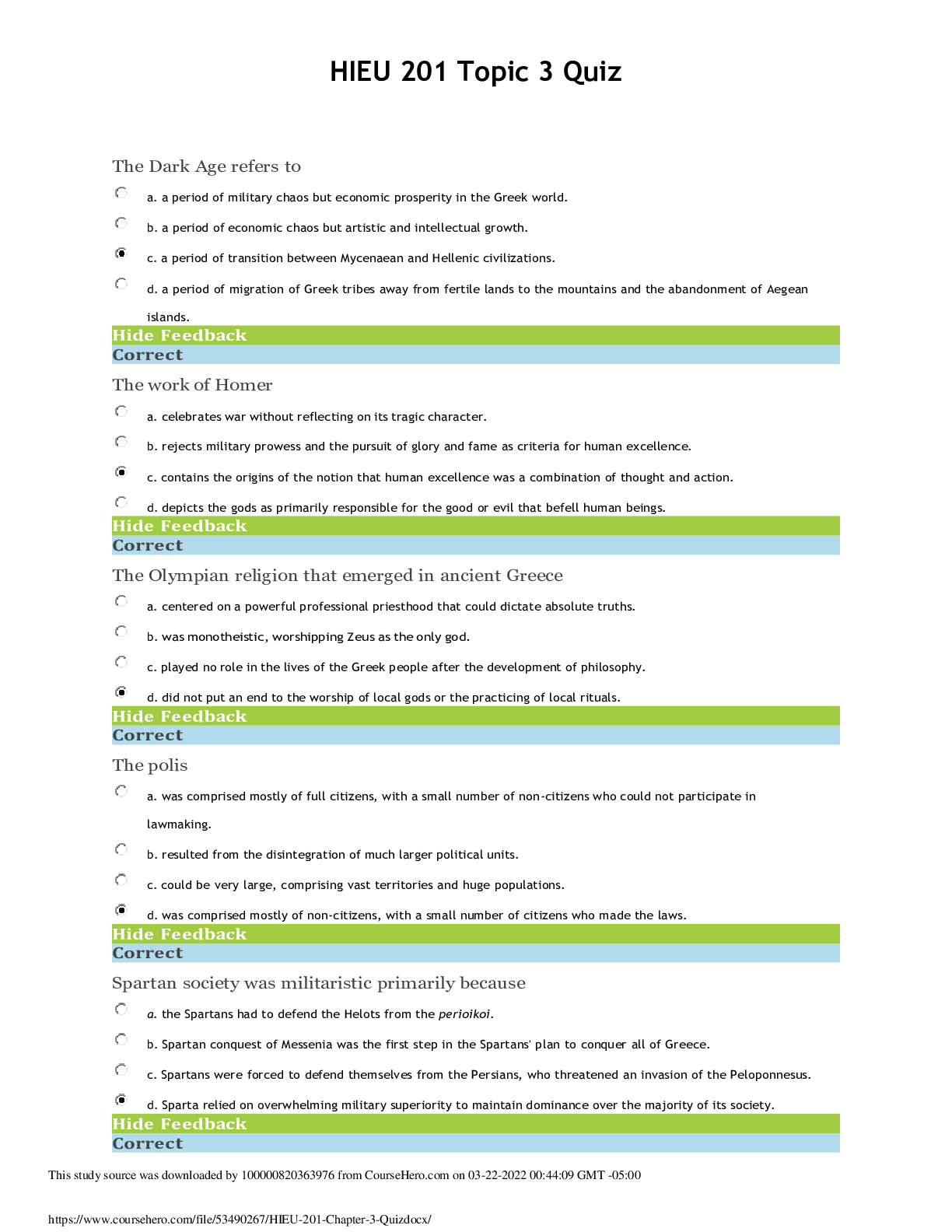
![Preview of [SOLVED] HIEU 201 HIEU201 Chapter 14 Quiz(LATEST 2022)](https://scholarfriends.com/storage/HIEU_201_Chapter_14_Quiz.png)

![Preview of [SOLVED] HIEU 201 / HIEU201 Chapter 3 Quiz (LATEST 2022)](https://scholarfriends.com/storage/HIEU_201_Chapter_3_Quiz.png)
![Preview of [SOLVED] - HIEU 201 / HIEU201 Chapter 4 Quiz (LATEST 2022)](https://scholarfriends.com/storage/HIEU_201_Chapter_4_Quiz.png)
![Preview of [SOLVED] HIEU 201 / HIEU201 Chapter 5 Quiz (LATEST 2022)](https://scholarfriends.com/storage/HIEU_201_Chapter_5_Quiz.png)