Final Study Guide
Reproductive:
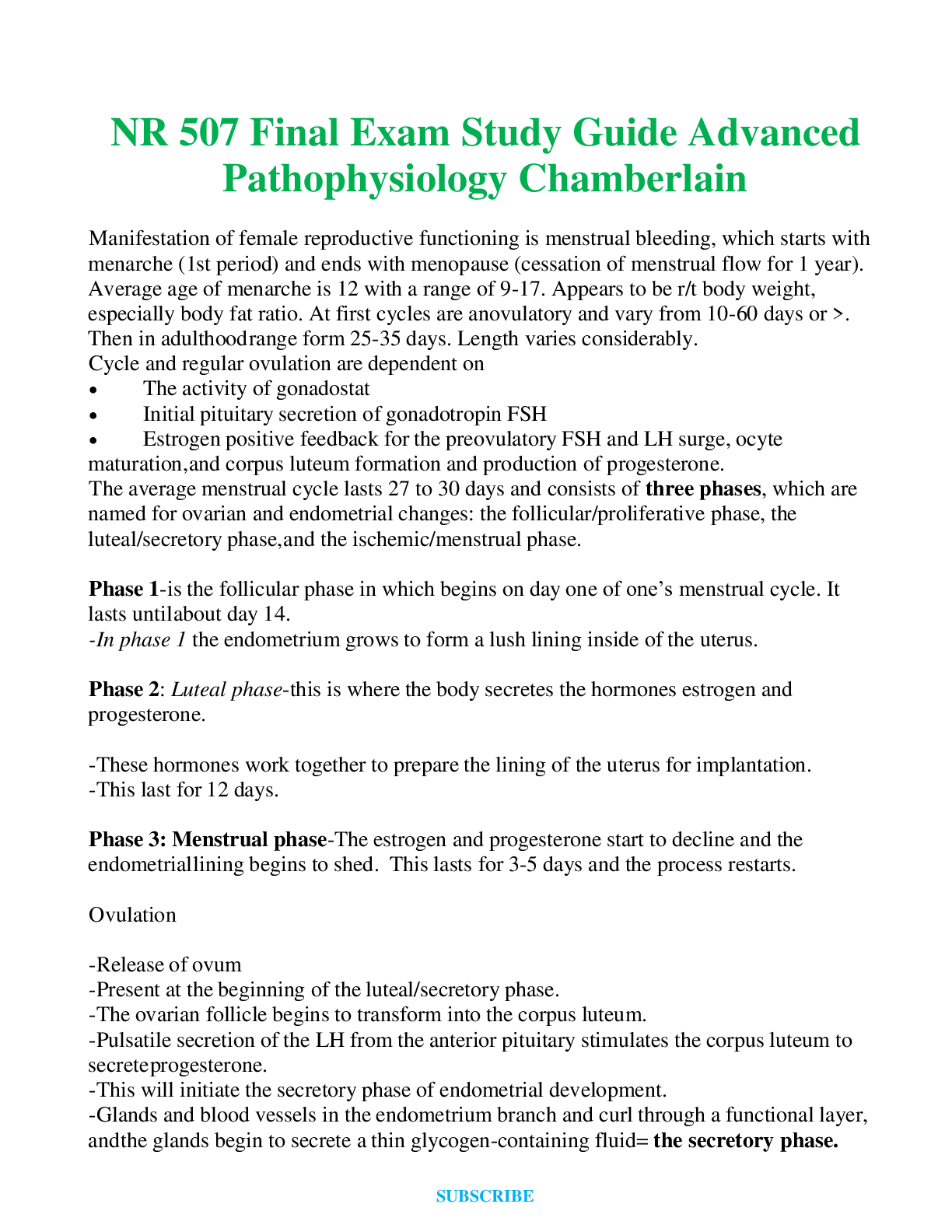
o Endometrial cycle (menstrual cycle) and the occurrence of
ovulation
During menstruation (menses), the functional layer if
endometrium disintegrates and is discharges through the
...
Final Study Guide
Reproductive:
o Endometrial cycle (menstrual cycle) and the occurrence of
ovulation
During menstruation (menses), the functional layer if
endometrium disintegrates and is discharges through the
vagina.
Follicular/proliferative phase - GnRH and a balance
between activin and inhibin from the granulosa cells
contribute to the rise of FSH levels, which stimulates a
number of follicles. The pulsatile secretion of FSH from the
anterior pituitary gland rescues a dominant ovarian follicle
from apoptosis by days 5 to 7 days of the cycle. Together
estrogen and FSH increase FSH receptors in the granulosa
cells of the primary follicle, making them more sensitive to
FSH. FSH and estrogen combine to induce production of LH
receptors on the granulosa cells of the primary follicle, thus
promoting LH stimulation to combine with FSH stimulation,
causing more rapid secretion of follicular estrogen. As
estrogen levels increase, FSH levels drop because of an
increase in inhibin-B secreted by the granulosa cells in the
dominant follicle. This drop in FSH level decreases the
growth of the less-developed follicles. Estrogen causes
cells of the endometrium to proliferate and stimulates
production of LH.
Luteal/secretory phase – ovulation marks the beginning of
this phase. The ovarian follicle begins its transformation
into a corpus luteum. Pulsatile secretion of LH from the
anterior pituitary stimulates the corpus luteum to secrete
progesterone, which in turn initiates the secretory phase of
endometrial development. Glands and blood vessels in the
endometrium branch and curl throughout the functional
layer, and the glands begin to secrete a thin glycogencontaining fluid, the secretory phase. If conception occurs,
the nutrient-laden endometrium is ready for implantation.
Human chorionic gonadotropin (HCG) is secreted 3 days
after fertilization by blastocytes and maintains the corpus
luteum once implantation occurs at about day 6 or 7. HCG
can be detected in maternal blood and urine 8 to 10 days
after ovulation.
Ischemic/menstrual phase
The production of estrogen and progesterone
continues until the placenta can adequately maintain
hormonal production. If conception and implantation
do not occur, the corpus luteum degenerates and
ceases production of progesterone and estrogen.
Without progesterone or estrogen to maintain it, the
endometrium becomes ischemic and disintegrates.
Menstruation then occurs marking the beginning of
another cycle.
Ovulatory cycles appear to have a minimum length of 24 to
26.5 days: the primary ovarian follicle requires 10 to 12.5
days to develop, and the luteal phase appears relatively
fixed at 14 days (+/- 3 days). Menstrual blood flow usually
lasts 3-7 days, but it may last as long as 8 days or stop
after 1 to 2 days and still be considered within normal
limits.
Ovulation – the release of an ovum from a mature follicle
and marks the beginning of the luteal/secretory phase.
o Uterine prolapse
Descent of the cervix or entire uterus into the vaginal
canal.
In severe cases, the uterus falls completely through the
vagina and protrudes from the introitus.
Symptoms of other pelvic floor disorders also may be
present.
Urinary: sensation of incomplete emptying of the
bladder, urinary incontinence, urinary
frequency/urgency, bladder “splinting” to accomplish
voiding
Bowel: constipation or feeling of rectal fullness or
blockage, difficult defecation, stool or flatus
incontinence
Urgency: manual “splinting” of posterior vaginal wall
to accomplish defecation
Pain & Bulging: vaginal, bladder, rectum; pelvic
pressure, bulging, pain, lower back pain
Sexual: dyspareunia, decreased sensation,
lubrication, arousal
Tx:
Kegel exercises
Estrogen to improve tone and vascularity of fascial
support
Pessary
Weight loss
Avoidance of constipation
o Polycystic ovarian syndrome
Most common cause of anovulation and ovulatory
dysfunction in women.
Defined as having at least two of the following three
features: irregular ovulation, elevated levels of androgens
[Show More]