NR-533 Week 6 Discussion: Business Plan Development: SWOT Analysis (Version 2)
For any new project or revision of a current process, key questions that will need to be answered are whether it's needed, does the institu
...
NR-533 Week 6 Discussion: Business Plan Development: SWOT Analysis (Version 2)
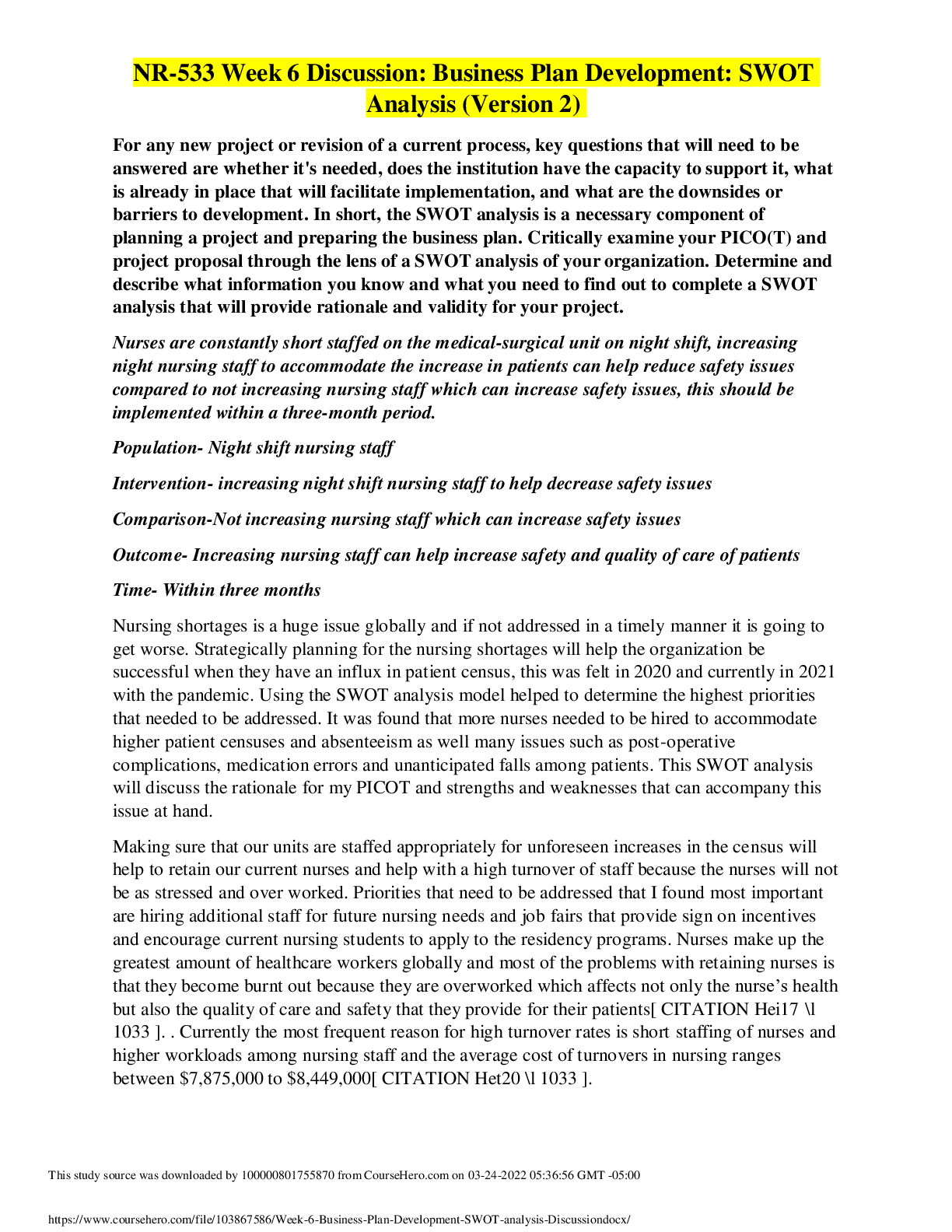
For any new project or revision of a current process, key questions that will need to be answered are whether it's needed, does the institution have the capacity to support it, what is already in place that will facilitate implementation, and what are the downsides or barriers to development. In short, the SWOT analysis is a necessary component of planning a project and preparing the business plan. Critically examine your PICO(T) and project proposal through the lens of a SWOT analysis of your organization. Determine and describe what information you know and what you need to find out to complete a SWOT analysis that will provide rationale and validity for your project.
Nurses are constantly short staffed on the medical-surgical unit on night shift, increasing night nursing staff to accommodate the increase in patients can help reduce safety issues compared to not increasing nursing staff which can increase safety issues, this should be implemented within a three-month period.
Population- Night shift nursing staff
Intervention- increasing night shift nursing staff to help decrease safety issues Comparison-Not increasing nursing staff which can increase safety issues
Outcome- Increasing nursing staff can help increase safety and quality of care of patients Time- Within three months
Nursing shortages is a huge issue globally and if not addressed in a timely manner it is going to get worse. Strategically planning for the nursing shortages will help the organization be successful when they have an influx in patient census, this was felt in 2020 and currently in 2021 with the pandemic. Using the SWOT analysis model helped to determine the highest priorities that needed to be addressed. It was found that more nurses needed to be hired to accommodate higher patient censuses and absenteeism as well many issues such as post-operative complications, medication errors and unanticipated falls among patients. This SWOT analysis will discuss the rationale for my PICOT and strengths and weaknesses that can accompany this issue at hand.
Making sure that our units are staffed appropriately for unforeseen increases in the census will help to retain our current nurses and help with a high turnover of staff because the nurses will not be as stressed and over worked. Priorities that need to be addressed that I found most important are hiring additional staff for future nursing needs and job fairs that provide sign on incentives and encourage current nursing students to apply to the residency programs. Nurses make up the greatest amount of healthcare workers globally and most of the problems with retaining nurses is that they become burnt out because they are overworked which affects not only the nurse’s health but also the quality of care and safety that they provide for their patients[ CITATION Hei17 \l 1033 ]. . Currently the most frequent reason for high turnover rates is short staffing of nurses and higher workloads among nursing staff and the average cost of turnovers in nursing ranges between $7,875,000 to $8,449,000[ CITATION Het20 \l 1033 ].
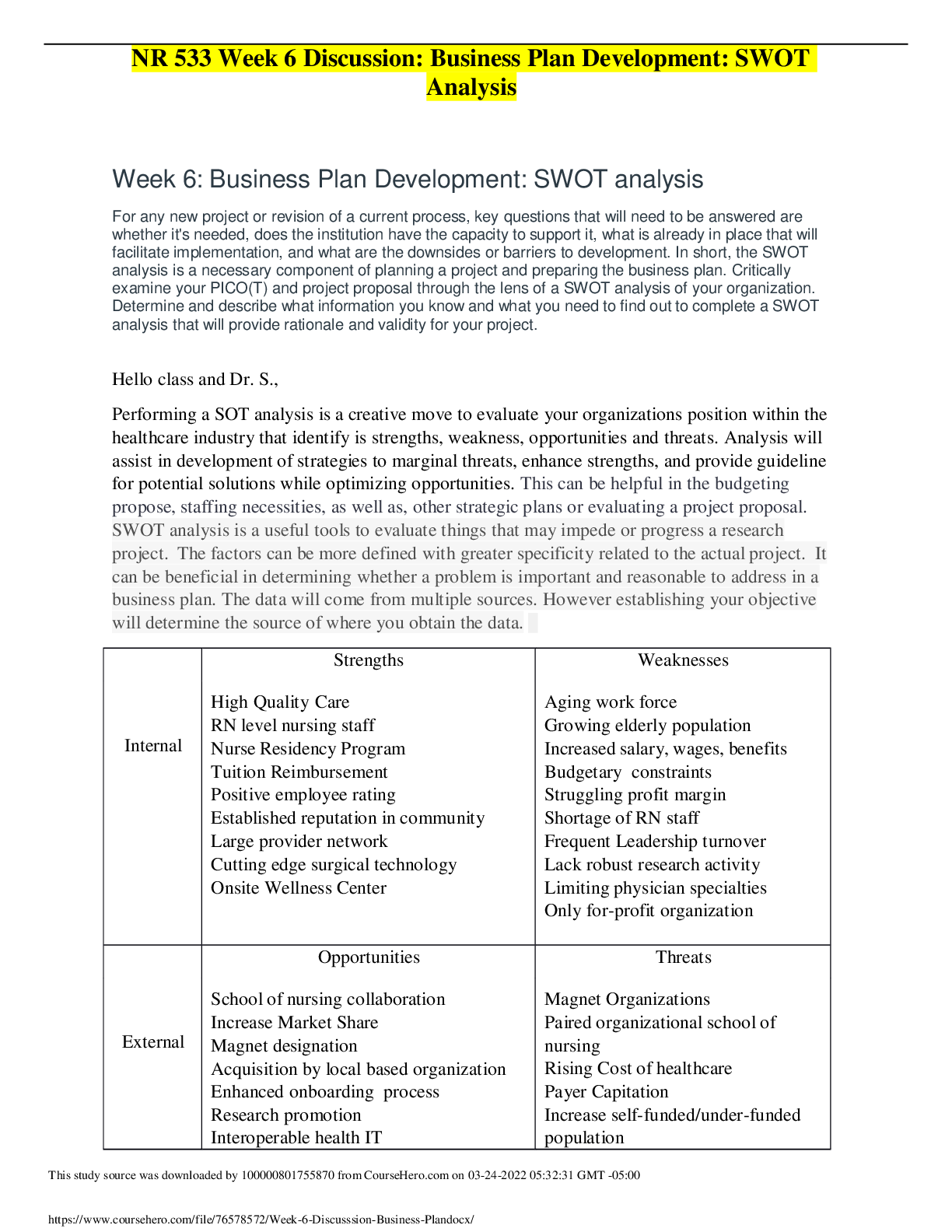
SWOT Analysis Chart
STRENGTHS
(Internal) WEAKNESS
(Internal) OPPORTUNITIES
(External) THREATS
(External)
* Shift incentives
* Supportive leadership * Increased fall rates
* Increased medication errors
* Increased post- operative complications
*High turnover rate
* High absenteeism
* Staff with limited experience
* No extra staff to accommodate high census. * Job fairs
* Residency programs
*Sign-on incentives * Multiple hospital chains in the area offering sign on bonuses.
* Staffing companies offering more money.
* Facilities offering lower patient to nurse ratio.
I believe that with the increase in nursing staff there will be a decrease in patient negative outcomes.
Kesha Clark References
Heidari, M., Seifi, B., & Gharebagh, Z. (2017). Nursing staff retention: Effective factors. Annals of Tropical Medicine and Public Health, 10(6), 1467-1473. doi:10.4103/ATMPH.ATMPH_353_17
Hetzel-Riggin, M., Swords, B., Deck, J., Spurgeon, N., & Tuang, H. (2020). Work engagement and resiliency impact the relationship between nursing stress and burnout. Applied Psychology, 123(5), 1835-1853. doi:10.1177/0033294119876076
[Show More]






.png)
.png)
.png)