Swift River Medical-Surgical cases All 2024/2025.
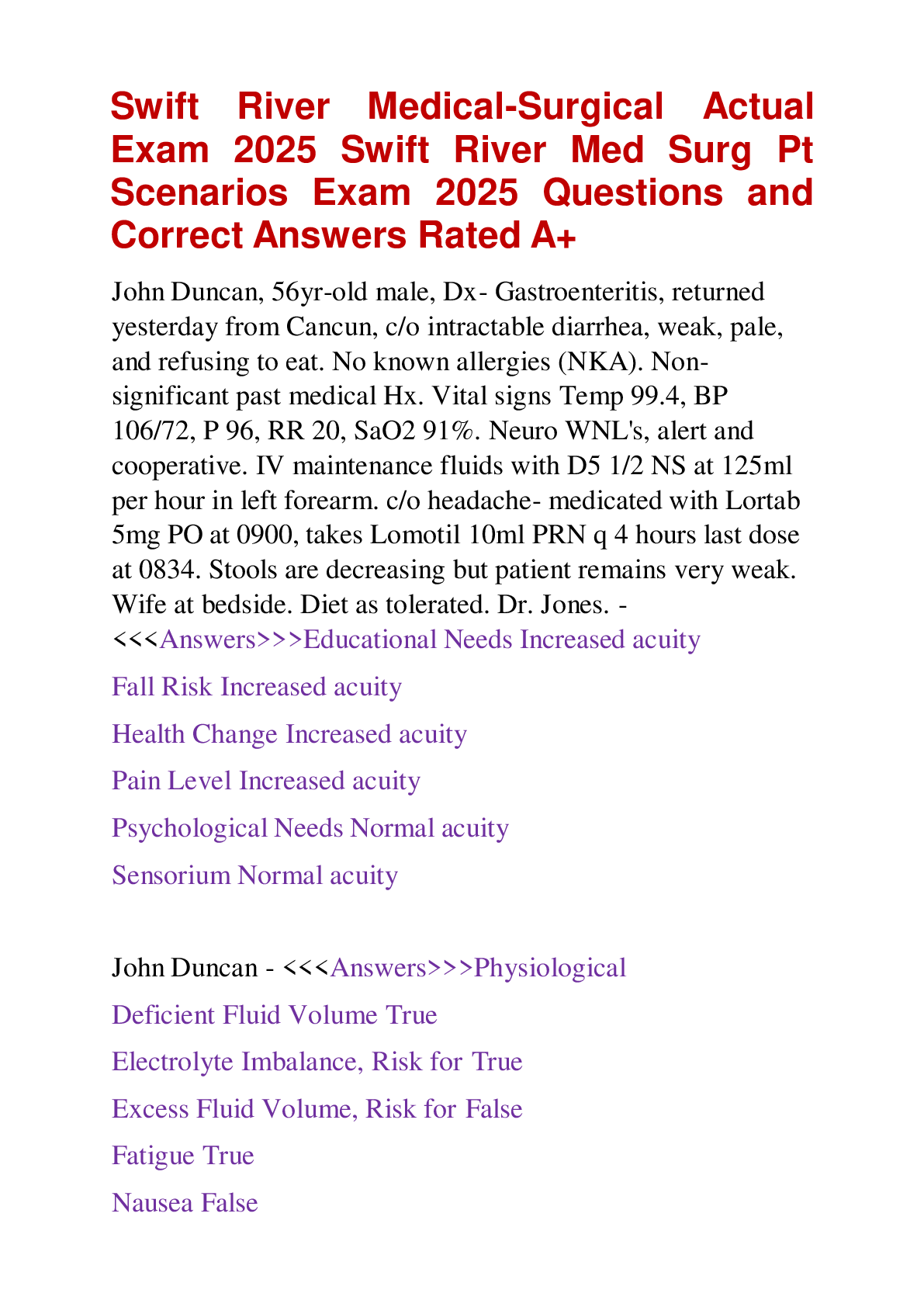
Ann Rails - Educational - Increased
Fall Risk - Increased
Health Change - Increased
Pain - Increased
Psychological Needs - Normal
Sensorium - Normal
Ann R
...
Swift River Medical-Surgical cases All 2024/2025.
Ann Rails - Educational - Increased
Fall Risk - Increased
Health Change - Increased
Pain - Increased
Psychological Needs - Normal
Sensorium - Normal
Ann Rails - Acute pain
Impaired comfort
Impaired mobility
Disturbed sensory perception
Fall, risk for
Peripheral neurovascular dysfunction
Ann Rails - Scenario #1
Use therapeutic
Educate pt.
Evaluate pt. learning
Place call light
Document
Scenario #2
Wash and glove hands
Assess
Provide comfort measures
Notify doctor
Document
Scenario #3
Listen to pt. concerns
Reassure pt. of options
Notify lead nurse/doctor
Contact Social Services
Document
Scenario #4
Wash and glove hands
Visual assessment
Do not disturb
Verify Call Light
Document
Scenario #5
Assess for bowel sounds
Encourage fluids/fiber/ambulation
Evaluate pt. understanding
Attain fluids/fiber diet
Document
Arthur Thomason - Educational - increased
Health change - increased
LOC - increased
Pain - increased
Psychological needs - increased
Safety - increased
Arthur Thomason - Impaired confort
Impaired gas exchange
Ineffective airway clearance
Shock, risk for
Anxiety/fear
Failure to thrive, risk for
Arthur Thomason - Scenario #1
Assess
Replace O2
Use therapeutic
Notify Dr. and charge nurse
Scenario #2
Remind physician
Explain to physician
Assist physician
Obtain recent
Reassure pt.
Scenario #3
Tap pt.
Elevate HOB
Call rapid response
Start secondary
Remain with pt.
Scenario #4
Provide verbal report
Emergency intubation
Assume role
Obtain pt. record
Provide information
Scenario #5
You explain that his condition
You explain that he is receiving
You have them remain with you
You escort them with you
You call his doctor
Calvin Umbyuma - Educational - increased
Fall Risk - normal
Health Change - increased
Pain - increased
Psychological needs - normal
Neurological - normal
Calvin Umbyuma - Acute pain
Deficient knowledge
Calvin Umbyuma - Scenario #1
Place on respiratory isolation
Ask Mr. U
Obtain blood cultures
Start IV
Collect sputum culture
Scenario#2
Wash hand, don PPE
Explain to the visitor
Respiratory assessment
Explain to Mr. U
Place signage on door
Scenario #3
Ask pt. what he knows
Ask pt. what his mother's
Educate pt.
Evaluate effectiveness
Report findings
Scenario #4
Pt. teaching
Contact respiratory therapy
Chest x-ray
Western blot
Bronchoscopy
Scenario #5
Elevate HOB
Initiate O2 at 4L
Reassess VS
Reevaluate amount of blood lost
Contact HCP
Cameron Daniels - Educational - increased
Fall Risk - increased
Health Change - increased
Pain - increased
Psychological Needs - normal
Neurological - normal
Cameron Daniels - Acute pain
Impaired mobility
Deficient knowledge
Fall, risk for
Infection, risk for
Cameron Daniels - Scenario #1
Give tylenol
Start another IV
Initiate bolus
Request additional pain med
Reasses temp in 1 hour
Scenario #2
Sit at an eye level
Teach Cameron
Evaluate understanding
Contact charge nurse
Document pt's statements
Scenario #3
Provide emotional support
Assure pt.
Explain to pt.
Stress importance
Inform pt.
Scenario #4
Make sure accurate wt.
Explain reason for medication
Tell the mother that you understand
Tell the mother that visitors are welcome
Be honest with Cameron
Scenario #5
Assess pt.
Perform rapid assessment
Ask pt.
Inform charge nurse
Call local law enforcement
Chanthavy Chhet - Educational - increased
Fall Risk - increased
Health Change - increased
Pain - increased
Psychological Needs - increased
Neurological - normal
Chanthavy Chhet - Acute pain
Impaired mobility, risk for
Nausea
Cultural competence
Deficient knowledge
Impaired verbal communication
Chanthavy Chhet - Scenario #1
Obtain translator
Initiate IV
Begin fluid and electrolyte
Administer IV ABX
Consult with MD
Scenario #2
What is going on?
We need to stop the bleeding
Tell me where you are
Who were you talking to?
What were the voices telling you?
Scenario #3
Attempt to establish rapport
Notify HCP of findings
Attempt to restart IV
Contact dietary
Obtain a sitter
Remove potential harmful objects
Scenario #4
Delay insertion of IV
Contact HCP
Contact CC's uncle
Request the uncle come
Request the uncle participates
Scenario #5
Provide one-to-one
Initiate anti-psychotic meds
Ensure family member
Reassess environment
Initiate continuous observation
Clement Hall - Educational - increased
Fall Risk - increased
Health Change - increased
Neurological - normal
Pain - increased
Psychological needs - normal
Clement Hall - Acute pain
Impaired mobility, risk for
Fluid & electrolyte imbalance, risk for
Infection
Clement Hal - Scenario #1
Contact isolation
Administer pain meds
Initiate IV
Ask pt.
Document physical findings
Scenario #2
Explain the need
Elevate HOB
Measure nose to ear
Have pt. swallow
Check placement
Scenario #3
Remind pt.
Reassess pt.
Obtain an order
Teach pt. to avoid
Teach pt. to apply
Scenario #4
Assess pain
Asminister morphine
NG tube to LIS
Call for triple lumen
Address concerns
Scenario #5
Therapeutic communication
Pt. teaching
Evaluate learning
Make referral
Dietary consult
Dana Fitzgerald - Educational - increased
Fall Risk - increased
Health Change - increased
Pain - increased
Psychological Needs - normal
Neurological - normal
Dana Fitzgerald - Deficient knowledge
Grieving, risk for
Dana Fitzgerald - Scenario #1
Sit with the pt.
Reinforce provider teaching
Assess family support system
Reassure the pt.
Ask the pt.
Scenario #2
Head-to-toe assessment
Inspect catheter
Teach pt.
Instruct pt.
Ask the charge nurse
Scenario #3
Teach the pt.
Explain to the pt.
Administer pain meds
Tell the pt.
Have the pt. ambulate
Scenario #4
Inspect pt's abdomen
Auscultate
Percuss & palpate
Contact provider
Tell husband & pt.
Scenario #5
Inform the pt.
Provide pt. privacy
Lubricate tip of enema
Squeeze the contents
Have the pt. lay on their side
Don Johnson - Educational - increased
Fall Risk - increased
Health Change - increased
Pain - increased
Psychological Needs - increased
Neurological - normal
Don Johnson - Acute pain
Altered body image, risk for
Audiology changes, risk for
Fluid & electrolyte imbalance, risk for
PTSD, risk for
Infection, risk for
Don Johnson - Scenario #1
Complete full assessment
Insert foley
Initiate IV
Apply Silvadene
Contact HCP
Scenario #2
Reassess lung sounds
Empty foley bag
Administer pain meds
Notify HCP
Document
Scenario #3
Elevate HOB
Assess pt's sputum
Reassure the pt.
Assure the pt.
Contact respiratory therapy
Scenario #4
Obtain doppler pulse
Adjust rate of IV
Ask for available tech
Change dressing
Determine if the pt.
Scenario #5
Obtain bear hugger
Explain to the pt.
Notify nursing supervisor
Contact nutritionist
Allow visitors to enter
Dotty Hamilton - Educational - increased
Fall Risk - normal
Health Change - normal
Pain - normal
Psychological Needs - increased
Neurological - normal
Dotty Hamilton - Bleeding, risk for
Impaired comfort, risk for
Deficient knowledge
Infection, risk for
Dotty Hamilton - Scenario #1
Contact surgeon
Complete pre-op
Ensure surgical consents
Check to see
Pt. teaching
Scenario #2
Wash hands
Complete full assessment
Check wound sites
Use therapeutic
Encourage first IS
Scenario #3
Reassure & communicate
Check blood glucose
Administer ABX
Encourage aggressive IS
Start PCA pump
Scenario #4
Reassure pt.
Complete full pt. assessment
Assess whether or not
Obtain labs
Notify HCP
Scenario #5
Complete full assessment
Place pt. on telemetry
Check foley
Assist anesthesia
Explain to pt.
Scenario #6
Have family step out
Bring the family in
Offer to the family
Contact funeral home
Ask nursing manager
Glenn Massey - Educational - increased
Fall Risk - increased
Health Change - increased
Pain - increased
Psychological Needs - normal
Neurological - normal
Glenn Massey - Acute pain
Impaired mobility, risk for
Nausea, risk for
Deficient knowledge
Glenn Massey - Scenario #1
Ensure room was cleaned
Disinfect call light
Clean and obtain IV pole
Obtain burn sheets
Notify infection control nurse
Scenario #2
Obtain VS
Initial assessment
Administer pain meds
Educate pt.
Check pt's chart
Scenario #3
Hand hygiene
Set up supplies
Apply clean gloves
Gently peel off
Clean wound site
Apply new dressing
Scenario #4
Notify HCP
Inform pt.
Initiate cardiac telemetry
Give 1L NS
Empty foley
Scenario #5
Explore why pt.
Educate pt.
Evaluate pt's understanding
Contact social services
Involve family
Hannah Knox - Educational- increased
Fall Risk - increased
Health Change - increased
Pain - increased
PsychologicL Needs - increased
Neurological - normal
Hannah Knox - Chronic pain
Impaired comfort
Deficient knowledge
Fear of death
Gas exchange, risk for
Infection, fisk for
Hannah Knox - Scenario #1
Full assessment
Contact IV team
Contact HCP
Set up PCA
Contact social services
Scenario #2
Administer ABX & start morphine
Contact hospice/social work
Place pt. on continuous pulse ox
Reassess effectiveness
Document
Scenario #3
Reassess VS & elevate HOB
Continue to provide
Seek clarification
Call respiratory therapy
Provide emotional support
Scenario #4
Full assessment
Place pt. on 100% non-rebreather
Review PCA pump history
DNR armband
Discuss with HCP
Scenario #5
Contact HCP
Contact chaplain
Take pt's family
Prepare Mrs. Knox's body
Notify social services
Hildegard Lowe - Educational - increased
Fall Risk - increased
Health Change - increased
Pain - normal
Psychological Needs - normal
Neurological - normal
Hildegard Lowe - Impaired mobility, risk for
Deficient knowledge
Impaired gas exchange, risk for
Peripheral neurovascular dysfunction, risk for
Risk for infection
Ineffective breathing pattern
Hildegard Lowe - Scenario #1
Reposition HOB to semi-fowler's
Increase supplemental O2
Orient pt.
Initiate IS treatment
Retake VS
Scenario #2
WBC
Magnesium
RBC
Hemoglobin
BUN
Scenario #3
Stop infusion
Don gloves
Inspect site
Collect supplies
Remove IV & document
Scenario #4
Have secretary
Review current
Discuss the policy
Ask Hildegard
Document teaching
Talk to daughter
Scenario #5
Don gloves & assist pt.
Assess stool
Assist pt. to bed
Anticipate need
Call the physician
Place pt. on enteric
Janene Whitmore - Educational - increased
Fall Risk - increased
Health Change - increased
Pain - increased
Psychological Needs - increased
Neurological - normal
Janene Whitmore - Acute pain
Bleeding
Impaired comfort
Deficient knowledge
Infection, risk for
Janene Whitmore - Scenario #1
Explain to pt.
Medicate pt.
Initiate IV
Put an arm band
Ask pt.
Scenario #2
Explain to Mrs. Whitmore
Inform pt.
Explain to pt.
Reassure pt.
Ask Mrs. Whitmore
Scenario #3
Contact charge nurse
Contact hospital liaison
Inform pt.
Inform admitting physician
Document
Scenario #4
Ask pt.
Administer Epoetin
Pt. teaching
Administer diluted iron
Reassess pt.
Scenario #5
Remind surgeon & staff
Notify HIPAA
Notify charge nurse
Suggest
Introduce hospital liaison
Jody Rush - Educational - increased
Fall Risk - increased
Health Change - increased
Pain - increased
Psychological Needs - normal
Neurological - normal
Jody Rush - Acute pain
Bleeding, risk for
Impaired mobility, risk for
Nausea
Deficient knowledge
Jody Rush - Scenario #1
Wash hands
Complete full assessment
Medicate
Encourage positioning
Orient friend
Scenario #2
Complete neuro
Educate Jody's parents
Offer full AM bath
Log roll pt.
Ensure foley is draining
Scenario #3
Inform pt. & family
Draw stat D-Dimer
Obtain additional support
Ask parents
Accompany pt.
Scenario #4
Start O2 100%
Provide SBAR
Page surgeon STAT
Prepare for heparin
Assist RRT
Scenario #5
Assist & support
Alert ICU
Following pt. arrival
Provide emotional support
Ask charge nurse
John Davis - Educational - increased
Fall Risk - normal
Health Change - increased
Pain - normal
Psychological Needs - normal
Neurological - normal
John Davis - Deficient knowledge
John Davis - Scenario #1
Offer pt. a urinal
Perform post-op
Assist pt.
Tell pt.
Ensure side rails
Scenario #2
Assess large dressing site
Administer pain meds
Assess dressing supply
Assess pt's need
Document
Scenario #3
Restart new IV
Administer nausea med
Assess for contraindications
Weight the pt.
Take VS & provide pt. teaching
Scenario #4
Complete full assessment
Apply clean dressing
Encourage pt.
Continue to encourage
Document & inform
Scenario #5
Assess pt's concerns
Teach pt.
Make referral
Consult social services
Have pt. verbalize
Joyce Workman - Educational - increased
Fall Risk - normal
Health Change - increased
Neurological - normal
Pain - normal
Psychological Needs - normal
Sensorium - normal
Joyce Workman - Enhanced readiness for learning
Ineffective health maintenance
Imbalanced nutrition
Risk for injury
Joyce Workman - Scenario #1
Ask Mrs. Workman
Explain in laymen terms
Discuss lifestyle choices
Discuss lifestyle changes
Document teaching
Scenario #2
Asses Mrs. Workman's knowledge
Ask Mrs. Workman for 24-hour diet
Educate Mrs. Workman
Provide Mrs. Workman
Ask Mrs. Workman to demonstrate
Scenario #3
Assess pt's preferred
Ensure the pt.
Provide an exercise routine
Review with Mrs. Workman
Use teach back
Scenario #4
Assess pt's blood glucose
Provide 20 gram carb
Provide another
Reassess blood glucose
Proved additional teaching
Scenario #5
Assess Mrs. Workman's understanding
Explain to Mrs. Workman
Explore new ways
Provide information
Document education
Kate Bradley - Educational - increased
Fall Risk - increased
Health Change - increased
Pain - increased
Psychological Needs - increased
Neurological - increased
Kate Bradley - Acute pain
Bleeding, risk for
Impaired comfort
Impaired mobility
Deficient knowledge
Fall, risk for
Infection, risk for
Kate Bradley - Scenario #1
Complete full assessment
Secure help
Medicate
Contact nursing supervisor
Complete bed bath
Scenario #2
Reassess VS
Report discrepancy
Notify HCP
Contact IV team
Document all findings
Scenario #3
Explain to surgeon
Check on labs
Contact charge nurse
Meet with daughter
Assess pt.
Scenario #4
Provide therapeutic
Assess last medication
Assist the IV team
Explain to daughter
Contact social services
Scenario #5
Witness daughter
Call report
88 y/o female
Former nursing home
Pt. has a foley
Have daughter stay
Kathy Gestalt - Educational - increased
Fall Risk - increased
Health Change - increased
Pain - normal
Psychological Needs - increased
Sensorium - normal
Kathy Gestalt - Acute Pain
Impaired mobility
Impaired skin integrity, risk for
Anxiety
Deficient knowledge
Fall, risk for
Decisional comfort
Disturbed body
Kathy Gestalt - Scenario #1
Check pedal cap refill
Educate pt.
Evaluate understanding
Adjust crutches
Assist pt. OOB
Scenario #2
Wash & glove
VS assessment
Administer anit-pyretics
Verify call light
Document results
Scenario #3
Inspect cast site
Assess toe movement
Notify Dr.
Document results
Scenario #4
Assess pain
Elevate extremity
Educate pt.
Notify lead nurse/Dr
Retrieve cast removal tool
Scenario #5
Use therapeutic
Notify lead nurse/Dr
Consult social services
Evaluation pt.
Document consults
Keaton Henderson - Educational - increased
Fall Risk - increased
Health Change - increased
Neurological - normal
Pain - normal
Psychological Needs - normal
Keaton Henderson - Acute pain
Bleeding, risk for
Impaired comfort
Fall risk
Keaton Henderson - Scenario #1
Introduce
Take vitals
Auscultate lungs
Inspect pleurovac
Mark drainage level
Scenario #2
Assess VS
Assess insertion site
Check pleurovac
Administer pain meds
Encourage use of IS
Scenario #3
Asses for mediastinal shift
Administer 100% O2
Auscultate lungs
Assess pleurovac
Cal rapid response
Scenario #4
Explain to pt.
Obtain 16 gauge angiocath
Set up sterile
Obtain & fill
Assist with insertion
Scenario #5
Assess VS
Auscultate lungs
Complete chest x-ray
Inspect insertion site
Ensure chest tube
Linda Yu - Educational - increased
Fall Risk - increased
Health Change - increased
Neurological - increased
Pain - increased
Psychological Needs - increased
Linda Yu - Acute pain
Impaired mobility
Fall risk
Risk for infection
Linda Yu - Scenario #1
Assess current pain
Obtain VS
Complete initial assessment
Educate pt.
Place personal aspirin
Scenario #2
Assess for injury
Obtain assistance
Take VS
Complete skin assessment
Notify healthcare provider
Scenario #3
Administer medication
Address pt's skin tear
Obtain bedside
Prepare pt.
Assign a UAP
Scenario #4
Assess leg
Treat pt.
Educate pt.
Contact power of attorney
Collect pre-op labs
Scenario #5
Assess VS & UO
Start secondary IV
Have a 2nd licensed nurse
Take VS
Assess pt. & VS
Mark Robinson - Educational - increased
Fall Risk - increased
Health Change - increased
Neurological - normal
Pain - increased
Psychological Needs - normal
Mark Robinson - Bleeding, risk for
Impaired comfort
Deficient knowledge
ETOH withdrawal, risk for
Mark Robinson - Scenario #1
Educate pt.
Draw labs
Initiate large bore IV
Advise pt.
Initiate I&O
Scenario #2
Stop the pt.
Explain to the wife
Reassess pt.
Call GI provider
Explain to pt. & wife
Scenario #3
Identify the client
Check the client
Document necessary
Check VS
Recheck VS q 5 min
Scenario #4
Repeat H&H
Administer ordered meds
Explain to the pt.
Verify with blood bank
Verify soft, low sodium
Scenario #5
Stop the platelets
Reassess VS & obtain UA
Notify HCP
Call charge nurse
Initiate incident report
Nathaniel Gonzalez - Educational - increased
Fall Risk - increased
Health Change - increased
Pain - increased
Psychological Needs - increased
Neurological - normal
Nathaniel Gonzalez - Acute pain
Deficient knowledge
Fall, risk for
Nathaniel Gonzalez - Scenario #1
Tell the pt. that
Perform admission
Tell the pt. to
Explain to the pt.
Ensure the bed
Scenario #2
Explain to the pt.
Reinforce the risk
Administer the medication
Assess if the contents
Remove the lunch tray
Scenario #3
Assess pt's LOC
Elevate HOB
Reapply NC
Remove the dinner tray
Reassess pt. q 5 min
Scenario #4
Restart IV
Give NS liter bolus
Recheck Tilts
Remind pt.
Draw a repeat CBC
Scenario #5
Assess pt's pain
If gastric reflux
If cardiac
Assess pt's anxiety
Verify if discharge
Paul Greer - Educational - increased
Fall Risk - normal
Health Change - increased
Pain - normal
Psychological Needs - normal
Neurological - normal
Paul Greer - Impaired comfort
Deficient knowledge
Sexuality
Paul Greer - Scenario #1
Complete initial
Check patency
Medicate for pain
Explain to pt.
Inform pt.
Scenario #2
Tell the wife
Explain to Mr. Greer
Teach the pt.
Evaluate pt's understanding
Continue to observe
Scenario #3
Using therapeutic
Contact HCP
Provide the pt.
Provide a diversional
When the HCP
Scenario #4
Complete head-to-toe
Ensure pt. privacy
Complete secondary
Reinforce to the pt.
Notify HCP
Scenario #5
Ask the pt. if it is okay
Explain that Docetaxel
Explain that Radium-223
Ask the pt. to verbalize
Assess pt's understanding
Roger Clinton - Educational - increased
Fall Risk - normal
Health Change - increased
Pain - normal
Psychological Needs - normal
Neurological - normal
Roger Clinton - Bleeding, risk for
Impaired comfort, risk for
Impaired mobility, risk for
Nausea, risk for
Deficient knowledge
Infection, risk for
Roger Clinton - Scenario#1
Wash hands
Explain to Roger
Obtain & verify
Initiate IV
Orient pt.
Scenario #2
Orient Roger
Take VS
Observe & mark
Assess pain
Fluid status
Scenario #3
Head-to-toe
Reinforce dressing
Notify surgeon
Notify charge nurse
Instruct pt.
Scenario #4
Take VS
Keep Mr. Clinton
Reinforce dressing
Initiate secondary
Witness signing
Scenario #5
Initiate head-to-toe
Check operative
Assess for pain
Review new orders
Encourage Mr. Clinton
Ronald Burgandy - Educational - increased
Fall Risk - increased
Health Change - increased
Pain - increased
Psychological Needs - increased
Sensorium - normal
Ronald Burgandy - Acute pain
Bleeding
Impaired comfort
Deficient knowledge
Fall, risk for
Ronald Burgandy - Scenario #1
Explain to the pt.
Ensure there is a full
Start and IV
Medicate
Advise pt.
Scenario #2
Explain to Mr. Burgandy
Inform Mr. Burgandy
Ask Mr. Burgandy
Reassure pt.
Reassess pt's physical
Scenario #3
Assess pt's ABCs
Take initial VS
Pale pt. on O2
Start IV
Set-up
Scenario #4
Explain procedure
Place pt. on 100% O2
Ensure there is suction
Obtain chest tube tray
Reassess pt's VS
Scenario #5
Instruct Mr. Burgandy
Notify charge nurse
Call security
Transport Mr. Burgandy
Complete incident report
Ruth Cummings - Educational - increased
Fall Risk - increased
Health Change - increased
Pain - increased
Psychological Needs - increased
Neurological - normal
Ruth Cummings - Acute pain
Deficient knowledge
Impaired mobility, risk for
Nausea
Ruth Cummings - Scenario #1
Orient pt.
Educate pt.
Administer rectal
Assess IV
Insert NG
Scenario #2
Describe to pt.
Explain how surgery
Practice using IS
Reinforce need
Evaluate pt. understanding
Scenario #3
Ensure signed surgical
Take VS
Ask pt. to verify
Check IV
Disconnect NG tube
Scenario #4
Receive handoff
Assess/inspect
Take VS
Elevate HOB
Give pt. call light
Scenario #5
Assis pt.
Ensure side rails
Notify charge nurse
Notify HCP
Complete incidence report
Trey Johnson - Educational - increased
Fall Risk - normal
Health Change - increased
Pain - increased
Psychological Needs - increased
Sensorium - normal
Trey Johnson - Acute pain
Nausea
Deficient knowledge
Trey Johnson - Scenario #1
VS & head-to-toe
Collect stool
Initiate IV
Initiate I&O
Teach pt.
Scenario #2
Place pt.
Relocate pt.
Contact HCP
Proved PRN
Continue strict I&O
Scenario #3
Notify Infection Control
Pt. education
Initiate medication
Continue medicating
Discuss coping
Scenario #4
Allow pt.
Educate pt.
Evaluate pt. understanding
Notify HCP
Document
Scenario #5
Educate pt. of protocols
Educate pt. of transmission
Evaluate potential barriers
Educate pt. of need
Evaluate pt. understanding
Wight Goodman - Educational - increased
Fall Risk - increased
Health Change - increased
Pain - increased
Psychological Needs - normal
Neurological - normal
Wight Goodman - Acute pain
Bleeding, risk for
Impaired comfort
Deficient knowledge
Infection, risk for
Wight Goodman - Scenario #1
Wash hands & assess
Complete neuro
Check the blood
Pre-op education
Ask surgeon
Scenario #2
Complete neuro
Educate pt.
Evaluate pt's understanding
Administer IV ABX
Sign additional
Scenario #3
Complete neuro
Educate pt. & family
Inform healthcare provider
Contact social services
Extensive discharge
Scenario #4
Repeat neuro
Reemphasize to pt.
Approach resident
Contact nursing supervisor
Document
Scenario #5
Take VS
Restart pt's IV
Obtain surgical
Assure pt.
Remain with pt.
Tim Jones - Educational - Increased
Fall Risk - Increased
Health Change - Increased
Neurological - Increased
Pain Level - Increased
Psychological Needs - Increased
Tim Jones - Defensive coping
Ineffective health maintenance
Risk for post traumatic stress syndrome
Risk for injury at home
Tim Jones - Scenario #1
Wash hands
Reassure pt.
Interviewing pt.
Complete physical
Notify charge nurse
Scenario #2
Use therapeutic
Seek clarification
Reassure Mr. Jones
Administer prescribed
Offer UAP
Scenario #3
Assess Mr. Jones
Assist Mr. Jones
Provide personal
Remind Mr. Jones
Obtain a sitter
Scenario #4
Notify HCP
Administer nebulizer
Reassess respiratory
Encourage Mr. Jones
Document
Scenario #5
Talk with Mr. Jones
Call Mr. Jones's children
Ask Mr. Jones
Discuss options
Notify the social worker
John Wiggins - Educational - increased
Fall Risk - increased
Health Change - increased
Neurological - normal
Pain - increased
Psychological Needs - normal
John Wiggins - Acute pain
Deficient knowledge
Impaired mobility, risk for
Nausea
Bleeding, risk for
John Wiggins - Scenario #1
Check for cognition
Check pupils
Check nose and ears
Check cranial nerves
Assess extremity
Scenario #2
Explain to Mr. Wiggins
Inform pt.
Ask pt. to remain
Put side rails up
Notify physician
Scenario #3
Contact radiology
Inform the pt. of the plan
Start a saline lock
Inform pt. why you are doing
Inform the pt. why he will
Notify charge RN
Scenario #4
Remain with pt.
Call for help
Note time when
Ensure IV access
Reassess VS
Scenario #5
Assist anesthesia
Administer Valium
Initiate a second 18g IV
Contact family
Continue frequent VS
Marcella Como - Educational - increased
Fall Risk - normal
Health Change - increased
Pain - increased
Psychological Needs - increased
Sensorium - normal
Marcella Como - Acute pain
Readiness for enhanced immunization status
Ineffective coping
Rape-trauma syndrome
Fear
Grieving
Infection, risk for
Disturbed energy field
Anxiety
Compromised family coping
Social isolation
Marcella Como - Scenario #1
Use therapeutic
Full assessment
Provide emotional
Document
Scenario #2
Use therapeutic
Educate pt.
Provide supplies
Offer to assist
Scenario #3
Use therapeutic
Ask open-ended
Seek clarification
Summarize
Scenario #4
Restsate or paraphrase
Acknowledge
Review plan
Notify social services
Document
Scenario #5
Review labs
Educate pt.
Provide emotional
Discuss support
Preston Wright - Educational - increased
Fall Risk - increased
Health Change - increased
Neurological - normal
Pain - increased
Psychological Needs - normal
Preston Wright - Acute pain
Altered body image
Impaired physical mobility
Impaired tissue integrity
Risk for imbalanced nutrition
Risk for infection
Risk for injury related to falls
Preston Wright - Scenario #1
Assess current pain
Assess documented pain
Review medication
Prepare and administer
Reassess pain
Scenario #2
Asses Mr. Wright's willingness
Eliminate as many
Explain rationales
Assess understanding
Document
Scenario #3
Remove old dressing
Assess the injury
Assess and document
Measure wound size
Re-apply new sterile dressing
Scenario #4
Don clean gloves
Remove clean gloves
Clean wound
Place sterile moistened
Secure dressing
Scenario #5
Explain S/Sx
Encourage Mr. Wright
Assess understanding
Alert Mr. Wright's case manager
Call Report
John Duncan - Educational - increased
Fall Risk - increased
Health Change - increased
Pain - increased
Psychological Needs - normal
Sensorium - normal
John Duncan - Deficient fluid volume
Electrolyte imbalance, risk for
Fatigue
Fall, risk for
Noncompliance
John Duncan - Scenario #1
Assess I&O
Construct dietary consult
Acquire daily weight
Evaluate outcome
Scenario #2
Full assessment
Check I&O
Teach pt. about safety
Document
Scenario #3
Wash/glove hands
Provide emesis basin
VS assessment
Administer antiemetic
Evaluate medication
Scenario #4
VS assessment
Assessment of bowel
Administer protocol
Document results
Include pt. condition
Scenario #5
Inform & educate spouse
Evaluate/modify
Assess food
Document
Karen Cole - Educational - increased
Fall Risk - normal
Health Change - increased
Pain - normal
Psychological Needs - normal
Sensorium - normal
Karen Cole - Impaired coping
Risk for impaired comfort
Infection risk
Risk for injury
Karen Cole - Scenario #1
Apply O2
Connect pt.
Complete full assessment
Obtain IV access
Orient pt. & husband
Scenario #2
Give IV morphine
Reassess VS
Notify Cath lab
Obtain informed consent
Transport pt.
Scenario #3
Take VS
Post-op assessment
Ensure pressure dressing
Instruct pt.
Assess pain
Scenario #4
Explain the necessary
Perform hand hygiene
Remove infiltrated IV
Don new gloves
Insert new IV
Scenario #5
Asses pt. & family
Provide pt. post MI
Pt. & family should
Schedule cardiac
Document
Tom Richardson - Educational - increased
Fall Risk - increased
Health Change - increased
Pain - increased
Psychological Needs - normal
Sensorium - normal
Tom Richardson - Acute pain
Impaired mobility, risk for
Impaired urinary elimination
Fall, risk for
Tom Richardson - Scenario #1
Wash & glove
Vital assessment
Administer
Reassess pt.
Document
Scenario #2
Vital assessment
Notify Dr.
Administer new
Reassess pt.
Scenario #3
Use therapeutic
Obtain urinary
Assist pt.
Remain w/ pt.
Document
Scenario #4
Use therapeutic
Educate pt.
Evaluate understanding
Contact dietary
Document
Scenario #5
D/C instruction
Evaluate understanding
Escort pt.
Document
Notify housekeeping
Mary Barkley - Educational - increased
Fall Risk - normal
Health Change - increased
Neurological - normal
Pain - increased
Psychological Needs - increased
Mary Barkley - Acute pain
Deficient knowledge
Grieving
impaired comfort
Infection
Mary Barkley - Scenario #1
Have pt.
Wash hands
Use therapeutic
Guide her back
Set her up
Scenario #2
InitiateO2
Scenario #3
Contact RT
Obtaintelemetry
Ask PCT
Don PPE
Assist RT
Scenario #4
Call rapid response
Continue to assist
Give SBAR
Call for crash cart
Ensure documentation
Scenario #5
Encourage the HCP
Offer to contact
Contact assisted living
Notify HCP
Assist w/ intubation
Richard Dominec - Educational - increased
Fall Risk - normal
Health Change - increased
LOC - normal
Pain - increased
Safety - increased
Psychological Needs - normal
Sensorium - normal
Richard Dominec - Acute pain
Knowledge deficit
Nutrition
Risk for infection
Skin integrity at risk
Fera/anxiety
Richard Dominec - Scenario #1
Perform full assessment
Provide comfort
Check surgical consent
Inform his partner
Scenario #2
Educate about recovery
Discuss his understanding
Offer assistance
Determine from medical
Scenario #3
You discuss this cough
Notify Dr. of change
Explain to Mr. Dominec
Explain that he will
Notify charge nurse
Scenario #4
Inform pt. about
Obtain and provide
Encourage Mr. Dominec
Document and provide
Scenario #5
This information
Remind staff
Leave the break room
Report this activity
Ramona Stukes - Educational - increased
Fall Risk - increased
Health Change - increased
Pain - increased
Psychological Needs - normal
Sensorium - normal
Ramona Stukes - Bleeding, risk for
Deficient fluid volume, risk for
Impaired mobility
Fall, risk for
Infection, risk for
Ramona Stukes - Scenario #1
Wash & glove
Full assessment
Allow expression
Educate pt.
Evaluate understanding
Scenario #2
Wash & glove
Full assessment
Check NG tube
Administer IV antiemetic
Scenario #3
Full assessment
Educate pt.
Evaluate understanding
Notify lead RN
Consult wound care
Scenario #4
Discuss w/ pt.
Notify lead RN
Contact social services
Update pt.
Scenario #5
Follow HIPAA
Explain HIPAA
Offer resource
Contact wound care
Document
Kenny Barrett - Educational - increased
Fall Risk - increased
Health Change - increased
Pain - increased
Psychological Needs - normal
Sensorium - increased
Kenny Barrett - Acute pain
Deficient knowledge
Fall risk
Kenny Barrett - Scenario #1
Perform hand hygiene
Reassess BP & P
Evaluate pt's understanding
Administer
Document
Scenario #2
Retake VS
Instruct pt.
Perform comfort
Request CNA
Notify the HCP
Scenario #3
Pt. Kenny Barrett
Pt. was admitted
Current VS
Request possible change
Scenario #4
Take VS not
Maintain strice
500 mL NS
Hold next dose
Contact HCP
Scenario #5
Assess stress level
Communicate
Discuss willingness
Educate pt.
Contact HCP
Lithia Monson - Educational - increased
Fall Risk - increased
Health Change - increased
Pain - increased
Psychological Needs - increased
Sensorium - increased
Lithia Monson - Bleeding, risk for
Imbalanced nutrition
Self-care deficit
Acute confusion
Fall, risk for
Failure to thrive
Lithia Monson - Scenario #1
Perform neuro
Reorient pt.
Assess for fall
Offer nutrition
Scenario #2
Explain reason
VS assessments
Apply restraint
Perform circulatory
Request sitter
Scenario #3
Employ therapeutic
Release restraints
Reapply restraints
Perform circulatory
Document
Scenario #4
Use therapeutic
Attempt to orient
Perform circulatory
Offer nutrition
Document
Scenario #5
Check monitor
Apply NC O2
VS reassessment
Notify lead RN
Remain w/ pt.
Charlie Raymond - Educational - increased
Fall - increased
Health Change - increased
Neurological - normal
Pain - normal
Psychological Needs - normal
Charlie Raymond - - Death anxiety
- Impaired gas exchange
- Ineffective breathing pattern
Charlie Raymond - Scenario #1
Don appropriate PPE
Change to simple
Perform focused
Notify respiratory therapy
Notify family
Scenario #2
Reorient pt.
Obtain a sitter
Restart IV
Begin strict
Obtain an order
Scenario #3
Use therapeutic
Position the pt.
Create sterile
Baby Strickland R03
Baby Strickland, 1-hour-old newborn female, 37-week gestational age born
via C-section, weight 9.9 lbs. Mom has history of diabetes, not well
controlled.
Estelle Hatcher R301
Estelle Hatcher 31yr-old, r/o appendicitis, 1st day post-op appendectomy; No
known allergies (NKA); Vital signs - Temp 101.2, BP 108/74, P 92, RR 20,
SaO2 99%, alert and cooperative. Wound site clean, dry and intact NPO, NGtube to low continuous suction. IV maintenance fluids with D5 1/2 NS with 20
KCL @ 125ml/hr in left forearm. Ambulates with minimal assistance. Family at
beside. Dr. Sangerstien
Hayden Clark R302
Hayden Clark, 6-year-old male, weighing 44 lbs., comes to school looking
disheveled, and not wearing a coat with the outside temperature in the low
40’s
Preston Wright R305
Preston Wright, 73-year-old male patient of Dr. Greene, status post CVA 4
weeks ago. He has been readmitted for a red spot on his sacrum of 1 cm and
a 2 cm blister on his right heel. IV fluids of D5 1/2 NS are infusing at 100
mL/hour to his right forearm. Mr. Wright is pleasant and cooperative but
needs to be reminded to avoid pressure on his heel and sacrum. Post CVA, he
has developed some aphasia and is having difficulty with verbal
communication. He has orders for dressing changes q daily and pain
medications before the dressing change
Jack Hammond R305 SR
Jack Hammond, 10 -year old boy who was admitted last night for cystic
fibrosis exacerbation and possible pneumonia. He has an IV of D5 NS infusing
to his right arm at 75 mL/hour. Oxygen per nasal cannula is in place at 3
L/min, chest x-ray results and sputum culture are pending. He is alert and
oriented, both parents are currently at the bedside. He does complain of
intercostal pain, especially with coughing. Current oxygen saturation is 94%
Calvin Umbyuma R302SR
Calvin Umbyuma Mr. Umbyuma is a 42 y/o male who has been admitted for complaints of
shortness of breath with pleuritic chest pain. He was diagnosed with HIV positive antibodies
over a year ago. He has recently been traveling back to his home country of Kenya to visit his
sick mother. He received traditional medical treatment at his village. His temp is 100.9 F, 38.3 C,
R 22, P92, BP 152/89 PaO2 91%. Inflammatory markers – Erythrocyte Sedimentation Rate
(ESR) and C-Reactive Protein (CRP) are elevated at 78.9 mm/h and 67.2 mg/L. He has been
placed in a room at the end of the hall.
Carlos Mancia R301SR
Carlos Mancia 48yr-old, Spanish speaking migrant worker with no known past medical Hx. r/o
Tuberculosis. Vital signs -Temp 99.1, BP 124/62, P 77, RR 20, SaO2 91%. Airborne Isolation.
Neuro WNL. Skin moist, respiratory bilateral wheezes and rhonchi. Blood-tinged mucous,
productive cough. Diet as tolerated. IV maintenance fluids with D5 1/4 NS @ 150 ml/hr X 3 then
reduce rate to 75 ml/hr. Expresses fatigue, fear, concern, and desire for recovery. Need frequent
reminder to stay in room and maintain mask precautions. If family/visitors come, will need
education to airborne precautions. Spanish interpreter available at extension 61178. Dr. Rondeau
Cameron Daniels R 304 SR
Cameron Daniels just turned 18 y/o. She is being admitted from the ER with a diagnosis of
pelvic inflammatory disease (PID). She has heavy vaginal discharge with an unpleasant odor.
She is complaining of abdominal pain and looks pale. She was seen by OBGYN in the ER and a
culture was sent to the lab for Chlamydia and/or Neisseria Gonorrhea. She was a very difficult
IV start and has a 23g saline lock (SL) in her right hand. They have ordered a liter bolus of LR,
but it is running very slowly and the IV is positional. VS BP 96/58, P 116, R 18, T 101.2 PaO2
92%.
Dotty Hamilton R304SR
Dotty Hamilton 52 y/o female who has been admitted for bariatric surgery.
She has arrived at 0600 and is scheduled for a laparoscopic Roux-en-Y gastric
bypass (RYGB). She is super morbidly obese with a BMI of 52, Ht, 5'3", Wt,
293lbs. She has well-controlled hypertension with Losartan (Cozaar) 50 mg q
daily. She also takes Metformin to control her Type 2 Diabetes. She has sleep
apnea, and she brought her CPAP machine. She is very excited about the
surgery but is also apprehensive. A friend told her that the complication rate
for this surgery is very high. She believes this surgery is her only hope, as
she says she has tried everything else to lose weight. Her husband is with
her and seems to be very supportive. Body Mass Index (BMI) = kg/m2, where
kg is a person's weight in kilograms and m2 is their height in meters
squared. A BMI of 25.0 or more is overweight, while the healthy range is 18.5
to 24.9. Example: Weight = 133.18 kg, Height = 160.02 cm (1.60 m)
Calculation: 133.18 ÷ (1.60)2 = 52
Arthur Silverstein R SR
Arthur Silverstein, Arthur Silverstein, a 68-year-old homeless Vietnam veteran recently
hospitalized for PTSD resulting from the abuse suffered during imprisonment by Viet Cong.
Arthur lives in a homeless shelter. He has experienced intermittent homelessness and alcohol
addiction since his wife died 18 years ago. Arthur experiences flashbacks and nightmares. He is
hyper-vigilant and becomes anxious in crowded spaces or in large groups of people.
Medications: NKDA. Paroxetine (Paxil) 30 mg daily for management of depression,
hypervigilance and PTSD symptoms and zolpidem (Ambien) for sleep as needed. Social history:
Arthur lives in a homeless shelter. Arthur openly struggles with the day room and the men’s
living quarters due to the number of people and limited personal space. Because of Arthur’s
alcohol addiction he has been denied access to the shelter if he was intoxicated forcing him to
sleep outdoors, regardless of the weather. Arthur has three children that he has not seen since
shortly after his wife died due to his mental health and alcohol abuse.
Linda Pittmon Room SR304
Linda Pittmon isa 74-year-old female patient who is a noncompliant diabetic and frequently stays
at the local homeless shelter. She has been admitted to the floor with complaints of numbness in
her right foot and ankle. Mrs. Pittmon states she has had numbness for years, but "now I can't
feel it at all, and my toes don't look the right color.". What screenings and assessments should
you antipate needing?
Paul Windsor SR
Paul Windsor, 4-year-old male admitted yesterday from the clinic with a
diagnosis of Nephrotic Syndrome. Vital signs: Temperature 99.0, HR 88, BP
104/76, RR 22, PaO2 95%. He presented yesterday with his parents reporting
a gradual increase in pain and “swelling” around his eyes and ankles, and
now his stomach is getting “bigger". Paul has little to no appetite. Current
weight is 56 pounds compared to a usual weight of 43 pounds. Urinalysis:
Thick, frothy appearance. Specific gravity: 1.025. Protein 3+. Blood 2+. Other
labs: Triglycerides 180 mg/dl. Cholesterol 190 mg/dl. Group B strep culture
negative in office.
Roger McClusky RSR
Roger McClusky, 70-year-old male recently diagnosed with Alzheimer’s Disease dementia
following evaluation of forgetfulness, difficulty processing new information, and increased
confusion. With his declining memory and hearing impairment Roger’s daughter, Lisa, is
concerned about his ability to care for himself and is interested in care options to assist him in
staying in his home. Medications: NKDA, memantine (Namenda) one tablet daily. Social
history: Roger lives alone in a two-bedroom home in a rural community. Roger came to the
community as a migrant worker 40 years ago and worked as farm help for a local farmer
providing manual labor in the fields. Roger is active in his church and attends with the men’s
Bible study weekly. His daughter lives nearby and visits Roger multiple times per week.
Community Assessment: Roger lives in a small rural community with a small downtown. On the
Main Street there is a grocery store, a family-owned pharmacy and milk shake shop, gas station,
diner, second-hand store, and an outreach family practice clinic. There are two churches, one on
the north side and one on the west end of town. The houses are spaced “a country mile,”
separated by farmland and fields. Most of the side roads are gravel. There are no public
transportation options.
Ann Rails SR 305
Ms. Rails has bruises to her right forearm and face. She complains of back
pain 6/10 pain scale. She was medicated with hydrocodone 5 mg PO two
hours ago. Her vital signs are BP: 110/60, P: 74, R: 20, PaO2: 98%, T: 98.6 F,
37 C. Ms. Rails has told you that she is concerned about returning home and
is afraid her boyfriend will return. She also expressed concern about finding a
new job
Hildegard Lowe R303 SR
Hildegard Lowe, 68 y/o female, newly admitted after a rough night in the ER
after coughing for the last 2 months. Patient is alert and cooperative, visually
limited and declining. She is on Oxygen at 2L. She has an IV 0.9 normal
saline, 125 an hour. Chest x-ray upon admission showed right middle lobe
pneumonia. Vital signs are BP: 128/86, P: 105, R: 32, T: 99.8 F, 37.7 C, SaO2:
93%. Plan of care is antibiotic therapy, incentive spirometry, O2
supplementation, and pending labs and blood cultures from the ER. Patient is
receiving Rocephin and received Zithromax in the ER. Patient does have a
history of Granulomatosis with Polyangiitis but has been stable for 5 years
w/o treatment. She is widowed and came to us from the retirement
community. She has one daughter who is on her way from out of state; she
will be arriving sometime today. Patient states she is allergic to mangos.
Mary Jane RSR
Mary Jane , Mary Jane is a 21-year-old female who was recently discharged from the behavioral
health unit. Mary Jane was engaging in cutting, sleeping excessively, was unable to complete
tasks, and had feelings of worthlessness. While in the behavioral health unit, Mary Jane exhibited
signs of severe anxiety. Mary Jane was diagnosed with major depressive disorder and prescribed
Tofranil. Discharge plans included continuation of imipramine and outpatient therapy.
Medications: imipramine (Tofranil) 100 mg daily. NKDA. Surgical history: Appendectomy age
10 Social history: Mary Jane lives at home with her parents. She is currently unemployed, and
looking for meaningful employment. She dropped out of college because she was unable to
concentrate and was experiencing overwhelming anxiety and depression symptoms.
Jody Rush 306 SR
Jody Rush, 20 y/o female, admitted for right femur fracture status post skiing
accident. She is in a traction splint and will be going for surgical repair today.
Vital signs are BP: 120/62, P:88, R: 20, T: 98.9 F, 37.2 C, PaO2: 99. She has
been in a lot of pain, and has been receiving 25 mcg IVP, q2 hours Fentanyl
for pain. She was nauseated after her last Fentanyl dose, and the Provider
ordered an additional 4mg IVP, Zofran. She has a history of exercise induced
asthma, and uses a rescue inhaler, Albuterol. Her parents are on their way;
they are flying in today. She was on a ski trip with some of her friends from
college; her best friend has been camped out with her. We were able to get
her on a bed pan earlier, but it took a lot of work. We just received an order
for a foley catheter. There was some concern that she may have sustained a
head injury as she has an abrasion to her forehead. She denies ever losing
consciousness. Patients affected extremity has normal pulses, and the
capillary refill is less than 3 seconds.
Maria Sanchez Room
Maria Sanchez , 20-year-old female, G1 T1 P0 A0 L1. Maria had an uncomplicated pregnancy
and normal spontaneous vaginal delivery at 39 weeks. She delivered a 3500 Gram male infant,
Juan. Maria is at the clinic for her 6-week post-partum visit. Maria shares with the nurse she is
feeling anxious and overwhelmed. Maria states she attempted to breastfeed but quit because
“Juan ate all of the time and cried most of the day.” Maria’s grandmother requested the
Curanderos visit the house to guide Le Cuarentena. Maria explains Le Cuarentena is a period of
40 days after a baby is born during which time the mother should do nothing but take care of
herself and the baby. Maria said, “grandmother told me Juan has colic because I did not eat the
right hot foods after Juan was born and that the breastfeeding trouble was too much during the
Le Cuarentena.” Maria tearfully expresses, “I failed as a mother.” Medications: NKDA Prenatal
vitamins and herbs from the Curanderos Social history: Maria lives in a multigenerational home
with her husband, Raul; 6-week infant, Juan; her mother and grandmother. Maria and her family
primarily speak Spanish; today’s visit includes an agency interpreter.
Michael Houston R
Michael Houston, 4-month old admitted with runny nose, decreased appetite,
dehydration, and cough. Respiratory Syncytial Virus (RSV)/Bronchiolitis is
suspected. He was born at 36 weeks and spent time in the NICU for
respiratory issues and patent ductus venosis that resolved with oxygen
treatment and time. A rRT-PCR on nasal secretions is pending, as is a chest xray. Vital signs are: Temp. 99.3 F, RR 54, HR170 with audible wheezes.
Mark Quinn R303
Mark Quinn, 9-year-old male comes to the school nurse with complaints of
abdominal pain and nausea. Vital signs: Temperature 98.2, HR 87, BP 104/
67, RR 22, PaO2 97%. The nursing assessment reveals diffuse lower
abdominal pain, tenderness, and normoactive bowel sounds. After
consultation with the child and the parents, the child is sent home with a
possible viral intestinal infection.
Suzanne Williams R305
Suzanne Williams, 5-year-old female, weight 35.2 lbs., recently diagnosed
with leukemia. CBC results: neutrophil count 1.7, white blood count 30,000.
She is reporting gradual arm and leg pain at a 6/10 over the last 4 weeks.
Parents attributed pain to “growing pains”. Patient experiencing n/v/d and
loss of appetite. Vital Signs Temperature 100.8, HR 115, BP 100/65, RR 23,
PaO2 95%. The patient is beginning a second round of chemotherapy.
John Davis R301
John Davis is a 54 y/o male admitted for surgical resection and biopsy of
multiple lesions on his back and shoulders. The patient is fair skinned with
multiple moles on his shoulders and anterior and posterior torso. The patient
is high risk for basal cell carcinoma and has had mole - mapping. Mr. Davis is
very thin and reports an 8 lbs. weight loss over the last four months. He
owns a landscape business, works outside, he also enjoys being out on his
boat. He had a basil cell carcinoma removed from his forehead four years
ago (Mohs micrographic surgery) which has left a large scar. Mr. Davis is
concerned about potential scars from these lesions. He denies any other
health issues. The patient does not smoke, but drinks 2 beers after work
daily and more on the weekends. VS BP 150/89, P 62, R 14, T 98.2.
Jim Goodman Sr
Jim Goodman, A home health nurse is scheduled to see a new client, Jim Goodman, for weekly
home health visits. Jim is a 77-year-old male with end-stage steroid-dependent COPD. He has
had five hospitalizations over the past six months for COPD exacerbations. He is 69 inches tall
and weighs 155 pounds. His comorbidities include hypertension, asthma, anxiety, and tobacco
abuse. There is concern about the client’s adherence to the medication regime. The client is
occasionally disoriented to place and time. Medications: NKDA. Oxygen nasal cannula 3 liters,
Prednisone 5 mg daily Ipratropium Bromide/Albuterol Sulfate 3 mg/0.5 ml/cc solution four
times daily via nebulizer Fluticasone one puff every 12 hours Amitriptyline 2.5 mg daily oral
Metoprolol 200 mg daily oral Albuterol inhaler 2 puffs as needed. Surgical history: Jim’s surgical
history is positive for a ruptured abdominal aortic aneurysm fifteen years ago and a subsequent
abdominal hernia repair. Social history: Jim lives in a 55 and older low-income apartment
building with his wife in a small rural community. He smokes 15 cigarettes per day, he does not
drink alcohol, and he walks around the block four times per week. Community Assessment:
small rural community with a main street with retail shops, restaurants, bank, a pharmacy,
grocery store and a department store. The houses and buildings are well kept. The sidewalks near
Jim’s apartment building are in moderate disrepair with some uneven surfaces and cracks. There
are no open green spaces in the community or evidence of public transportation.
Roger Clinton SR
Roger Clinton, 57-year-old male construction worker arrives at 0600 to be prepared for a partial
thyroidectomy to determine if he has cancer. His past symptoms for three months have been that
he noticed a slight hoarseness in speaking, a slight dry cough not related to a cold, and upon
examination had a “pea-size" lump on the center of his neck. His Endocrinologist had a
radioiodine scan performed that showed a suspicious area. The plan is to obtain a biopsy from
several areas of the thyroid gland, and hopefully to leave as much as possible in place. Roger
knows that it will take three days after surgery to determine if he has cancer but does not
understand the implications resulting from a thyroidectomy. (Lifetime thyroid replacement
medication.)
Linda Yu R302
Linda Yu, was admitted to your unit after surgery on her left hip due to a fall.
She is 2 days post-op. She is 85 years old and has a history of osteoarthritis
and cataracts. PT has been getting the patient up with a walker and she is
able to take a few steps. She is aware of herself and the situation, but no
time or day. She is also anxious as a result of recent surgery. Her family lives
out of state, but the daughter was here for the surgery, she left yesterday.
The plan is to discharge Ms. Yu back to her assisted living facility. Her daily
medications at home include: Prednisone 5 mg, Furosemide 20 mg, and ASA
81 mg daily. The surgeon added oxycodone 5mg q 4-6 hours prn pain. NKDA.
Suzanne Olsen SR
Suzanne Olsen, 24-year-old female who comes to the community clinic with complaints of
increased vaginal discharge, pain with intercourse, lower abdominal pain, and urinary frequency.
Suzanne reports her symptoms started over a week ago. Suzanne is accompanied to the clinic by
her boyfriend. Suzanne is 5 feet 6 inches tall, 117 pounds. BP 132/76 mmHg, T 100.2 F. (37.9
C.), P 88 beats/minutes, RR 18 breaths/minutes. Medical history: Suzanne’s medical history is
significant for five elective first trimester pregnancy terminations and two full term spontaneous
vaginal deliveries. Suzanne’s boyfriend states she gave the two children up for adoption.
Medications: NKA. Surgical history: T & A age 5 Social history: Suzanne is new to the area and
has not established a primary care provider. When asked what she does for employment, her
boyfriend states because she is new to the area, she is unemployed and does not currently have
insurance. He states that they are living in his apartment but are looking for another place to live.
Sarah Kathryn Horton R305
Sarah Kathryn Horton, 25-year-old graduate student was brought to the emergency room via
ambulance after being shot on the local college campus. Sarah was admitted to Med-Surg at 2am.
She has two through and through gun-shot wounds. One to her right thigh and one to her right
shoulder. She has a 20- gauge peripheral IV to left forearm with 75 mL/hr. of 0.9% saline
infusing. Vital signs are stable at this time, alert and oriented x3, reports pain 6/10. She remains
tearful and has been told that her best friend died on the scene.
Virginia Smith 303
Virginia Smith 57-year-old who has elected to have a total mastectomy
based on consultation with her surgeon, a total mastectomy removes all
breast tissue but leaves all or most of axillary lymph nodes and chest
muscles intact. She is also to receive radiation, chemotherapy, and hormone
therapy post operatively. She is with her physician. She is also investigating
bone marrow transplantation. She has arrived in pre-op and about to have
surgery this morning. Her husband and two grown children are also with her
as she is prepared with gown and head cap awaiting transport to the
operating room. She has IV access and has received a small dose of Valium
to reduce apprehension. Temperature is 98.3, HR is 87, RR is16, BP is 121/74,
PaO2 is 98%.
Ramona Stukes RSR
Ramona Stukes, Ramona Stukes is a 69-year-old female who had a failed cholecystectomy and
subsequent ileostomy. Ramona was discharged postoperatively to home six weeks ago.
Ramona’s ostomy appliance has been leaking. She is frustrated and overwhelmed with the new
appliance and the fact it is not working properly. Ramona’s neighbor, Shirley, has been assisting
in her care since she has been home because Ramona’s husband is unwilling to assist with her
ostomy care. She is 64 inches tall and weighs 226 pounds. Medications: NKDA. Oxycodone
with acetaminophen (Percocet) 1-2 tablets every four hours as needed for postoperative pain,
gabapentin (Neurontin) 300 mg by mouth three times daily for chronic nerve pain and ketorolac
(Toradol) every 6 hours as needed for breakthrough pain. Medical history: Ramona was
diagnosed with and has been treated for chronic nerve pain. Ramona reports “I have had so much
pain since the surgery. I take all the medicine I can but it still doesn’t help.” Surgical history:
positive for a ruptured appendectomy at age 18 and her recent history of failed cholecystectomy
and subsequent ileostomy. Social history: Ramona lives in a single-family home with her
husband. Both Ramona and her husband are retired. Community Assessment: Ramona and her
husband live in a single- family home in a rural farming community. The town is 4 miles south of
their home and consists of the local 745 VFW, a church, and gas station with a convenience
store, and a small café. The next nearest town, Twin Valley, is 12 miles from their home has a
population of 37,000. Twin Valley offers a large discount department store with a pharmacy, two
large service grocery stores and multiple restaurants, places of worship, banks and on and off
liquor sales, and specialty shops. Twin Valley is home to a critical access hospital and an
outreach specialty clinic supported from the major city 37 miles south.
Ann Rails R
Ann Rails, The nurse provides community health consultation to a domestic violence shelter.
Ann Rails is a 38 years old female recently hospitalized for evaluation of back pain and leg pain,
numbness in her legs bilaterally, left leg weakness and an unsteady gait. Ann was discharged to a
women’s domestic violence shelter after she disclosed to her nurse that she was afraid to go
home to an abusive husband. Ann’s discharge plan, in addition to safety, protection, and
supportive services from the women domestic violence shelter included pain management and
restoration of a normal gait. Most recent vital signs: BP 124/82 mmHg, Temp 98.2 F (36.8 C), P
84 beats per minute, RR 22 breaths per minute, SaO2 96%. Medical history: Other than Ann’s
recent hospitalization, her past medical history is otherwise non-significant. Medications: No
known allergies (NKA). Hydrocodone 5 mg po as needed for pain; Acetaminophen 325 mg one –
two tabs every four hours po as needed for pain, Gabapentin 300 mg three times daily po for
nerve pain. Surgical history: Negative. Social history: Prior to her hospitalization, Ann lived with
her husband and their 2 dogs. Ann did not work outside of the home
Charlie Raymond R301
Charlie Raymond, 65-year-old male who was admitted to a negative pressure
room on Med-Surg for COVID precautions. He has a history of COPD,
hypertension, diabetes type II, and a recent myocardial infarction. He is a
retired postal worker who lives at home with his wife. He is on Claforan
(cefotaxime) 2 g IV BID hr and sliding scale insulin. Initially this cardiologist
was concerned about congestive heart failure and Mr. Raymond is receiving
Furosemide (Lasix) 20 mg IV twice a day for pulmonary edema. Vital Signs:
BP is 145/78, Pulse 89 Respirations 24 and slightly labored, Temperature
100.2 SaO2 94% on 2L nasal cannula. The patient/family is fearing the worst
due to COVID-19 Pandemic.
Antel Musaka R
Antel Musaka, 13-year-old entering the 6th grade in middle school. Antel experienced cerebral anoxia during a prolonged labor and delivery which resulted in cerebral palsy, quadriplegia, and developmental delay. Although his physical development is delayed, Antel uses a communication board and is on grade level with his intellectual development. Six months ago, Antel underwent a posterior spinal fusion to treat scoliosis and ensure proper alignment in his adapted wheelchair. Antel attends school and participates inacademic, physical, and occupational therapies. Antel has been treated for many years for gastroesophageal reflux. He has a percutaneous endoscopic gastrostomy (PEG) tube for feedings and medications, but he can eat by mouth. Antel has a history of aspiration pneumonia and drools a lot. Antel has a history of seizure activity and receives carbamezepine via the PEG tube. Antel has multiple pressure areas on his body due to his random spastic movements, functional immobility, and lack of voluntary coordination. Antel lives at home with his parents. His mother is his sole careprovider, although she tried to encourage Antel’s father to assist in care. Antel’s father tells the community health nurse “I just don’t like to provide personal care for my son, in my culture a father should not care for his teen son that way.” Antel’s mother appears fatigued and tearful. The community health nurse explores some tasks that Antel’s father may assist with, including PEG tube feedings and medications. Antel’s family is not aware of nor do they use community resources. Although Antel’s family has adequate financial resources, Antel’s care has depleted the family’s available insurance and they have high deductibles and co-payments.
Mary Barkley R306
Mary Barkley, 74y/o female has been admitted to your floor with a
respiratory infection and she has tested positive for COVID-19. She resides in
an assisted living facility which has seen four deaths related to COVID-19.
She is exhibiting the same initial signs and symptoms as the other patients
and her primary care provider would like to start aggressively treating her.
She is running a low-grade fever of 99.8 F, SpO2 91%, and has a sore
scratchy throat which is causing an unproductive cough. She also is
complaining of chills, muscle pain and headache. She is an at-risk patient
because of her age. She also suffers from Lupus and is already taking
Hydroxychloroquine, a first-line lupus therapy, but there is no conclusive
evidence of its benefits for coronavirus yet. She is very fearful and is
requesting to see her family. She states that she does not want to die alone.
Jenny Smith R
Jenny Smith, 23-year-old G2P1 who presents at the clinic after having a dilatation and curettage
(D and C) following a spontaneous abortion at 10 weeks gestation six weeks ago. During her
hospital discharge instructions, Jenny was advised to schedule a 1-2 week follow-up appointment
with her provider to ensure a safe physical recovery and to discuss either birth control or to plan
her next pregnancy if she desires to try again. Jenny cancelled her 2-week post-operative
appointment because she “felt fine.” She presents today with complaints of lower abdominal
pain, generalized malaise, swollen glands, and body aches. Jenny is also requesting a long-term
contraceptive option. Jenny admits her last pregnancy was not planned and “I do not want to go
through that again and I don’t want my family to go through it again”. She is particularly
concerned for her 4-year-old son who keeps asking “Where is the baby?” Jenny admits this has
been very hard emotionally for her and her mom. Her significant other is generally supportive,
he also grieves the loss of the pregnancy. BP 130/70 mmHg, T 98.8 F (37.1 C), P 90
beats/minute, RR 18 breaths/minute Medications: Prenatal vitamins. Allergies: Sulfa drugs
Social history: Jenny lives in an apartment with her 4-year old son. Jenny is a second-grade
teacher. Jenny’s significant works in building construction and he was the father of the previous
pregnancy. He splits his time with Jenny and with children from a previous relationship. Jenny
and her mother are very close, and she talks with her mother every day
Kathy Gestalt R303
Kathy Gestalt, 33yr-old, Dx- second-day post-op open right Tibia/Fibula
fracture, plaster cast in place on the right lower leg. No known allergies. Vital
signs -Temp 98.4, BP 116/76, P 96, RR 20, SaO2 99%. Neuro WNL, alert and
cooperative but worried about scarring and is reluctant regarding walking on
leg. Diet as tolerated, up ad-lib after gait training. Crutches at bedside
adjusted for height. Dr. Anderson
Gina Smith Room
Gina Smith, 56-year-old female who has experienced a number of significant life changes over
the past year as a result of her alcohol and IV drug addiction. Medical history: Six months ago,
Gina was hospitalized for alcohol addiction. At that time, she was experiencing gastric pain,
elevated liver enzymes, and was prescribed disulfiram (Antabuse). Gina is taking fluoxetine for
depression and anxiety. Medications: NKDA. Fluoxetine (Prozac), one tablet by mouth daily.
Social history: Gina lost her job as a graphic artist because she came to work intoxicated on two
occasions. Due to her unemployment and addictions, she did not pay her rent and was evicted
from her apartment. Gina has been forced to spend nights either in the shelter or “couch surfing.”
Due to the stress of being unemployed and homeless, Gina began to drink alcohol again because
it “numbs the pain.” In Gina’s struggle to find work to pay for her alcohol addiction, she resorted
to delivering drugs for drug dealers and began using IV drugs.
Kenny Barrett Room
Kenny Barrett, Kenny Barrett is a 64-year-old male recently hospitalized for management of
undiagnosed hypertension. It was determined Kenny’s hypertension and lower extremity pain
was related to vasculitis. Kenny was diagnosed with Buerger’s Disease. Medications: Atenolol
50 mg daily. Tylenol 325 mg prn pain. NKDA Surgical history: Kenny’s surgical history is
positive for a cholecystectomy and inguinal hernia repair. Social history: Kenny is widowed. He
lives alone in a two-bedroom home in a rural community. Kenny recently retired and does not
work outside of the home. He admits to struggling financially and being dependent on his
savings until he can receive social security. He smokes one pack per day. The pain in his lower
extremities prohibits his engagement in exercise. Community Assessment: Kenny lives in a rural
community with limited resources. Kenny’s home is on a dirt road, the nearest neighbor is “one
country mile” away. Kenny lives seven miles from the farm co-op where he can purchase fresh
vegetables and milk. To purchase items not available from the co-op, Kenny must go to “town”
nearly thirty miles from his home. There is a family physician in town, however, the nearest
hospital and specialty clinics are 80 miles. Kenny receives his prescriptions via mail. Kenny
travels via his car, which is unreliable.
Hannah Johnson R302
Hannah Johnson, 10-year-old female presented to the ED 45 minutes ago
with dehydration, dysuria, and significant weight loss of 18 pounds over the
last 2 months. Both parents are with the child, the father is insisting that he
be notified of all interventions before they are initiated. Initial assessment
reveals: Skin dry and warm to touch, B/P 90/58, T 99.2, HR 110, RR 30. Child
appears thin. Breathing is fast and deep. Noted fruity odor to breath. Initial
labs: CBC WNL, K+ 2.89, BG 459, Urinalysis: Positive for ketones, glucose,
and bacteria. Orders: IV 0.9% normal Saline at 150 ml/hour, Add 20 mEq K+
after first liter, Ampicillin 250 mg PO q 6 hours, finger stick blood glucose
(FSBG) q 1 hour.
[Show More]