not limited to a single audience; men and women are equally likely to be targeted, often in very similar
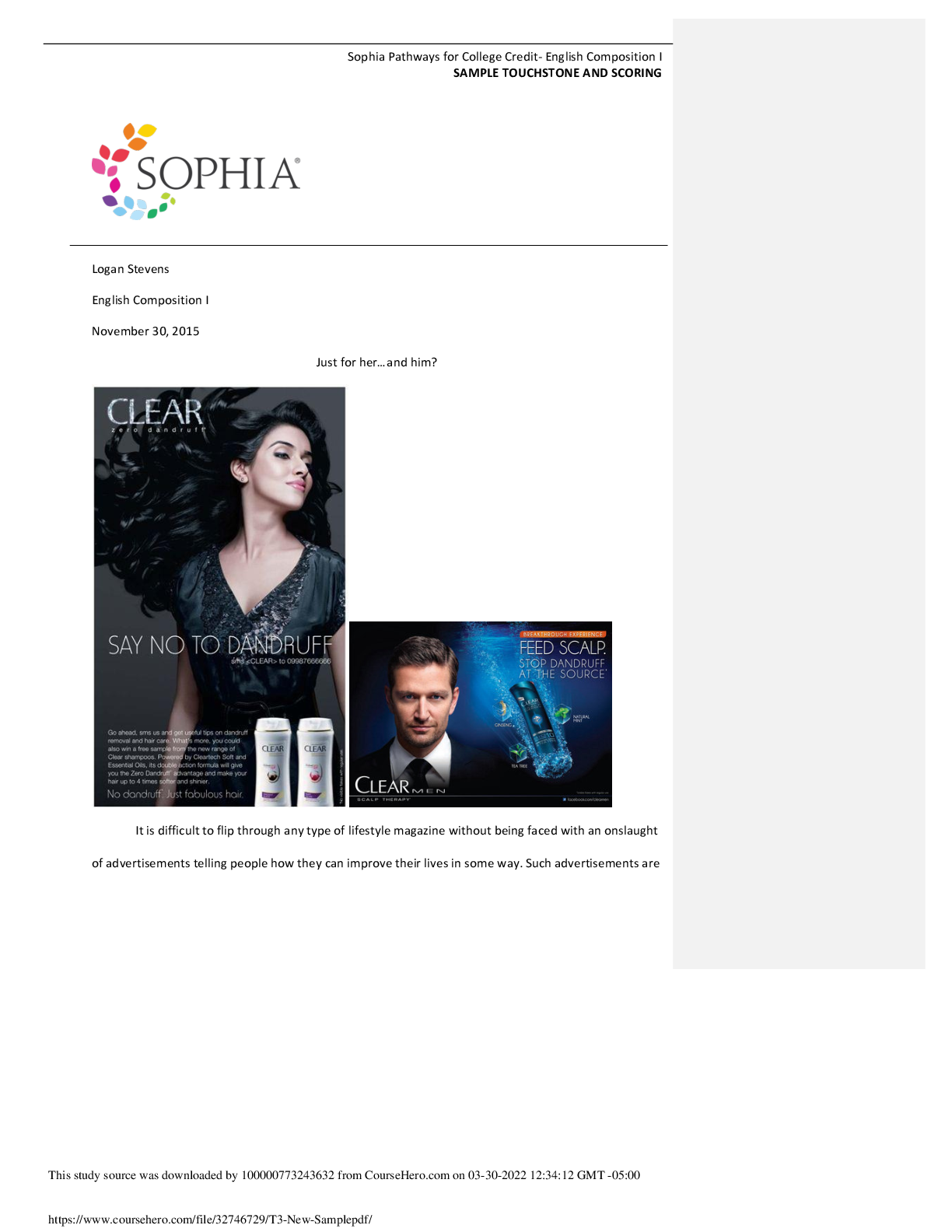
ways. The two images for Clear shampoo displayed above demonstrate how a single product can be
marketed effecti
...
not limited to a single audience; men and women are equally likely to be targeted, often in very similar
ways. The two images for Clear shampoo displayed above demonstrate how a single product can be
marketed effectively toward two different audiences. These advertisements, although similar in
appearance, effectively exploit the differences between their two target audiences, men and women, by
playing on traditional gender stereotypes in both image and text.
Although the advertisements are aimed at different audiences, they use similar techniques in
order to demonstrate the effectiveness of the product. The first clearly targets a female audience, which
is evident from the central placement of a female figure and her glorious, shining mane of hair. Likewise,
the second advertisement shows a male model who also possesses a very fine head of hair. The dark
hair and clothing of both models invite the audience to look for visible signs of white, flaky dandruff. Of
course, there are none, which hints toward the success of this product. These images draw clear
parallels meant to evoke a response in the audience: these models have shiny, clean hair; they use Clear
shampoo; if I use Clear shampoo, I will also have shiny, clean, dandruff-free hair (and hopefully look like
these models). The audiences are visually informed that the use of Clear shampoo works for both men
and women in order to eliminate dandruff, and the ads are successful in marketing their product.
Although the main visual techniques are similar, there are other differences indicating which
product is aimed at men and which is aimed at women. As a whole, the first ad appears softer, more
subtly compelling; the second ad is sharper, more abrupt. This difference targets key stereotypes of men
and women: women are softer, emotionally and physically, while men are hard, sharp, and unyielding.
The color schemes for the two ads reflect this distinction. The first ad uses a muted color palette,
focusing on shades of black and cream, reinforcing a sense of softness and elegance. The second ad, in
contrast, introduces bold, contrasting shades of blue and orange which underscore the action in the
scene: the shampoo bottle breaks through the water, just as the accompanying text refers to this
Aleisha 11/30/2015 4:01 PM
Comment [1]: Good. This thesis statement is
much clearer and talks more about how the ads
target their audiences and why they are effective.
Aleisha 11/30/2015 4:04 PM
Comment [2]: Ah, I can see here that you have
restructured your essay. This version does a good
job of comparing and contrasting the two ads
thematically in each paragraph, rather than
following the “Describe Ad 1, Describe Ad 2,
Similarities, Differences” format. Very well done.
This study source was downloaded by 100000773243632 from CourseHero.com on 03-30-2022 12:34:12 GMT -05:00
https://www.coursehero.com/file/32746729/T3-New-Samplepdf/
Sophia Pathways for College Credit- English Composition I
SAMPLE TOUCHSTONE AND SCORING
shampoo as a “Breakthrough Experience.” The tone of the two advertisements is very different, yet both
ads create an atmosphere which targets a specific gender stereotype in order to highlight the audience
for each product.
The prominent text in each ad also reinforces these stereotypes. The text at the bottom of the
first image indicates that women just want to look pretty: “No dandruff. Just fabulous hair.” If y
[Show More]