Managing Patient Care
1. Nursing care delivery models; clinical application, Case Management; discharge planning, referrals
delivery models:
team nursing – work and help each other; starts w/ same level then going hig
...
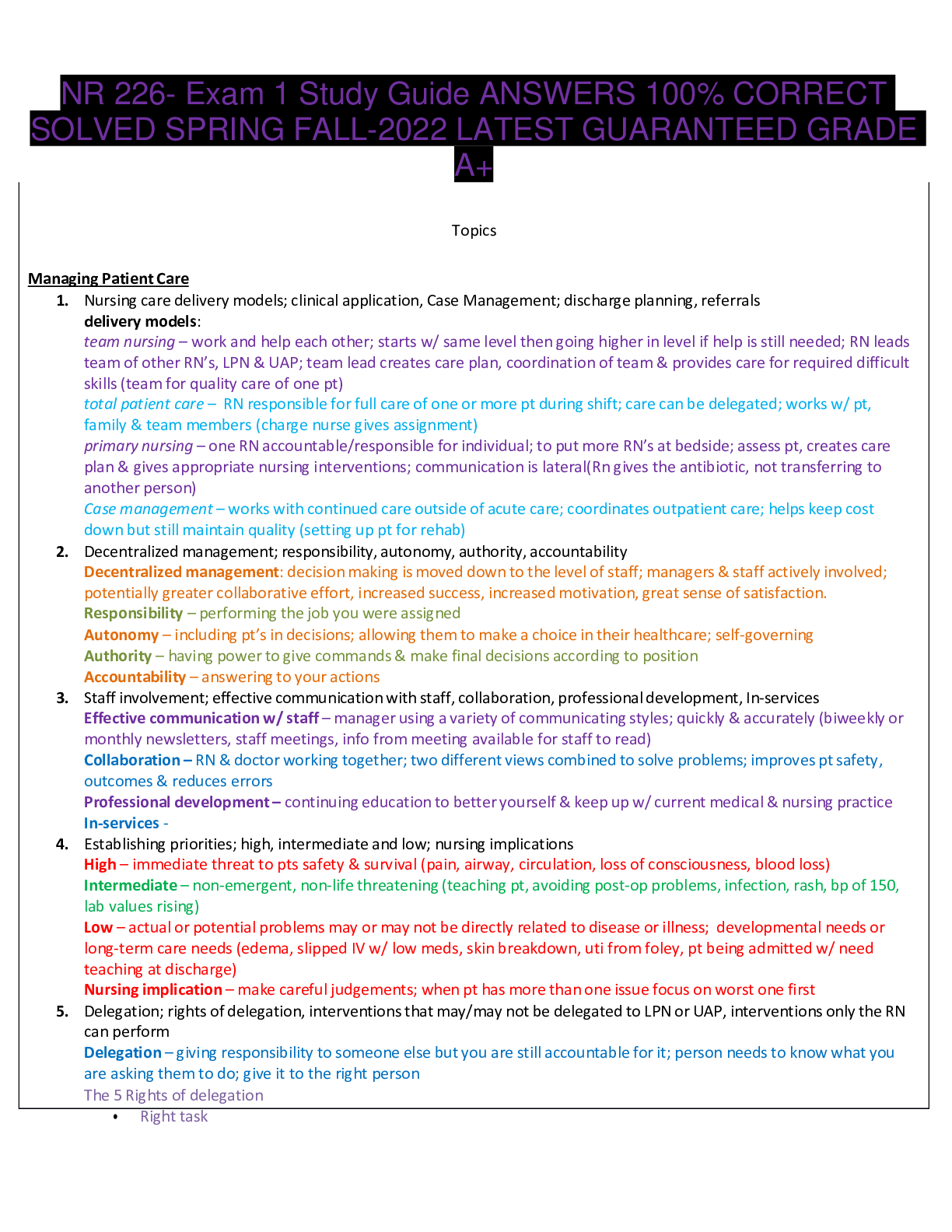
Managing Patient Care
1. Nursing care delivery models; clinical application, Case Management; discharge planning, referrals
delivery models:
team nursing – work and help each other; starts w/ same level then going higher in level if help is still needed; RN leads team of other RN’s, LPN & UAP; team lead creates care plan, coordination of team & provides care for required difficult skills (team for quality care of one pt)
total patient care – RN responsible for full care of one or more pt during shift; care can be delegated; works w/ pt, family & team members (charge nurse gives assignment)
primary nursing – one RN accountable/responsible for individual; to put more RN’s at bedside; assess pt, creates care plan & gives appropriate nursing interventions; communication is lateral(Rn gives the antibiotic, not transferring to another person)
Case management – works with continued care outside of acute care; coordinates outpatient care; helps keep cost down but still maintain quality (setting up pt for rehab)
2. Decentralized management; responsibility, autonomy, authority, accountability
Decentralized management: decision making is moved down to the level of staff; managers & staff actively involved; potentially greater collaborative effort, increased success, increased motivation, great sense of satisfaction.
Responsibility – performing the job you were assigned
Autonomy – including pt’s in decisions; allowing them to make a choice in their healthcare; self-governing
Authority – having power to give commands & make final decisions according to position
Accountability – answering to your actions
3. Staff involvement; effective communication with staff, collaboration, professional development, In-services
Effective communication w/ staff – manager using a variety of communicating styles; quickly & accurately (biweekly or monthly newsletters, staff meetings, info from meeting available for staff to read)
Collaboration – RN & doctor working together; two different views combined to solve problems; improves pt safety, outcomes & reduces errors
Professional development – continuing education to better yourself & keep up w/ current medical & nursing practice
In-services -
4. Establishing priorities; high, intermediate and low; nursing implications
High – immediate threat to pts safety & survival (pain, airway, circulation, loss of consciousness, blood loss) Intermediate – non-emergent, non-life threatening (teaching pt, avoiding post-op problems, infection, rash, bp of 150, lab values rising)
Low – actual or potential problems may or may not be directly related to disease or illness; developmental needs or long-term care needs (edema, slipped IV w/ low meds, skin breakdown, uti from foley, pt being admitted w/ need teaching at discharge)
Nursing implication – make careful judgements; when pt has more than one issue focus on worst one first
5. Delegation; rights of delegation, interventions that may/may not be delegated to LPN or UAP, interventions only the RN can perform
Delegation – giving responsibility to someone else but you are still accountable for it; person needs to know what you are asking them to do; give it to the right person
The 5 Rights of delegation
• Right task
• Right circumstance
• Right person
• Right direction
• Right supervision
Delegations that LPN or UAP can & cannot do -
Only RN can – perform any interventions that fall under ADPIE
Ethics and Values
1. Ethics: autonomy, beneficence, nonmaleficence, justice, fidelity; clinical application
Ethics – study of conduct & character; determining what acting “good” for everyone is; reflects who you are. Autonomy – self-governing; including pt’s in decisions; allowing them to make a choice in their healthcare (having pt clean themselves if they are willing to try)
Beneficence – doing good for your pt; doing what is best for them not you (giving pt a pain med before cleaning wound)
Nonmaleficence – avoiding harm to pt; (unintentional harm – breaking ribs while doing CPR)
Justice – being fair (having two family of different cultures and giving them same type of care)
Fidelity – keeping promises; not abandoning pt when it care becomes to difficult (saying your going to give a letter to family after surgery in case they die & going through with your word)
2. Code of ethics; responsibility, accountability, confidentiality (HIPAA)
Code of ethics – govern by ANA; foundation & guideline of nursing; a collective statement about the group’s expectations & standard behavior
Responsibility – the will to respect an obligation & following through on the promise.
Accountability – answering for your own actions; being able to explain to pt & employer your actions
Confidentiality (HIPPA) – must maintain at all times; protects personal health info; fined for violation
3. Ethical dilemma; steps for solving an ethical dilemma; nursing implications
Ethical dilemma – usually occur when there are conflicting values; cause distress & controversy; processing issues requires negotiation of differences of opinion & should promote free expression of feeling and opinions
Steps to solve –
1. Ask if this is an ethical dilemma
2. Gather all relevant info
3. Clarify values
4. Verbalize the problem
5. Identify possible course of action
6. Negotiate a plan
7. Evaluate the plan
Respect your values and respect the values of others if they are different; you don’t have to agree but you have respect.
4. Ethical issues and the older adult; nurse role/responsibilities
They don’t know about autonomy (become uncomfortable disagreeing w/ doc, view assertiveness as violation of trust); communication problems(decreased hearing & vision, memory problems, & chronic illnesses [stroke or disease], multiple meds); consensus about medical goals is harder to achieve.
Teach pt about being a part of medical plan and that it is ok to disagree if they are uncomfortable; always assess pt for understanding of treatment and assist when needed;
5. Ethical issues and minors
Privacy has to be maintained for the minor if the minor request for the parent to not know about sexual activity; parent
has control over decisions on the minor unless minor is legally married, a parent, pregnant, has VD, or has drug problem.
[Show More]