San Jose State University BUS1 129. 129a - Chapter 15. 91 HERE IS A LIST OF THE QUESTIONS 1. A sample in which the characteristics of the sample are the same as those of
the population is a(n):
A) variables sample.
...
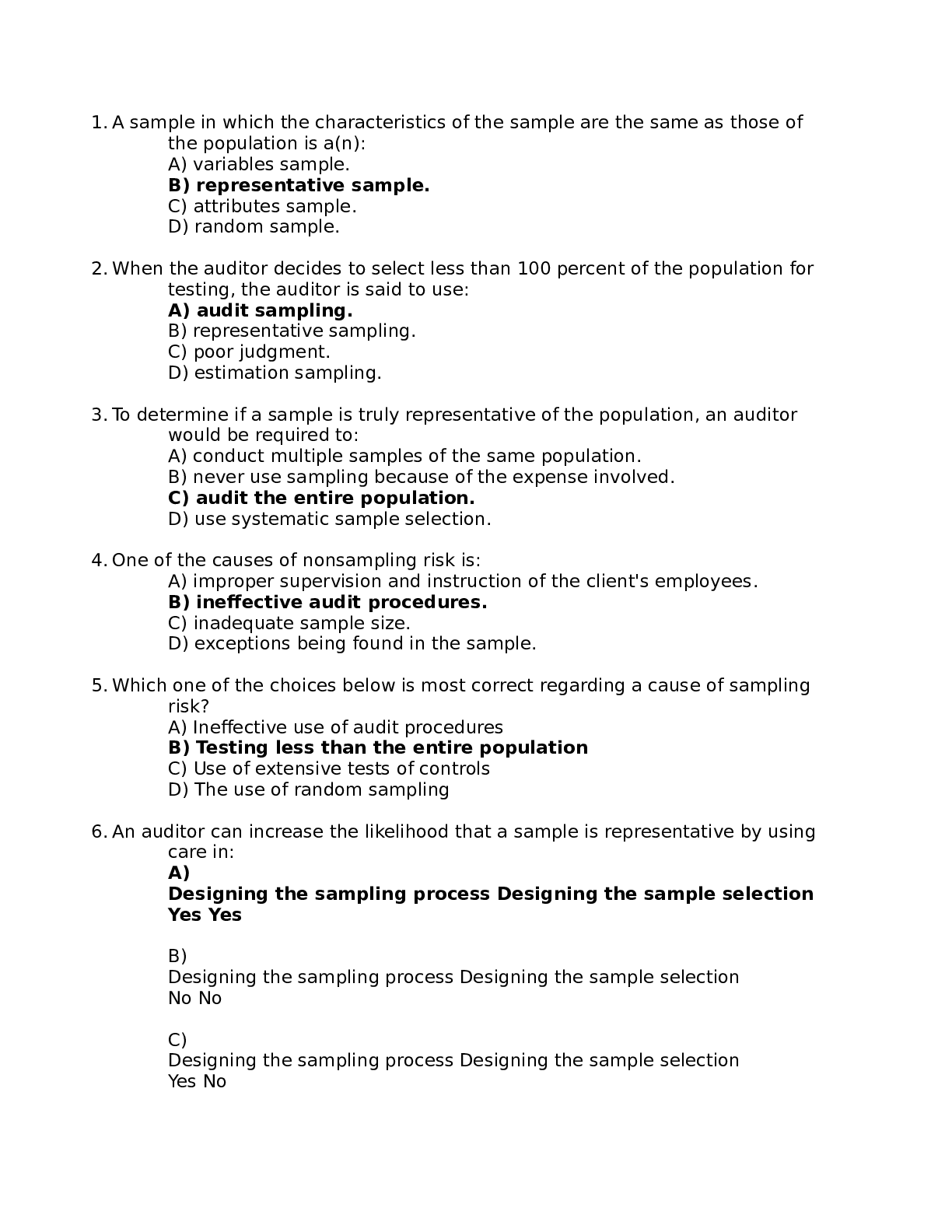
San Jose State University BUS1 129. 129a - Chapter 15. 91 HERE IS A LIST OF THE QUESTIONS 1. A sample in which the characteristics of the sample are the same as those of
the population is a(n):
A) variables sample.
B) representative sample.
C) attributes sample.
D) random sample.
2. When the auditor decides to select less than 100 percent of the population for
testing, the auditor is said to use:
A) audit sampling.
B) representative sampling.
C) poor judgment.
D) estimation sampling.
3. To determine if a sample is truly representative of the population, an auditor
would be required to:
A) conduct multiple samples of the same population.
B) never use sampling because of the expense involved.
C) audit the entire population.
D) use systematic sample selection.
4. One of the causes of nonsampling risk is:
A) improper supervision and instruction of the client's employees.
B) ineffective audit procedures.
C) inadequate sample size.
D) exceptions being found in the sample.
5. Which one of the choices below is most correct regarding a cause of sampling
risk?
A) Ineffective use of audit procedures
B) Testing less than the entire population
C) Use of extensive tests of controls
D) The use of random sampling
6. An auditor can increase the likelihood that a sample is representative by using
care in:
A)
Designing the sampling process Designing the sample selection
Yes Yes
B)
Designing the sampling process Designing the sample selection
No No
C)
Designing the sampling process Designing the sample selection
Yes NoD)
Designing the sampling process Designing the sample selection
No Yes
7. Which of the following is the risk that audit tests will not uncover existing
exceptions in a sample?
A) Sampling risk
B) Nonsampling risk
C) Audit risk
D) Detection risk
8. Which of the following is the risk that an auditor will reach an incorrect
conclusion because a sample is not representative of the population?
A) Sampling risk
B) Nonsampling risk
C) Audit risk
D) Detection risk
9. Sampling risk may be controlled by:
A)
Adjusting the sample size Using an appropriate method of
selecting sample items
Yes Yes
B)
Adjusting the sample size Using an appropriate method of selecting
sample items
No No
C)
Adjusting the sample size Using an appropriate method of selecting
sample items
Yes No
D)
Adjusting the sample size Using an appropriate method of selecting
sample items
No Yes
10. Which of the following statements is most correct?
A) A sample of all items of a population will eliminate sampling risk, but
increase nonsampling risk.
B) The use of an appropriate sample selection technique ensures a
representative sample.
C) The auditor's failure to recognize an exception is a significant cause of
sampling risk.
D) The use of inappropriate audit procedures is a significant
cause of nonsampling risk.11. There are three phases in both statistical and nonstatistical sampling. The
first phase is to:
A) generate random numbers for the sample.
B) evaluate the results.
C) plan the sample.
D) select the sample.
12. When auditors wish to evaluate a sample statistically, an acceptable
selection method is:
A) systematic sample selection.
B) judgmental selection.
C) haphazard selection.
D) block sample selection.
13. Which of the following statements is most correct with concerning the
quantification of sampling risk?
A) Sampling risk cannot be quantified.
B) Sampling risk can be quantified only when nonprobabilistic selection
techniques are used to select the sample.
C) Sampling risk can be quantified only when probabilistic
selection techniques are used to select the sample.
D) None of the above.
14. Which of the following statements is most correct with respect to the
evaluation of nonprobabilistic sample results?
A) It is acceptable to make nonprobabilistic evaluations only when
probabilistic sample selection is used.
B) It is acceptable to make nonprobabilistic evaluations only if the auditor
cannot quantify sampling risk.
C) It is never acceptable to evaluate a nonprobabilistic sample
using statistical methods.
D) All of the above are correct.
15. Which of the following statements is a valid criticism of nonstatistical
sampling?
A) Many audit tests, such as footing of journals, must be performed
outside a statistical sampling context.
B) The cost of performing random selection or testing often exceeds the
benefits.
C) Nonstatistical sampling does not differ substantially from statistical
sampling methods.
D) Conclusions may be drawn in more precise ways when using
statistical sampling methods.
16. Which of the following statements is not correct regarding probabilistic
and nonprobabilistic sample selection?
A) In probabilistic selection, every population item has a known chance ofbeing selected.
B) It is acceptable to evaluate a nonprobabilistic sample using
statistical methods.
C) Probabilistic selection is required for all statistical sampling methods.
D) Both methods are acceptable and commonly used.
17. Nonprobabilistic selection methods are not based on mathematical
probabilities; therefore:
A) the extent to which a sample is representative of the
population may be difficult to determine.
B) they are discouraged by the AICPA.
C) they are not allowed by the Statements on Auditing Standards.
D) they are not as effective as statistical sampling.
18. An advantage of using statistical sampling techniques is that such
techniques:
A) mathematically measure risk.
B) eliminate the need for judgmental decisions.
C) define the values of precision and reliability required to provide audit
satisfaction.
D) have been established in the courts to be superior to judgmental
sampling.
19. Auditors who prefer statistical to nonstatistical sampling believe that the
principal advantage of statistical sampling flows from its ability to:
A) quantify sampling risk.
B) promote a more legally defensible procedural approach.
C) define the precision required to provide audit satisfaction.
D) establish conclusive audit evidence with decreased audit effort.
20. Which of the following statements best expresses the impact that the
performance of audit procedures has on statistical vs. nonstatistical
sampling?
A) Audit procedures on the sample item will vary as a result of using
either statistical or nonstatistical sampling.
B) The audit procedures will be the same for either statistical or
nonstatistical sampling but they must be performed differently for each.
C) Statistical sampling requires quantitative audit procedures, whereas
nonstatistical sampling requires judgmental audit procedures.
D) Audit procedures on the sample item will not vary as a
result of using either statistical or nonstatistical sampling.
21. A sample in which every possible combination of items in the population
has an equal chance of constituting the sample is a:
A) random sample.
B) statistical sample.
C) judgment sample.
D) representative sample.22. The process which requires the calculation of an interval and then selects
the items based on the size of the interval is:
A) statistical sampling.
B) random sample selection.
C) systematic sample selection.
D) computerized sample selection.
23. In systematic sample selection, the population size is divided by the
number of sample items desired in order to determine the:
A) sampling interval.
B) tolerable exception rate.
C) computed upper exceptions rate.
D) mean.
24. Which of the following methods of sample selection is appropriately used
when selecting a random sample?
A)
Auditor's judgmental
selection of items Use of random number generators Generalized audit
software
Yes No Yes
B)
Auditor's judgmental
selection of items Use of random number generators Generalized audit
software
No Yes Yes
C)
Auditor's judgmental
selection of items Use of random number generators Generalized audit
software
Yes No No
D)
Auditor's judgmental
selection of items Use of random number generators Generalized audit
software
No Yes No
25. Simple random sampling:
A) is used when there is a need to emphasize one or more types of
population items.
B) requires both input and output parameters to be set when using a
random number generator.
C) is generally used with replacement sampling.
D) is a probabilistic sampling method.26. When a population is divided into subpopulations, usually by dollar size,
and larger samples are taken from the subpopulation with the larger
sizes, ________ is being used.
A) sampling with probability proportional to size
B) stratified sampling
C) block sampling
D) haphazard sampling
27. The advantage of systematic sample selection is that:
A) it is easy to use.
B) there is limited possibility of it being biased.
C) it is unnecessary to determine if the population is arranged randomly.
D) it automatically selects items material to the financial statements.
28. In performing a review of a client's cash disbursements, an auditor uses
systematic sample selection with a random start. The primary
disadvantage of this technique is population items:
A) may occur twice in the sample.
B) must be reordered in a systematic pattern before the sample can be
drawn.
C) may occur in a systematic pattern, thus negating the
randomness of the sample.
D) must be replaced in the population after sampling to permit valid
statistical inference.
29. Which of the following is a correct statement regarding block sampling?
A) It is acceptable to use block sampling only if a reasonable
number of blocks are used.
B) Block sampling uses sampling with replacement.
C) Block sampling is a probabilistic sampling method.
D) There is considerable cost and time involved when block sampling is
used.
30. The most serious shortcoming of the haphazard sample selection method
is:
A) it is not subject to statistical sampling methods.
B) it is time consuming to use.
C) it is costly to use.
D) it is difficult to remain completely unbiased in the selection.
31. Which of the following statements regarding block sampling is least likely
to be true?
A) Block sampling is the selection of several items in sequence.
B) It is acceptable to use block sampling for tests of transactions only if a
reasonable number of blocks is used.
C) Only one block should be selected to increase the probability
of a representative sample.D) Once the first item in the block is selected, the remainder of the block
is chosen automatically.
32. When the auditor goes through a population and selects items using
nonprobabilistic selection methods, without regard to their size, source,
or other distinguishing characteristics, it is called:
A) block sample selection.
B) haphazard selection.
C) systematic sample selection.
D) statistical selection.
33. Which of the following occurrences would be least likely to warrant
further audit attention for the auditor?
A) Deviations from client's established control procedures
B) Deviations from client's budgeted values
C) Monetary misstatements in populations of transaction data
D) Monetary misstatements in populations of account balance details
34. Which of the following statements is correct when dealing with sampling
for exception rates?
A) The term exception refers to both deviations from the client's
control procedures and amounts that are not monetarily correct.
B) When used with sampling, the term deviation is synonymous with the
term exception.
C) The actual population exception rate is the same as the sample
exception rate.
D) In using audit sampling for exception rates, the auditor is most
concerned with the confidence interval.
35. In using audit sampling for exception rates:
A) the auditor wants to know the most the exception rate is
likely to be.
B) sampling error is the likelihood that the auditor will miss a monetary
misstatement.
C) the upper limit of the interval estimate is known as the sampling risk.
D) CUER cannot be considered in the context of specific audit objectives.
36. Which of the following is most correct when using audit sampling for
exception rates?
A) Auditor is concerned with the lowest rate.
B) Auditor is concerned with the highest rate.
C) Auditor is concerned with the average on previous audits.
D) This doesn't impact the auditor's decision.
37. The highest estimated exception rate in the population at a particular
acceptable risk of assessing control risk too low is:
A) the upper exception rate.
B) estimated population exception rate.C) the computed upper exception rate.
D) the tolerable exception rate.
38. You are determining the significance of the following: you set a 5% risk of
assessing control risk to low and your computation of the upper deviation
risk is 7%. What could you conclude?
A) There is a 95% chance the deviation rate is the population is less than
5%.
B) There is a 5% chance the deviation rate in the population is less than
7%.
C) There is a 95% chance the deviation rate in the population exceeds
95%.
D) There is a 5% chance the deviation rate in the population
exceeds 7%.
39. The risk which the auditor is willing to take in accepting a control as
being effective when the true population exception rate is greater than a
tolerable rate is the:
A) finite correction factor.
B) tolerable exception rate.
C) acceptable risk of overreliance.
D) estimated population exception rate.
40. The exception rate the auditor will permit in the population and still be
willing to reduce the assessed level of control risk is called the:
A) tolerable exception rate.
B) estimated population exception rate.
C) acceptable risk of overreliance.
D) sample exception rate.
41. If the auditor decides to assess control risk at the moderate level in a
private company audit, when in previous years the auditor set control risk
at the maximum level, then tests of controls for the current year would
be:
A) increased in number.
B) reduced in number.
C) not performed.
D) unchanged from prior planned settings.
42. When the computed upper exception rate is greater than the tolerable
exception rate, it is necessary for the auditor to take specific action.
Which of the following courses of action would be most difficult to justify?
A) Reduce the tolerable exception rate so as to accept the
sample results.
B) Expand the sample size and perform more tests.
C) Revise the assessed control risk.
D) Write a letter to management which outlines the control deficiencies.43. Which of the following would have the least impact in determining
sample size?
A) Acceptable risk of overreliance
B) Risk of assessing control risk too low
C) Tolerable exception rate
D) Population size
44. Which of the following represents the best description of the tolerable
exception?
A) The highest exception rate the auditor will permit in the
control being tested and still conclude it is operating effectively
B) The highest exception rate the auditor expects to find in the
population
C) The number of exceptions found in the sample divided by the sample
size
D) The highest estimated exception rate in a population at a given EPER
45. When analyzing exceptions, the auditor should keep in mind that:
A) all exceptions must be reported to management.
B) they should determine the breakdown in the internal controls
that allowed the exceptions to occur.
C) the nature of an exception and its causes have no effect on the
qualitative evaluation of the system.
D) exceptions do not need to be analyzed if it is too costly.
46. The exception rate that the auditor will permit in the population and still
be willing to use the preliminary control risk assessment is called the:
A) acceptable exception rate.
B) estimated population exception rate.
C) sample exception rate.
D) tolerable exception rate.
47. Auditors often use the ________ to determine the estimated population
exception rate.
A) current year's audit results
B) tolerable exception rate
C) preceeding year's audit results
D) estimated computed by management
48. Place the following steps in their proper order:
1. Analyze exceptions
2. Select the sample
3. Define attributes and exception conditions
4. State the objectives of the audit test
5. Specify the tolerable exception rate
A) 1, 3, 2, 4, 5.
B) 4, 3, 1, 2, 5.C) 4, 3, 5, 2, 1.
D) 1, 2, 3, 4, 5.
49. If an auditor judgmentally selects a sample of one hundred items from a
population and finds two exceptions, the auditor:
A) can conclude that the sample exception rate is 2%.
B) can conclude that the population exception rate is 2%.
C) can calculate the highest exception rate expected in the population.
D) cannot make any conclusions about either the sample or the
population.
50. In testing controls, an overreliance on internal controls that reduces
substantive tests and increases the likelihood of not detecting a material
misstatement occurs because:
A) true deviation in the population was less than the sample.
B) true deviation in the population was greater than the sample.
C) auditor judgment was flawed.
D) it is inherent in the audit risk model.
51. Which of the following is the exception rate that the auditor expects to
find before testing?
A) Sample exception rate
B) Estimated population exception rate
C) Computed exception rate
D) Tolerable exception rate
52. Which of the following is not a term related to evaluating results in audit
sampling until after a sample is tested and evaluated?
A) Sample exception rate
B) Estimated population exception rate
C) Computed upper exception rate
D) Exception
53. The relationship of tolerable exception rate (TER) to sample size is:
A) direct (larger TER = larger sample).
B) inverse (larger TER = smaller sample).
C) variable (sometimes larger, sometimes smaller).
D) not determinable.
54. Which of the following must be set prior to testing a sample?
A) Sample exception rate
B) Achieved upper precision limit
C) Computed exception rate
D) Tolerable exception rate
55. The acceptable risk of overreliance:
A) is the risk that the auditor will erroneously conclude that the controls
are less effective than they actually are.B) is less of a concern to the auditors than the risk of underreliance.
C) represents the auditor's measure of sampling risk.
D) is determined by a statistical formula, and not by professional
judgment.
56. The sample exception rate equals:
A) the number of exceptions in the population divided by the sample size.
B) the number of items in the population multiplied by the number of
exceptions in the sample.
C) the number of exceptions in the sample divided by the sample
size.
D) the number of exceptions in the population divided by the population
size.
57. When defining the population:
A) it may be necessary to define separate populations for different audit
procedures.
B) the auditor may generalize only about the population that has been
sampled.
C) auditors can define the population to include any items they want.
D) all of the above.
58. One way to evaluate sampling risk when nonstatistical sampling is used
is to:
A) subtract the sample exception rate from the tolerable
exception rate.
B) add the sample exception rate and the tolerable exception rate.
C) subtract the sample exception rate from the acceptable risk of
overreliance.
D) add the sample exception rate and the acceptable risk of overreliance.
59. A danger in setting the acceptable risk of overreliance too low is:
A)
The risk that the auditor is willing to take of accepting a control as
ineffective when it is effective The risk that the auditor is willing to take
of accepting a control as effective when it is ineffective
Yes Yes
B)
The risk that the auditor is willing to take of accepting a control as
ineffective when it is effective The risk that the auditor is willing to take
of accepting a control as effective when it is ineffective
No No
C)
The risk that the auditor is willing to take of accepting a control as
ineffective when it is effective The risk that the auditor is willing to take
of accepting a control as effective when it is ineffectiveYes No
D)
The risk that the auditor is willing to take of accepting a control
as
ineffective when it is effective The risk that the auditor is willing
to take of accepting a control as effective when it is ineffective
No Yes
60. When using statistical sampling, the auditor would most likely require a
smaller sample if the:
A) population increases.
B) desired reliability decreases.
C) desired precision interval narrows.
D) expected exception rate increases.
61. Whenever auditors use sampling, they risk making incorrect conclusions
about the population. The risk that the auditor concludes that controls
are nore effective than they actually are is known as the:
A) risk of overreliance.
B) risk of underreliance.
C) risk that the sample is not representative of the population.
D) risk that the sample conclusions cannot be useful because of
nonprobability sampling.
62. When choosing the appropriate acceptable risk of overreliance, the
auditor needs to:
A) rely on his/her professional judgment.
B) err on the side of conservatism.
C) consult the professional standards.
D) follow SEC guidelines.
63. The difference between the tolerable exception rate and the estimated
population exception rate is called:
A) accuracy of the initial sample estimate.
B) inflation factor of the initial sample estimate.
C) precision of the initial sample estimate.
D) reliability of the initial sample estimate.
64. If the result obtained from a particular sample for control and substantive
tests of transactions is critical to the formation of an audit opinion, which
of the following is the most important to the auditor in concluding of the
appropriateness and sufficiency of evidence gathered?
A) Acceptable risk of overreliance
B) Estimated population exception rate
C) Tolerable exception rate
D) Size of the population65. There is a(n) ________ relationship between acceptable risk of
overreliance and planned sample size.
A) direct.
B) inverse.
C) proportional.
D) exponential.
66. Which of the following results in a larger sample size?
A) Decrease the estimated population exception rate and decrease the
tolerable exception rate.
B) Increase the estimated population exception rate and
decrease the tolerable exception rate.
C) Decrease the estimated population exception rate and increase the
tolerable exception rate.
D) Increase the estimated population exception rate and increase the
tolerable exception rate
67. An auditor plans to examine a sample of 40 canceled checks for a
countersignature which is prescribed in the client's control procedures
manual. Two of the checks in sample cannot be located by the company
or the auditor. The auditor would most likely:
A) treat the missing checks as a deviation when evaluating the
results of the sample.
B) draw a conclusion on a sample size of 38.
C) substitute two more checks to get to a sample size of 40.
D) recalculate the sample excluding the original 40 checks.
68. Rodgers CPA believes that the rate of client billing errors is 4% and has
established a tolerable deviation rate of 6%. In auditing client invoices
Rodgers should use:
A) stratified sampling.
B) classical sampling.
C) proportional sampling.
D) attributes sampling.
69. Attributes sampling would be an appropriate method to use on which one
of the following procedures in an audit program?
A) Review sales transactions for large and unreasonable amounts.
B) Observe whether the duties of the accounts receivable clerk are
separate from handling cash.
C) Examine a sample of duplicate sales invoices for credit
approval by the credit manager.
D) Review the aged schedule of accounts receivable to determine if
receivables from officers are
70. Attributes sampling is based on the ________ distribution, in which each
possible sample in the population has one of two possible values, such as
yes or no.A) random
B) binomial
C) statistical
D) nonstatistical
71. For which of the following audit procedures would audit sampling not be
appropriate?
A) Review sales transactions for large and unusual amounts.
B) Examine a sample of duplicate sales invoices for credit approval.
C) Compare the quantity on duplicate sales invoices with the quantity on
related shipping documents.
D) Audit sampling is appropriate for each of the above procedures.
72. A principal advantage of statistical methods of attributes sampling over
nonstatistical methods is that they provide a scientific basis for
establishing the:
A) risk of assessing control risk too low.
B) tolerable exception rate.
C) expected population exception rate.
D) sample size.
73. In using sampling distribution for attributes, which one of the following
must be known to evaluate the sample results?
A) Estimated dollar value of the population
B) Standard exception of the values in the population
C) Actual exception rate of the attribute in the population
D) Sample size
74. When audit procedures have been completed for an attributes sampling
application, the auditor must generalize from the sample to the
population. Which of the following statements would be incorrect
regarding this process?
A) The auditor would use an attributes sampling table to determine the
computed upper exception rate.
B) If the sample size is not equal to those provided for in the
attributes sampling evaluation tables, the auditor cannot use
attribute sampling.
C) It would be wrong for the auditor to conclude that the population
exception rate is exactly the same as the sample exception rate.
D) In selecting the table corresponding to the ARO, it should be the same
as the ARO used for determining the initial sample size.
75. When deciding the acceptability of the population:
A) the methodology for deciding the acceptability of the population for
attributes differs from determining the acceptability for nonstatistical
sampling.
B) before the population can be considered acceptable, the CUER
determined on the basis of the actual sample results must beless than or equal to TER when both are based on the same ARO.
C) when the CUER is greater than the TER, the auditor must increase the
sample size.
D) the CUER is compared with the TER in total, not for each attribute.
76. In the evaluation of the results of an attributes sample, the fact that the
exception rate in the sample was 2% rather than the estimated
population exception rate of 4% would cause the computed upper
exception rate to:
A) be less than the tolerable exception rate.
B) equal the tolerable exception rate.
C) exceed the tolerable exception rate.
D) cannot be determined from the information given.
77. As the auditor you are assessing the proper sample size to use in testing
controls. When using attributes sampling which of the following is most
correct?
A) A 10% change in population size will have the least effect on
sample size.
B) A 10% change in the tolerable deviation rate will have the least effect
on sample size.
C) A 10% change in the expected deviation rate will have the least effect
on sample size.
D) A 10% change in the tolerable will have the least effect on sample
size.
78. In attributes sampling, an estimate of the expected population exception
rate is necessary to plan the sample size. The relationship of expected
population exception rate (EPER) to sample size is:
A) direct (small EPER = small sample).
B) inverse (small EPER = large sample).
C) a variable (sometimes small, sometimes large) dependent on other
factors present.
D) indeterminate.
79. Sampling risk results from the auditor's failure to recognize exceptions in
transaction data.
A) True
B) False
80. If an auditor does a test in the wrong direction, sampling risk will
increase.
A) True
B) False
81. If a particular internal control is not followed by the client exactly 6% of
the time, and the auditor's tests of that control find three control
violations in a sample of 50, the sample is considered to berepresentative.
A) True
B) False
82. In practice, auditors do not know whether a sample is representative,
even after all testing is complete.
A) True
B) False
83. One way to control sampling risk is to increase sample size.
A) True
B) False
84. A sample of all items in a population will have a zero sampling risk.
A) True
B) False
85. It is virtually impossible to reduce sampling risk to zero.
A) True
B) False
86. It is equally acceptable under professional auditing standards for auditors
to use either statistical or nonstatistical sampling methods.
A) True
B) False
87. When using nonstatistical sampling, the sample must be a probabilistic
one.
A) True
B) False
88. The use of haphazard sample selection is encouraged under professional
auditing standards.
A) True
B) False
89. Directed sample selection, block sample selection, and haphazard sample
selection are three types of probabilistic sample selection methods.
A) True
B) False
90. lthough systematic sample selection is easy to use, its primary
disadvantage is that it is not a probabilistic sampling method.
A) True
B) False
91. Nonprobabilistic sampling methods are not based on mathematical
probabilities and therefore the representativeness of the sample may bedifficult to determine.
A) True
B) False
[Show More]





.png)
.png)