1-The nurse is assessing the motor and sensory function of an unconscious client. The nurse should use
which technique to test the client's peripheral response to pain?
1. Sternal rub
2. Nail bed pressure
3. Pressure
...
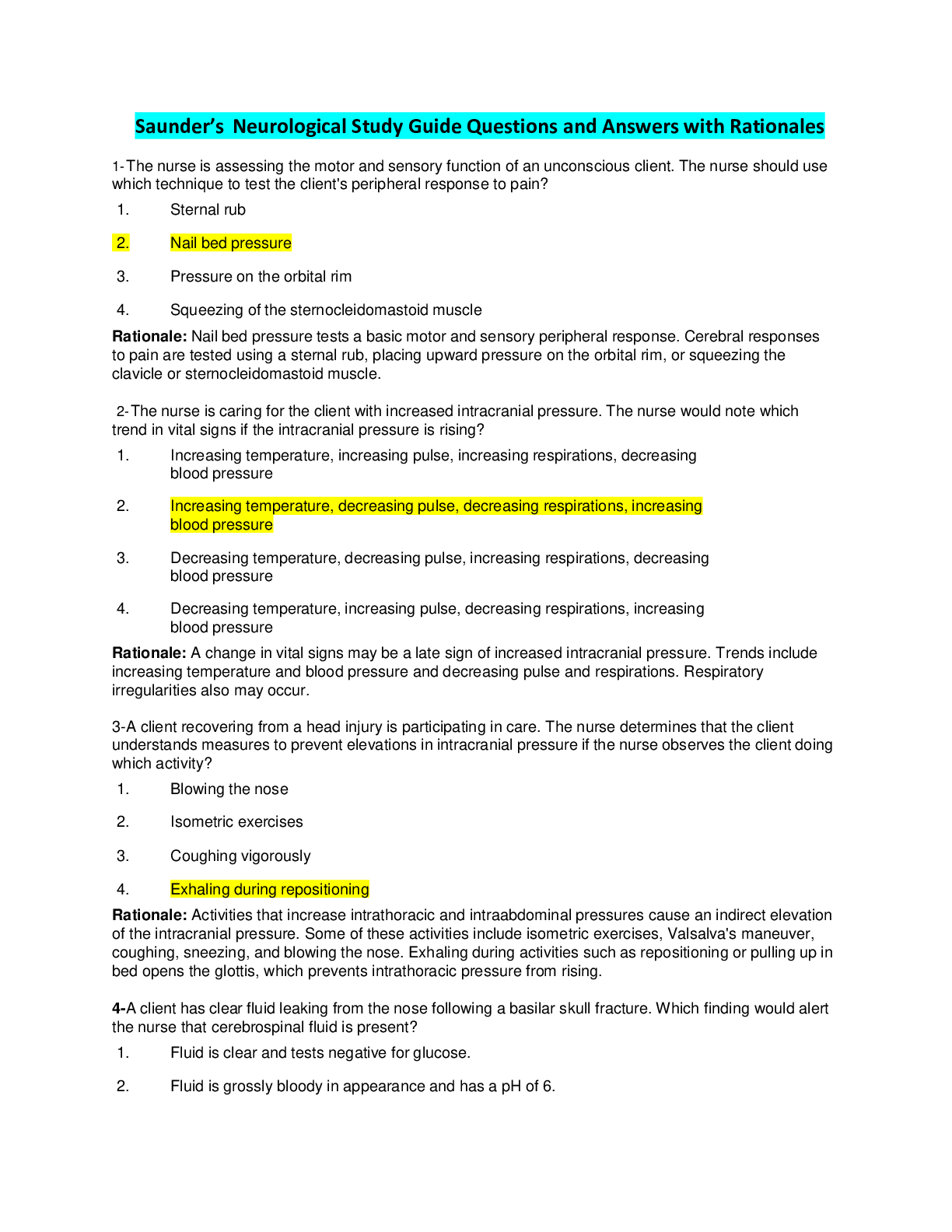
1-The nurse is assessing the motor and sensory function of an unconscious client. The nurse should use
which technique to test the client's peripheral response to pain?
1. Sternal rub
2. Nail bed pressure
3. Pressure on the orbital rim
4. Squeezing of the sternocleidomastoid muscle
Rationale: Nail bed pressure tests a basic motor and sensory peripheral response. Cerebral responses
to pain are tested using a sternal rub, placing upward pressure on the orbital rim, or squeezing the
clavicle or sternocleidomastoid muscle.
2-The nurse is caring for the client with increased intracranial pressure. The nurse would note which
trend in vital signs if the intracranial pressure is rising?
1. Increasing temperature, increasing pulse, increasing respirations, decreasing
blood pressure
2. Increasing temperature, decreasing pulse, decreasing respirations, increasing
blood pressure
3. Decreasing temperature, decreasing pulse, increasing respirations, decreasing
blood pressure
4. Decreasing temperature, increasing pulse, decreasing respirations, increasing
blood pressure
Rationale: A change in vital signs may be a late sign of increased intracranial pressure. Trends include
increasing temperature and blood pressure and decreasing pulse and respirations. Respiratory
irregularities also may occur.
3-A client recovering from a head injury is participating in care. The nurse determines that the client
understands measures to prevent elevations in intracranial pressure if the nurse observes the client doing
which activity?
1. Blowing the nose
2. Isometric exercises
3. Coughing vigorously
4. Exhaling during repositioning
Rationale: Activities that increase intrathoracic and intraabdominal pressures cause an indirect elevation
of the intracranial pressure. Some of these activities include isometric exercises, Valsalva's maneuver,
coughing, sneezing, and blowing the nose. Exhaling during activities such as repositioning or pulling up in
bed opens the glottis, which prevents intrathoracic pressure from rising.
4-A client has clear fluid leaking from the nose following a basilar skull fracture. Which finding would alert
the nurse that cerebrospinal fluid is present?
1. Fluid is clear and tests negative for glucose.
2. Fluid is grossly bloody in appearance and has a pH of 6.
[Show More]