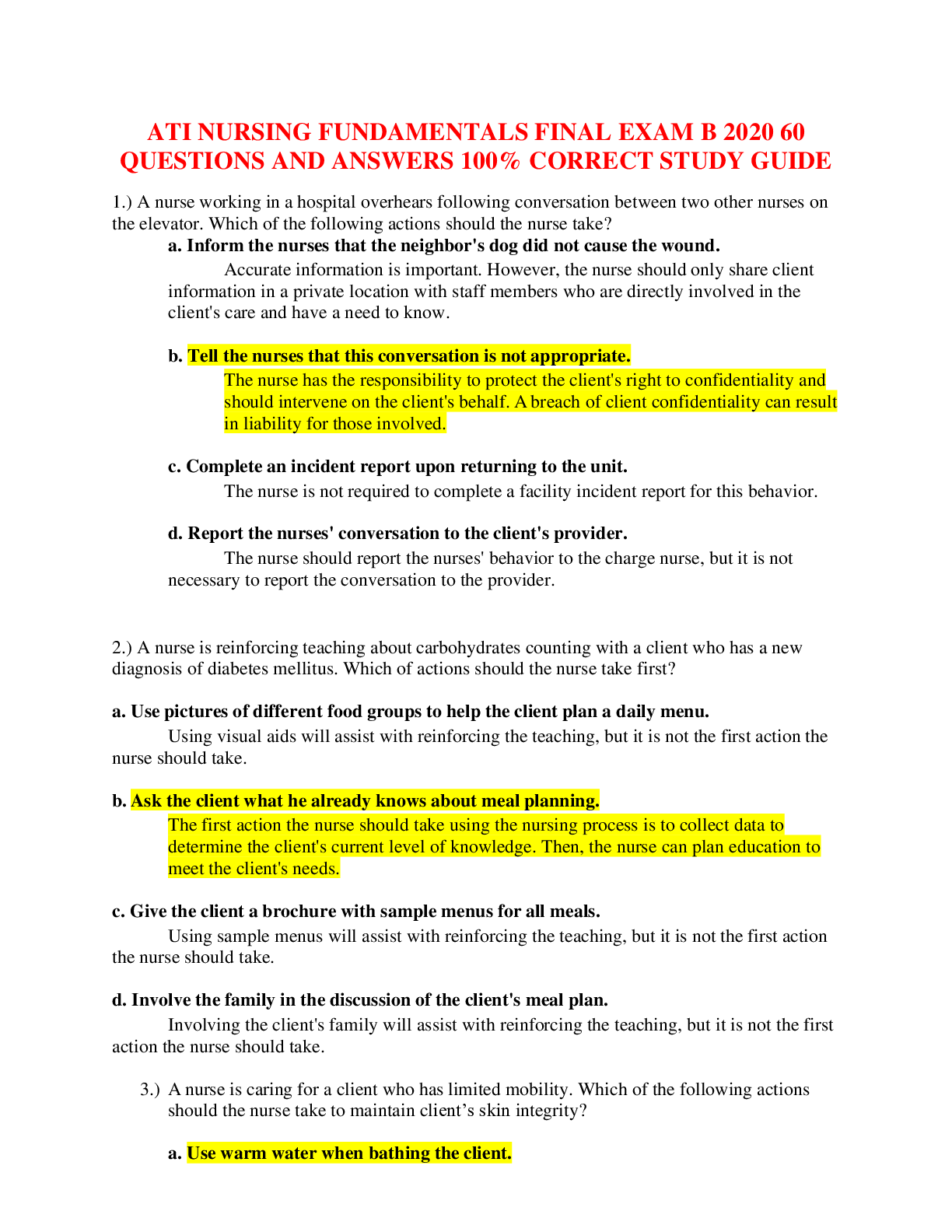
1.) A nurse working in a hospital overhears following conversation between two other nurses on
the elevator. Which of the following actions should the nurse take?
a. Inform the nurses that the neighbor's dog did not ca
...
1.) A nurse working in a hospital overhears following conversation between two other nurses on
the elevator. Which of the following actions should the nurse take?
a. Inform the nurses that the neighbor's dog did not cause the wound.
Accurate information is important. However, the nurse should only share client
information in a private location with staff members who are directly involved in the
client's care and have a need to know.
b. Tell the nurses that this conversation is not appropriate.
The nurse has the responsibility to protect the client's right to confidentiality and
should intervene on the client's behalf. A breach of client confidentiality can result
in liability for those involved.
c. Complete an incident report upon returning to the unit.
The nurse is not required to complete a facility incident report for this behavior.
d. Report the nurses' conversation to the client's provider.
The nurse should report the nurses' behavior to the charge nurse, but it is not
necessary to report the conversation to the provider.
2.) A nurse is reinforcing teaching about carbohydrates counting with a client who has a new
diagnosis of diabetes mellitus. Which of actions should the nurse take first?
a. Use pictures of different food groups to help the client plan a daily menu.
Using visual aids will assist with reinforcing the teaching, but it is not the first action the
nurse should take.
b. Ask the client what he already knows about meal planning.
The first action the nurse should take using the nursing process is to collect data to
determine the client's current level of knowledge. Then, the nurse can plan education to
meet the client's needs.
c. Give the client a brochure with sample menus for all meals.
Using sample menus will assist with reinforcing the teaching, but it is not the first action
the nurse should take.
d. Involve the family in the discussion of the client's meal plan.
Involving the client's family will assist with reinforcing the teaching, but it is not the first
action the nurse should take.
3.) A nurse is caring for a client who has limited mobility. Which of the following actions
should the nurse take to maintain client’s skin integrity?
a. Use warm water when bathing the client.
The nurse should use warm water to bathe the client because hot water can dry
and damage the skin.
b. Place a donut-shaped cushion in the client's chair.
The nurse should use a gel, foam, or air cushion to redistribute weight away from the
ischial areas. Rigid and donut-shaped cushions are contraindicated because they reduce blood
supply to the area.
c. Massage reddened areas over bony prominences.
The nurse should not massage bony prominences because it can lead to tissue trauma.
d. Maintain the client in high-Fowler's position.
The nurse should keep the head of the client's bed at 30° or less to prevent pressure ulcers
from forming.
4.) A nurse is contributing to the plan of care for four clients. For which of the following clients
should the nurse initiate airborne precautions?
a. A client who has pneumonia
The nurse should initiate droplet precautions for a client who has pneumonia.
b. A client who has measles
The nurse should initiate airborne precautions for a client who has measles.
c. A client who has pertussis
The nurse should initiate droplet precautions for a client who has pertussis.
d. A client who has methicillin-resistant Staphylococcus aureus (MRSA)
The nurse should initiate contact precautions for a client who has MRSA.
5.) A nurse is caring for a client who is postoperative following a mastectomy. The client
states “I can barely look at myself in the mirror”. The nurse should identify that the client
is experiencing which of the following?
a. Complicated grief
Complicated grief results when the usual stages of grieving do not take place.
b. Maturational loss
Maturational loss results from a developmental process, such as the growth of a
child into an adult.
c. Disenfranchised grief
Disenfranchised grief results when clients have a loss they are unable to share
publicly and that society might view as controversial. An example is the death of a
partner who had a spouse.
d. Actual loss
The nurse should identify that the client's comments indicate an actual loss, which is a
loss that occurs when the person can no longer feel, see, hear, or know an object, another person,
or a part of themselves, such as the loss of a body part.
6.) A nurse is reinforcing teaching with a new parent of an infant who is concerned about
sudden infant death syndrome (SIDS). Which of the following statements by the client
indicates an understanding of the teaching?
a.) "I will place my baby on her side to sleep."
The nurse should reinforce the need to place the infant in a supine position during
sleep to reduce the risk for SIDS.
b.) "I should avoid giving my baby a pacifier."
The nurse should reinforce that infants who use a pacifier during sleep until age 1
have a reduced risk for SIDS.
c.) "I will remove all stuffed animals from my baby's crib."
The nurse should reinforce the need to remove all stuffed animals and toys when
the infant is sleeping to reduce the risk for SIDS.
d.) "I will cover my baby with a light blanket when she is sleeping."
The nurse should reinforce the need to remove blankets and all soft bedding when the
infant is sleeping to reduce the risk for SIDS.
7.) A nurse is collecting data from a client who is 1 day postoperative following abdominal
surgery. Which of the following findings is the priority for the nurse to report to the
provider?
a.) The client reports an incisional pain level of 7 on a scale of 0 to 10.
The nurse should take measures to relieve the client's pain; however, another finding is the
priority.
b.) The client reports increased nausea and chills.
The nurse should take measures to relieve the client's discomfort; however, another finding is the
priority.
c.) The client has an oral temperature of 39° C (102.2° F).
The nurse should treat the temperature with an antipyretic; however, another finding is the
priority.
d.) The client has redness and warmth in his calf.
When using the airway, breathing, circulation approach to client care, the nurse should determine
that the priority finding is redness and warmth in a client's calf, which can indicate the presence
of a thrombus. If it moves from the vein to the heart, brain, or lungs, it can cause life-threatening
complications.
8.) A nurse is preparing a client for a Romberg test. Which of the following statements
should the nurse make?
a.) "Stand with your feet together and your arms at your sides."
The Romberg test measures stability with and without the eyes closed. The nurse should instruct
the client to stand with his feet together and his arms at his sides.
b.) "After I place the tuning fork, tell me when you no longer hear the sound."
The nurse should instruct the client to indicate when he no longer hears the sound of the tuning
fork for a Rinne test.
c.) "I'm going to stroke the lateral side of the bottom of your foot."
The nurse should stroke the lateral side of the bottom of the client's foot to test for the presence
of a Babinski reflex.
d.) "Touch each fingertip as quickly as possible with your thumb."
The nurse should instruct the client to touch his thumb to each fingertip as quickly as possible to
evaluate his fine motor skills.
9.) A nurse is reinforcing teaching with a client about self-administration of ophthalmic drops.
Which of the following instructions should the nurse include?
a. "You will need to look to the side when you put the drops in your eye."
The nurse should instruct the client to look up during instillation of the medication to help
protect the cornea and to reduce blinking.
b. "You should put the drops directly in the center of your eyeball."
The nurse should instruct the client to place the drops on the lower conjunctival sac to protect the
cornea.
c. "You should cleanse your eye from the inner to the outer edge prior to putting in the
drops."
The nurse should instruct the client to cleanse the eye from the inner to the outer canthus to
prevent contamination of the lacrimal duct.
d. "You should avoid pressing on your tear duct after putting the drops in your eye."
The nurse should instruct the client to press on the nasolacrimal duct for 30 seconds after
instillation to prevent systemic absorption of the medication.
9.) A nurse is providing oral hygiene for a client who is unconscious. Identify the sequence
of the steps the nurse should take.
1.) Assess the client’s gag reflex
2.) Position the client on his side with his head turned to the side
3.) Place a towel under the client’s head with emesis basin under his chin
4.) Separate the client’s upper and lower teeth with an oral device
6.) Cleanse the client’s mouth using a toothbrush
Rationale: The nurse should first assess the client's gag reflex to determine risk for aspiration.
Turning the client on his side allows secretions to drain from the mouth. Using a towel and
emesis basin helps protect bed linens. An oral airway device allows safe access to the client's
mouth. Finally, the client's mouth can be cleansed with a toothbrush or swabs.
10.) A nurse in a long-term care facility is collecting admission data from a client who
uses hearing aid. Which of the following actions should the nurse take?
a. Sit beside the client
The nurse should sit directly in front of the clients so the client can read the
nurse’s lips while conversing
b. Speak slowly and loudly to the client
The nurse should speak clearly at a moderate rate and volume. Speaking loudly
can make it more difficult for the client to understand
c. Dim the lights in the client’s room
The nurse should provide lighting that is bright enough for the client to see the
nurse’s face
d. Choo.......................................................................................CONTINUED
[Show More]