1. Before performing an abdominal examination, the examiner should:
Have the patient empty their bladder
2. During an interview, tears appear in the patient’s eyes and his voice becomes shaky. Initially, you should:
o
...
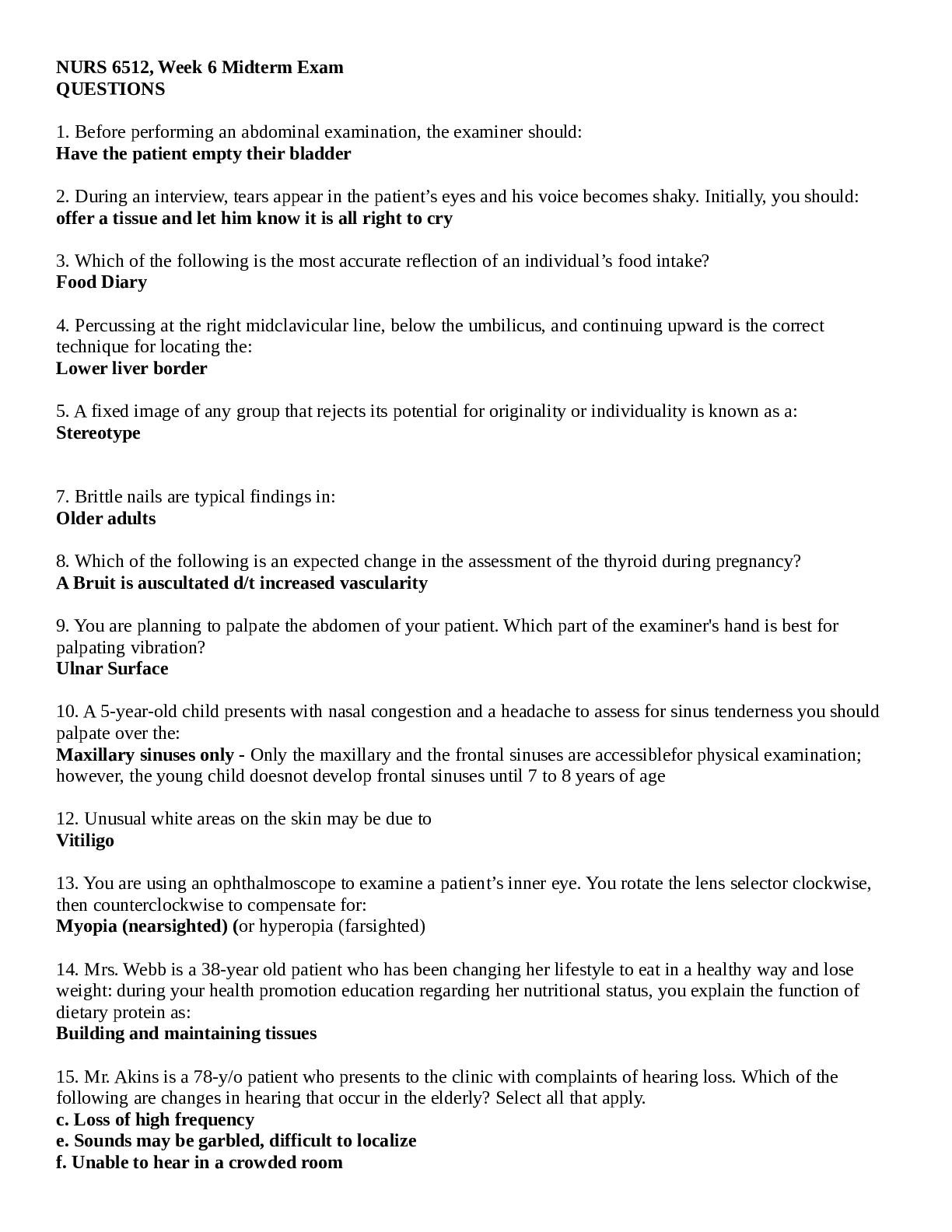
1. Before performing an abdominal examination, the examiner should:
Have the patient empty their bladder
2. During an interview, tears appear in the patient’s eyes and his voice becomes shaky. Initially, you should:
offer a tissue and let him know it is all right to cry
3. Which of the following is the most accurate reflection of an individual’s food intake?
Food Diary
4. Percussing at the right midclavicular line, below the umbilicus, and continuing upward is the correct
technique for locating the:
Lower liver border
5. A fixed image of any group that rejects its potential for originality or individuality is known as a:
Stereotype
7. Brittle nails are typical findings in:
Older adults
8. Which of the following is an expected change in the assessment of the thyroid during pregnancy?
A Bruit is auscultated d/t increased vascularity
9. You are planning to palpate the abdomen of your patient. Which part of the examiner's hand is best for
palpating vibration?
Ulnar Surface
10. A 5-year-old child presents with nasal congestion and a headache to assess for sinus tenderness you should
palpate over the:
Maxillary sinuses only - Only the maxillary and the frontal sinuses are accessiblefor physical examination;
however, the young child doesnot develop frontal sinuses until 7 to 8 years of age
12. Unusual white areas on the skin may be due to
Vitiligo
13. You are using an ophthalmoscope to examine a patient’s inner eye. You rotate the lens selector clockwise,
then counterclockwise to compensate for:
Myopia (nearsighted) (or hyperopia (farsighted)
14. Mrs. Webb is a 38-year old patient who has been changing her lifestyle to eat in a healthy way and lose
weight: during your health promotion education regarding her nutritional status, you explain the function of
dietary protein as:
Building and maintaining tissues
15. Mr. Akins is a 78-y/o patient who presents to the clinic with complaints of hearing loss. Which of the
following are changes in hearing that occur in the elderly? Select all that apply.
c. Loss of high frequency
e. Sounds may be garbled, difficult to localize
f. Unable to hear in a crowded room
[Show More]