*NURSING > QUESTIONS & ANSWERS > NSG 6435 Week 4 Quiz and Answers Latest Updated Graded A (All)
NSG 6435 Week 4 Quiz and Answers Latest Updated Graded A
Document Content and Description Below
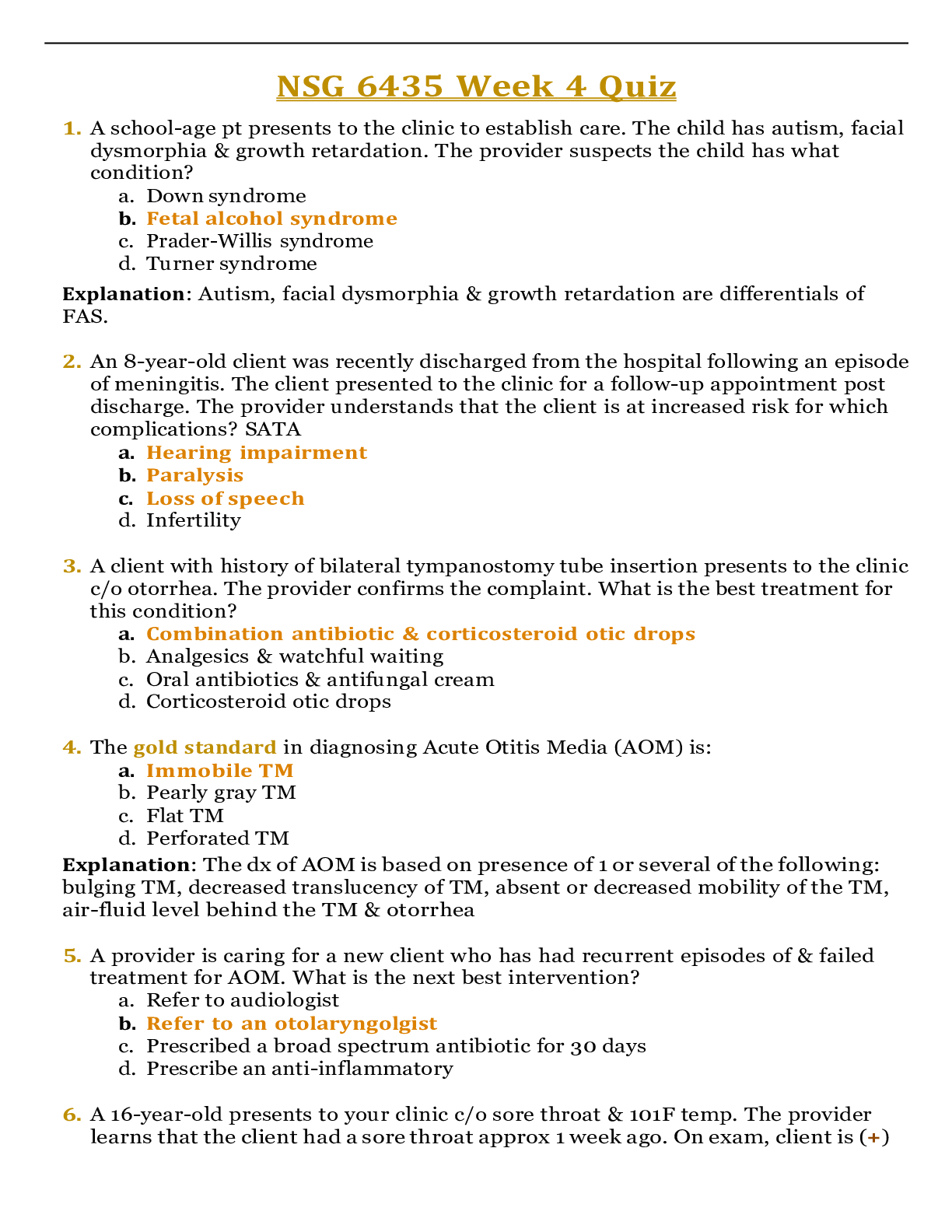
NSG 6435 Week 4 Quiz 1. A school-age pt presents to the clinic to establish care. The child has autism, facial dysmorphia & growth retardation. The provider suspects the child has what condition? ... a. Down syndrome b. Fetal alcohol syndrome c. Prader-Willis syndrome d. Turner syndrome Explanation: Autism, facial dysmorphia & growth retardation are differentials of FAS. 2. An 8-year-old client was recently discharged from the hospital following an episode of meningitis. The client presented to the clinic for a follow-up appointment post discharge. The provider understands that the client is at increased risk for which complications? SATA a. Hearing impairment b. Paralysis c. Loss of speech d. Infertility 3. A client with history of bilateral tympanostomy tube insertion presents to the clinic c/o otorrhea. The provider confirms the complaint. What is the best treatment for this condition? a. Combination antibiotic & corticosteroid otic drops b. Analgesics & watchful waiting c. Oral antibiotics & antifungal cream d. Corticosteroid otic drops 4. The gold standard in diagnosing Acute Otitis Media (AOM) is: a. Immobile TM b. Pearly gray TM c. Flat TM d. Perforated TM Explanation: The dx of AOM is based on presence of 1 or several of the following: bulging TM, decreased translucency of TM, absent or decreased mobility of the TM, air-fluid level behind the TM & otorrhea 5. A provider is caring for a new client who has had recurrent episodes of & failed treatment for AOM. What is the next best intervention? a. Refer to audiologist b. Refer to an otolaryngolgist c. Prescribed a broad spectrum antibiotic for 30 days d. Prescribe an anti-inflammatory 6. A 16-year-old presents to your clinic c/o sore throat & 101F temp. The provider learns that the client had a sore throat approx 1 week ago. On exam, client is (+) This study source was downloaded by 100000831988016 from CourseHero.com on 04-12-2022 06:26:08 GMT -05:00 https://www.coursehero.com/file/49020944/6435-Week-4-Quizdocx/ for cervical lymphadenopathy, enlarged left tonsil, edematous pharynx & uvula displacement. What condition does this client most likely have? a. Acute uvulitis b. Infectious mononucleosis c. Mumps d. Peritonsillar abscess 7. A 5-year-old client presents to the clinic for an annual physical. While performing the physical exam, the provider attempts to examine the client’s ears. What does the provider do? a. Gently pull outer ear down & back b. Gently pull outer ear up & back c. Gently pull outer ear down d. Gently pull outer ear back 8. What are the most common causes of bacterial pneumonia in neonates? SATA. a. Staphylococcus Aureus b. Group B Streptococcus c. Listeria Monocytogenese d. E.coli 9. An ill appearing 3-month-old infant is presented to your clinic. The parent reports that their child has a fever, persistent cough, rhinorrhea, wheezing, hypoxemia, & anorexia for 4 days. After the provider’s exam & work-up, the child is diagnosed with Bronchiolitis. What is the most likely treatment option for this infant? a. Refer patient for hospitalization b. Refer patient for pulmonologist c. Refer patient for bronchoscopy d. Refer patient for chest x-ray Explanation: Bronchiolitis is the term used for an infant seen with wheezing for the very first time & is the leading cause of hospitalizations for infants. It presents with cough, fever, coryza, tachypnea, expiratory wheezing, air trapping, & inspiratory crackles. In mild cases, symptoms can last for 1 to 3 days. In severe cases, cyanosis, air hunger, retractions, & nasal flaring with symptoms of severe respiratory distress within a few hours may be seen. Apnea can occur & may require mechanical ventilation. 10. An ill appearing child is presented to your clinic with a fever, sore throat, restless behavior, dysphagia, drooling, & inspiratory distress without stridor. The child tests positive for Haemophilus influenza type b (Hib). What is the most likely diagnosis? a. Tonsillitis b. Epiglottitis c. Laryngotracheobronchitis d. Retropharyngeal abscess Explanation: Epiglottitis is characterized by inflammation of the epiglottis, the aryepiglottic folds & the ventricular bands at the base of the epiglottis. The causative organism is Haemophilus influenzae type B (HIB). There is an abrupt onset of fever, This study source was downloaded by 100000831988016 from CourseHero.com on 04-12-2022 06:26:08 GMT -05:00 https://www.coursehero.com/file/49020944/6435-Week-4-Quizdocx/ severe sore throat, dyspnea, inspiratory distress without stridor, & drooling. The child looks acutely ill & toxic. If epiglottitis is suspected, do not examine the throat. Do not place the child in the supine position, & immediately transport the child to the hospital via emergency medical services. [Show More]
Last updated: 3 years ago
Preview 1 out of 3 pages
Buy this document to get the full access instantly
Instant Download Access after purchase
Buy NowInstant download
We Accept:

Reviews( 0 )
$10.00
Can't find what you want? Try our AI powered Search
Document information
Connected school, study & course
About the document
Uploaded On
Apr 12, 2022
Number of pages
3
Written in
All

Additional information
This document has been written for:
Uploaded
Apr 12, 2022
Downloads
0
Views
119




.png)