Let x1 , x2 , and x3 be 0 - 1 variables whose values indicate whether the projects are not done (0) or are
done (1). Which answer below indicates that at least two of the projects must be done?
x1 + x2 + x3 ≥ 2
Each p
...
Let x1 , x2 , and x3 be 0 - 1 variables whose values indicate whether the projects are not done (0) or are
done (1). Which answer below indicates that at least two of the projects must be done?
x1 + x2 + x3 ≥ 2
Each point on the efficient frontier graph associated with the Markowitz portfolio model is the
minimum possible risk for the given return.
The number of units shipped from origin i to destination j is represented by
xij.
The media selection model presented in the textbook involves maximizing the number of potential
customers reached subject to a minimum total exposure quality rating.
False
To develop a portfolio that provides the best return possible with a minimum risk, the linear
programming model will have an objective function which
maximizes the minimum return.
The solution to the LP Relaxation of a maximization integer linear program provides
an upper bound for the value of the objective function.
The constraint x1 + x2 + x3 + x4 ≤ 2 means that two out of the first four projects must be selected.
FALSE
Consider a maximal flow problem in which vehicle traffic entering a city is routed among several
routes before eventually leaving the city. When represented with a network,
the arcs represent one way streets.
Let Pij = the production of product i in period j. To specify that production of product 1 in period 3
and in period 4 differs by no more than 100 units,
P13 - P14 ≤ 100; P14 - P13 ≤ 100
The dual price for a constraint that compares funds used with funds available is .058. This means
that
if more funds can be obtained at a rate of 5.5%, some should be.
For many waiting line situations, the arrivals occur randomly and independently of other arrivals
and it has been found that a good description of the arrival pattern is provided by
a Poisson probability distribution.
The overall goal of portfolio models is to create a portfolio that provides the best balance between
risk and return.
0
If the acceptance of project A is conditional on the acceptance of project B, and vice versa, the
appropriate constraint to use is a
corequisite constraint.
Assuming W1, W2 and W3 are 0 -1 integer variables, the constraint W1 + W2 + W3 < 1 is often called a
mutually exclusive constraint.
If a transportation problem has four origins and five destinations, the LP formulation of the problem will
have
9 constraints
Modern revenue management systems maximize revenue potential for an organization by helping to
manage
pricing strategies.
short-term supply decisions.
reservation policies.
All of the alternatives are correct.
In a waiting line situation, arrivals occur, on average, every 10 minutes, and 10 units can be received
every hour. What are λ and μ?
A company makes two products from steel; one requires 2 tons of steel and the other requires 3 tons.
There are 100 tons of steel available daily. A constraint on daily production could be written as: 2x1 +
3x2 ≤ 100.
True
If arrivals occur according to the Poisson distribution every 20 minutes, then which is NOT true?
λ = 20 arrivals per hour
Let M be the number of units to make and B be the number of units to buy. If it costs $2 to make a unit
and $3 to buy a unit and 4000 units are needed, the objective function is
0
Min 2M + 3B
The assignment problem constraint x31 + x32 + x33 + x34 ≤ 2 means
agent 3 can be assigned to 2 tasks.
The total cost for a waiting line does NOT specifically depend on
the cost of a lost customer.
The assumption that arrivals follow a Poisson probability distribution is equivalent to the assumption
that the time between arrivals has
an exponential probability distribution
Problem 15-7 (Algorithmic)
Speedy Oil provides a single-server automobile oil change and lubrication service. Customers provide
an arrival rate of 2.5 cars per hour. The service rate is 4 cars per hour. Assume that arrivals follow a
Poisson probability distribution and that service times follow an exponential probability distribution.
a. What is the average number of cars in the system? If required, round your answer to two
decimal places
L = 1.04
b. What is the average time that a car waits for the oil and lubrication service to begin? If
required, round your answer to two decimal places.
Wq = hours 1.67
c. What is the average time a car spends in the system? If required, round your answer to two
decimal places.
W = hours 0.42
d. What is the probability that an arrival has to wait for service? If required, round your answer to
two decimal places.
Pw = Right answer!
Problem 12-27 (Algorithmic)
Andalus Furniture Company has two manufacturing plants, one at Aynor and another at Spartanburg.
The cost in dollars of producing a kitchen chair at each of the two plants is given here.
Aynor: Cost = 65Q1 + 5Q12 + 96
Spartanburg: Cost = 21Q2 + 3Q22 + 147
Where
0.63
0
Q1 = number of chairs produced at Aynor
Q2= number of chairs produced at Spartanburg
Andalus needs to manufacture a total of 50 kitchen chairs to meet an order just received. How many
chairs should be made at Aynor and how many should be made at Spartanburg in order to minimize
total production cost? When required, round your answers to the nearest dollar.
The optimal solution is to produce chairs at Aynor for a cost of $ and
chairs at Spartanburg for a cost of $ . The total cost is $ .
Problem 11-9 (Algorithmic)
Hawkins Manufacturing Company produces connecting rods for 4- and 6-cylinder automobile engines
using the same production line. The cost required to set up the production line to produce the 4-
cylinder connecting rods is $2400, and the cost required to set up the production line for the 6-cylinder
connecting rods is $3400. Manufacturing costs are $13 for each 4-cylinder connecting rod and $18 for
each 6-cylinder connecting rod. Hawkins makes a decision at the end of each week as to which product
will be manufactured the following week. If there is a production changeover from one week to the
next, the weekend is used to reconfigure the production line. Once the line has been set up, the weekly
production capacities are 6300 6-cylinder connecting rods and 7800 4-cylinder connecting rods.
Let
x4 = the number of 4-cylinder connecting rods produced next week
x6 = the number of 6-cylinder connecting rods produced next week
s4= 1 if the production line is set up to produce the 4-cylinder connecting rods; 0 if otherwise
s6 = 1 if the production line is set up to produce the 6-cylinder connecting rods; 0 if otherwise
a. Using the decision variables x4 and s4, write a constraint that limits next week's production of
the 4-cylinder connecting rods to either 0 or 7800 units.
x4 ≤ s4
b. Using the decision variables x6 and s6, write a constraint that limits next week's production of
the 6-cylinder connecting rods to either 0 or 6300 units.
x6 ≤ s6
c. Write three constraints that, taken together, limit the production of connecting rods for next
week.
d. Write an objective function for minimizing the cost of production for next week.
Min x4 + x6 + s4 + s6
Problem 10-09 (Algorithmic)
The Ace Manufacturing Company has orders for three similar products:
Product Order (Units)
A 2250
B 550
C 1100
Three machines are available for the manufacturing operations. All three machines can produce all the
products at the same production rate. However, due to varying defect percentages of each product on
each machine, the unit costs of the products vary depending on the machine used. Machine capacities
for the next week and the unit costs are as follows:
Machine Capacity
(Units)
Use the transportation model to develop the minimum cost production schedule for the products and
machines. Show the linear programming formulation. If required, round your answers to one decimal
place.
The linear programming formulation and optimal solution are shown.
Let x1A Units of product A on machine 1
x1B = Units of product B on machine 1
• • •
x3C = Units of product C on machine 3
xij ≥ 0 for all i, j
Optimal
Total $
Problem 9-11 (Algorithmic)
Edwards Manufacturing Company purchases two component parts from three different suppliers. The
suppliers have limited capacity, and no one supplier can meet all the company’s needs. In addition, the
suppliers charge different prices for the components. Component price data (in price per unit) are as
follows:
Supplier
Component 1 2 3
Each supplier has a limited capacity in terms of the total number of components it can supply.
However, as long as Edwards provides sufficient advance orders, each supplier can devote its capacity
to component 1, component 2, or any combination of the two components, if the total number of units
ordered is within its capacity. Supplier capacities are as follows:
Supplier 1 2 3
1100
0
Capacity 550 975 800
If the Edwards production plan for the next period includes 1025 units of component 1 and 775 units of
component 2, what purchases do you recommend? That is, how many units of each component should
be ordered from each supplier?
Supplier
1 2 3
Component 1
Component 2
What is the total purchase cost for the components?
$
Problem 15-9 (Algorithmic)
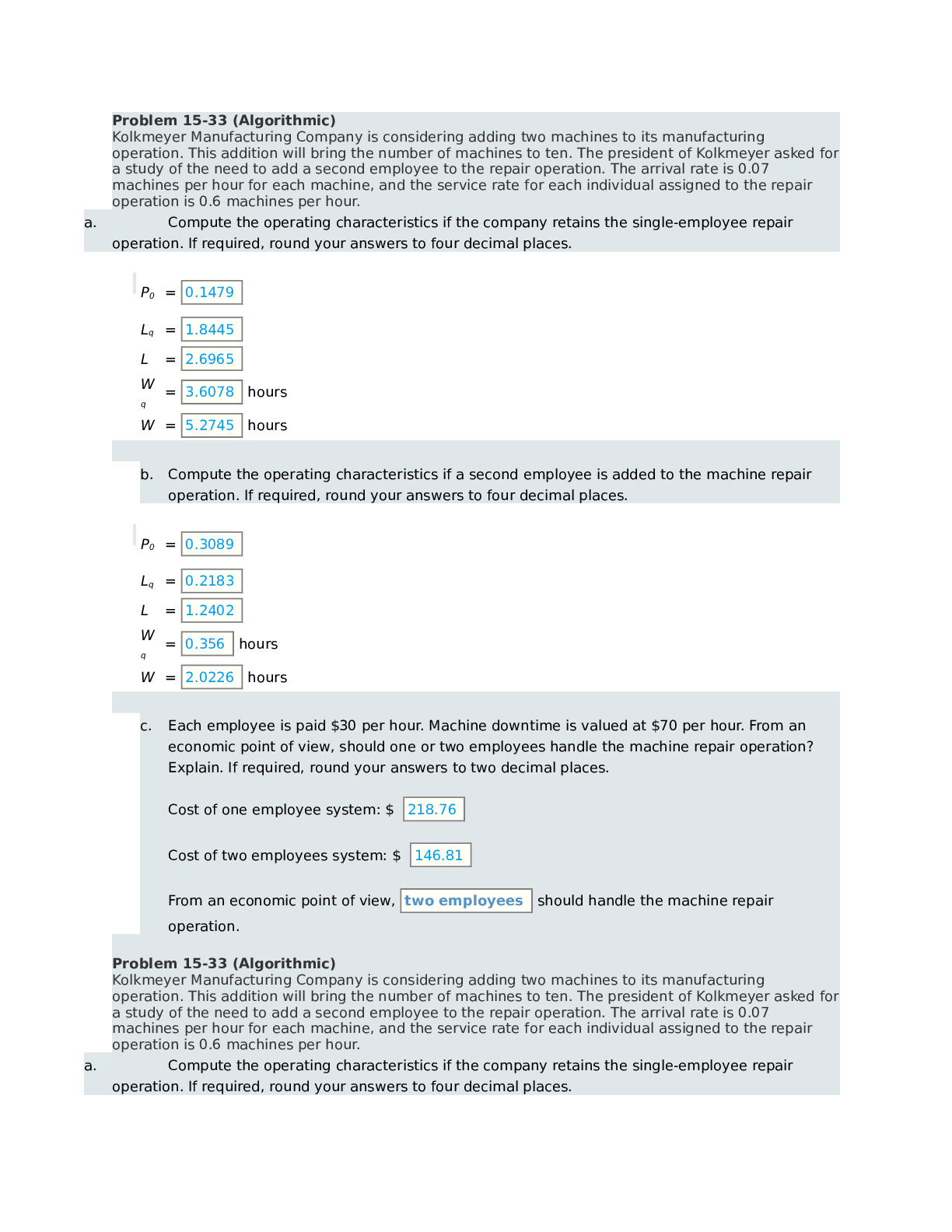
Marty's Barber Shop has one barber. Customers have an arrival rate of 2.1 customers per hour, and
haircuts are given with a service rate of 4 per hour. Use the Poisson arrivals and exponential service
times model to answer the following questions:
a. What is the probability that no units are in the system? If required, round your answer to four
decimal places.
P0 =
b. What is the probability that one customer is receiving a haircut and no one is waiting? If
required, round your answer to four decimal places.
P1 =
c. What is the probability that one customer is receiving a haircut and one customer is waiting? If
required, round your answer to four decimal places.
P2 =
d. What is the probability that one customer is receiving a haircut and two customers are waiting?
If required, round your answer to four decimal places.
P3 =
e. What is the probability that more than two customers are waiting? If required, round your
answer to four decimal places.
P(More than 2 waiting) =
f. What is the average time a customer waits for service? If required, round your answer to four
decimal places.
Wq = hours
0.2763
[Show More]



, 3e Bruce Crauder, Benny Evans, Jerry Johnson, Alan Noell.png)
.png)
![Preview of [Solved] BMAL 590 Quantitative Research Techniques and Statistics](https://scholarfriends.com/storage/BMAL_590_Quantitative_Research_Techniques_and_Statistics.png)