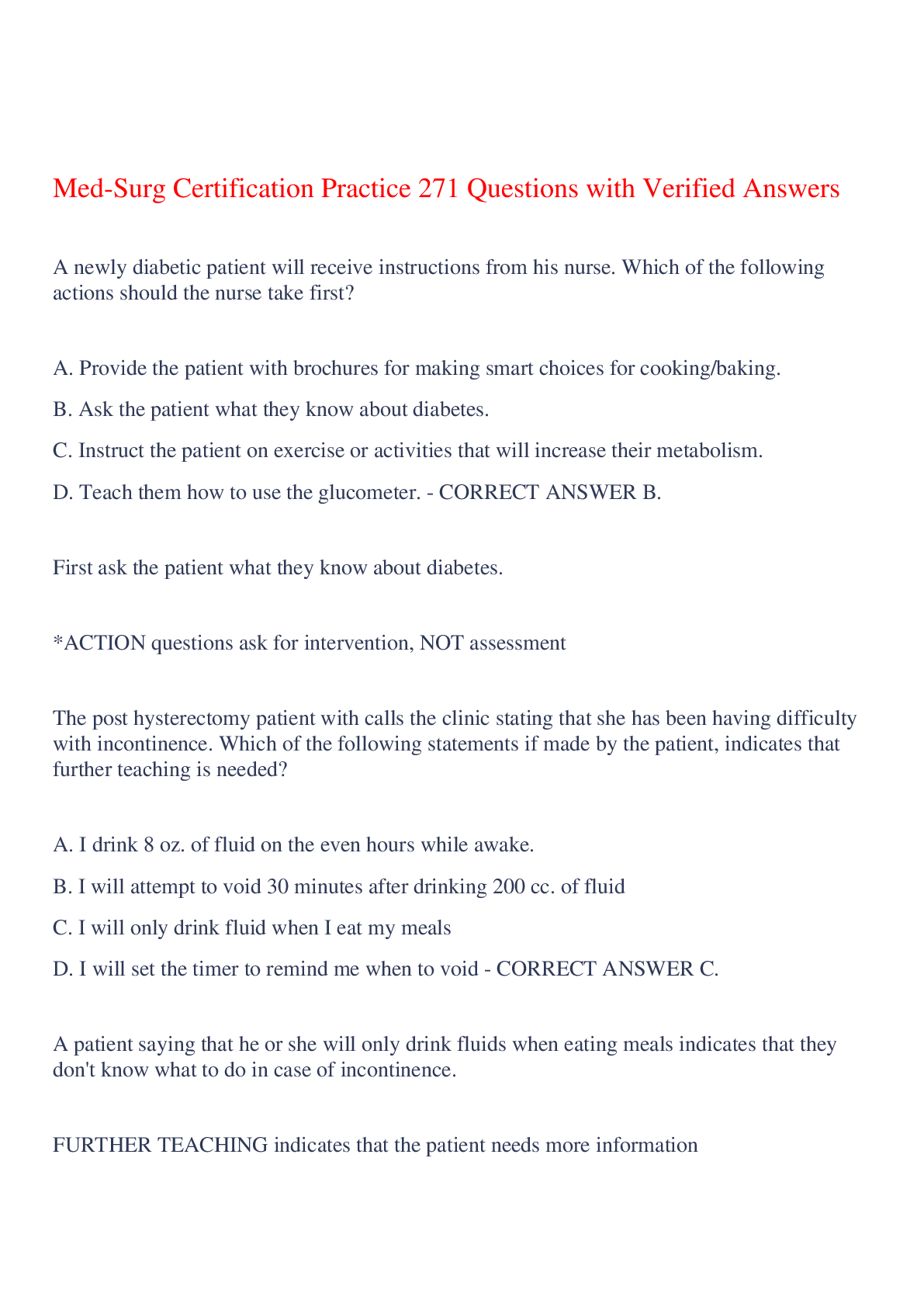
NUR 370 MATERNITY EXAM 2 STUDY GUIDE Latest updated 2021/2022
Chapter 10 – Assessment of high risk pregnancy Risk Factors:
• Biophysical
o Genetic: chrom abnormalities, poor nutrition (young age, fad diets, drugs/alco
...
NUR 370 MATERNITY EXAM 2 STUDY GUIDE Latest updated 2021/2022
Chapter 10 – Assessment of high risk pregnancy Risk Factors:
• Biophysical
o Genetic: chrom abnormalities, poor nutrition (young age, fad diets, drugs/alcohol, chronic illness), diabetes, obesity, hypertensive disorders
• Sociodemographic
o Income, prenatal care, age, ethnicity, environmental factors (infection/radiation/chemicals/drugs), age, parity,
o Dystocia – difficult birth, caused by a large or awkwardly positioned fetus
• Psychosocial
o Emotional distress, lack of supportive relationships
Specific pregnancy problems:
• Oligohydramnios – not enough amniotic fluid
o Maternal hypertension, prolonged pregnancy
• Polyhydramnios – too much amniotic fluid
o Uncontrolled diabetes mellitus
• IUGR – intra uterine growth restriction
o Poor weight gain, hypertension, chronic disease, smoking/alcohol/drugs, high altitude
ANTEPARTUM TESTING:
• Daily fetal movement count
o Count once a day for 60 mins, 2-3 times daily, 10 movements in 12 hour period
o FETAL ALARM SIGN – WHEN MOVEMENTS CEASE ENTIRELY FOR 12 HOURS
• Ultrasound
o Fetal HR activity, gestational age, fetal growth, fetal anatomy, genetic disorders, placental position/function, visual assistance
o Head and abdominal circumference – gestational age and fetal growth
o Nursing role – education and guidance regarding procedure
o Fetal well-being
▪ Doppler blood flow
▪ Amniotic fluid
▪ Biophysical profile
• MRI – soft tissues
• Biochemical assessment – AMNIOCENTESIS (AFTER 14 WEEKS)
o Fetomaternal hemorrhage – fetal blood enters maternal bloodstream – dangerous with Rh
o Amniotic fluid embolism – amniotic fluid enters maternal bloodstream – emergency, super dangerous
o Used to check for lung maturity
• Chronic Villus Sampling – 10-13 weeks gestation
o Removal of small tissue specimen from fetal portion of placenta
• Percutaneous umbilical blood sampling – replaced in many centers by placental biopsy
MATERNAL ASSAYS
• Alpha-fetoprotein
o Maternal serum screened for neural tube defects (80-85% can be detected early)
• Maternal marker screening – 11-14 weeks
o Detects chromosomal abnormalities (downs)
• Contraction stress test – provides warning of fetal compromise earlier than NST
• OLIGOHYDRAMNIOS – associated with fetal renal abnormalities
• POLYHYDRAMNIOS – GI, brain/spinal abnormalities
CH. 11 – HIGH RISK PRENATAL CARE – PREEXISTING CONDITIONS
• Diabetes – strict maternal glucose control
• INSULIN NEEDS DURING PREGNANCY ARE DIFFERENT
o Lower than normal during weeks 13-20
o Spikes between weeks 26-36
o Drops off after baby is delivered
o Non-breastfeeding mother needs more insulin!
• Thyroid disorders
o Hyperthyroid – Grave's disease – risk for miscarriage and preterm birth
o Hypothyroidism – risk for infertility
• Maternal phenylketonuria
o Baby will have reaction to protein
o Prevention – identification of women during childbearing years
• Cardiovascular disorders
o Heparin – drug that does not cross into the placenta
• Anemia
o Iron deficiency
o Folic acid deficiency
o Sickle cell
o Thalassemia
• Epilepsy – all medications carry risk of congenital abnormalities
CHAPTER 12: HIGH RISK: GESTATIONAL CONDITIONS
Disorders that did not exist before pregnancy
• Most common is hypertension
o Preeclampsia – HTN develops after 20 weeks with proteinuria. Can be mild or severe
▪ Disappears after birth
▪ Reduced kidney perfusion
▪ HELLP syndrome – severe preeclampsia – hepatic dysfunction
• Hemolysis
• Elevated Liver enzymes
• Low Platelets
▪ Associated with increased risk for:
• Pulmonary edema, renal failure, liver failure, disseminated intravascular coagulation (abnormal clots in blood vessels), placental abruption, acute
respiratory distress, sepsis, stroke, fetal and maternal death
▪ IDENTIFYING AND PREVENTING:
• Physical exam – dependent/pitting edema, deep tendon reflexes (decrease w magnesium sulfate use), clonus
• Lab tests – proteinuria
• Magnesium sulfate toxicity – GIVE CALCIUM GLUCONATE OR CALCIUM CHLORIDE
o Eclampsia – seizure or coma
o Gestational HTN – onset without proteinuria after 20th week
o Chronic HTN – present before pregnancy or before 20th week
• HEMMORHAGIC DISORDERS – MEDICAL EMERGENCY
o Maternal blood loss reduces oxygen-carrying capacity
• Recurrent premature dilation of cervix
o Prophylactic Cerclage (stitch) is placed in the cervix around 11-15 weeks
o Abdominal cerclage 11-13 weeks
• Ectopic pregnancy
o Patient presents w severe pain, delayed menses and abnormal vaginal bleeding
o Treatment:
▪ Medical: methotrexate
▪ Surgical: salpingectomy
• Gestational Trophoblastic Disease (molar pregnancy)
o Empty
o Vaginal bleeding, significantly larger fundus
o Most pass spontaneously, or with D&C
o *induction of labor not recommended
• Late pregnancy bleeding
o Placenta previa – placenta implanted in lower uterine segment – covering part of cervix (complete, marginal, low lying)
o PAINLESS BLEEDING
o Abnormal placental attachment, excessive bleeding, anemia
o Diagnose with ultrasound – observation, bed rest, c section
o Abruptio placentae – premature separation of placenta (mild, moderate, severe)
o HARD, BOARD-LIKE ABDOMEN, VERY PAINFUL BLEEDING
• CLOTTING DISORDERS
o Disseminated Intravascular Coagulation (DIC)
o Major medical emergency
o Blood clots excessively
• UTI
o Triggered by severe preeclampsia, HELLP, gram negative sepsis
o Can cause preterm labor!!
o Asymptomatic bacteruria – bacteria with no symptoms
• Trauma – fetal survival depends on maternal survival
CHAPTER 13: LABOR AND BIRTH PROCESS
• 5 P’s affecting labor: passenger, passageway, powers, position of mother, psychologic response
• Passenger (fetus)
o Fetal presentation – part of body coming out first
o Fetal lie – spine to spine
o Fetal altitude – relation of fetal body parts to one another
o Fetal position – presenting part
o Back fontanel (soft spot) closes at 6-8 weeks
o Front fontanel closes by 18 months
• Passageway (pelvis)
o Gynecoid – normal female pelvis
o Android – male pelvis
o Anthropoid
o Platypellpoid – flate pelvis
• Powers
o Effacement – need to be at 100% (lining thinned)
o Dilation – need to be at 10
o Ferguson reflex – sensation to bear down
• Position
o Encourage mother to change position often
STAGES OF LABOR:
• STAGE 1:
o Onset of regular uterine contractions to full dilation
• STAGE 2:
o Full dilation to birth of baby
▪ LATENT PHASE – fetus descends passively through birth canal and rotates to an anterior position
▪ ACTIVE PUSHING – strong urge to bear down as presenting part of fetus descends and passes on stretch receptors of pelvic floor
• STAGE 3:
o Birth of baby to birth of placenta
• STAGE 4:
o 2 hours after the placenta is delivered
Signs preceding labor: dropping about 2 weeks prior, mucus plug
• Mechanism of labor: occur in vertex presentation
o Engagement (asynclitism) - when head passes the pelvic inlet
o Descent – the progress of the presenting part – depends on 4 forces:
▪ Pressure from amniotic fluid
▪ Pressure from contractions of fundus on fetus
▪ Force of contraction
▪ Extension and straightening of fetal body
o Flexion – when descending head meets resistance from the cervix, pelvic wall or pelvic floor
o Internal rotation
o Extension
o External rotation – after head is born/as shoulders descend and engage
o Expulsion (birth)
• Fetal adaptations to labor:
o Fetal HR ranges from 110-160 bpm
o Fetal circulation – affected by position, contraction
o Fetal respirations – changes stimulate the fetus to be ready for respirations
• Maternal adaptations to labor:
o Cardio changes – output peaks at 10-30 mins post-delivery, BP increases during contraction, blood circulation increases during contraction
o Increased respiratory rate
o Renal – voiding may be difficult, +1 protein may be normal
o Stretching of the vaginal introitus
o Diaphoresis, fatigue
o Euphoric, amnesia
o Decreased motility
o Decrease in progesterone and blood glucose levels
o Increase in estrogen, prostaglandins, oxytocin and metabolism
CHAPTER 14 – PAIN MANAGEMENT
• First stage of labor – visceral pain (from cervical changes)
• Second stage of labor – somatic pain (from stretching or tearing)
• Third stage of labor – visceral pain
• Nonpharm pain management best for all patients
• Anesthesia – watch for decreased resp and BP – have narcan on hand!!
• Pharmacological pain management
o Local numbing – Lidocaine
o Sedatives – relieve anxiety and induce sleep
o Analgesia and anesthesia
▪ Anesthesia – abolish pain perception by interrupting nerve impulses to the brain
– may be partial or complete
▪ Systemic analgesia – alleviation of sensation of pain or raising threshold of pain perception w/o loss of consiousness
• Opiod agonist analgesics – demerol, fetanyl
• Opiod agonist-antagonist analgesics – stadol, nubain
• Opiod antagonist – narcan --> reverses opiod respiratory distress
o Epidural - vaginal delivery, can get if up to 5-6 cm dilated
▪ Immediate relief
▪ Feel pressure, no pain
o Spinal block - c-section delivery, subarachnoid space
▪ Immediate relief
▪ Provides numbness higher up (for c-sections)
▪ Can get severe spinal headache
▪ No catheter
o Pudendal - vaginal delivery, woman too far along for epidural
▪ 10-20 mins for effects
▪ Blocks lower region pain
o General Anesthesia
▪ For emergency c section – rapid birth
▪ Patient is supposed to be NPO prior
***MATERNAL HYPOTENSION IS AN EMERGENCY --> DECREASED PLACENTAL PERFUSION
• CONTRAINDICATIONS TO EPIDURAL:
o Hemorrhage, maternal hypotension, coagulopathy, infection at injection site, allergy to anesthetic drug, maternal refusal/inability to cooperate, maternal cardiac conditions
CHAPTER 15 – FETAL ASSESSMENT DURING LABOR
• Fetal monitor – fetal HR is on top, contraction is on bottom
• Each box = 10 seconds
• One dark line to another = 10 minutes
• Measure: frequency of contractions (how many min apart), duration of contractions (how long is 1), strength of contractions, resting tone, relaxation time (between contractions)
• Normal FHR pattern: between 110-160, no periodic changes, moderate baseline variability
• Internal measurement of FHR – intrauterine pressure transducer (measures uterine contractions), cardiotachometer measures FHR on baby’s head
• Absent variability – not good, indicates fetal hypoxemia
• Moderate variability is normal (amplitude changes between 6-25 bpm)
• High variability – sinusoidal FHR pattern
• Tachycardia – FHR >160 for more than 10 mins --> maternal fever
• Bradycardia – FHR <110 for more than 10 mins --> cord compression, post term, epidural
• REMEMBER VEAL CHOP:
o V – VARIABLE DECCELERATION --> C – CORD ISSUE
o E – EARLY (DECELERATION SAME TIME AS CONTRACTION) --> H – HEAD COMPRESSED
o A – ACCELERATION (HR INCREASE DURING CONTRACTION --> O – OK
o L – LATE DECCELERATION --> P – PLACENTAL ABRUPTION
*LATE DECCELERATION IS AN EMERGENCY – GET BABY OUT!!!
Variable:
Early:
Late:
CHAPTER 16 – NURSING CARE OF THE FAMILY DURING LABOR AND BIRTH
• True vs false labor
o True labor:
▪ Cervix by vaginal exam shows softening, effacement, and dilation
▪ Presenting part of fetus becomes engaged in pelvis
o False labor:
▪ Irregular or temp contractions Stages and phases of labor:
• 1st– onset of regular uterine contractions -> full dilation of the cervix- (varies the most in length)
o Latent phase: up to 3 cm of dilation (~6 -8 hours)
o Active phase: 4 to 7 cm of dilation (~3-6 hours)
o Transition phase: 8 to 10 cm of dilation (~20- 40 mins)
• 2nd stage cervix is fully dilated -> the birth of the fetus
o Latent- the fetus continues to descend passively through the birth canal and rotate to an anterior position as a result of ongoing uterine contractions
o Decent Phase- Active pushing- a strong urge to bear down as the presenting part of the fetus descends and presses on the stretch receptors of the pelvic floor
• 3rd stage- fetus -> placenta delivered
• 4th stage about 2 hours AFTER the placenta is delivered
Lepold maneuvers – determine number of fetuses, position, lie,
True labor is considered an emergency medical condition
Ritgen maneuver – applying upward pressure from the coccyx region
CH 17 LABOR AND BIRTH COMPLICATIONS
• Low birth weight – only weight, <5.5 lbs
• Antenatal glucocorticoids (accelerates fetal lung maturity by stimulating fetal surfactant production. Optimal benefit occurs 24 hours after the 1st injection)
• Premature rupture of membranes (PROM) - Rupture of amniotic sac and leakage of amniotic fluid beginning at least 1 hour before onset of labor at any gestational age
• ***Chorioamniotis – bacterial infection of amniotic cavity is the most common maternal complication of PPROM
• Oxytocin – used to stimulate uterine contractions and induce labor
[Show More]

 Answered 2021-2022_compressed.png)




.png)


1.png)