YMCA CPR Exam II &III_ Answered 2022.
YMCA CPR Exam II
You are a newly trained first aid provider responding at work to a report of someone who has collapsed. Which of the following best describes your role in a medi
...
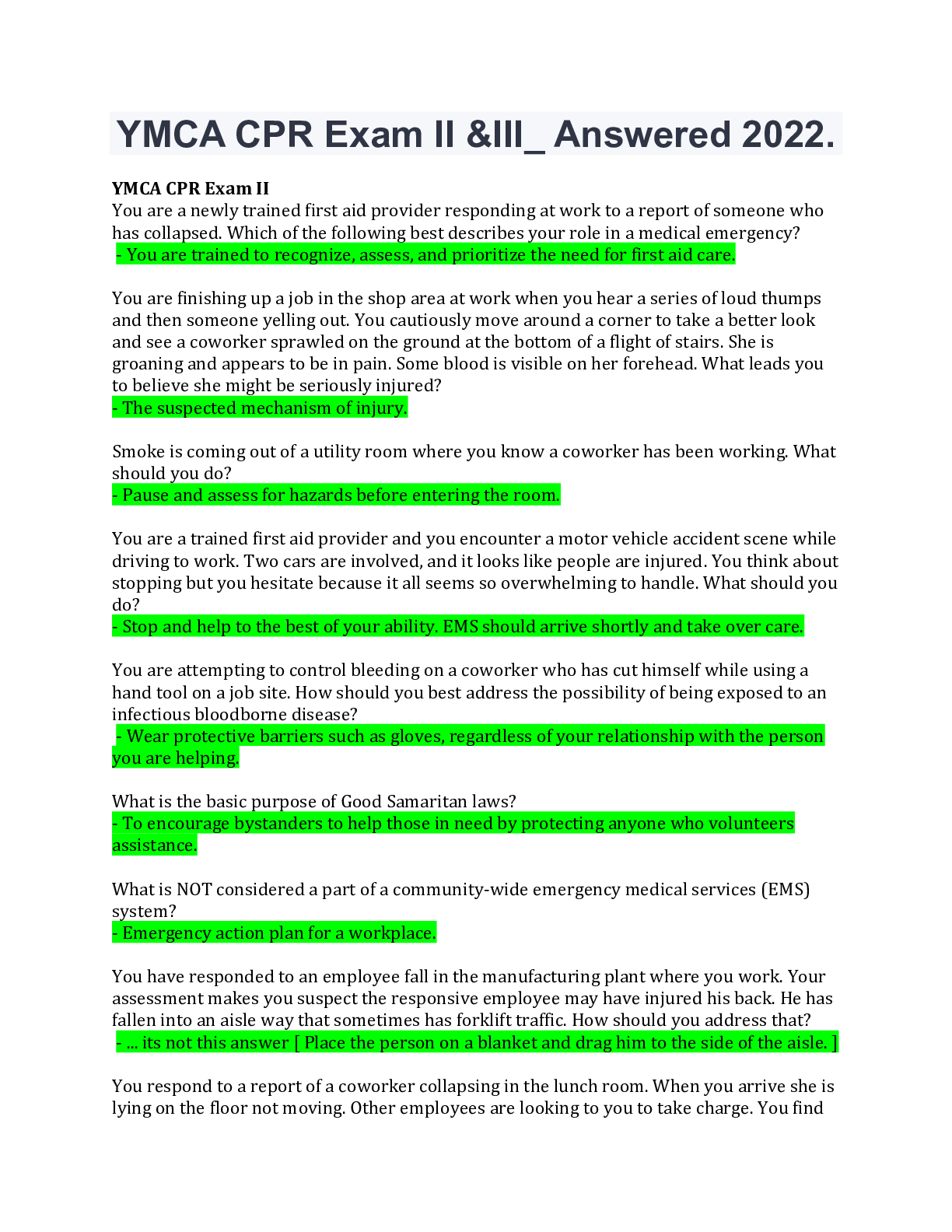
YMCA CPR Exam II &III_ Answered 2022.
YMCA CPR Exam II
You are a newly trained first aid provider responding at work to a report of someone who has collapsed. Which of the following best describes your role in a medical emergency?
You are finishing up a job in the shop area at work when you hear a series of loud thumps and then someone yelling out. You cautiously move around a corner to take a better look and see a coworker sprawled on the ground at the bottom of a flight of stairs. She is groaning and appears to be in pain. Some blood is visible on her forehead. What leads you to believe she might be seriously injured?
Smoke is coming out of a utility room where you know a coworker has been working. What should you do?
You are a trained first aid provider and you encounter a motor vehicle accident scene while driving to work. Two cars are involved, and it looks like people are injured. You think about stopping but you hesitate because it all seems so overwhelming to handle. What should you do?
You are attempting to control bleeding on a coworker who has cut himself while using a hand tool on a job site. How should you best address the possibility of being exposed to an infectious bloodborne disease?
What is the basic purpose of Good Samaritan laws?
What is NOT considered a part of a community-wide emergency medical services (EMS) system?
You have responded to an employee fall in the manufacturing plant where you work. Your assessment makes you suspect the responsive employee may have injured his back. He has fallen into an aisle way that sometimes has forklift traffic. How should you address that?
You respond to a report of a coworker collapsing in the lunch room. When you arrive she is lying on the floor not moving. Other employees are looking to you to take charge. You find her to be unresponsive so you direct others to activate EMS and get the company's AED. During your breathing assessment, you determine she is breathing normally. What is your next step?
Why is angling the body and face towards the ground important when placing a person in the recovery position?
You are eating lunch in the cafeteria at work when another employee at a nearby table stands up suddenly and grasps his hands to his throat. You go to help and ask him if he is choking. How can you tell if the obstruction is severe and requires your help?
It is safe for you to help someone who has been injured by a cutting machine. She is responsive, so you introduce yourself and ask if you can help. She agrees and you assess she has no difficulty breathing. A quick scan for bleeding reveals a heavily bleeding wound on her left upper leg. What is your next action?
You have responded as a first aid provider to a coworker who has accidentally cut himself on his forearm. He is responsive and safe to approach. He has his hand clamped down on the wound, but there is a pool of blood on the floor and blood is still dripping from beneath his hand. What approach will you take to control bleeding?
Because you cannot clearly see injuries inside the body, internal bleeding can be difficult to detect. Which of the following would make you suspect the possibility of internal bleeding?
What is the general underlying cause of shock?
You are caring for a person who has fallen onto a concrete floor from a high ladder. He is responsive and has a small bruise on his forehead. What should you do?
You are treating someone who has sustained a significant blow to the head. He is awake but clearly confused and unable to understand you. A bloody fluid is flowing from one of his ears. What should you do?
You have been called to assess a person who accidentally struck his head on a low-hanging steel beam. Witnesses tell you he was initially stunned and slow to respond, but seems much better now. He seems normal to you, but is still a bit confused about what happened. What should you do?
You are caring for a person who has fallen and injured her forearm, which is lying at an unnatural angle. You cut away her shirt sleeve to reveal an open wound with exposed bone and minor bleeding. What should you do?
You are the first aid provider on scene for a responsive person whose shirt sleeve caught fire while he was welding. The scene is safe and you have removed his burning shirt. He has a burn on his forearm about the size of your palm that has damaged the skin. What will be your initial treatment for the burn?
You are caring for a coworker with a nosebleed. What should you do to provide care?
You are caring for a person whose tooth has been accidentally knocked out. She has no other issues you are concerned about. Proper care for the knocked out tooth includes:
You are waiting for EMS to arrive while caring for a person with an altered mental status. If the person's level of responsiveness becomes severely diminished, what should you do?
Your coworker who has been standing in place a long time while monitoring a production line tells you that he suddenly feels light-headed and warm. How should you respond? -
What tool can you use to help reduce the time it takes to get a person with a suspected stroke treated at a hospital?
You have been called to help a visitor to your workplace who was interacting normally but suddenly became confused, shaky, and pale. The person he is with tells you he is diabetic and a medical alert bracelet confirms that. The man is able to follow simple commands and can swallow without trouble. How should you respond?
You are talking with a group of coworkers when one of them suddenly collapses to the ground. Her whole body is jerking and convulsing. What is your immediate care?
You are caring for a person who has difficulty breathing. A bystander tells you she has asthma but does not have her medication with her. Her breathing is fast, weak, and taking significant effort. Her lips look bluish-purple and she appears exhausted. What should you prepare for?
You are sitting outside with a coworker when he is stung by a bee. He becomes very anxious and tells you he is allergic to bee stings. Within minutes, his face and lips are swollen and his effort to breathe becomes more difficult. What should you do?
A coworker of yours is complaining of not feeling well. He says he has a severe pressure and discomfort in his chest. His skin is pale, and he is sweating. He asks you not to make a fuss over him, but you know he has problems with his heart. What should you do?
A coworker thinks she may have accidentally swallowed something poisonous. She is responsive and looks worried but does not look or feel sick. What should you do?
You approach an ill employee who works near the furnaces in the glass blowing shop. She is responsive but confused. Her skin is dry and very warm, almost hot to your touch. What care should you provide for her?
On a bitterly cold day, you are caring for a fellow logger whom you suspect of having frostbite on his fingers. A rural EMS service is on the way to your logging site. What general care should you provide?
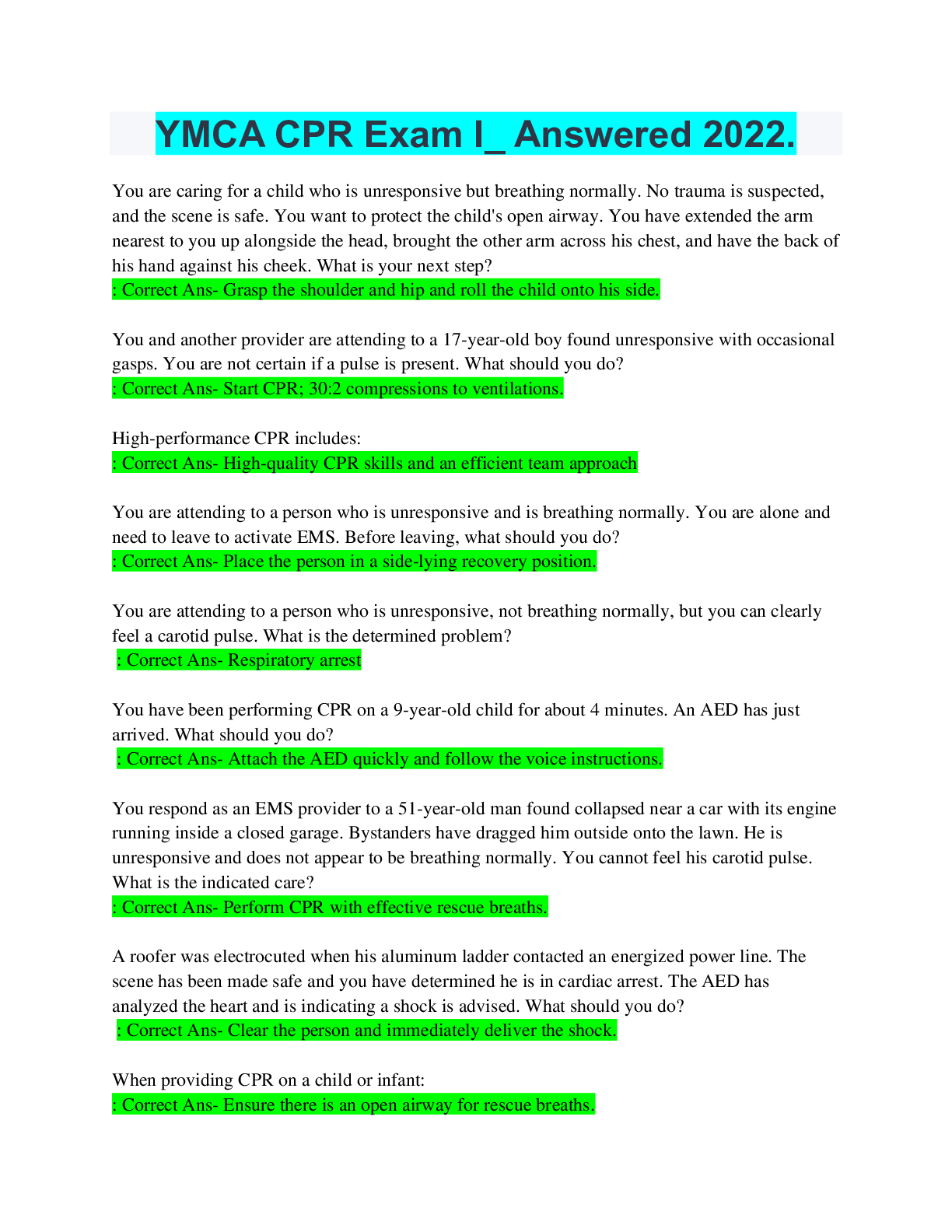
YMCA CPR Exam III_ Answered 2022.
Ill or injured persons may benefit from emergency oxygen in situations that include serious bleeding, divers with a decompression injury, difficulty breathing, suspected internal injury, and:
Which of the following is a delivery device that can be used when providing emergency oxygen to a breathing person?
To be considered an emergency oxygen delivery system, it must provide a minimum of______ liters per minute (LPM) of oxygen for a minimum of ______minutes.
Emergency oxygen can help a person who may be experiencing:
Which of the following statements is true? - ...
When considering the use of emergency oxygen, initial priorities of care include all of the following EXCEPT:
The reservoir bag of a non-rebreather mask must be ______ before putting it on the person's face.
You have responded to a woman who may be going into shock in the hardware store where you work. After completing a primary assessment, you apply a pulse oximeter. The reading shows an SPo2 level of 91%. Her breathing is rapid and shallow and her lips have a bluish tint. She has no visible signs of injury but stated that she slipped and hit her abdomen against a stack of paver bricks in the garden center. EMS has been activated and you are giving care for shock. How should you provide emergency oxygen as part of your care? (Which of the following would be the most appropriate?)
A(n) ______ reduces the pressure of compressed oxygen inside the oxygen cylinder to a level more appropriate for patient care.
To create a seal on an unresponsive person's face using a ventilation mask, lift the ______ into the ______.
Safe handling and storage practices for emergency oxygen systems include:
Checking and preparing an emergency oxygen system for return to service includes all of the following EXCEPT: - ...
The preferred oxygen delivery device to use when providing emergency oxygen to a non breathing person is a: - ...
CPR is in progress on a middle-aged man who had been removed from the pool unconscious by two of your lifeguards. An AED is being prepared. Emergency oxygen is also available and you bring it to the scene. How should you integrate the use of emergency oxygen in the care for this person?
You have been called to respond to an adult with shortness of breath. As you assess him, you observe that he is showing signs of breathing difficulty. He appears pale and his skin is cool and moist. You have a pulse oximeter and have checked his SPo2, but the reading appears to be normal. You should:
[Show More]



.png)


