ATI MATERNAL NEWBORN PROCTORED EXAM 2019 - STUDY GUIDE
1. The nurse is assessing a client who is 6 hours postpartum after delivering a full-term healthy
newborn. The client complains to the nurse of feelings of faintn
...
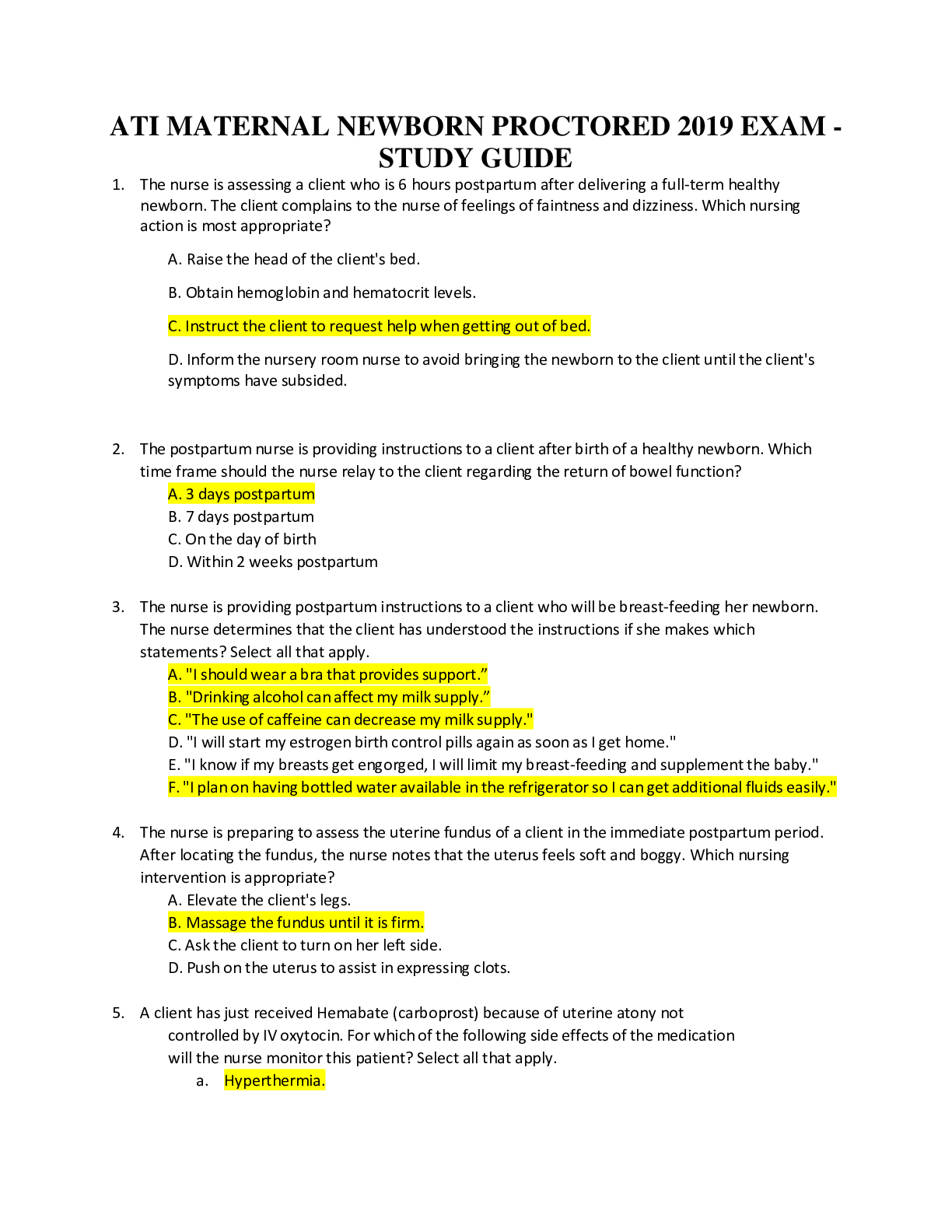
ATI MATERNAL NEWBORN PROCTORED EXAM 2019 - STUDY GUIDE
1. The nurse is assessing a client who is 6 hours postpartum after delivering a full-term healthy
newborn. The client complains to the nurse of feelings of faintness and dizziness. Which nursing
action is most appropriate?
A. Raise the head of the client's bed.
B. Obtain hemoglobin and hematocrit levels.
C. Instruct the client to request help when getting out of bed.
D. Inform the nursery room nurse to avoid bringing the newborn to the client until the client's
symptoms have subsided.
2. The postpartum nurse is providing instructions to a client after birth of a healthy newborn. Which
time frame should the nurse relay to the client regarding the return of bowel function?
A. 3 days postpartum
B. 7 days postpartum
C. On the day of birth
D. Within 2 weeks postpartum
3. The nurse is providing postpartum instructionsto a client who will be breast-feeding her newborn.
The nurse determines that the client has understood the instructions if she makes which
statements? Select all that apply.
A. "Ishould wear a bra that provides support.”
B. "Drinking alcohol can affect my milk supply.”
C. "The use of caffeine can decrease my milk supply."
D. "I will start my estrogen birth control pills again as soon as I get home."
E. "I know if my breasts get engorged, I will limit my breast-feeding and supplement the baby."
F. "I plan on having bottled water available in the refrigeratorso I can get additional fluids easily."
4. The nurse is preparing to assess the uterine fundus of a client in the immediate postpartum period.
After locating the fundus, the nurse notes that the uterus feels soft and boggy. Which nursing
intervention is appropriate?
A. Elevate the client's legs.
B. Massage the fundus until it is firm.
C. Ask the client to turn on her left side.
D. Push on the uterus to assist in expressing clots.
5. A client has just received Hemabate (carboprost) because of uterine atony not
controlled by IV oxytocin. For which of the following side effects of the medication
will the nurse monitor this patient? Select all that apply.
a. Hyperthermia.
b. Diarrhea.
c. Hypotension.
d. Palpitations.
e. Anasarca.
6. A client, who is 2 weeks postpartum, calls her obstetrician's nurse and states that she has had a
whitish discharge for 1 week but today she is "bleeding and saturating a pad about every ½ hour."
Which of the following is an appropriate response by the nurse?
a. "That is normal. You are starting to menstruate again."
b. "You should stay on complete bed rest until the bleeding subsides."
c. "Pushing during a bowel movement may have loosened yourstitches."
d. "The physician should see you. Please go to the emergency department."
7. The nurse is performing a postpartum assessment on a client who delivered 4 hours ago. The nurse
notes a firm uterus at the umbilicus with heavy lochial flow. Which of the following nursing actions is
appropriate?
• Massage the uterus.
• Notify the obstetrician.
• Administer an oxytocic as ordered.
• Assist the client to the bathroom.
8. The nurse should suspect puerperal infection when a client exhibits which of the following?
• Temperature of 100.2°F.
• White blood cell count of 14,500 cells/mm3.
• Diaphoresis during the night.
• Malodorouslochia discharge.
9. The nurse should expect to observe which behavior in a 3-week-multigravid
postpartum client with postpartum depression?
• Feelings of infanticide.
• Difficulty with breastfeeding latch.
• Feelings of failure as a mother.
• Concerns about sibling jealousy
10. Which symptom would the nurse expect to observe in a postpartum client with a vaginal
hematoma?
• Pain.
• Bleeding.
• Warmth.
• Redness.
11. A breastfeeding woman calls the pediatric nurse with the following complaint: "I woke up this
morning with a terrible cold. I don't want my baby to get sick. Which kind of formula should I have
my husband feed the baby until I get better?" Which of the following replies by the nurse is
appropriate at this time?
• "Any formula brand is satisfactory, but it is essential that it be mixed with water
that has been boiled for at least 5 minutes."
• "Don't forget to pump your breasts every 3 hours while the baby is being fed the
prescribed formula."
• "The best way to keep your baby from getting sick is for you to keep
breastfeeding him rather than switching him to formula."
• "In addition to giving the baby formula, you should wear a surgical face mask
when you are around him."
12. A woman who wishes to breastfeed advises the nurse that she had a breast reduction
one year earlier. Which of the following responses by the nurse is appropriate?
• Advise the woman that unfortunately she will be unable to breastfeed.
• Examine the woman's breasts to see where the incision was placed.
• Monitor the baby's daily weights for excessive weight loss.
• Inform the woman that reduction surgery rarely affects milk transfer
13. The nurse is caring for a postoperative cesarean client. The woman is obese and is an
insulin-dependent diabetic. For which of the following complications should the
nurse carefully monitor this client?
o Failed lactogenesis.
o Dysfunctional parenting.
o Wound dehiscence.
o Projectile vomiting.
14. In which of the following situations should a nurse report a possible deep vein
thrombosis (DVT)?
o The woman complains of numbness in the toes and heel of one foot.
o The woman has cramping pain in a calf that is relieved when the foot is dorsiflexed.
o One of the woman's calves is swollen, red, and warm to the touch.
o The veins in the ankle of one of the woman's legs are spider-like and purple.
15. A woman, 26 weeks' gestation, hasjust delivered a fetal demise. Which of the following
nursing actions is appropriate at this time?
o Remind the mother that she will be able to have another baby in the future.
o Dress the baby in a tee shirt and swaddle the baby in a receiving blanket.
o Ask the woman ifshe would like the doctor to prescribe a sedative for her.
o Remove the baby from the delivery room as quickly as possible.
16. A client is 10 minutes postpartum from a forceps delivery of a 4,500-gram neonate
with a cleft lip. The physician performed a right mediolateral episiotomy during the
delivery. The client is at risk for each of the following nursing diagnoses. Which of
the diagnoses is highest priority at this time?
o Ineffective breastfeeding.
o Fluid volume deficit.
o Infection.
o Pain.
o
17. A client is postpartum 24 hours from a spontaneous vaginal delivery with rupture of
membranes for 42 hours. Which of the following signs/symptoms should the nurse
report to the client's health care practitioner?
• Foul-smelling lochia.
• Engorged breasts.
• Cracked nipples.
• Cluster of hemorrhoids.
18. A client, 1 day postpartum (PP), is being monitored carefully after a significant postpartum
hemorrhage. Which of the following should the nurse report to the obstetrician?
o Urine output 200 mL for the past 8 hours.
o Weight decreases of 2 pounds since delivery.
o Drop in hematocrit of 2% since admission.
o Pulse rate of 68 beats per minute.
o
19. A nurse is working on the postpartum unit. Which of the following patients should the nurse assess
first?
o PP1 from vaginal delivery with complaints of burning on urination.
o PP2 from forceps delivery with blood loss of 500 mL at time of delivery.
o PP3 from vacuum delivery with hemoglobin of 7.2 g/dL.
o PO4 from cesarean delivery with complaints of firm and painful breasts.
20. A nurse has administered Methergine (methylergonovine) 0.2 mg po to a grand
multipara who delivered vaginally 30 minutes earlier. Which of the following
outcomes indicates that the medication is effective?
o Blood pressure 120/80.
o Pulse rate 80 bpm and regular.
o Fundus firm at umbilicus.
o Increase in prothrombin time.
21. A nurse on the postpartum unit is caring for two postoperative cesarean clients. One
client had spinal anesthesia for the delivery and the other client had an epidural.
Which of the following complications will the nurse monitor the spinal client for
that the epidural client is much less high risk for?
o Pruritus.
o Nausea.
o Postural headache.
o Respiratory depression.
22. A postpartum woman has been diagnosed with postpartum psychosis. Which of the
following signs/symptoms would the client exhibit?
o Hallucinations.
o Polyphagia.
o Induced vomiting.
o Weepy sadness.
23. The nurse is providing discharge counseling to a woman who is breastfeeding her
baby. What should the nurse advise the woman to do if she should palpate tender,
hard nodules in her breasts?
o Gently massage the areas toward the nipple, especially during feedings.
o Apply ice to the areas between feedings.
o Bottle feed forthe next twenty-four hours.
o Apply lanolin ointm.....................................................................................................CONTINUED
[Show More]


.png)