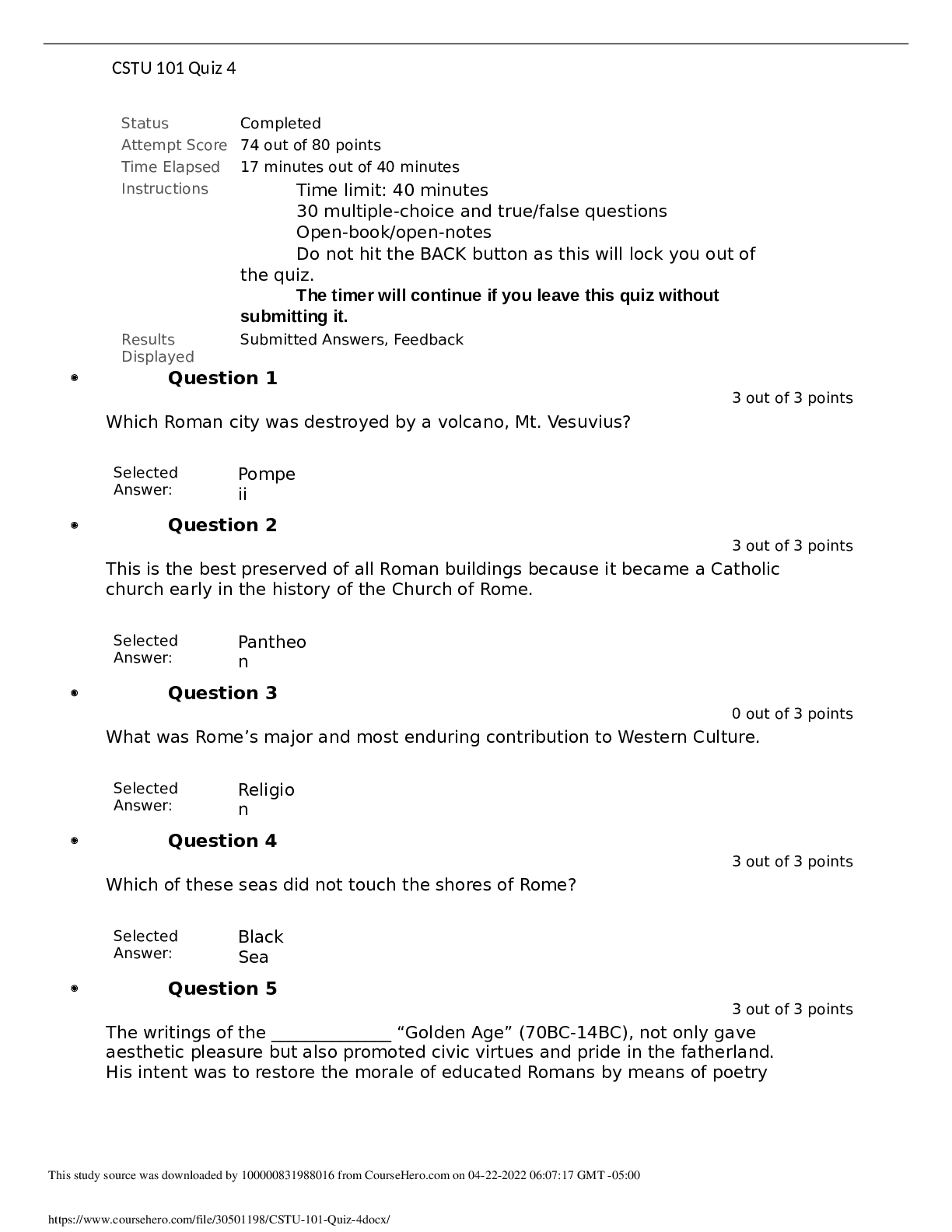
Liberty University CSTU 101 Quiz 4
· Question 1
3 out of 3 points
Which Roman city was destroyed by a volcano, Mt. Vesuvius?
Pompeii
· Question 2
3 out of 3 points
This is the best pr
...
Liberty University CSTU 101 Quiz 4
· Question 1
3 out of 3 points
Which Roman city was destroyed by a volcano, Mt. Vesuvius?
Pompeii
· Question 2
3 out of 3 points
This is the best preserved of all Roman buildings because it became a Catholic church early in the history of the Church of Rome.
Pantheon
· Question 3
0 out of 3 points
What was Rome’s major and most enduring contribution to Western Culture.
Religion
· Question 4
3 out of 3 points
Which of these seas did not touch the shores of Rome?
Black Sea
· Question 5
3 out of 3 points
The writings of the ______________ “Golden Age” (70BC-14BC), not only gave aesthetic pleasure but also promoted civic virtues and pride in the fatherland. His intent was to restore the morale of educated Romans by means of poetry and history.
Maecenas
· Question 6
3 out of 3 points
According to the Roman timeline this Republic began around what date?
510 BC
· Question 7
3 out of 3 points
The greatest Roman poet of the Republic.
Lucretius
· Question 8
3 out of 3 points
According to your textbook who is the greatest Roman historian?
Tacitus
· Question 9
0 out of 3 points
Greeks characteristically created while the Romans were often content to copy art; Roman artists excelled in portraiture and ____________________ narrative precisely because they copied the work as they saw it.
cultural
· Question 10
3 out of 3 points
Caesar Augustus, we know from the Bible gave himself this name. What was his name before he took this new name?
Octavian
· Question 11
3 out of 3 points
What structure did the Romans build that allowed their expression of who they were in the world and what they were trying to do? It was also used as a propaganda device; a representation of the yoke of oxen.
Triumphal Arch
· Question 12
3 out of 3 points
Which document did Jefferson write?
Declaration of Independence
· Question 13
3 out of 3 points
Representing Roman engineering and power, ______________ were a highly visible portion of the network of waterways.
Aqueducts
· Question 14
3 out of 3 points
Which two structures illustrate Roman eclecticism?
Coliseum and Pantheon
· Question 15
3 out of 3 points
Who wrote the poem the Aeneid?
Virgil
· Question 16
3 out of 3 points
From the Christian's perspective which of these is true?
"Lex, Rex"
· Question 17
3 out of 3 points
This is the oldest continuously used religious building in the West, having started as a pagan temple and then converted to a Catholic church.
Pantheon
· Question 18
3 out of 3 points
His long sentences and his forceful word choice and arrangement made him the model of all who aspired to write Latin correctly from antiquity right through the Renaissance.
Cicero
· Question 19
3 out of 3 points
Literally means “the public affair” or “the people’s affair”.
Republic
· Question 20
3 out of 3 points
The period from the rule of Caesar Augustus through Marcus Aurelius.
Pax Romana
· Question 21
2 out of 2 points
The Romans took pride in their Imperialism.
True
· Question 22
2 out of 2 points
The Greeks had slaves but the Romans chose not to embrace slavery.
False
· Question 23
2 out of 2 points
The Greeks were more interested in what works, while the Romans were more interested in what is right.
False
· Question 24
2 out of 2 points
The Romans viewed the Greek culture as very distasteful and refused to use any of it with their own culture.
False
· Question 25
2 out of 2 points
Lex, Rex was written by the King of England in 1644.
False
· Question 26
2 out of 2 points
The chief arts of Rome were architecture and sculpture.
True
· Question 27
2 out of 2 points
Much of our knowledge of Roman painting comes from the buried city of Pompeii.
True
· Question 28
2 out of 2 points
The Roman Coliseum was not as big as previously thought and probably only held a few thousand people.
False
· Question 29
2 out of 2 points
Greece has very little influence on the Roman culture?
False
· Question 30
2 out of 2 points
Duty, honor, and patriotism were Greek virtues as opposed to the Roman ideals of freedom, truth, and beauty.
False
[Show More]