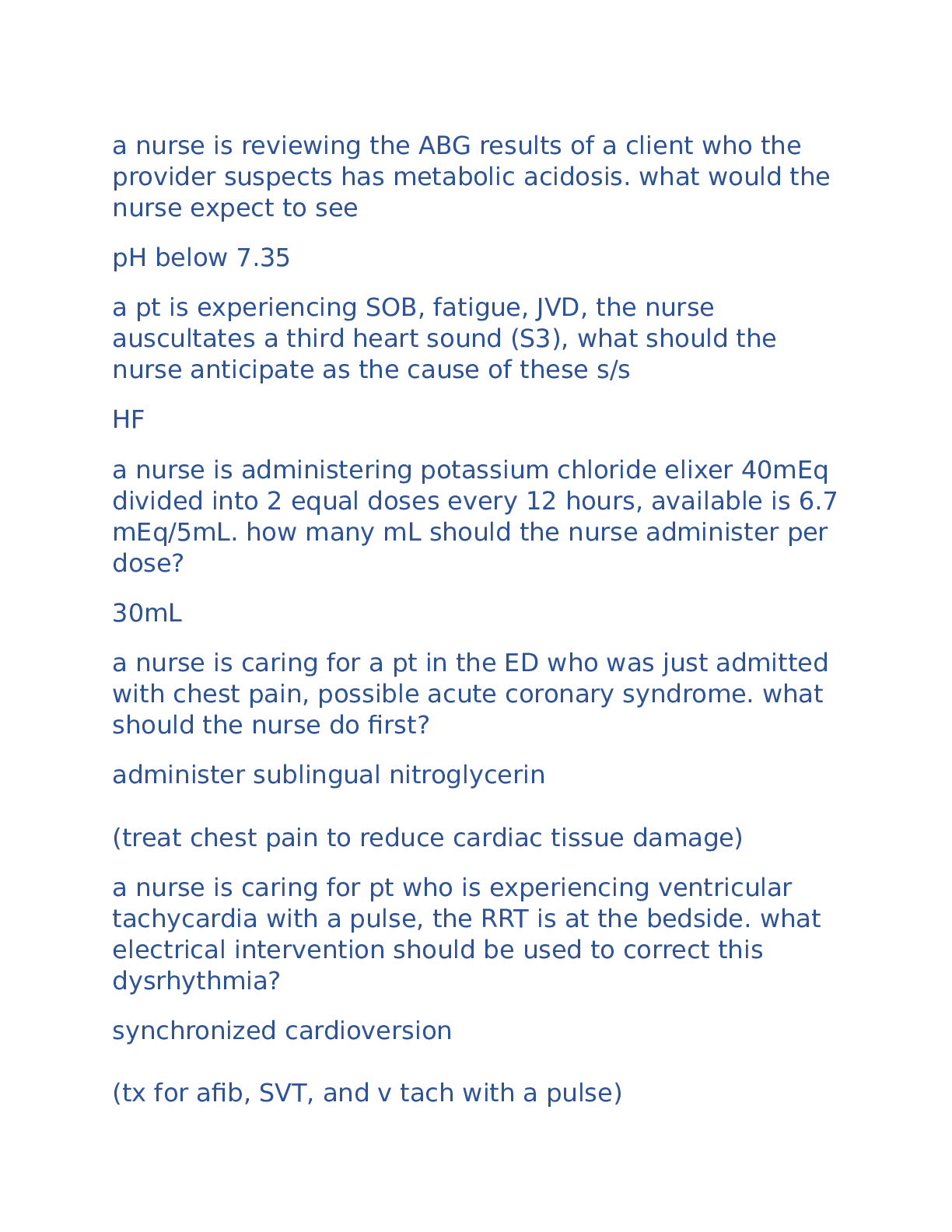
Maternity/OB PN Hesi Specialty V2
1. A client is admitted to the labor and delivery unit with contractions that are 3-5 minutes apart, lasting
60-70 seconds. She reports that she is leaking fluid. A vaginal exam reve
...
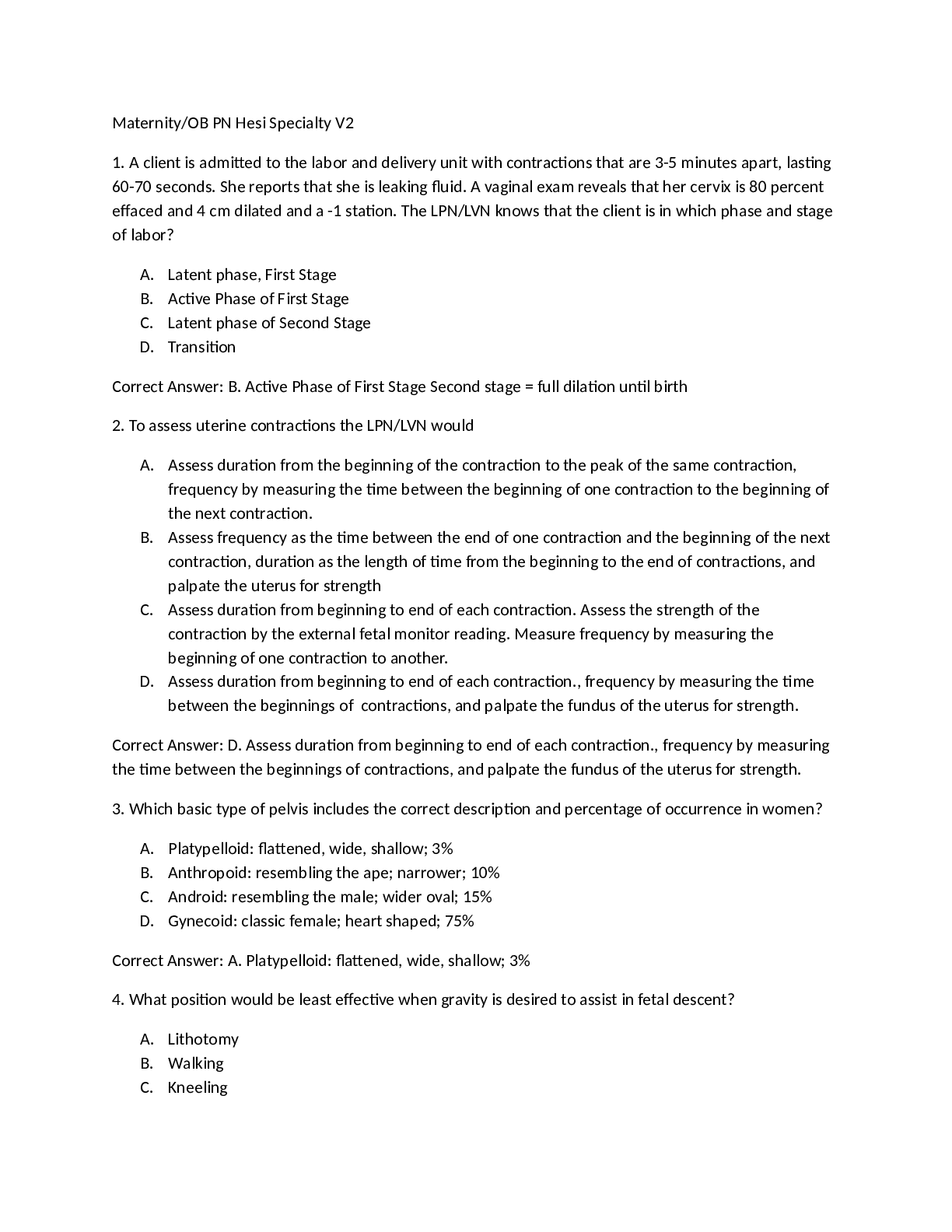
Maternity/OB PN Hesi Specialty V2
1. A client is admitted to the labor and delivery unit with contractions that are 3-5 minutes apart, lasting
60-70 seconds. She reports that she is leaking fluid. A vaginal exam reveals that her cervix is 80 percent
effaced and 4 cm dilated and a -1 station. The LPN/LVN knows that the client is in which phase and stage
of labor?
A. Latent phase, First Stage
B. Active Phase of First Stage
C. Latent phase of Second Stage
D. Transition
Correct Answer: B. Active Phase of First Stage Second stage = full dilation until birth
2. To assess uterine contractions the LPN/LVN would
A. Assess duration from the beginning of the contraction to the peak of the same contraction,
frequency by measuring the time between the beginning of one contraction to the beginning of
the next contraction.
B. Assess frequency as the time between the end of one contraction and the beginning of the next
contraction, duration as the length of time from the beginning to the end of contractions, and
palpate the uterus for strength
C. Assess duration from beginning to end of each contraction. Assess the strength of the
contraction by the external fetal monitor reading. Measure frequency by measuring the
beginning of one contraction to another.
D. Assess duration from beginning to end of each contraction., frequency by measuring the time
between the beginnings of contractions, and palpate the fundus of the uterus for strength.
Correct Answer: D. Assess duration from beginning to end of each contraction., frequency by measuring
the time between the beginnings of contractions, and palpate the fundus of the uterus for strength.
3. Which basic type of pelvis includes the correct description and percentage of occurrence in women?
A. Platypelloid: flattened, wide, shallow; 3%
B. Anthropoid: resembling the ape; narrower; 10%
C. Android: resembling the male; wider oval; 15%
D. Gynecoid: classic female; heart shaped; 75%
Correct Answer: A. Platypelloid: flattened, wide, shallow; 3%
4. What position would be least effective when gravity is desired to assist in fetal descent?
A. Lithotomy
B. Walking
C. Kneeling
D. Sitting
Correct Answer: A. Lithotom
[Show More]

.png)








.png)


.png)



 Chamberlain College Of Nursing (100 Correct Q & A.png)