Midterm SG
1. General principles of Nursing Informatics
o Informatics: Turns data into information
Focuses on HIT & involves computer, cognitive and social sciences
Science of how to use data, information and kno
...
Midterm SG
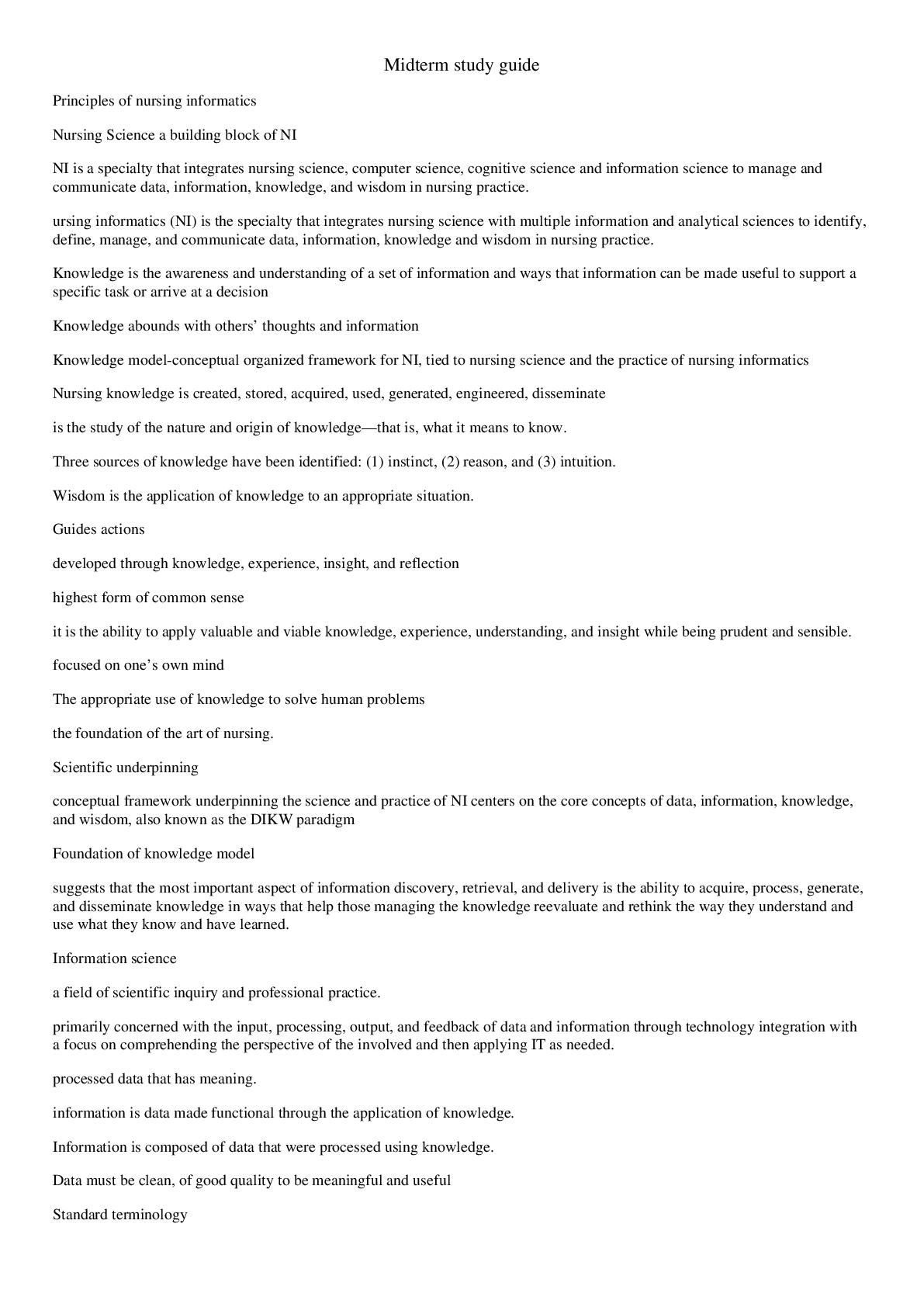
1. General principles of Nursing Informatics
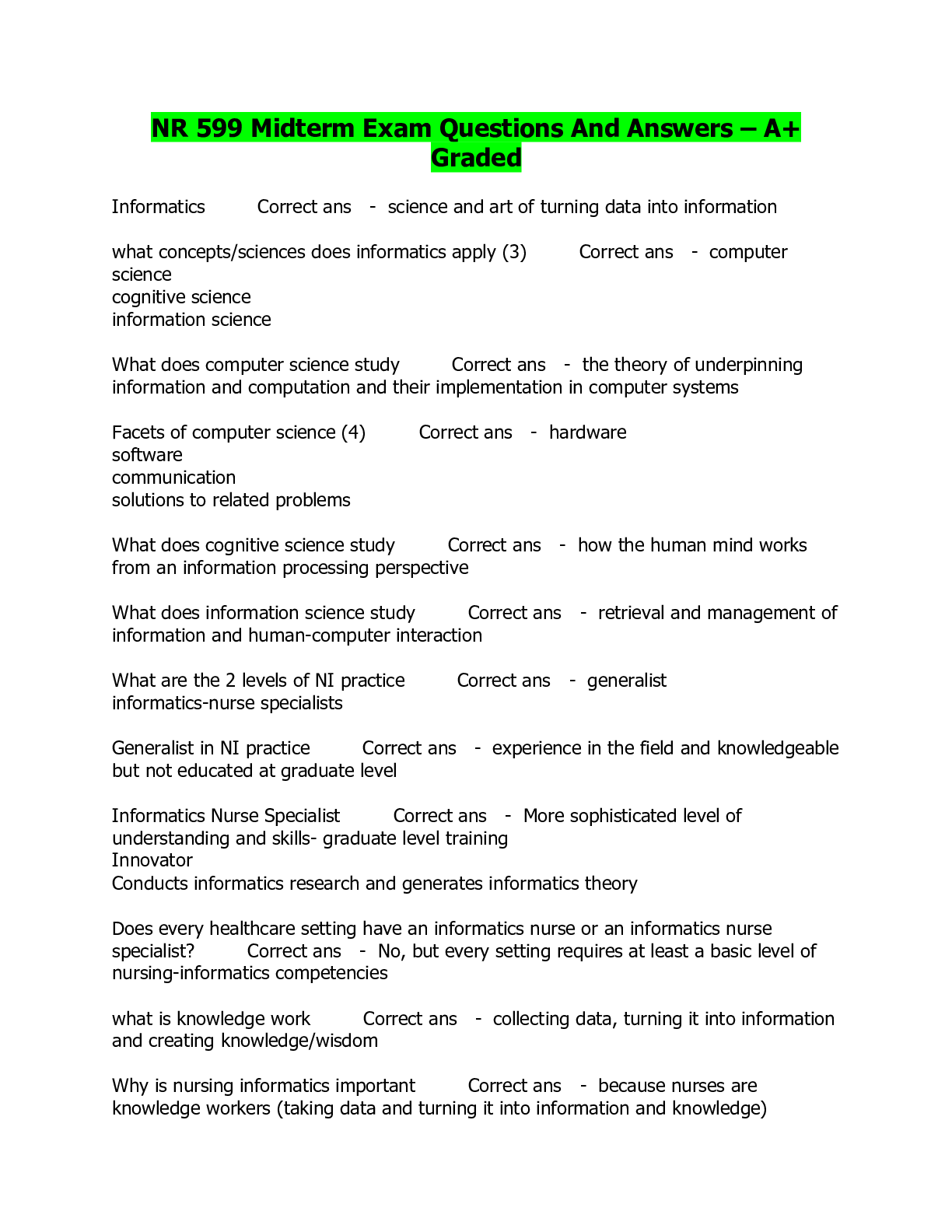
o Informatics: Turns data into information
Focuses on HIT & involves computer, cognitive and social sciences
Science of how to use data, information and knowledge to improve human health & delivery
NI: specialty integrating nursing science, computer science, information science and
cognitive science to manage and communicate data, information, knowledge, and wisdom in
nursing practice.
Building blocks of NI: Nursing, information, computer and cognitive science
2. Knowledge
o Information is a key building block of knowledge
o Awareness and understanding of a set of information and ways that information can be made useful
to support a specific task or arrive at a decision
o Information that is synthesized so that relationships are identified and formed
o Information that has judgment applied to it or meaning extracted from it
o Processed information that helps to clarify or explain some portion of our environment or world that
we can use as a basis for action or upon which we can act.
o Internal process of thinking (cognition)
o External process of testing, sense, observation, and interacting
Knowledge that is patterned for use in reasoning is known as knowledge representation
o Epistemology: study of the nature and origin of knowledge (what it means 2 know)
o Sources of knowledge: instinct, reason and intuition
3. Wisdom
o “Foundation of the art of nursing”
o “Highest form of common sense” result from accumulated knowledge or deep learning (erudition) or
enlightenment
o Application of knowledge to an appropriate situation.
o Actions are directed by wisdom
o Uses knowledge and experience to heighten common sense and insight to exercise sound judgment
in practical matters
o Its developed through knowledge, experience, insight, and reflection.
o Transparent wisdom: applying knowledge in a practical way or translating knowledge into actions
without conscious thought
Knowledge abounds with others’ thoughts and information, whereas wisdom is focused on one’s own mind and
the synthesis of experience, insight, understanding, and knowledge.
4. The Foundation of Knowledge Model Base: bits, bytes (quantify data) data and information
ADGP Cones: aspects of knowledge
1. Knowledge Acquisition: the act of getting
knowledge
2. Knowledge Dissemination: distribution and
sharing of knowledge
3. Knowledge Generation: The creation of new
knowledge by changing and evolving knowledge
based on one’s experience, education, and input
from others.
4. Knowledge Processing: (where A, D & G
intersect) The activity or process of gathering or
collecting, perceiving, analyzing, synthesizing,
saving or storing, manipulating, conveying, and
transmitting knowledge.
Feedback: cut through & may transform all aspects
of knowledge (cones).
ADGP & feedback are constantly evolving
This study source was downloaded by 100000831988016 from CourseHero.com on 04-25-2022 01:29:06 GMT -05:00
https://www.coursehero.com/file/54567420/Midterm-SGdocx/
5. Scientific Underpinning
o Cognitive science
o DIKW paradigm (data, info, knowledge, wisdom)
6. Computer science
o Offers tools that if used right, can facilitate acquisition and manipulation of data and information by
nurses, who can then synthesize these into evolving knowledge and wisdom base.
o Can facilitate professional development and the ability to apply evidence-based practice decisions
within nursing care, and if the results are disseminated and shared, can also advance the professional
knowledge base.
7. Cognitive science
o Studies the mind, intelligence, and behavior from an information-processing perspective
8. Information science
o Information is data made functional through the application of knowledge
o Information is valuable if: accessible, accurate, timely, complete, cost-effective, flexible, reliable,
relevant, simple, verifiable, and secure
o Data is converted to information (& new knowledge) when previous knowledge is applied to data.
o
9. Standard Terminology
o
10. Informatics Competencies
o NI competency
o Three categories: computer skills, informatics knowledge, and informatics skills
11.Information literacy
o Framework for finding, understanding, evaluating and using information
12. Health literacy
o The degree to which individuals have the capacity to obtain, process, and
understand basic health information and services needed to make appropriate
health decision
This study source was downloaded by 100000831988016 from CourseHero.com on 04-25-2022 01:29:06 GMT -05:00
https://www.coursehero.com/file/54567420/Midterm-SGdocx/
o
13. Meaningful Use (MU)
o Rules and regulations established by the ARRA (American recovery and reinvestment act)
o Healthcare organizations can qualify for financial incentives based on the level of MU
o The ARRA of 2009 specifies three main components of meaningful use:
(1) the use of a certified electronic health record (EHR) in a meaningful manner, such as eprescribing;
(2) the use of certified EHR technology for electronic exchange of health information to
improve quality of health care; and
(3) the use of certified EHR technology to submit clinical quality and other measures.
o The criteria for meaningful use will be staged in three steps.
Stage 1 (2011–2012) set the baseline for electronic data capture and information sharing.
Stage 2 (2014)
Stage 3 (launched in 2017/2017) continue to expand on this baseline and be developed
through future rule making.
o The goal of meaningful use is to exchange clinical structured data in a manner that is
accurate and complete to improve patient care in a cost-efficient way.
14. Patient-centered Information Systems
o Patient-centered information systems focused on collecting data and
disseminating information related to direct care. Several of these systems have
become mainstream types of systems used in health care. The four types of
systems most commonly found in healthcare organizations include (1) clinical
documentation systems, (2) pharmacy information systems, (3) laboratory
information systems, and (4) radiology information systems.
15. Clinical Decision Support Systems
o A computer-based program designed to assist clinicians in making clinical
decisions by filtering or integrating vast amounts of information and providing
suggestions for clinical intervention. May also be called a clinical decision
support system (CDSS).
16. Electronic Medical Records
o Computer-based data warehouses or repositories of information regarding the
health status of a client, which are replacing the former paper-based medical
records; they are the systematic documentation of a client’s health status and
health care in a secured digital format, meaning that they can be processed,
stored, transmitted, and accessed by authorized interdisciplinary professionals
for the purpose of supporting efficient, high-quality health care across the
client’s healthcare continuum. Also known as electronic medical records (EMRs).
This study source was downloaded by 100000831988016 from CourseHero.com on 04-25-2022 01:29:06 GMT -05:00
https://www.coursehero.com/file/54567420/Midterm-SGdocx/
17. Human-Technology Interface
o The hardware and software through which the user interacts with any
technology (e.g., computers, patient monitors, telephone).
18. Health Information Technology (HIT)
19. Alarm fatigue
o Multiple false alarms by smart technology that cause workers to ignore or
respond slowly to them.
20. Digital natives
21. Information Literacy Competency Standards for Nursing
22. HITECH Act
23. TIGER-based Nursing Informatics Competencies Model
o Tiger initiative: the work of the technology informatics guiding education reform team. This team
of nurse leaders developed a vision for utilizing information technology to transform nursing
practice
Focus of Nursing
Human responses to actual or potential health problems and advocacy for various
clients
Nursing Science
The ethical application of knowledge acquired through education, research, and
practice to provide services and interventions to patients so as to maintain, enhance,
or restore their health; to advocate for health; and to acquire, process, generate, and
disseminate nursing knowledge to advance the nursing profession.
Borrowed theories
Theories borrowed or made use of from other disciplines. As nursing began to
evolve, theories from other disciplines (e.g., psychology, sociology) were adopted to
try to empirically describe, explain, or predict nursing phenomena. As nursing
theories continue to be developed, nurses are now questioning whether these
borrowed theories were sufficient or satisfactory in their relation to the nursing
phenomena they were used to describe, explain, or predict.
Nursing theories
Concepts, propositions, and definitions that represent a methodical viewpoint and
provide a framework for organizing and standardizing nursing actions.
Clinical database
Collections of related patient records stored in a computer system using software
that permits a person or program to query the data to extract needed patient
information.
Clinical practice
guidelines
Informal or formal rules or guiding principles that a healthcare provider uses when
determining diagnostic tests and treatment strategies for individual patients. In the
electronic health record, they are included in a variety of ways such as prompts,
pop-ups, and text messages.
Relational database
A database that can store and retrieve data very rapidly.
“Relational” refers to how the data are stored in the database and
how they are organized.
Data mining
A process of utilizing software to sort through data so as to
discover patterns and ascertain or establish relationships. This
process may help to discover or uncover previously unidentified
relationships among the data in a database.
Computer science Branch of engineering (application of science) that studies the theoretical
foundations of information and computation and their implementation and
This study source was downloaded by 100000831988016 from CourseHero.com on 04-25-2022 01:29:06 GMT -05:00
https://www.coursehero.com/file/54567420/Midterm-SGdocx/
application in computer systems. The study of storage/memory, conversion and
transformation, and transfer or transmission of information in machines— that is,
computers—through both algorithms and practical implementation problems.
Algorithms are detailed, unambiguous action sequences in the design, efficiency,
and application of computer systems, whereas practical implementation problems
deal with the software and hardware.
practicing nurses could be classified into four categories: (1) beginning nurse, (2) experienced nurse,
(3) informatics nurse specialist , and (4) informatics innovator .
This study source was downloaded by 100000831988016 from CourseHero.com on 04-25-2022 01:29:06 GMT -05:00
https://www.coursehero.com/file/54567420/Midterm-SGdocx/
This study source was downloaded by 100000831988016 from
[Show More]