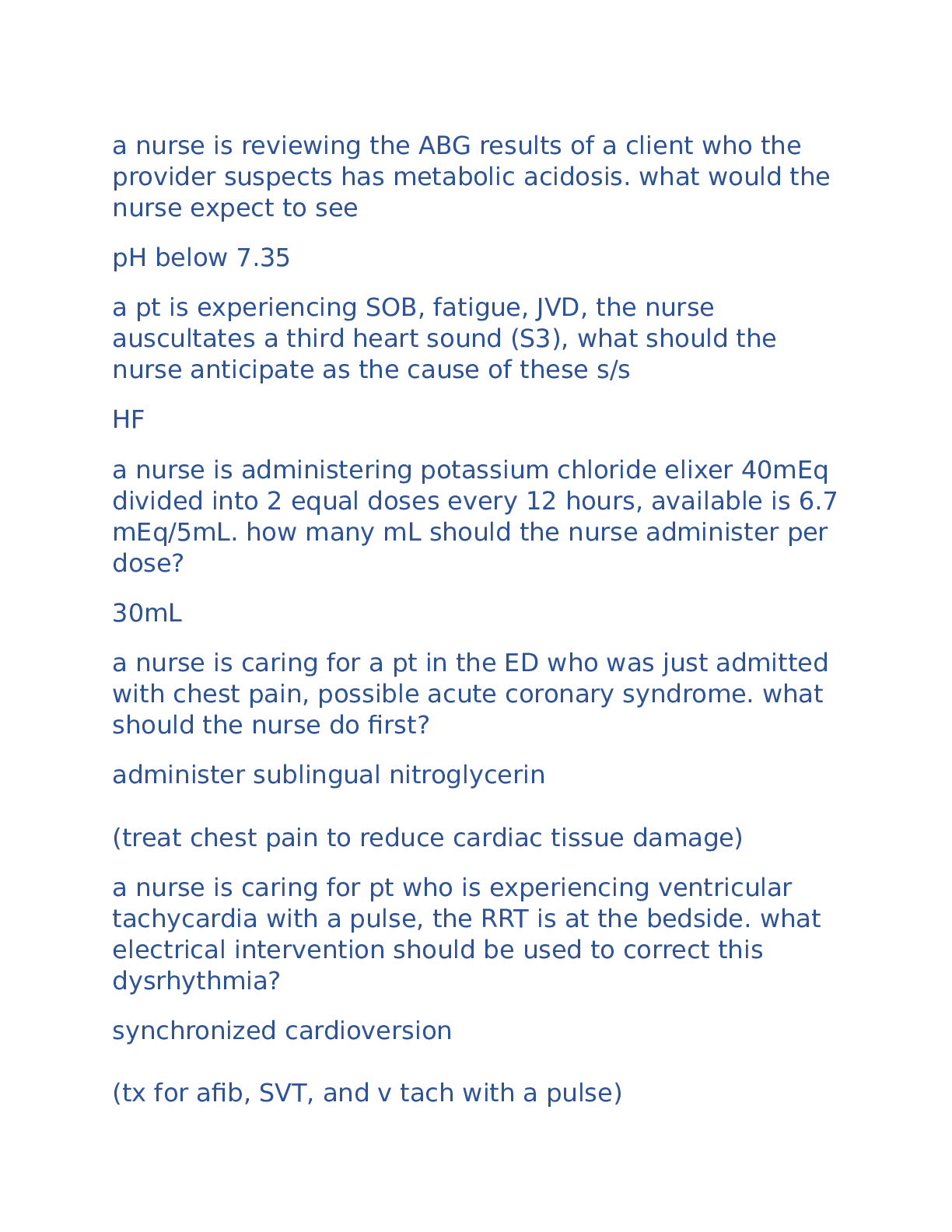
Exam 2
1. True or False: As movement requires energy, metabolism can be defined as a controlled set of
biochemical reactions that occur in only motile organisms in order to maintain life. False.
Metabolism occurs in
...
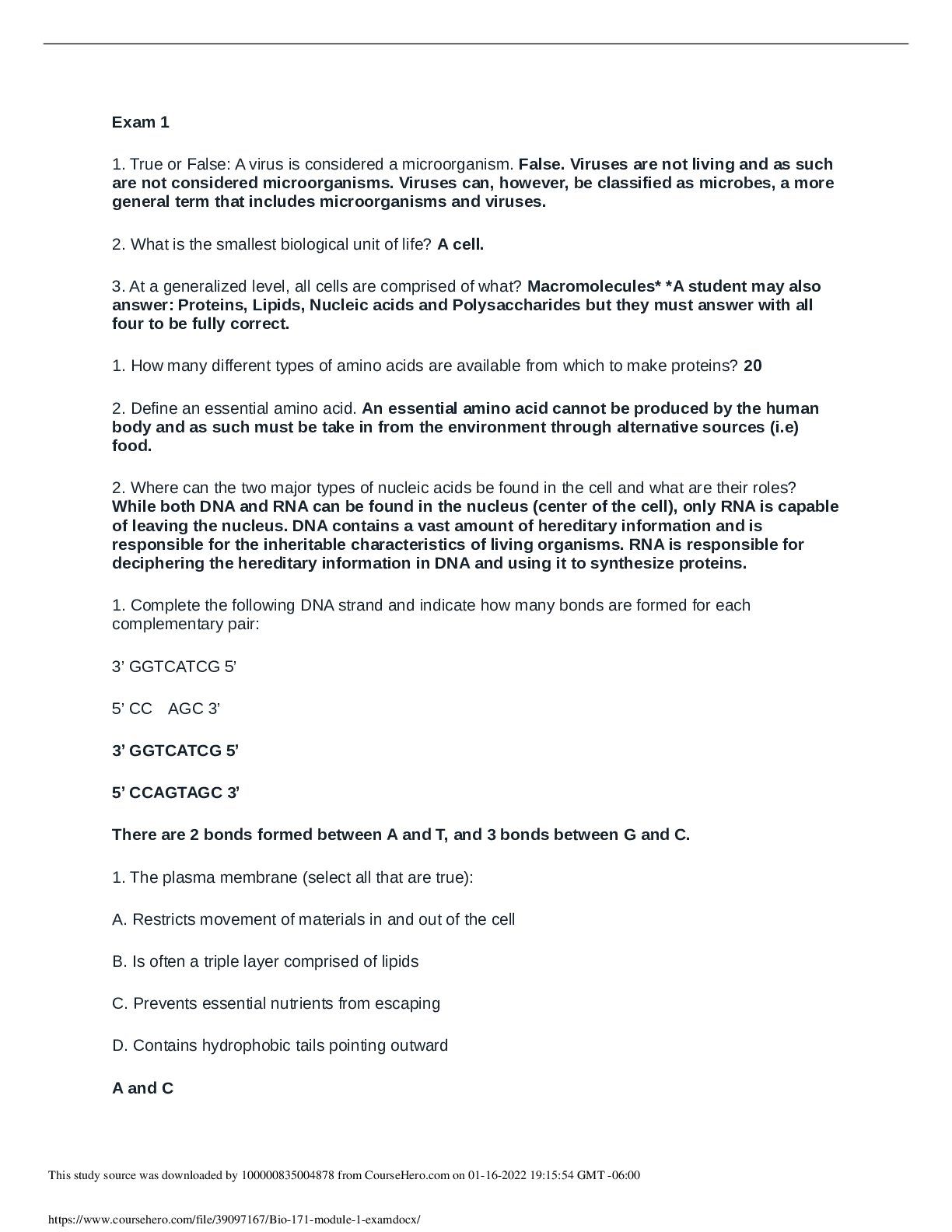
Exam 2
1. True or False: As movement requires energy, metabolism can be defined as a controlled set of
biochemical reactions that occur in only motile organisms in order to maintain life. False.
Metabolism occurs in all living organisms, not just those that move.
2. True or False: Enzymes slow down chemical reactions to conserve energy. False. Enzyme
catalyze (speed up) chemical reactions.
3. What is a cofactor? And give a general example. A cofactor is a small chemical component
that assists an enzyme during the catalysis reactions. A cofactor is usually metal ions.
1. Define catabolism. Catabolism is the process of breaking down larger molecules into useful
energy sources.
2. Upon cellular injury, which metabolic process is involved during the growth and repair phases of
the cell? The anabolic process would be active as it (by definition) is involved in the building
up of small complexes into larger complexes.
1. Describe the energy transfer process relative to both ATP and ADP. ATP has the energy
(phosphate group) to donate while ADP can accept energy in the form of a
phosphate group. Thus, ATP can be reduced (ATP →ADP + Pi) while ADP can be
built into ATP (ADP + Pi →ATP).
2. An organism that derives its energy (generates ATP) from photons of light is called a _________?
Phototrophic microorganism.
An organism that derives its energy by removing electrons from elemental sulfur would be classified
as a __________? Lithotroph
4. A reactive intermediate would be present in which phosphorylation process?
A. Photophosphorylation
B. Substrate-level phosphorylation
C. Oxidative phosphorylation
B. The chemical compound losing the phosphate group is referred to as the phosphorylated
reactive intermediate.
1. Identify the products of the following chemical equation:
Glucose + 2NAD+ → 2 NADH + 2 Pyruvate + 2 ATP The products are to the right of the
arrow: 2NADH, 2 Pyruvates and 2 ATP
2. What are the main two roles of glucose-6-phosphate in the cell? Glucose-6-phosphate, also
known as G6P (1) prevents glucose from diffusing out of the cell as well as (2) serves as the
signal molecule to the cell that glycolysis is about to begin.
This study source was downloaded by 100000835004878 from CourseHero.com on 01-16-2022 19:15:07 GMT -06:00
https://www.coursehero.com/file/39094148/Bio-171-Module-2-Examdocx/
3. True or False: During fermentation one means of eliminating pyruvate is by converting it into lactic
acid. True. Pyruvate can be converted into either lactic acid or ethanol and then eliminated
from the cell.
1. What is the primary byproduct of the TCA cycle? Select all that apply.
A. NAD+
B. FAD
C. NADH
D. FADH2
C and D. The TCA cycle produces an abundance of reduced electron carriers (NADH and
FADH2).
2. True or False. The reactants of the TCA cycle directly enter and fuel the electron transport system.
False. The products of the TCA cycle (reduced electron carriers) enter and drive the
production of ATP via the electron transport system.
1. In the absence of glucose, which of the following can be used as alternative energy sources?
Select all that apply.
A. Lactose
B. Nucleic acids
[Show More]











.png)



 Chamberlain College Of Nursing (100 Correct Q & A.png)