NR 508 Final Exam Consist of 100 Questions From a Random Test Bank of
Questions from All 8 weeks and All Embedded Recorded Lectures. Information is
taken from the following Areas listed below: These areas are areas to
...
NR 508 Final Exam Consist of 100 Questions From a Random Test Bank of
Questions from All 8 weeks and All Embedded Recorded Lectures. Information is
taken from the following Areas listed below: These areas are areas to help you
understand the concepts better they are in NO way an indication of what you are
guaranteed to see on the exam. Remember these are random some of your
classmates may not have the same question that appear on your exam. PLEASE
NOTE that this study guide may not be inclusive of all topics you may see on the
exam
Cardiovascular management:
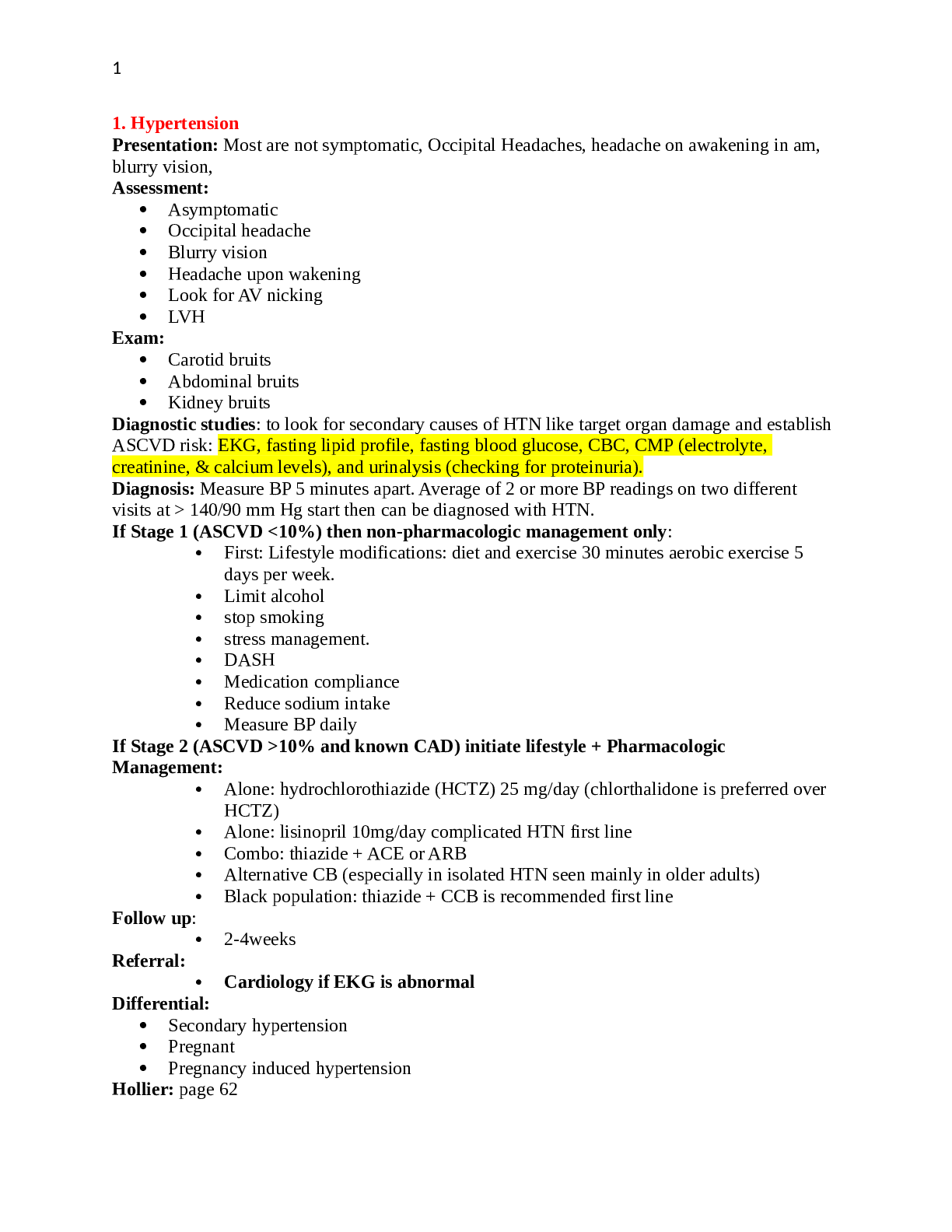
Know Initial treatment choices for HTN
Know first line treatment options for HTN for African Americans without renal
impairment.
First line option for HTN for anyone with chronic kidney disease
Diuretics:
Types
Uses
Side effects
Names (eg metolazone, furosemide, spironolactone, HCTZ
Preferred diuretic with renal impairment
Side effect of post diuretic sodium retention
Recognition that some diuretics are sulfa derivatives (carbonic anhydrase
inhibitors, loop diuretics, thiazides, but NOT ethacrynic acid)
Management of edema
CHF drugs including diuretic choices
Neuro/Psych:
Know migraine management and prophylactics (see migraine lecture)
Herbal migraine management
What drugs can cause serotonin syndrome?
What migraine prophylactic medication class to avoid in patients with asthma.
Know the common side effects of methylphenidate Ritalin
ADHD management –
This study source was downloaded by 100000831988016 from CourseHero.com on 04-26-2022 06:48:09 GMT -05:00
https://www.coursehero.com/file/31629962/Final-Exam-Guide-May-2018-1docx/
At what age can ADHD dx be made?
Stimulants including
Side effects -eg HA, tics, appetite suppression, elevated BP
At what age can medications for ADHD be prescribed?
Which is the longest acting stimulant?
Nonstimulant alternatives:
Strattera/ atomoxetine
Clonidine derivatives eg guanfacine (intuniv)- these tend to be most effective in
younger boys with hyperactivity symptoms and can be helpful with insomnia
Buproprion (wellbutrin) (it is an off-label use) – consider in adolescent who also
has depressive symptoms
Know the treatment of Alzheimer’s and the education behind the medication
management of the disease.
- Cholinesterase inhibitors (ChE inhibitors (this abbreviation may be seen on the
exam) eg donepezil: Can be used at any stage; Helps with functioning
- Memantine for moderate to late stages; can be added to ChE inhibitors
(When are each of them indicated? What is their benefit?)
Parkinson Disease: Drugs including
- Levodopa/carbidopa – monotherapy or adjunctive; most effective therapy for
slowness, stiffness, tremor; can cause dyskinesias (abnormal movements)
- Benztropine – this is an anticholinergic that can be used to treat tremor in
younger patients with PD; it can also be used to treat excessive drooling;
anticholinergics can cause confusion, hallucinations, dry mouth, blurred vision
and urinary retention (anticholinergic adverse effects more commonly a problem
for older patients)
- MAOI (eg selegiline) – monotherapy for slowness, stiffness therapy; adjunctive
as well for motor fluctuations – wearing off phenomena
- Amantadine – not the most effective but can be tried as adjunctive therapy for
classic PD sx of slowness, stiffness and tremor
- Pramipexole – this is a dopamine agonist and can be used as mono or adjunctive
therapy for classic PD sx
This study source was downloaded by 100000831988016 from CourseHero.com on 04-26-2022 06:48:09 GMT -05:00
https://www.coursehero.com/file/31629962/Final-Exam-Guide-May-2018-1docx/
- Apomorphine – used for late stage PD as an adjunctive therapy for wearing off
symptoms
- Wearing off phenomena
- Effect of protein on absorption of levodopa
Depression medications including
SSRIs
SNRIs
Recognition that the SNRI duloxetine can be used for pain management as well
It has official approval for both OA and fibromyalgia and neuropathic pain.
Which SSRI is approved for use in children/teen?
Monitoring of depression.
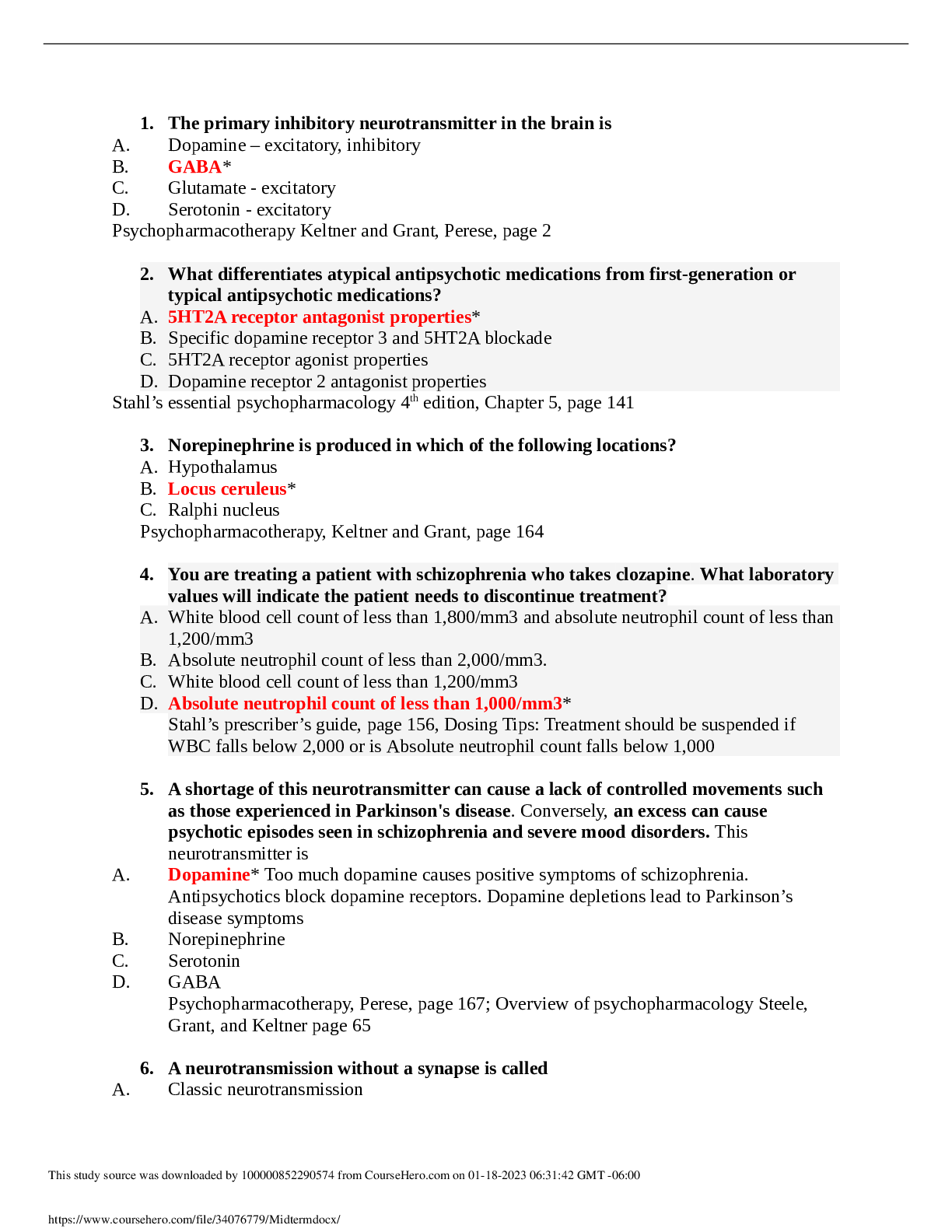
Side effects of antipsychotics
What is the side effect of antipsychotics that can lead to abnormal rhythmic
movements? How should this be managed?
- Serentil
- Mesoridazine
- Lab monitoring required with Clozaril
- Side effects of carbamazepine and lab monitoring
Know first line treatment for generalized seizure management (eg Dilantin) not
adjunct therapies
GU:
Be familiar with Beer’s Criteria
Evaluation of incontinence – initial steps
Meds for erectile dysfunction know which have a quick onset of action. – which has
quickest onset: tadalafil (Cialis), sildenafil (Viagra), avanafil (Stendra) or vardenafil
(Levitra)?
Why should we avoid use of chronic nitrofurantoin in older adults? (See Geriatric
lecture)
Endocrine:
Know the treatment and labs for Hyperthyroid and Hypothyroid (know normal TSH and
T4 labs as well as pattern seen with hypo vs hyperthyroidism)
This study source was downloaded by 100000831988016 from CourseHero.com on 04-26-2022 06:48:09 GMT -05:00
https://www.coursehero.com/file/31629962/Final-Exam-Guide-May-2018-1docx/
What dose of levothyroxine should be started in a patient who has coronary artery
disease?
How often should one obtain a TSH when initially treating hypothyroidism?
Know what labs indicate Hypothyroid and which indicate Hyperthyroid
Know side effects of hyperthyroid medications
How to monitor methimazole therapy
What is the typical course of congenital hypothyroidism – will the child always need
thyroid replacement?
Know how to prescribe oral diabetic medications and what labs to monitor.
Know first line medication management in Type II Diabetes.
Know first line oral diabetes management in a patient with and without renal disease.
DM:
Preferred first line oral agent- Metformin
Vitamin deficiency associated with this drug (Metformin)
Side effects of this drug (Metformin)
MOA and side effects of acarbose
MOA and side effects of canaglifozin
ENT:
Know the treatment for Otitis Media and Otitis Externa
Preferred medication for impetigo (honey crusted skin lesions)? What are the
recommended therapies if the impetigo is in a limited area vs more extensive?
Preferred first line antibiotic for acute OM including dose and management of otorrhea
in a patient who has tympanostomy tubes
How should you manage OME? When should you check hearing in a patient who has
OME?
How should you treat resistant AOM?
(See lecture slides under Course Resources)
Tx of otitis externa
GI/nutrition:
This study source was downloaded by 100000831988016 from CourseHero.com on 04-26-2022 06:48:09 GMT -05:00
https://www.coursehero.com/file/31629962/Final-Exam-Guide-May-2018-1docx/
Know evaluation and treatment of IBS including specific medications and their side
effects, assessment of abdominal pain, evaluation and tx of IBS
Antispasmodics, simethicone, TCAs
Tx of infant with oral candidiasis/thrush
Vitamin deficiency questions (eg what are the symptoms of various vitamin
deficiencies?)
What vitamin deficiency is common with chronic alcohol abuse?
What iron deficiency is associated with overconsumption of milk in toddlers? What is the
screening test that should be ordered?
What side effect can occur with salt substitutes?
Vitamins a vegetarian may require
[Show More]

.png)