ATI CAPSTONE A & B COMBINATION ASSESSMENT
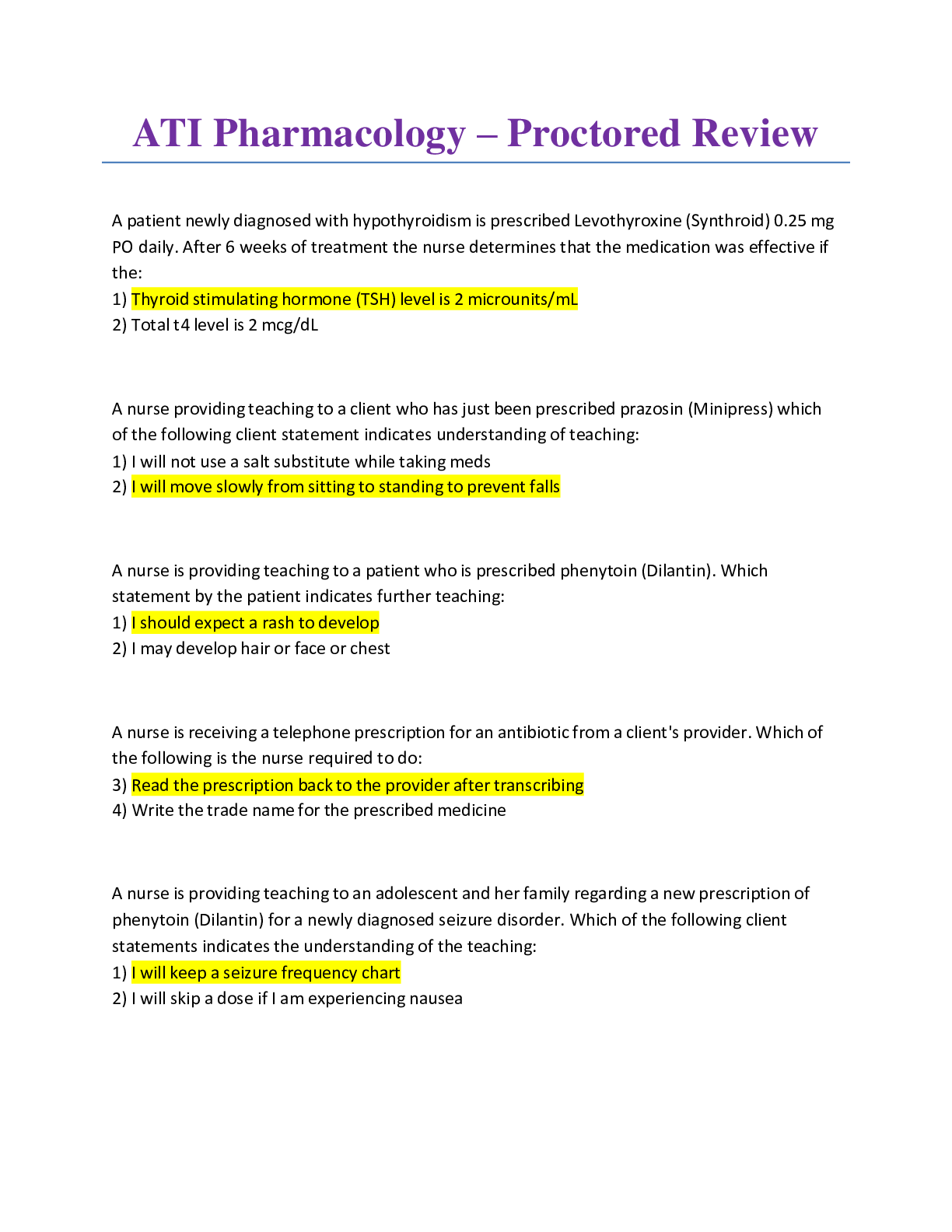
1. what is montelukast (singular) for?
a. a leukotriene modifier, and is taken on a regular basis, once a day, and not prn, and is not used for exercise induced asthma
2. wh
...
ATI CAPSTONE A & B COMBINATION ASSESSMENT
1. what is montelukast (singular) for?
a. a leukotriene modifier, and is taken on a regular basis, once a day, and not prn, and is not used for exercise induced asthma
2. what does advance directives contain?
a. written instructions regarding end of life care
3. what is the greatest risk to a pt receiving hemodialysis?
a. disequilibrium syndrome as a result of rapid loss of fluids and decrease bun
4. what is the clinical manifestation of disequilibrium?
a. restlessness and decreased level of consciousness
5. what are expected findings in hemodialysis?
a. elevated temp
weight loss
decreased bp
6. what should the nurse do when a pt feels lightheaded and begins to fall?
a. spread feet apart and extend one leg for the pt to slide down while lowering the pt to the floor
7. what are the characteristics of a pt with dependent personality disorder?
a. they have problems making everyday decision without input from others
8. a pregnant pt who is bleeding is always?
a. priority
9. what should a pregnant pt with urgency and frequent urination do?
a. should perform kegel exercises
10. what should a pregnant pt with odorless vaginal mucus do?
a. practice good hygiene, use perineal pads
11. a pregnant pt with edema of the ankles do?
12. avoid prolonged standing, to wear support hose, and rest through out the day with legs/hip elevated
13. when should a colostomy bag be changed?
when is 1/3 -1/2 full
14. how large should the opening of the stoma pouch be?
no larger than 1/4 inch
15. what should the pt with a colostomy avoid?
the use of moisturizers, which will decrease the adherence of the pouch to the skin
16. what should the pt do with the pouch removing it?
17. they should empty the pouch to avoid spilling the effluent on to the skin
18. where should drops be instill into?
19. into the conjuctival sac
20. what is a positive way of dealing with a terminal illness?
21. "remembering things they used to do together"
22. what are normal findings after a colonoscopy?
23. abd cramping
fatigue
passage of liquid stools
24. what are unexpected finding after a colonoscopy?
25. guarding- can indicate bowel perforation
26. what do you do if an order is questioned?
27. the nurse should record seeking clarification from the provider
28. what should pt with gastritis eat?
29. a well balanced diet, they should keep a record of foods that cause discomfort, pts can modify their diet accordingly
30. what is the cause autonomic dysreflexia?
31. bladder distention
32. what are s/s of icp?
33. restlessness
change in LOC
34. what is late s/s of ICP?
35. widening pulse
decerebrate posturing
36. when can a child with varicella(chickenpox) return school?
37. the child can return to school when the blisters are dry and no longer drained (scabbed over)
38. what is an appropriate behavior of a pt with hx of violence?
39. pt will avoid violence provoking situations
40. what is a skin cancer prevention?
41. pts should use sunscreen that protects against uva and uvb
42. what is the first thing you should do with excessive lochial discharge?
43. perform a fundal massage
44. what is the nurse responsibility of the nurse when witnessing the pts signature on an informed consent?
45. that the pt is fully informed and understands the procedure befor signing the consent form
46. who are at greater risk for std?
47. females because of increased vascularity to the vagina
48. does trichomonas vaginalis increased the risk for cervical cancer?
49. NO
50. Gonorrhea can lead to?
51. pelvic inflammatory disease and tubal scarring and can result in infertility
52. what should you do with postmortem care?
53. always check about religious practices prior to body preparation in order to honor fam wishes
54. what can you not give to a pt with thickened liquids?
55. no ice chips
no water
no icepops
56. what can a pt with thickened liquids have?
57. oatmeal
58. what should a pt do with incentive spirometer?
59. they should elevate the cylinder by inhaling deeply
assume semi fowlers or high fowlers position
60. in order to maintain sterile technique what should the nurse do?
61. should open all sterile packages prior to donning sterile gloves
62. what is psycho-motor learning?
63. have the pt demonstrate back the procedure
64. what places a newborn at risk for respiratory depression?
65. administration of an opioid analgesic
exa: fentanyl (sublimaze)
66. what is an effective method of bowel retraining?
67. anal stimulation with a gloved finger after the evening meal, it will help stimulate the gastrocolic reflex
68. when inserting an NG tube?
69. the nurse should insert the tube into the airway that is patent and has greater airflow
70. what technique should be NG tube insertion?
71. clean technique
72. if NG tube meets resistance?
73. the nurse should rotate the tube without forcing it past the area of resistance
74. what kind of lubricant should be used during NG tube insertion?
75. water- based lubricant NOT petroleum jelly
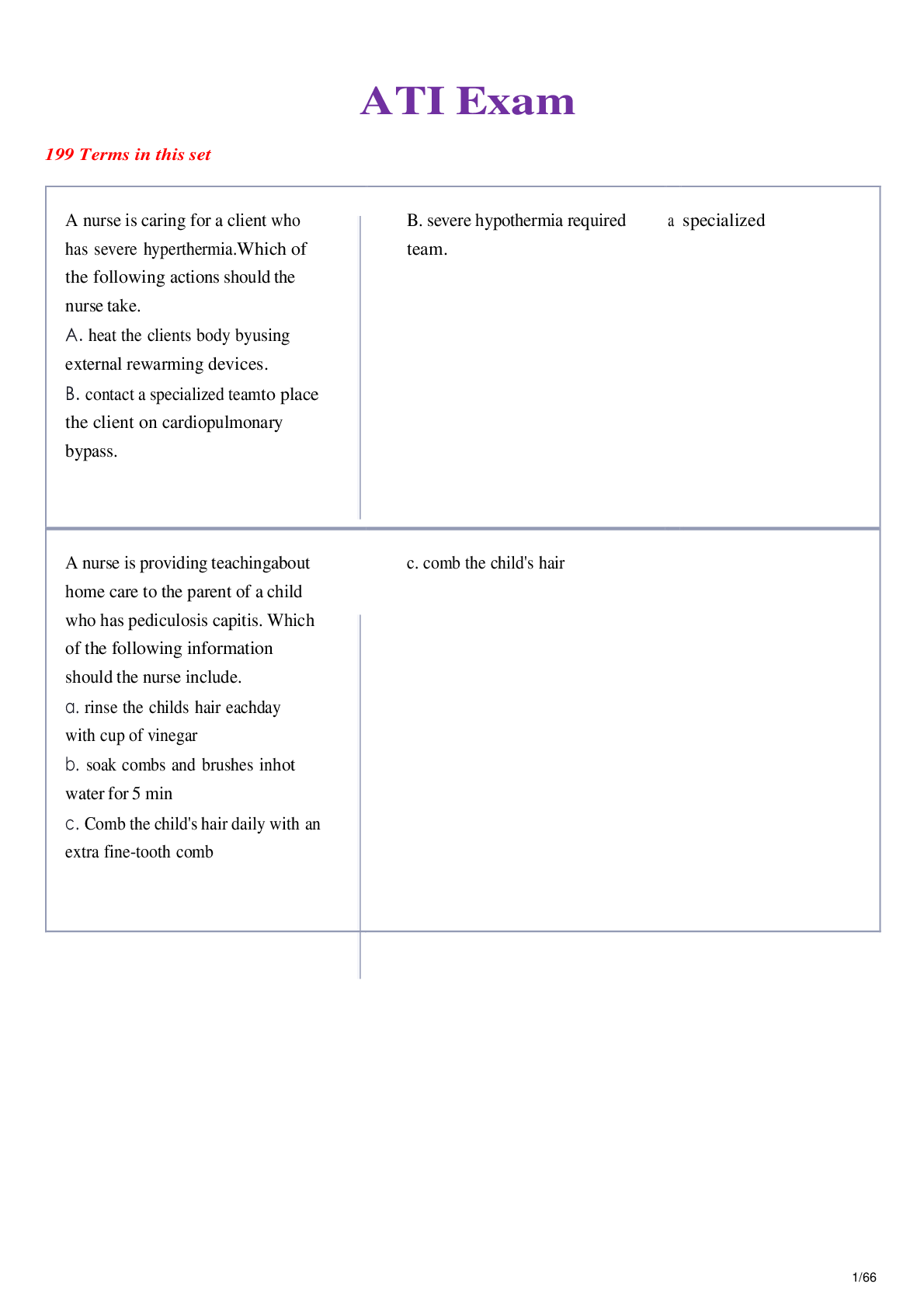
76. what is pediculosis capitis management?
77. store child's clothing in a separate cubicle at school
boil brushes and combs in water for 10 mins
dry bed lines and clothing in a hot dryer for at least 20 mins
78. what can visual disturbances indicate?
79. preeclampsia
80. what is expected 24 hrs after surgery?
81. hypo active bowel sounds
pain
82. what is an abnormal finding 24 hrs after surgery?
83. low HGB
84. what must be done in bucks traction?
85. the pt must be in proper alignment
boots are secured by 3 straps, around pt leg
weights must hang freely
footplate is resting 15.24 cm (6inches) from the footboard
86. what does pts with delirium demonstrate?
87. a fluctuating LOC often at night or in am
88. pt with dementia demonstrate?
89. difficulty finding correct words to use
90. pt with anxiety disorders demonstrate?
91. obsessive behavior
92. how would the nurse determine progression of ascites?
93. abdominal girth should be measured daily
94. what is a food high in potassium?
95. cantaloupe
96. what is an indication of peripheral venous disease?
97. brown pigmentation around ankles
98. what is indication of peripheral arterial disease?
99. intermittent, leg muscle pain
100. what is some skin care for pts on radiation therapy?
101. pat area when drying
use hand to wash
do not use sunscreen
102. what can hydromorpone cause?
103. urinary retention
104. what does bethanechol (urecholine) causes?
105. it stimulates urinary out put
106. how is nystatin best absorb?
107. if given 1 hour before or after a feeding
108. what is a sign that a newborn has finished eating?
109. a slowed suck/swallow pattern is a sign that the newborn is finished eating
110. what not to do when breastfeeding?
111. is not necessary for the entire areola be in the mouth
each feeding should start at the opposite breast
do not push back of newborns head-toward the nipple
112. what should be included in a stool specimen?
113. visible blood, pus, or mucus
114. what is the first action in an infiltrated IV?
115. to d/c the saline lock
116. what is the first action when preparing to do a dressing change?
117. to determine the pts level of pain
118. what should a with hemonymous hemionopsia with right visual field, what will help pt eat better?
119. the pt should turn head to the right to see all food on tray
120. what are some side effect for theophylline (theo-dur)?
121. is used to prevent wheezing,sob, chest tightness in asthma
irregular pulse and dysrhythmias
seizures
anxiety
urinary frequency
anorexia
n/v
diarrhea
122. what should you do when given enoxaparin (lovenox)?
123. it should be injected SUBQ
do not aspirate
do not massage
do not inject in same area
124. what is the babinski reflex?
125. stroke sole of the foot upward, toward the great toe
126. what is the moro reflex?
127. startle the infant by clapping hands`
128. what is the stepping reflex?
129. hold infant upright and allow one foot to touch tables surface
130. what is the palmer grasp reflex?
131. place an object in the palm of infant hand
132. what should you do when catheterizing a male pt?
133. pt should be place in supine position
penis should be at 90 degree angle
retract the foreskin and clean the glans prior to catherization
134. what color is the meconium?
135. it is the first stool passed and it is dark green and viscous
136. what is an inportant thing to ask when pt having cardiac catherization?
137. if pt allergic to iodine
138. what should be done with nitroglycerin (nitrostat)?
139. if pt continues to have pain after taking 1 tab, they should call 911 and take a second tab
140. what is normal after taking a nitroglycerin (nitrostat) tab?
141. h/a
change positions slowly
it should be kept in original, dark colored bottle to avoid light exposure
142. what to do for restrains use?
143. observe skin condition before applying restrains
use a quick release knot to secure the restraints
belt restrains should be placed over pts waist
able to insert two fingers under restraints
do not use all four side of rails to restrain pt
144. what would indicate an active peristalsis?
145. the presence of vowel sounds
146. what does pt with COPD have?
147. increased metabolism due to work of labored breathing
they have dry mouth/thick mucus
constipation
decreased peristalsis
148. how to use a cane?
149. pt should hold cane on the stronger side of the body
place it forward 6-10 inches and move his weaker leg forward to the cane
distributing his weight between the cane and the stronger leg
then he should move the stronger leg forward beyond the cane and distribute his weight between the cane and weaker leg
150. what does the use of cardiac catherization required?
151. that the pt have normal renal functions for excretion of the dye
152. how should drops be apply?
153. the nurse should apply gently pressure to the inner canthus of the eye for 30-60 seconds
154. what are hyperthyroidism findings?
155. tachycardia
156. what are hypothyroidism findings?
157. cold intolerance
constipation
brittle hair
158. how much should infants grow?
159. 1 inch per month, during the first 6 months
they should be able to double their birth weight between 4-6 months of age
and gain approximately 150-210 (about 5-7oz) per week
160. what should you do when evaluating an infant?
161. the nurse should measure ht/wt separately, and not combine
162. what can reduce the anti hypertensive effect of anti hypertensives?
163. ibuprofen (advil) or any NSAIDS
164. what is the first action when IV pump alarm is beeping?
165. to observe the iv site for infiltration or phlebitis
166. how are normal bowel sounds?
167. high pitched, irregular gurgles that occur every 5-15 seconds, in a rage of 5-30 per/min
168. what is hypoactive?
169. infrequent less than 5/min
170. what is hyperactive?
171. every 3 seconds or greater
172. what is actinic keratosis?
173. a pre-malignant lesion
flat, scaly area with red edges
174. what are cherry angiomas?
175. bright red, raised spots (expected skin changes with aging)
176. what does a change in color mole indicate?
177. indicates skin cancer
178. what happens in passive ROM?
179. the pt does not actively participates
the nurse should support the pts extremities distal and proximal to the joints to facilitate passive ROM
180. what do you do when inserting a urinary catheter, and urine is seen in the tubing?
181. the catheter should be advance another 2.5-5 cm to ensure that the balloon is inflated in the bladder
182. what to do when addressing pt dilemma?
183. determine the facts related to dilema
identify possible solutions
consider clients wishes
184. what should a pt with peripheral vascular disease do?
185. walk until feel pain, rest for 3 min and continue until tired
should sit with legs in a dependent position
186. what are s/s of a detached retina?
187. photopsia= bright flashes of light
188. what are s/s of macular degeneration?
189. loss of peripheral vision
190. what is a normal s/s of aging?
191. presbyopia= difficulty focusing on close objects
192. what should a pt with DM and influenza report?
193. temp higher than 101.5 or greater for 24 hours
194. what should be done with pts with closed head injury?
195. should be log roll
only suction on prn basis
maintain HOB at least 30 degrees
do not use an incentive spirometer ICP might go up
196. what should a pt with cardiac catherization experience?
197. they should drink adequate fluids
may need to cough during test
may experience a feeling of heat "hot flash"
only need bed rest for 4-6 hours
198. what should pt with COPD do?
199. should perform pursed- lip breathing
alternate activities with rest
eat high protein snacks
practice relaxation techniques
200. turp care?
201. monitor pt for fluid volume over load
remind pt that they will feel urge while catheter is in place
calculate urinary out put every 2 hours
measure pain level every 2-3 hours
pt should get up to a chair asap, risk for dvt
202. how to administer ear drops to children under 3 yrs?
203. pull pinna down and back
204. how will ventricular fibrilation look on ekg?
205. irregular rate without P waves, bizarre and variable QRS
206. what are sinus tachycardia look on EKG?
207. regular rate greater than 100/min normal P and QRS waves
208. atrial ventricular (AV) block look on EKG?
209. regular rate between 60-100/min with extended PR intervals
210. premature atrial contractions look on EKG?
211. irregular rate with ectopic atrial beats earlier than expected
212. what are s/s of febrile transfussion reaction?
213. chills
214. what are s/s of circulatory overload transfussion reaction?
215. bounding pulse and hypertension
216. what are s/s of hemolytic transfussion reaction?
217. lower back pain
218. what foods are rich in iron?
219. red meats, liver
220. what to look for in HCTZ (Hydrodiuril)?
221. flunctuation in weight
encourage increase of potassium
should be taken with food or right after a meal
222. what are s/s of anaphalictic reactions?
223. increased respiratory effort
hypotension
bronchoconstriction (laryngeal stridor)
224. what does benzodiazepines (lorazepam/ativan) causes?
225. lethargic and somnolent
226. what are pt with preclampsia at risk for?
227. seizures
228. how should the formula be to prevent gastric cramping in an enteral feeding?
229. administer the formula at room temp
230. what is a s/s of bulemia nervosa?
231. hemoptysis
232. what is a s/s of anorexia nervosa?
233. amenorrhea
acrocynosis
234. what are interventions for a salem sump tube?
235. the most common ng tube it is a double lumen (two-channeled) it irrigates the stomach and removes fluid and gas from stomach.
-pt should be reposition every 2 hours to promote emptiying of stomach content
-set suction 80-100
-never clamp air vent
pt should be NPO
236. what might cause dry skin in older adults?
237. a decrease in elasticity of the skin which is an expected change associated with aging
238. what is a bronchoscope?
239. a tube that allows the doctor to see in the lungs and airways and remove objects
240. what are nursing interventions for pts with dementias?
241. should encourage verbal praise
do not exceed 20 mins in tub
may not be able to follow direction
they should not disrobe until right before entering the bath to prevent chilling
242. what to do with ankle sprain?
243. check for pedal edema
[Show More]



 - Over 500 Questions – Nightingale College.png)


 - Over 500 Questions (Latest 2021) Correct Study Guide, Download to Score A.png)