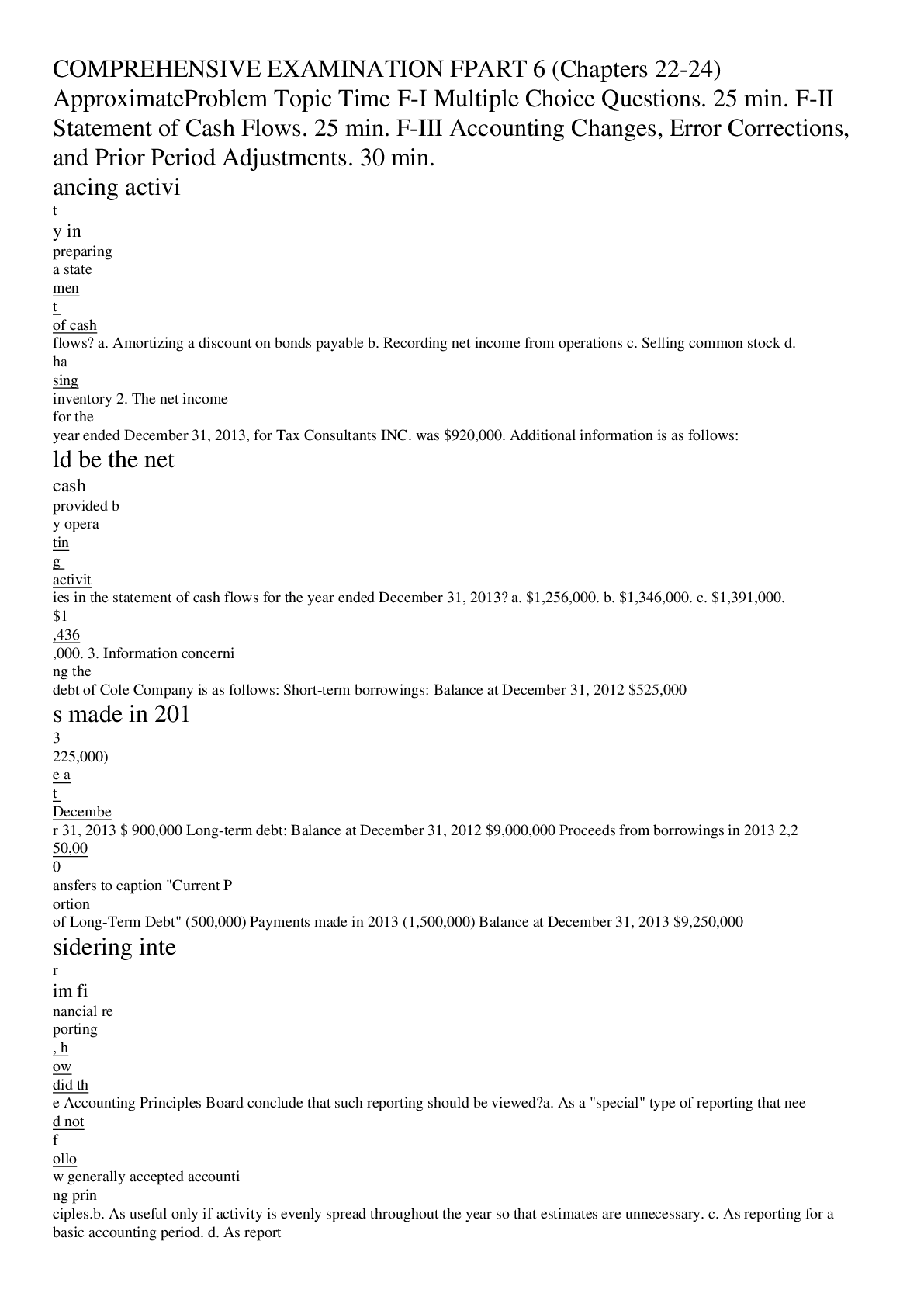
COMPREHENSIVE EXAMINATION F
Approximate
Problem Topic
...
COMPREHENSIVE EXAMINATION F
Approximate
Problem Topic Time
F-I Multiple Choice Questions. 25 min.
F-II Statement of Cash Flows. 25 min.
F-III Accounting Changes, Error Corrections, and
Prior Period Adjustments. 30 min.
F-IV * Analysis of Financial Statements. 25 min.
F-V Segment Reporting. 15 min.
120 min.
*This topic is dealt with in an Appendix to the chapter.
Problem F-I — Multiple Choice Questions.
1. Which of the following transactions would be considered a financing activity in preparing a statement of cash flows?
a. Amortizing a discount on bonds payable
b. Recording net income from operations
c. Selling common stock
d. Purchasing inventory
2. The net income for the year ended December 31, 2013, for Tax Consultants INC. was $920,000. Additional information is as follows:
Capital expenditures $1,200,000
Depreciation on plant assets 450,000
Cash dividends paid on common stock 180,000
Increase in noncurrent deferred tax liability 45,000
Amortization of patents 21,000
Based on the information given above, what should be the net cash provided by operating activities in the statement of cash flows for the year ended December 31, 2013?
a. $1,256,000.
b. $1,346,000.
c. $1,391,000.
d. $1,436,000.
3. Information concerning the debt of Cole Company is as follows:
Short-term borrowings:
Balance at December 31, 2012 $525,000
Proceeds from borrowings in 2013 325,000
Payments made in 2013 (450,000)
Balance at December 31, 2013 $400,000
Current portion of long-term debt:
Balance at December 31, 2012 $1,625,000
Transfers from caption "Long-Term Debt" 500,000
Payments made in 2013 (1,225,000)
Balance at December 31, 2013 $ 900,000
Long-term debt:
Balance at December 31, 2012 $9,000,000
Proceeds from borrowings in 2013 2,250,000
Transfers to caption "Current Portion of Long-Term Debt" (500,000)
Payments made in 2013 (1,500,000)
Balance at December 31, 2013 $9,250,000
In preparing a statement of cash flows for the year ended December 31, 2013, for Cole Company, cash flows from financing activities would reflect
Outflow
a. $2,000,000
b. $2,250,000
c. $2,575,000
d. $3,175,000
Problem F-I — (cont.)
4. In considering interim financial reporting, how did the Accounting Principles Board conclude that such reporting should be viewed?
a. As a "special" type of reporting that need not follow generally accepted accounting principles.
b. As useful only if activity is evenly spread throughout the year so that estimates are unnecessary.
c. As reporting for a basic accounting period.
d. As reporting for an integral part of an annual period.
5. Which of the following items represents a potential use of cash?
a. Patent amortization
b. Sale of plant assets at a loss
c. Net loss from operations
d. Declaration of a stock dividend
6. Worthington Company purchased a machine on January 1, 2010, for $4,800,000. At the date of acquisition, the machine had an estimated useful life of six years with no salvage. The machine is being depreciated on a straight-line basis. On January 1, 2013, Worthington determined, as a result of additional information, that the machine had an estimated useful life of eight years from the date of acquisition with no salvage. An accounting change was made to reflect this additional information. What amount of depreciation expense should be reported in Worthington’s income statement for the year ended December 31, 2013?
a. $800,000
b. $600,000
c. $480,000
d. $300,000
7. On January 7, 2011, Yoder Corporation acquired machinery at a cost of $1,500,000. Yoder adopted the sum-of-the-years’-digits method of depreciation for this machine and had been recording depreciation over an estimated life of five years, with no residual value. At the beginning of 2013, a decision was made to change to the straight-line method of depreciation for this machine. Assuming a 30% tax rate, the cumulative effect of this accounting change, net of tax, is
a. $0
b. $200,000
c. $210,000
d. $300,000
*8. Information from Collins Company’s balance sheet is as follows:
Current assets:
Cash $ 12,000,000
Short-term investments 20,000,000
Accounts receivable 50,000,000
Inventories 66,000,000
Prepaid expenses 2,000,000
Total current assets $150,000,000
Problem F-I (cont.)
Current liabilities:
Notes payable $ 11,000,000
Accounts payable 18,000,000
Accrued expenses 13,000,000
Income taxes payable 3,000,000
Current portion of long-term debt 5,000,000
Total current liabilities $ 50,000,000
What is the acid-test (quick) ratio?
a. 1:24 to 1
b. 1.64 to 1
c. 1.68 to 1
d. 3.00 to 1
*9. Fargo, Inc. disclosed the following information as of and for the year ended December 31, 2013:
Net cash sales 600,000
Net credit sales 900,000
Inventory at beginning 100,000
Inventory at end 150,000
Net income 30,000
Accounts receivable at beginning of year 110,000
Accounts receivable at end of year 130,000
Fargo’s receivables turnover is
a. 6.9 to 1.
b. 7.5 to 1.
c. 12.5 to 1.
d. 13.6 to 1.
*10. The calculation of the number of times interest is earned involves dividing
a. net income by annual interest expense.
b. net income plus income taxes by annual interest expense.
c. net income plus income taxes and interest expense by annual interest expense.
d. none of the above.
Problem F-II — Statement of Cash Flows.
Sharp Company
Comparative Balance Sheet
December 31
2013 2012
Cash $ 54,000 $ 36,000
Accounts receivable, net 53,000 57,000
Inventory 161,000 123,000
Land 180,000 285,000
Building 300,000 300,000
Accumulated depreciation (75,000) (60,000)
Equipment 1,565,000 900,000
Accumulated depreciation (177,000) (141,000)
$2,061,000 $1,500,000
Accounts payable $ 202,000 $ 150,000
Bonds payable 450,000 -0-
Capital stock, $10 par 1,125,000 1,125,000
Retained earnings 284,000 225,000
$2,061,000 $1,500,000
Additional Data:
1. Net income for the year amounted to $104,000.
2. Cash dividends were paid amounting to 4% of par value.
3. Land was sold for $120,000.
4. Sharp sold equipment, which cost $225,000 and had accumulated depreciation of $90,000, for $105,000.
Instructions
Prepare a statement of cash flows using the indirect method.
Problem F-III — Accounting Changes, Error Corrections, and Prior Period Adjustments.
Molina Company’s reported net incomes for 2013 and the previous two years are presented
below.
2013 2012 2011
$105,000 $95,000 $70,000
2013’s net income was properly determined after giving effect to the following accounting changes, error corrections, etc. which took place during the year. The incomes for 2011 and 2012 do not take these items into account and are stated at the amounts determined in those years. Ignore income taxes.
Instructions
(a) For each of the six accounting changes, errors, or prior period adjustment situations described below, prepare the journal entry or entries Molina Company should record during 2013. If no entry is required, write “none.”
(b) After recording the situation in part (a) above, prepare the year-end adjusting entry for December 31, 2013. If no entry, write “none.”
1. Early in 2013, Molina determined that equipment purchased in January, 2011 at a cost of $645,000, with an estimated life of 5 years and salvage value of $45,000 is now estimated to continue in use until December 31, 2017 and will have a $15,000 salvage value. Molina recorded its 2013 depreciation at the end of 2013.
(a)
(b)
2. Molina determined that it had understated its depreciation by $20,000 in 2012 owing to the fact that an adjusting entry did not get recorded.
(a)
(b)
3. Molina bought a truck January 1, 2010 for $50,000 with a $5,000 estimated salvage value and a six-year life. The company debited an expense account and credited cash on the purchase date. The truck is expected to be traded at the end of 2015. Molina uses straight-line depreciation for its trucks.
(a)
(b)
Problem F-III (cont.).
4. During 2013, Molina changed from the straight-line method of depreciating its cement plant to the double-declining-balance method. The following calculations present depreciation on both bases. (Ignore income taxes.) The 2013 amount applies double-declining balance to the 1/1/13 carrying amount after straight-line was used.
20
[Show More]





![Preview of THE TEFL ACADEMY LEVEL 5 - ASSIGNMENT C - AUTHENTIC MATERIAL [2026]](https://browseimages.nyc3.digitaloceanspaces.com/paper-images/2026/04/10/HpVkRcWV2026-04-10-11-5769d96426bd64f.png)
.png)