Question 1
1 / 1 pts
Using the rules for assessing inferences to the best explanation (in Chapter 6), which of
the following is likely the best inference to the best explanation for the following
observation:
“Tha
...
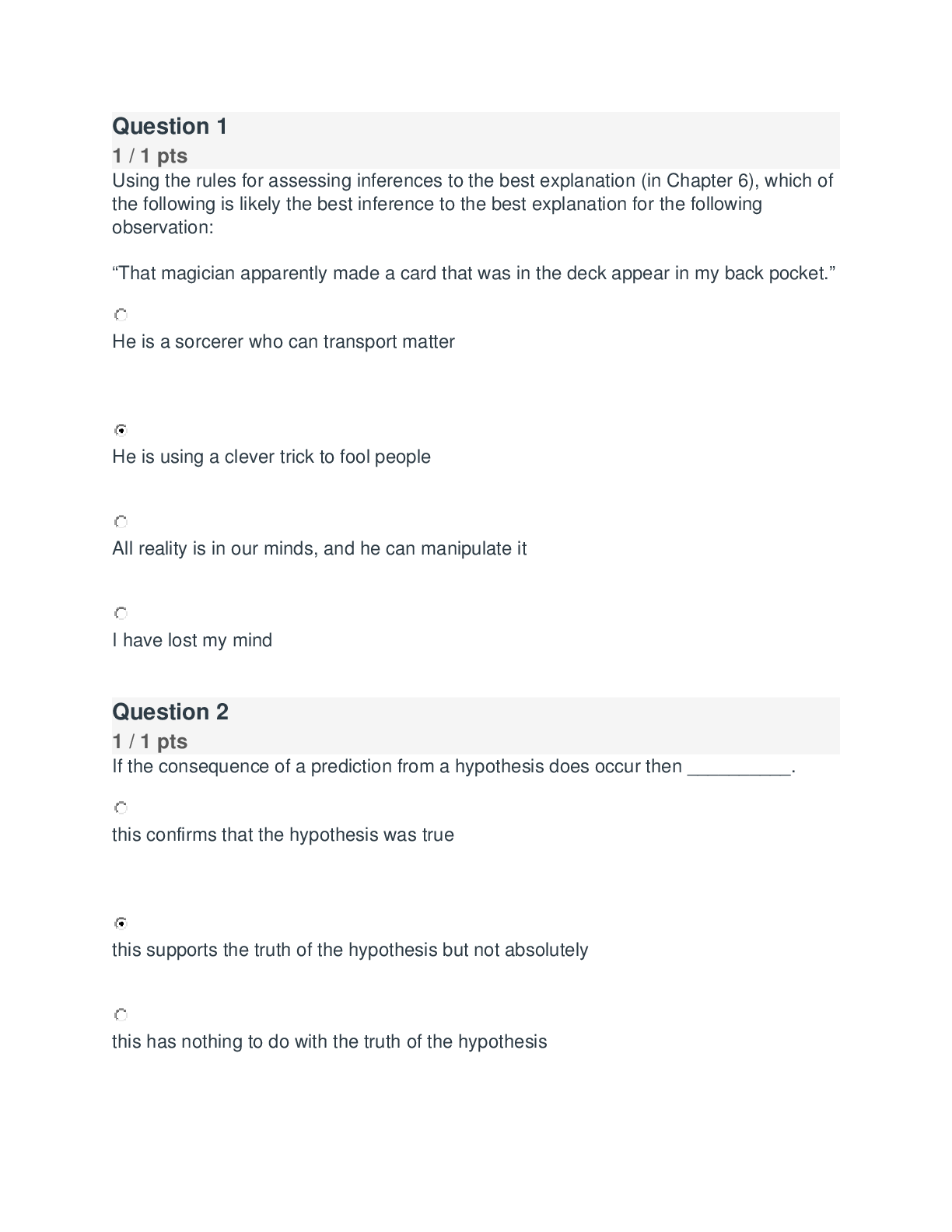
Question 1
1 / 1 pts
Using the rules for assessing inferences to the best explanation (in Chapter 6), which of
the following is likely the best inference to the best explanation for the following
observation:
“That magician apparently made a card that was in the deck appear in my back pocket.”
He is a sorcerer who can transport matter
Correct!
He is using a clever trick to fool people
All reality is in our minds, and he can manipulate it
I have lost my mind
Question 2
1 / 1 pts
If the consequence of a prediction from a hypothesis does occur then __________.
this confirms that the hypothesis was true
Correct!
this supports the truth of the hypothesis but not absolutely
this has nothing to do with the truth of the hypothesis
this indicates that the hypothesis was false
Question 3
1 / 1 pts
What type of inductive argument is the following example?
“The garbage cans were not picked up today; it must be some kind of holiday.”
Argument from analogy
Inductive generalization
Statistical syllogism
Correct!
Inference to the best explanation
Question 4
1 / 1 pts
Which of the following is necessary in order for an explanation to be adequate?
It does not agree with other human knowledge
It provides an overly complex solution
Correct!
It is noncircular
It is contradicted by other instances
Question 5
1 / 1 pts
How does one go about testing a hypothesis?
Correct!
Make a prediction that would (likely) occur if the hypothesis were true
See if it agrees with what you preferred to be true
Reject the hypothesis if it disagrees with other research in the scientific literature
Look for data that will confirm it no matter what
Question 6
1 / 1 pts
The following is one of the ways (listed in our text) to assess the quality of an inference
to the best explanation:
Is the information published elsewhere?
Correct!
Does it provide the simplest explanation of the observed phenomena?
Is it likely to promote beneficial consequences?
Is it novel and innovative?
Question 7
0 / 1 pts
This form of inductive argument moves from the general to the specific:
inductive generalization
Correct Answer
statistical syllogism
argument from authority
You Answered
deductive argument
The answer can be found in Section 6.1, “Contrasting Deduction and Induction,” of With
Good Reason: A Guide to Critical Thinking.
Question 8
1 / 1 pts
Adding more premises to a valid deductive argument ____________.
can make it go from valid to invalid
can make it inductively stronger
can make the other premises true
Correct!
cannot make it invalid
Question 9
1 / 1 pts
Which of the following is true about inductive reasoning versus deductive reasoning?
Deductive reasoning is always preferable.
Inductive reasoning is always preferable.
Correct!
Inductive reasoning is often preferable.
One should only use inductive reasoning if one can’t find a valid argument.
Question 10
1 / 1 pts
Which of these is a limitation of inferences to the best explanation?
Most of reality cannot be explained
It will never be as convincing as deductive inference
Correct!
It depends upon our coming up with the right explanation as one of the candidates
It generally leads us away from scientific explanations
Question 11
1 / 1 pts
The following is one of the ways (listed in our text) to assess the quality of an inference
to the best explanation:
Is it indubitably true?
Correct!
Does it help us explain other phenomena as well?
Is there proof of it?
Does the result seem important?
Question 12
1 / 1 pts
This form of argument is an inductive form that reasons from the general to the specific.
Modus ponens
Correct!
Statistical syllogism
Hypothetical syllogism
Inductive generalization
Question 13
1 / 1 pts
This is the theory that, when there are multiple possible explanations of an event or
phenomenon, the simplest is th
[Show More]