(Solution guide) 2022 International Board Certified Lactation Consultant (IBCLC) Certification Exam.
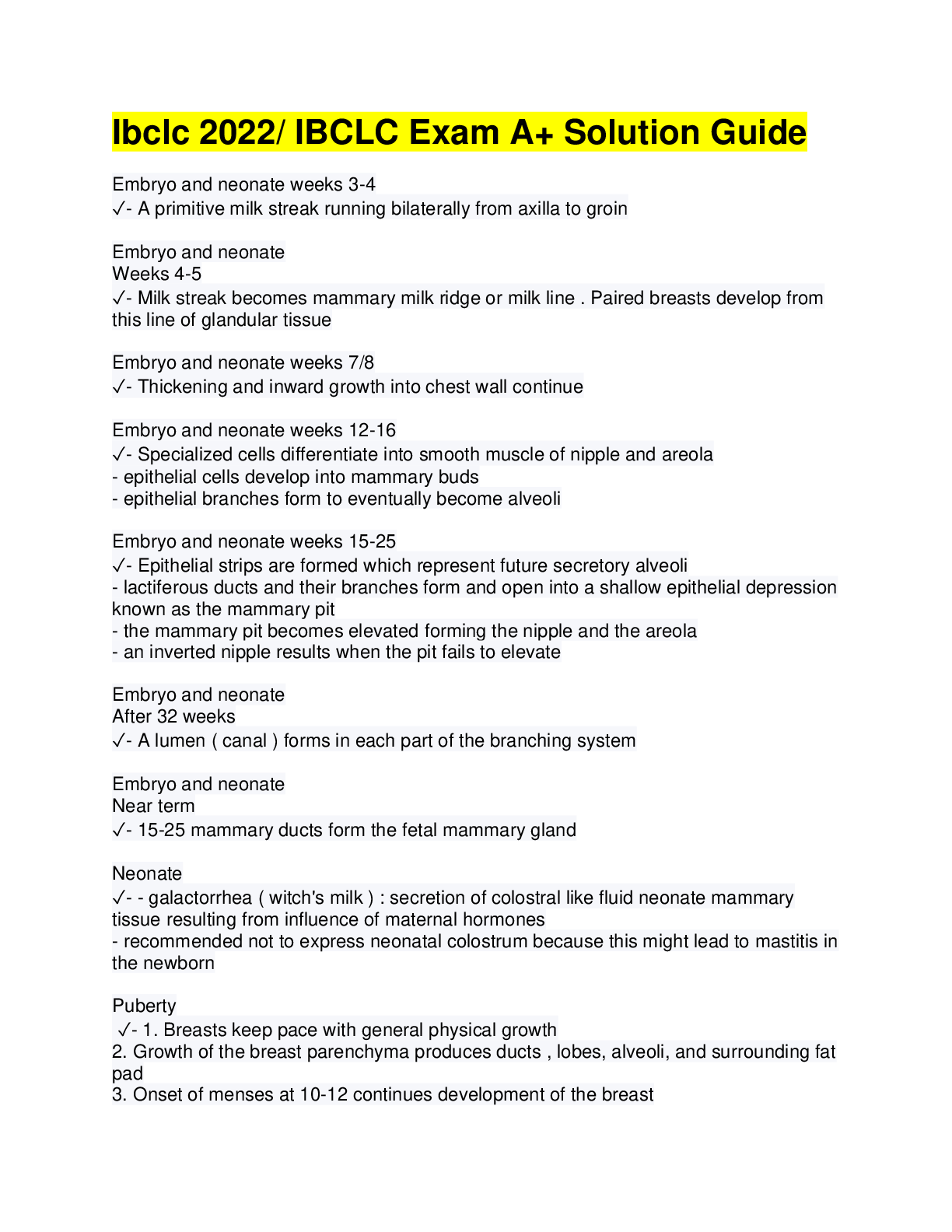
Ibclc 2022/ IBCLC Exam A+ Solution Guide
Embryo and neonate weeks 3-4
✓- A primitive milk streak running bilatera
...
(Solution guide) 2022 International Board Certified Lactation Consultant (IBCLC) Certification Exam.
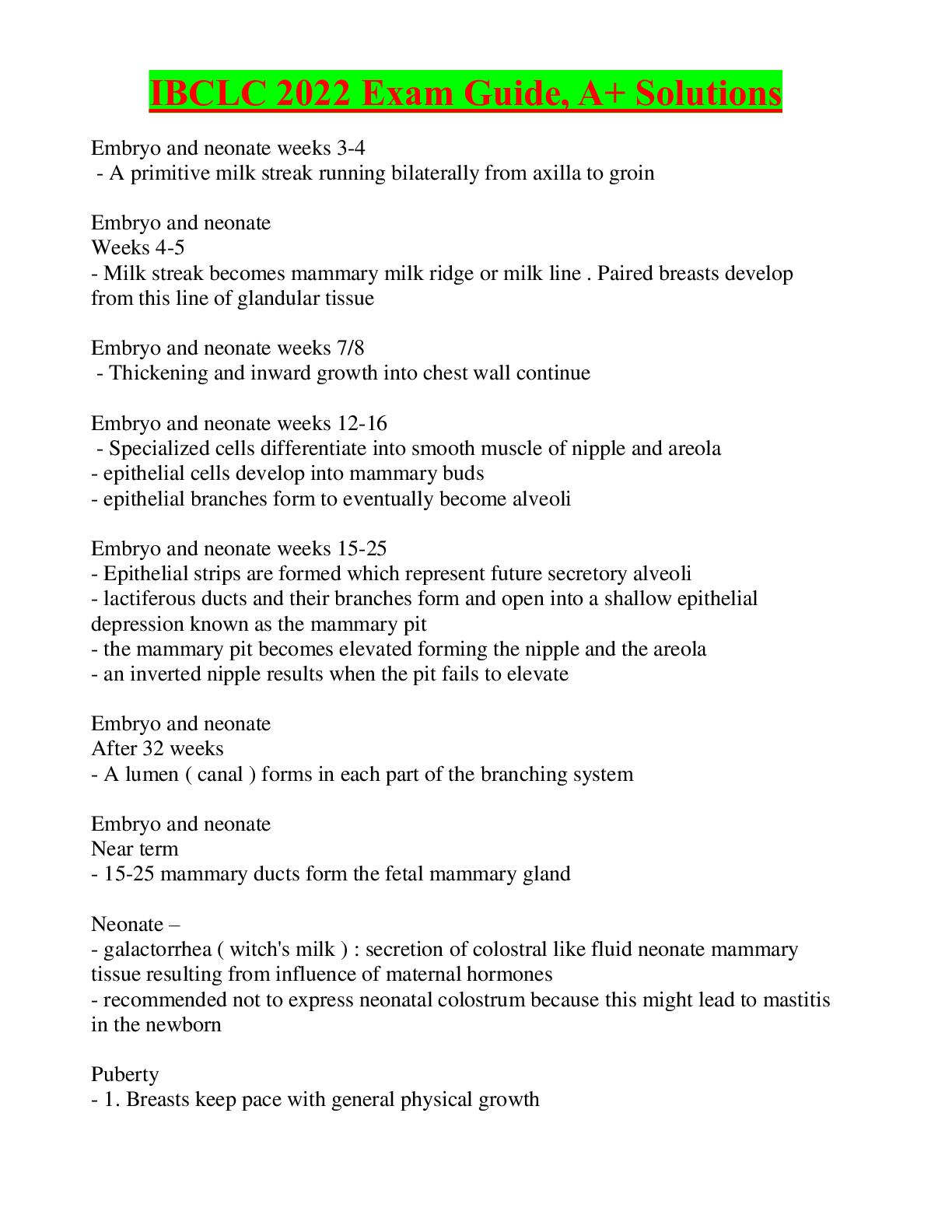
Ibclc 2022/ IBCLC Exam A+ Solution Guide
Embryo and neonate weeks 3-4
✓- A primitive milk streak running bilaterally from axilla to groin
Embryo and neonate
Weeks 4-5
✓- Milk streak becomes mammary milk ridge or milk line . Paired breasts develop from this line of glandular tissue
Embryo and neonate weeks 7/8
✓- Thickening and inward growth into chest wall continue
Embryo and neonate weeks 12-16
✓- Specialized cells differentiate into smooth muscle of nipple and areola
- epithelial cells develop into mammary buds
- epithelial branches form to eventually become alveoli
Embryo and neonate weeks 15-25
✓- Epithelial strips are formed which represent future secretory alveoli
- lactiferous ducts and their branches form and open into a shallow epithelial depression known as the mammary pit
- the mammary pit becomes elevated forming the nipple and the areola
- an inverted nipple results when the pit fails to elevate
Embryo and neonate
After 32 weeks
✓- A lumen ( canal ) forms in each part of the branching system
Embryo and neonate
Near term
✓- 15-25 mammary ducts form the fetal mammary gland
Neonate
✓- - galactorrhea ( witch's milk ) : secretion of colostral like fluid neonate mammary tissue resulting from influence of maternal hormones
- recommended not to express neonatal colostrum because this might lead to mastitis in the newborn
Puberty
✓- 1. Breasts keep pace with general physical growth
2. Growth of the breast parenchyma produces ducts , lobes, alveoli, and surrounding fat pad
3. Onset of menses at 10-12 continues development of the breast
- primary and secondary ducts grow and divide .
- terminal end buds form , which later become alveoli (small sacs where milk is secreted ) in the mature breast
- proliferation and active growth of duct tissue takes place during each period and continues to about 35 years of age
Pregnancy breast
Development
✓- 1. Complete development of mammary function occurs only in pregnancy
2. Breast size increases , skin appears thinner , and veins become more prominent
3. Areola diameter increases - Montgomery glands enlarge , and nipple pigment darkens
Anomalies in breast
Development
✓- 1. Illnesses, chemo, therapeutic radiation to the chest , chest surgery , or injuries to the chest might affect development
2. Programmed apoptosis ( cell death ) has been suggested as one reason for lower breast cancer rates in bf women
Exterior breast
✓- Located in the superficial fascia ( fibrous tissue beneath skin) between 2nd rib and 6th intercostal space
Tail of spence
✓- Mammary glandular tissue that projects into the axillary region
- distinguished from the supernumerary tissue because it connects to the duct system
- potential are of milk pooling and mastitis
Skin surface of
Breast contains
✓- Nipple, areola, and Montgomery glands
Size
✓- Not related to functional capacity
Gives breast it's
Shape and size
✓- Fat composition
Size may indicate
✓- Milk storage potential
Nipple
✓- Conical elevation located slightly below center of areola
Average diameter of
Nipple ✓- 1.6cm
Average length of
Nipple ✓- 0.7 cm
Hoe many milk
Duct openings
In nipple ✓- 5-10
Smooth muscle fibers
Function as a ✓- Closure mechanism to keep milk from continuously leaking from the nipple
The nipple is
Densely innervated
With ✓- Sensory nerve endings
What makes the nipple erect when contracted ✓- Longitudinal inner muscles and outer circular and radial muscles
Venostasis ✓- Slows blood flow and decreases surface area
Areola ✓- Dark pigmented area that surrounds the nipple - elastic like nipple
Average diameter
Of areola ✓- 6.4 cm
Areola is constructed
Of ✓- Smooth muscle and collagenous , elastic , connective tissue fibers in radial and circular arrangement
How does the nipple
Aid infant in latching ✓- Becomes smaller , firmer, and more prominent
What happens to
Areola in pregnancy ✓- Darkens and enlarges
Where are montgomerys tubercules located ✓- Around the areola
The Montgomery tubercules contain ✓- Ductal openings of the sebaceous and lactiferous glands and sweat glands
What happens to Montgomery glands in pregnancy ✓- They enlarge and resemble small , raised pimples
The Montgomery glands secrete ? ✓- A substance that lubricates and protects the nipple
Some secrete a small amount of milk
Secretions of the Montgomery gland may produce ? ✓- A scent to help the infant locate the nipple
Parenchyma are ✓- Functional parts of the breast
Alveoli are ? ✓- ( acini) are the basic components of the mature mammary gland . Secretory cells in which the milk is produced
Lactocytes ( specialized epithelial cells ) that line the interior of the alveolus do ? ✓- Absorb nutrients , immunoglobulin, and hormones from the mothers bloodstream to compose milk
Prolactin receptor sites in the lactocytes Allow? ✓- Prolactin to be absorbed from the blood and enter into the alveoli to stimulate milk production
Myoepithelial cells do what ? ✓- Encase the alveoli and contact in response to oxytocin to eject milk into ductules
How many lobes does the breast contain ✓- 15-25 that carry the milk through the ductules from the alveoli to the nipple
Each lobe contains how many alveoli ✓- 10-100 in an intricate system of ductules that branch out from the lobes to converge into lactiferous ducts behind the nipple
Ultrasound of lobes shows? ✓- Connections between lobes
What do ducts do in response to milk ejection ✓- Temporarily widen
What do ducts do in response to duct drainage ✓- Narrow
What happens to milk that is not removed ✓- It flows backward up the collecting ducts
Lactiferous ducts lead to ✓- 5-10 openings in the nipple
Stroma ✓- Supporting tissues of the breast
Stroma include ✓- Connective tissue , fat tissue, blood vessels , nerves, and lymphatics
Coopers ligaments are ✓- Suspensory ligaments running vertically through the breast
What do coopers ligaments do ✓- Attach the deep layer of subcutaneous tissue to the dermis layer of the skin
The breast is highly ✓- Vascular
What supplies 60%of blood to the breast ✓- Internal mammary artery
What supplies 30%of blood to the breast ✓- Lateral thoracic artery
Blood vessels within the breast do ? ✓- Enlarge
What stimulates growth of the ducts ✓- Surges of estrogen
What causes glandular tissue to expand ? ✓- Surges of progesterone
The lymphatic system collects ? ✓- Excess fluids from tissue spaces, bacteria, and cast off cell parts
The lymphatic system drains where ? ✓- The axillary lymph nodes mainly
Breast innervation derives from mainly where ? ✓- Branches of the 4th, 5th, and 6th intercostal nerves
Where is nerve supply sparse ? ✓- The innermost parts of the breast
The fourth intercostal nerve ✓- Penetrates the posterior aspect of the breast
The 4th intercostal nerve supplies the greatest amount of sensation to the areola where ? ✓- 4:00 on the left breast and 8:00 on the right breast
How many branches does the 4th intercostal nerve divide into ✓- 5 branches and it becomes more superficial as it reaches the areola
The Lowermost branch of the 4th intercostal nerve penetrates the areola where ? ✓- 5:00 on left breast and 7:00 on the right
Trauma to the 4th intercostal nerve might result in ✓- Some loss of sensation in the breast
If the lowermost branch of the 4th intercostal nerve is severed what happens ? ✓- Loss of sensation to the nipple and areola may result
Aberrant sensory or autonomic nerve distributions in the nipple/areola complex could ✓- Affect milk ejection reflex and secretion of prolactin and oxytocin
Trauma or severing of the 4th intercostal nerve could result from ✓- Breast augmentation or reduction surgery
How much does a non pregnant mature breast weigh ✓- 200g
How much does a pregnant near term breast Weigh ✓- 400-600g
How much does a lactating breast weigh ✓- 600-800g
Asymmetry is common . Which breast is often larger ✓- Left larger than right often
Hypermastia ✓- Presence of an accessory mammary gland - accessory or supernumerary nipple develops along the milk line between the axilla and groin
- often prominent during pregnancy and lactation
Hypermastia can be associated with ✓- Renal or other organ system abnormalities
What can lactate and undergo malignant changes ✓- Accessory glandular tissue tissue
Hyperthelia ✓- Nipple without accompanying mammary tissue
Hypertrophy ✓- Abnormally large breast
Hypomastia ✓- Abnormally small breast
Hyperplasia ✓- Overdevelopment of the breast - hyperplastic breast
Hypoplasia ✓- Underdevelopment of the breast - hypoplastic breast
Tubular or tuberous shape of because lack of glandular tissue ✓- Hypoplastic breast
Breasts may have large areolas ✓- Hypoplastic breasts
Breast are frequently asymmetric and widely spaced ✓- Hypoplastic breast
What type of breast may present increased risk for insufficient milk ✓- Hypoplastic breast
Poland's syndrome ✓- Unilateral hypoplasia of the breast combined with hypoplasia of the thorax and pectoral muscle
The normal nipple should ✓- Evert and become protractor when compressed or stimulated
What is the range of incidence of poor protractility in primigravid women ✓- 10-35%
Protractility ✓- Improves during pregnancy - effect on latch is minimal when baby has a large amount of breast tissue
Nipple inversion occurs in how many women ✓- 3% and is usually bilateral
A truly inverted nipple does what ✓- Remains inverted when compressed or stimulated
A pseudo inverted nipple does what ✓- Appears inverted but everts when compressed or stimulated
A short shanked nipple does what ✓- Appears Everted but retracts when compressed or stimulated
Common nipple does what ✓- Protrudes slightly when at rest and becomes more erect and graspable when stimulated - baby can find and pull in mouth and stretch it to the roof of his mouth
Flat and or short shanked nipple ✓- May be soft or pliable and have the ability to ridge so it molds to infants mouth without a problem . The flat nipple may have a short shank which makes it less easy to ridge and the baby to find and grasp . May benefit from a syringe to increase protractility .
Retracted nipple ✓- Most common type of inverted nipple - initially appears graspable - retracts on stimulation making attachment difficult - does respond well to techniques that increase nipple protrusion
Inverted nipple ✓- Truly inverted nipple retracted both at rest and when stimulated. Very uncommon and more difficult for baby to grasp . All techniques used to enhance protractility of breast tissue can be used to improve attachment . Even with nipple retraction baby should be able to latch if mother helps form breast in mouth
Bulbous ✓- Large nipple that may be difficult for baby to grasp
Dimpled nipple ✓- Increases the risk for maceration as the nipple lies enveloped by the areola
Midsagittal ✓- The plane vertically dividing the body through the midline into left and right halves
Sagittal ✓- Any plane that is parallel to the midsagittal line vertically divided body into right and left portions
Coronal ✓- Frontal - any plane dividing body into anterior or posterior
Transverse ✓- Upper and lower portions
Ipsilateral ✓- Pertaining to the same side
Contralateral ✓- Pertaining to the opposite side
Alveolus ✓- A small cavity in the breast - an arrangement of lactocytes around a central Lumen drained by a ductule
Process ✓- Projections on a bone
Fontanel ✓- Junctions of cranial bones covered by a tough membrane
Lumen ✓- The cavity or channel within a tube or tubular organ
Temporomandibular ✓- Opens and closes the jaw . Lateral displacement of the mandible
Suture ✓- A joint that does not move - the bones are united by a thin layer of fibrous tissue
Involuntary muscles ✓- Contraction controlled by autonomic nervous system no willful control
Voluntary muscles ✓- Movement using willful control , central nervous system
Visceral smooth muscles ✓- Found in digestive and respiratory tracts
Cardiac / striated muscles ✓- Involuntary striated muscle - allowing coordination of contraction
Skeletal / striated muscle ✓- Voluntary , striated ; gross and fine motors movements
Lymphatic system ✓- Drains tissue spaces, provides for intercellular waste disposal , and carries absorbed fat in the blood
Endocrine system ✓- Chemical regulator of body functions
Occipital bone ✓- Forms the back and base of the cranium ; contains the foramen magnum through which the spinal cord passes
Frontal bone ✓- Forms the forehead , roof of the nasal cavity , and orbits
Parietal bone ✓- Sides and roof of the cranium
Temporal bone ✓- Sides and base of the cranium ; houses the middle and inner ear structures
Sphenoid ✓- Butterfly shaped bone bridging the other cranial bones internally forming part of the temple floor of the skull ( sella turcica- seat of the pituitary ) nasal septum , posterior walls of orbits
Ethmoid bone ✓- Between the nasal bones and sphenoid ; forms parts of the nasal septum ; walls of orbits
Nasal bone ✓- Upper bridge of nose
Vomer bone ✓- Posterior nasal cavity ; forms a portion of the nasal septum
Lacrimal bone ✓- Anterior , medial wall of the orbit
Zygomatic arch ✓- Prominence of the cheeks and part of the lateral wall and floor of the orbits
Palatine ✓- Posterior cavity between the maxillae and sphenoid
Maxilla ✓- Upper jaw
Mandible ✓- Lower jaw
Hyoid bone ✓- Horseshoe shaped bone suspended from the styloid process of the temporal bone p
Choanae ✓- Posterior nasal apertures paired passages from the nasal cavity to the nasopharynx
What does bf do to the choanae ✓- Widens it unless tongue tie is present
Coronal suture ✓- Line of articulation between the frontal bone and the 2 parietal bones
Sagittal suture ✓- Line of articulation between the 2 parietal bones in the midline
Lambdoidal ✓- Anterior articulation between the occipital and parietal bones
Anterior fontanel ✓- A diamond shaped interval where the frontal angles of the parietal bones meet the 2 separate halves of the frontal bones
Posterior fontanel ✓- A triangular interval at the union of the lambdoid and sagittal sutures
Sphenoidal fontanel ✓- Irregularly shaped interval on either side of the skull
Mastoid fontanel ✓- Interval on either side of the posterior skull
Cranial nerve I ✓- Olfactory : smell
cranial nerve 2 ✓- Optic : sight
Cranial nerve 3 ✓- Oculormotor:innervates external muscles for several movements of the eye
Cranial nerve 4 ✓- Trochlear : innervates muscles that move the eye up and down
Cranial nerve 5 ✓- Trigeminal : three branches : muscles of mastication
Cranial nerve 6 ✓- Abducens: moves the eye away from the center of the body
Cranial nerve 7 ✓- Facial : muscles of facial expression
Cranial nerve 8 ✓- Vestibulocochlear: hearing and equilibrium
Cranial nerve 9 ✓- Glossopharyngeal: taste, sensation in pharynx ( important for swallowing )
Cranial nerve 10 ✓- Vagus: larynx, pharynx
Cranial nerve 11 ✓- Spinal accessory : muscles of the neck and shoulder
Cranial nerve 12 ✓- Hypoglossal: movements of the tongue
How many nerves and muscles must coordinate for swallowing ✓- 26 muscles and 6 cranial nerves
Mouth suckling cranial nerves ✓- 5 ( sensory - shape: texture ) 7 motor
Tongue suckling cranial nerves ✓- 7, 9 (taste , sensory ) 12 motor
Jaw suckling cranial nerves ✓- 5 ( sensory position of TMJ) 5 motor ; 5 does both sensory and motor
Palate swallowing nerves ✓- 5, 9 ( sensory ) 5,7,9,10 motor
Tongue swallowing nerves ✓- 9 sensory 5,7,12 motor
Pharynx swallowing nerves ✓- 5,9 sensory 9, 10 motor
Larynx ✓- 10 sensory : 9,10 motor
Muscles used in mastication and suckling ✓- Temporalis, Masseter, medial pterygoid , lateral pterygoid, buccinator , orbicularis Oris mentalis
Temporalis muscle ✓- Raises the mandible : closes mouth : draws the mandible backward
Masseter muscle ✓- Closes the jaw
Medial pterygoid muscle ✓- Raises the mandible : closes the mouth
Lateral pterygoid ✓- Brings the jaw forward
Buccinator ✓- Compresses the cheeks and retracts the angle
Orbicularis oris ✓- Closes the lips
Mentalis muscle ✓- Elevates center of lower lip
Genioglossus muscle ✓- Depressed and extends / protrudes tongue forward
Styloglossus muscle ✓- Draws the tongue upward and backward
Stylohyoid ✓- Draws the hyoid and tongue upward
Digastric muscle ✓- Raises the hyoid or opens the mouth
Mylohyoid muscle ✓- Elevated the hyoid : supports the mouth floor
Hypoglossus muscle ✓- Depresses the tongue
Geniohyoid ✓- Elevates and draws the hyoid forward
Superior longitudinal muscle ✓- Elevates tip and sides of tongue , makes tongue concave
Inferior longitudinal muscle ✓- Curls tongue tip downward , makes tongue convex
Transverse lingual muscle ✓- Narrows, elongages and protrudes
Vertical lingual muscle ✓- Broadens and lengthens tongue
Sternohyoid muscle ✓- Depresses the hyoid and larynx
Omohyoid muscle ✓- Depresses the hyoid
Sternothyroid muscle ✓- Depresses the thyroid cartilage
Thyrohyoid ✓- Raises and changes the form of the larynx
The oral cavity or mouth is bounded by what ✓- The roof , floor, lips , and cheeks
The roof of the mouth consists of what ✓- The Palatine process of the maxilla and the palatine bone ( hard palate )
The roof of the mouth transitions into what ✓- Posteriorly into the soft palate and uvula
The floor of the mouth consists of what ✓- Mandible spanned by the mylohyoid, geniohyoid , and front of the digastric muscle
What muscle surrounds the lips ✓- Orbicularis oris
What muscles define the cheeks ✓- Buccinator and Masseter muscles
What helps provide stability for the cheek during sucking and provides lateral borders for the tongue ✓- Sucking pads that consist of fatty tissue encased in the cheek
The mandible is ✓- Small and retracted
The tongue does what ✓- Fills the entire oral cavity and touches the roof and floor of the mouth as well as the lateral gum lines and cheeks
Lingual frenulum ✓- Fold of mucous membrane extending from the floor of the mouth to the midline of the under surface of the tongue , should regress during midgestation
Labial frenae ✓- The membranes that attach the lips to the gum ridges , inferiorily and superiority
Pharynx ✓- A soft muscular tube at the back of the throat
Oropharynx ✓- Composed of the area between the elevated soft palate and the epiglottis
Nasopharynx ✓- Section of the pharynx between the nasal choanae and the elevated soft palate : the eustachian tubes originate here
Hypopharynx ✓- Extends from base of epiglottis to the cricopharyngeal sphincter
Larynx ✓- Gateway to the trachea composed of cartilage suspended by muscles ligaments to the hyoid bone and cervical vertebrae
The larynx contains what ✓- The epiglottis and the vocal folds or chords
What does the epiglottis do during swallowing ✓- Folds down to cover the airway
What do the vocal folds or cords do During swallowing ✓- They close to protect the airway
Trachea ✓- Tube that bridges into bronchi leading to each lung
Esophagus ✓- A thin muscular tube that extends to the stomach and distends as food is propelled through it by peristaltic motion
What does the hard palate do ✓- Assists with positioning and stability of the nipple within the mouth
What does the soft palate do ✓- Works with the tongue to create the posterior seal of the oral cavity
What does the soft palate do during swallowing ✓- It elevates contacting the pharyngeal walls and closing off the nasal cavity directing the bolus toward the hypopharynx
The hard palate should be ✓- Intact and smoothly contoured
In utero and after birth the shape of the hard palate ✓- Is contoured by the tongue and it's continual pressure as it rests and moves against the palate
Submucous clefts of the soft palate ✓- Cannot be directly visualized
High palate ✓- The palate or a portion of the palate is very high altering the shallow saucer shape
Wide or flat palate ✓- Reduced arch
Narrow palate ✓- Reduced horizontal spread of palate
Short and longer palates ✓- Shorter or longer than typical 1 inch from the alveolar ridge ( gum ridge ) to the point where the soft palate folds
Channel palate ✓- Midline groove usually from the prolonged presence of orotracheal tubes
V shaped arch ✓- A high narrow palate that is narrow anteriorly
Bony prominences ✓- Uncommon : more common is an Epstein pearl
Epstein pearl ✓- Accumulations of epithelial cells also called a retention cyst located at the juncture of the hard and soft palates
Sloped palate ✓- Sudden declines in the normal curve
Bubble palate ✓- Concavities of the hard palate confined with a rim
Cleft palate ✓- A complete opening in the hard or soft palate resulting from the failure of the primary palate and or palatal shelves to meet and fuse during the 7-8 week of gestation
Normal mandible placement is ✓- Upper and lower jaw loosely opposed : both gum ridges in direct opposition
Recessed jaw ✓- The lower gum ridge is posterior to the upper gum ridge
Micrognathia ✓- An excessively small or posteriorly positioned mandible ; internally the tongue is also posteriorly positioned in relation to the oral cavity
What does the tongue do ✓- Brings the nipple into the mouth shaping it and stabilizing its position
What happens when the posterior tongue and mandible drop ✓- Negative pressure in the mouth causes milk to flow from the nipple
What does the wave of compression from front to back with the tongue do ✓- Exerts positive pressure to initiate swallow moving bolus back into pharynx
The tongue forms a central groove in order to ✓- Stabilize the teat and channel fluid toward the pharynx
The tongue assists in ✓- Forming a bolus to prep for swallow
The tongue is ✓- Soft with a rounded tip
The tongue is normally where ✓- The bottom of the mouth with a slight central groove and the tip over the lower gum
Tongue tip elevation ✓- The tip of the tongue is in opposition to the upper gum ridge or the palate behind the alveolar ridge
Humped tongue ✓- tongue is compressed from front to back
Bunched tongue ✓- Compressed in a lateral direction
Retracted tongue ✓- Held posteriorly in the mouth behind the inferior alveolar ridge
Protruded tongue ✓- The tip rests forward well past the lips
Tongue tie or ankyloglossia ✓- A short or tight lingual frenulum
What does the rooting reflex cause ✓- Touching or stroking the baby's lips or cheek causes a turning of the head toward the stimulus and opens the mouth ( gape response )
Sucking reflex ✓- A light touch of the nipple or a finger to the lips or tongue initiates the complex movements of the suckle
Swallowing is elicited by ✓- A bolus of fluid impacting the sensory receptors of the soft palate and back of the mouth : has both reflexive and voluntary properties triggered at the valeculae in newborns
Protrusion reflex ✓- Baby's tongue moves down and foresee grasping and drawing the breast into the mouth
Gag reflex ✓- Protects the baby from ingesting items that are too large for the esophagus - elicited in the newborn at the mid tongue area
Cough reflex ✓- Mechanism that protects the airway from the aspiration of liquids
Scanning ✓- Searching the breasts with the cheeks by moving the head from side to side
Stepping reflex ✓- Using the stepping reflex to crawl to the breast
Hand movement reflex ✓- Predictable hand movement to stimulate move and shape the breast
The breasts are capable of full lactation when ✓- From 16 weeks forward
What happens early in the first trimester ✓- Mammary epithelial cells proliferate ductal sprouting and branching are initiated and lobular formation occurs
First trimester ✓- Ducts proliferate into fatty pad and ductal ends bud into alveoli
First trimester ✓- Increases occur in mammary flow , interstitial water , and electrolyte concentrations
First trimester ✓- Mammary blood vessels increase their luminal diameters and form new capillaries around the lobules
Third trimester ✓- Secretory cells fill with fat droplets and the alveoli are distended with colostrum
Mid pregnancy ✓- Mammary cells become competent to secrete milk proteins but are kept in check by high levels of steroids circulating , particularly progesterone
Where do most milk products secreted during pregnancy go ? ✓- They find their way back into the plasma via the leaky junctions (spaces between the mammary alveolar cells )
Lactogenesis is driven by the hormones of the ✓- Endocrine control system
What accelerates breast growth ✓- Lactogen , prolactin , and human chorionic gonadotropin
What is required for mammary growth and epithelial proliferation during pregnancy ✓- A form of estrogen , 17 beta - estradiol
What enhances formation of the lobules during pregnancy ✓- Glucocorticoids
What does estrogen do during pregnancy ✓- Increases and stimulates ductal sprouting
✅Continues
[Show More]


.png)
.png)
.png)

.png)


.png)
.png)


 2022.png)