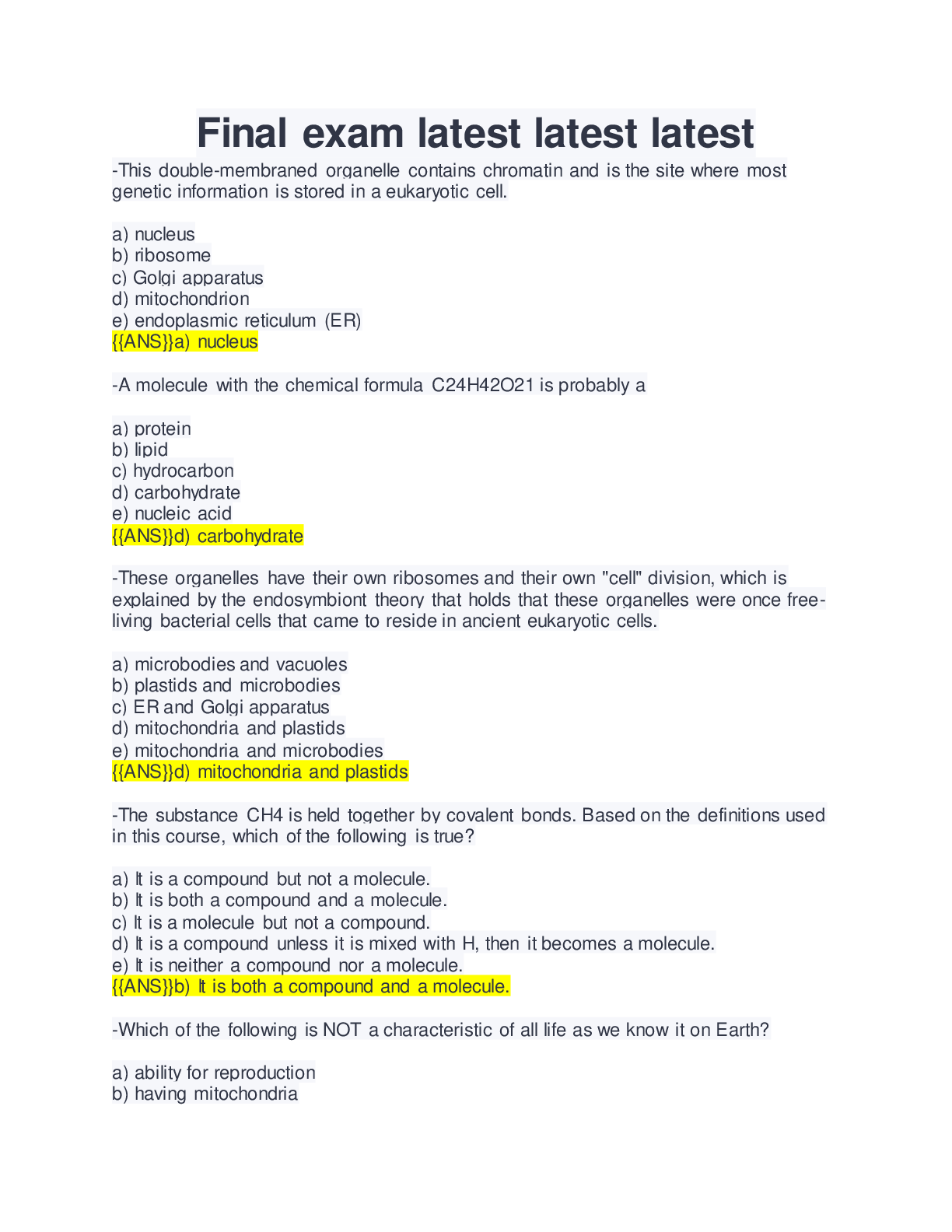
Final exam latest latest latest
-This double-membraned organelle contains chromatin and is the site where most genetic information is stored in a eukaryotic cell.
a) nucleus
b) ribosome
c) Golgi apparatus
d) mitoc
...
Final exam latest latest latest
-This double-membraned organelle contains chromatin and is the site where most genetic information is stored in a eukaryotic cell.
a) nucleus
b) ribosome
c) Golgi apparatus
d) mitochondrion
e) endoplasmic reticulum (ER)
{{ANS}}a) nucleus
-A molecule with the chemical formula C24H42O21 is probably a
a) protein
b) lipid
c) hydrocarbon
d) carbohydrate
e) nucleic acid
{{ANS}}d) carbohydrate
-These organelles have their own ribosomes and their own "cell" division, which is explained by the endosymbiont theory that holds that these organelles were once free-living bacterial cells that came to reside in ancient eukaryotic cells.
a) microbodies and vacuoles
b) plastids and microbodies
c) ER and Golgi apparatus
d) mitochondria and plastids
e) mitochondria and microbodies
{{ANS}}d) mitochondria and plastids
-The substance CH4 is held together by covalent bonds. Based on the definitions used in this course, which of the following is true?
a) It is a compound but not a molecule.
b) It is both a compound and a molecule.
c) It is a molecule but not a compound.
d) It is a compound unless it is mixed with H, then it becomes a molecule.
e) It is neither a compound nor a molecule.
{{ANS}}b) It is both a compound and a molecule.
-Which of the following is NOT a characteristic of all life as we know it on Earth?
a) ability for reproduction
b) having mitochondria
c) ability to control metabolism
d) being composed of cells
e) ability to grow or develop
{{ANS}}b) having mitochondria
-All of the following are part of a prokaryotic cell except
a) plasma membrane
b) enzymes
c) DNA
d) endoplasmic reticulum
e) ribosomes
{{ANS}}d) endoplasmic reticulum
-All of the following are correct matches of the location of a protein and the location of its synthesis except
a) protein secreted from the cell - rough ER.
b) lysosomal protein - free cytoplasmic ribosomes.
c) cytoplasmic proteins - free cytoplasmic ribosomes.
d) chloroplast stromal protein - chloroplast ribosomes.
e) plasma membrane protein - rough ER.
{{ANS}}b) lysosomal protein - free cytoplasmic ribosomes.
-The two amino acids depicted above both have R groups that are:
a) charged and hydrophilic
b) nonpolar and hydrophilic
c) polar and hydrophilic
d) charged and hydrophobic
e) nonpolar and hydrophobic
{{ANS}}c) polar and hydrophilic
-Human white blood cells are given radioactively labeled amino acids that they will incorporate into proteins. This "tagging" of newly synthesized proteins enables a researcher to track their location. In this case, we are tracking an enzyme that will be used for digestion within the cell, and that will require an environment with lower pH than found in the rest of the cell to function. What is its most likely pathway for these proteins from synthesis to final destination?
a) ER ® Golgi ® lysosome
b) ER ® lysosomes ® vesicles that fuse with plasma membrane
c) ER ® Golgi ® vesicles that fuse with plasma membrane
d) nucleus ® ER ® Golgi
e) Golgi ® ER ® lysosome
{{ANS}}a) ER ® Golgi ® lysosome
-The smooth regions of this winding membrane network are the primary sites of lipid synthesis in cells.
a) Golgi apparatus
b) endoplasmic reticulum (ER)
c) mitochondrion
d) nucleus
e) ribosome
{{ANS}}b) endoplasmic reticulum (ER)
-A scientist wants to investigate the interior of bacterial cells. She decides to use 70,000x magnification, and will use very thin slices of the cell samples embedded in plastic. Which instrument would be best suited for her studies?
a) a scanning light microscope
b) a centrifuge
c) a scanning electron microscope
d) a transmission light microscope
e) a transmission electron microscope
{{ANS}}e) a transmission electron microscope
-Which molecule has a shaded functional group that is a carboxyl group?
a) 1
b) 2
c) 3
d) 4
e) 5
{{ANS}}d) 4
-Which molecule has a shaded functional group that is weakly basic?
a) 1
b) 2
c) 3
d) 4
e) 6
{{ANS}}c) 3
-Which molecule has a shaded functional group that is nonpolar?
a) 1
b) 2
c) 3
d) 4
e) 6
{{ANS}}b) 2
-The two molecules shown above provide an example of
a) radioactive isotopes.
b) chemical isotopes.
c) cis-trans isomers.
d) structural isomers.
e) enantiomers.
{{ANS}}c) cis-trans isomers.
-About 96% of living matter is made up of which four elements?
a) oxygen, hydrogen, calcium, sodium
b) carbon, oxygen, hydrogen, calcium
c) carbon, sodium, chlorine, nitrogen
d) carbon, hydrogen, nitrogen, oxygen
e) carbon, sulfur, phosphorus, hydrogen
{{ANS}}d) carbon, hydrogen, nitrogen, oxygen
-This protein is found in the plasma membrane of animal cells. It typically binds to parts of the extracellular matrix and receives signals from the extracellular matrix.
a) integrin
b) dynein
c) fibronectin
d) actin
e) collagen
{{ANS}}a) integrin
-Water has a molecular mass of 18 g per mole, and glucose has a molecular mass of 180 g per mole. Which of the following would have approximately one glucose molecule for every ten water molecules?
a) 180 g of water and 180 g of glucose
b) 18 g of water and 180 g of glucose
c) 180 g of water and 18 g of glucose
d) 180 g of water and 1.8 g of glucose
e) 1.8 g of water and 180 g of glucose
{{ANS}}a) 180 g of water and 180 g of glucose
-According to the rules for normal basepairing, which of the following represents a correct DNA-DNA basepair?
a) G-G
b) G-A
c) C-A
d) C-G
e) A-U
{{ANS}}d) C-G
-Besides explaining existing observations, the key characteristic of a model generated using the scientific method is that the model (be it a hypothesis, theory, principle, or law) is
a) an uncovering of truth, and thus always makes correct predictions.
b) adaptable, and thus still able to be used if its predictions fail.
c) the only available explanation.
d) testable, and thus able to be disproved if its predictions fail.
e) proven as truth by experiments.
{{ANS}}d) testable, and thus able to be disproved if its predictions fail.
-The structure shown in the figure below would be best classified as a:
a) polypeptide
b) lipid
c) nucleic acid
d) carbohydrate
{{ANS}}b) lipid
-What is the atomic number of an atom with 12 neutrons, 11 protons, and 10 electrons?
a) 12
b) 11
c) 23
d) 33
e) 21
{{ANS}}b) 11
-Cell theory states that:
a) Presently living cells fall into several unrelated groups.
b) On Earth today, new cells are only made from existing cells.
c) Eukaryotic cells arose independently from prokaryotic cells.
d) All cells have membrane-bound organelles.
e) All living organisms have a cell wall.
{{ANS}}b) On Earth today, new cells are only made from existing cells.
-If the pH of a solution changes from pH 1 to pH 4, it means that the
a) concentration of H+ is 1/1000 of what it was at pH 1.
b) concentration of H+ is 1/4 of what it was at pH 1.
c) concentration of H+ is 4 times greater than what it was at pH 1.
d) concentration of OH- is 4 times greater than what it was at pH 1.
e) concentration of H+ is 1000 times greater than what it was at pH 1.
{{ANS}}a) concentration of H+ is 1/1000 of what it was at pH 1.
-When added to an aqueous solution at pH (7.0), a base such as NaOH will
a) act as a proton donor, lowering the pH of the aqueous solution.
b) act as a proton acceptor, raising the pH of the aqueous solution.
c) act as a proton donor, raising the pH of the aqueous solution.
d) do nothing since the aqueous solution is neutral.
e) act as a proton acceptor, lowering the pH of the aqueous solution.{{ANS}}b) act as a proton acceptor, raising the pH of the aqueous solution.
-The molecule depicted above is:
a) glycerol
b) cyclic AMP
c) cytosine
d) ATP
e) NADH{{ANS}}d) ATP
-The molecule depicted above is:
a) ATP
b) glycerol
c) NADH
d) cyclic AMP
e) cytosine{{ANS}}b) glycerol
-Isotopes of the same element have:
a) different atomic masses, different numbers of protons, and different atomic numbers
b) different atomic masses and different numbers of protons but the same atomic number
c) the same atomic mass, the same number of protons, and the same atomic number
d) the same atomic mass but different numbers of protons and different atomic numbers
e) different atomic masses but the same number of protons and the same atomic number{{ANS}}e) different atomic masses but the same number of protons and the same atomic number
-The two molecules shown above provide an example of
a) radioactive isotopes.
b) structural isomers.
c) chemical isotopes.
d) cis-trans isomers.
e) enantiomers.{{ANS}}b) structural isomers.
-What type of bond produces a region with a partial positive charge (d+) and a region with a partial negative charge (d-)?
a) hydrophobic
b) polar covalent
c) nonpolar covalent
d) ionic
e) hydrogen{{ANS}}b) polar covalent
-The chemical linkages where atoms share electrons equally are called
a) ionic bonds.
b) hydrophobic bonds.
c) polar covalent bonds.
d) nonpolar covalent bonds.
e) hydrogen bonds.{{ANS}}d) nonpolar covalent bonds.
-In the formation of some lipids, condensation forms ___ linkages between glycerol and fatty acids.
a) ester
b) peptide
c) glycosidic
d) phosphodiester{{ANS}}a) ester
-Which kingdom is characterized by its members being multicellular eukaryotes with tissues and organs and with cellulose as the main structural component of their cell walls?
a) Plantae
b) Protista
c) Fungi
d) Eubacteria
e) Animalia{{ANS}}a) Plantae
-Consider a spherical cell that begins with a radius of 1 mm. As it grows so that its radius becomes 4 mm, what will happen to its volume and its surface area?
a) Volume will become 64x larger, and surface area will also become 64x larger.
b) Volume will not change, while surface area will become 16x larger.
c) Volume will become 16x larger, while surface area will become 64x larger.
d) Volume will become 64x larger, while surface area will not change.
e) Volume will become 64x larger, while surface area will become 16x larger.{{ANS}}e) Volume will become 64x larger, while surface area will become 16x larger.
-The two amino acids depicted above both have R groups that are:
a) polar and hydrophilic
b) nonpolar and hydrophobic
c) nonpolar and hydrophilic
d) charged and hydrophilic
e) charged and hydrophobic{{ANS}}b) nonpolar and hydrophobic
-Which of the following is most likely to gain an electron and become an anion?
a) carbon (4 valence electrons)
b) chlorine (7 valence electrons)
c) oxygen (6 valence electrons)
d) potassium (1 valence electron)
e) neon (8 valence electrons){{ANS}}b) chlorine (7 valence electrons)
-This organelle is a stack of flattened membrane-bound sacs where proteins are processed, modified, and sorted.
a) Golgi apparatus
b) nucleus
c) chloroplast
d) endoplasmic reticulum (ER)
e) mitochondrion{{ANS}}a) Golgi apparatus
-A phosphorous atom with an atomic mass 32 and atomic number 15 has:
a) 32 neutrons and 15 protons
b) 17 neutrons and 17 protons
c) 8 neutrons and 9 protons
d) 17 neutrons and 15 protons
e) 8 neutrons and 7 protons{{ANS}}d) 17 neutrons and 15 protons
-Which arrow is pointing to a phosphodiester bond?
a) A
b) B
c) C
d) D
e) E{{ANS}}a) A
-Which of the following creates secondary structure in proteins?
a) polar covalent bonds involving atoms of the variable groups
b) hydrogen bonds involving atoms of the polypeptide backbone
c) nonpolar covalent bonds involving atoms of the polypeptide backbone
d) hydrophobic interactions involving atoms of the variable groups
e) ionic interactions involving atoms of the polypeptide backbone{{ANS}}b) hydrogen bonds involving atoms of the polypeptide backbone
-The molecule below is a/an:
a) fatty acid
b) nucleotide
c) amino acid
d) monosaccharide{{ANS}}c) amino acid
-Microtubules are _______ than microfilaments and are made of _______ .
a) thicker; a-tubulin and b-tubulin dimers
b) thinner; actin monomers
c) thicker; kinesin and dynein motors
d) thinner; a-tubulin and b-tubulin dimers
e) thicker; actin monomers{{ANS}}a) thicker; a-tubulin and b-tubulin dimers
-This organelle is a granular body that is the site of protein synthesis.
a) nucleus
b) Golgi apparatus
c) chloroplast
d) ribosome
e) endoplasmic reticulum (ER){{ANS}}d) ribosome
-The image above was produced using a:
a) compound light microscope.
b) transmission electron microscope.
c) scanning light microscope.
d) transmission light microscope.
e) scanning electron microscope.{{ANS}}c) scanning light microscope.
-Consider the scientific name for the bald eagle, Haliaeetus leucocephalus. Which of the following is true?
a) Haliaeetus leucocephalus is the species name, and Haliaeetus is the genus name.
b) Haliaeetus is the genus name and leucocephalus is the species name.
c) H. leucocephalus is the genus name, and Haliaeetus leucocephalus is the species name.
d) Haliaeetus leucocephalus is both the genus and species name.
e) leucocephalus is the species name, and Haliaeetus leucocephalus is the genus name.{{ANS}}a) Haliaeetus leucocephalus is the species name, and Haliaeetus is the genus name.
-In studies of species of mammals that live in colder climates (such as the Arctic), it has been consistently found that ancestors and the closest living relatives of those species that lived or live in warmer climates have a lower average adult body mass than that of the mammalian species that live in colder climates. Based on this, the following statements are made:
I. Adults of species of mammals that live in colder climates weight more on average than their closest relative species in warmer climates.
II. If a mammalian species is limited to a region where the climate becomes colder, over time that species will wind up with a higher average adult weight than it started with.
What type of reasoning was used for each of these statements?
a) I - inductive; II - inductive
b) I - deductive; II - inductive
c) I - deductive; II - deductive
d) I - inductive; II - deductive{{ANS}}d) I - inductive; II - deductive
-Water's high specific heat is mainly a consequence of the
a) fact that water is a poor heat conductor.
b) high specific heat of oxygen and hydrogen atoms.
c) inability of water to dissipate heat into dry air.
d) small size of the water molecules.
e) absorption and release of heat when hydrogen bonds form and break.{{ANS}}e) absorption and release of heat when hydrogen bonds form and break.
-Related classes are grouped into a/an ____ as the next taxonomic level.
a) phylum
b) order
c) class
d) family
e) kingdom{{ANS}}a) phylum
-A protein that is secreted from a cell should leave the Golgi in a:
a) food vacuole
b) vesicle
c) lysosome
d) ribosome
e) protein pump{{ANS}}b) vesicle
-The structure shown in the figure below is considered to be which of the following?
a) lipid
b) carbohydrate
c) protein
d) nucleic acid{{ANS}}b) carbohydrate
-What is the function of the nuclear pores in living eukaryotic cells?
a) communication with components of the endomembrane system
b) production of transfer RNA
c) assembly of ribosomes from raw materials that are synthesized in the nucleus
d) regulation of passage of materials into and out of the nucleus
e) synthesis and repair of DNA{{ANS}}d) regulation of passage of materials into and out of the nucleus
-In the fractionation of homogenized cells using centrifugation, the primary factor that determines whether a specific cellular component ends up in the supernatant or the pellet is
a) the number of enzymes in the fraction.
b) the presence or absence of lipids in the component.
c) the percentage of carbohydrates in the component.
d) the size and weight of the component.
e) the relative solubility of the component.{{ANS}}d) the size and weight of the component.
-The molecule _____ is reduced relative to _______ .
a) O2; H2O
b) NADP+; NADPH
c) ADP; ATP
d) NAD+; NADH
e) FADH2; FAD{{ANS}}e) FADH2; FAD
-Phagocytosis:
a) is movement of molecules with their concentration gradient through a permeable membrane.
b) is ingestion of small regions of dissolved materials by the cell.
c) results in secretion of materials outside the cell.
d) always requires the specific binding of molecules to receptors on the cell surface.
e) is engulfment of large solid particles by the cell.{{ANS}}e) is engulfment of large solid particles by the cell.
-During glycolysis, when glucose is catabolized to pyruvate, most of the energy of glucose is
a) used to phosphorylate fructose to form fructose-6-phosphate.
b) transferred to ADP, forming ATP.
c) retained in the pyruvate.
d) transferred directly to ATP.
e) stored in the NADH produced.{{ANS}}c) retained in the pyruvate.
-An enzyme that catalyzes the movement of a phosphate group from one substance to another would be considered a/an:
a) oxidoreductase
b) transferase
c) ligase
d) lyase
e) isomerase{{ANS}}b) transferase
-The conversion of phosphoenolpyruvate (PEP) to chorismate is catalyzed by a specific enzyme. When tyrosine is introduced to a solution containing the enzyme and a saturating concentration of PEP the rate of the reaction decreases. Adding more PEP does nothing to overcome the effect of tyrosine on the reaction rate. Further studies reveal that tyrosine binds to the enzyme at a different location than PEP does. Also, it binds reversibly, allowing the enzyme to be fully functional if tyrosine is removed from the solution. In this situation tyrosine is acting as
a) a competitive inhibitor.
b) an allosteric activator.
c) a cofactor.
d) a buffer.
e) a noncompetitive inhibitor.{{ANS}}e) a noncompetitive inhibitor.
-Refer to Figure 06-2. The line on the graph labeled B represents the:
a) net change in free energy.
b) activation energy with or without an enzyme or other catalyst.
c) activation energy with an enzyme or other catalyst.
d) net energy consumed by the reaction.
e) activation energy without an enzyme or other catalyst.{{ANS}}c) activation energy with an enzyme or other catalyst.
-In prophase of mitosis you should find that sister chromatids:
a) have their kinetochores on opposite sides.
b) have broken apart at the centromere.
c) are connected to each other by chiasmata.
d) are completing DNA replication.
e) have their kinetochores side-by-side{{ANS}}a) have their kinetochores on opposite sides.
-Oxidative decarboxylation of 2 pyruvates at the pyruvate dehydrogenase complex yields:
a) 1 ATP + 1 CO2 + 1 NADH.
b) 2 ATP + 2 CO2 + 2 NADH.
c) 1 acetyl CoA + 1 ATP.
d) 2 acetyl CoA + 2 CO2 + 2 NADH.
e) 2 G3P.{{ANS}}d) 2 acetyl CoA + 2 CO2 + 2 NADH.
-Which of the following types of electromagnetic radiation has the most energy per photon?
a) red light
b) ultraviolet light
c) gamma rays
d) infrared light
e) blue light{{ANS}}c) gamma rays
-Which of the following is considered one of the primary ways that enzymes reduce activation energy requirements?
a) providing a net input of energy to the reactants
b) stabilizing existing bonds
c) holding reactants far from each other
d) dramatically increasing the temperature
e) providing a microenvironment that is more chemically suited to the reaction{{ANS}}e) providing a microenvironment that is more chemically suited to the reaction
-Cytochromes, iron-sulfur proteins, and ubiquinone are all part of:
a) glycolysis
b) photosystem II/P680
c) the citric acid cycle
d) pyruvate dehydrogenase
e) an electron transport chain{{ANS}}e) an electron transport chain
-One important regulation point in the aerobic respiration of mammals occurs in glycolysis at the site of the enzyme phosphofructokinase, which is:
a) activated by the presence of O2.
b) inhibited by low levels of ATP.
c) activated by the introduction of glucose.
d) inhibited by high levels of AMP.
e) inhibited by high levels of ATP.{{ANS}}e) inhibited by high levels of ATP.
-When ATP hydrolysis is used in a coupled reaction to provide energy:
a) a phosphorylated intermediate is often produced
b) the overall reaction has a net endergonic nature
c) ADP is typically found only as an intermediate
d) the ratio of ATP to ADP increases
e) the other reaction usually produces an oxidized compound{{ANS}}a) a phosphorylated intermediate is often produced
-Consider a situation in which an enzyme is operating at optimum temperature and pH and has not been saturated with substrate. What is your best option for increasing the rate of the reaction?
a) remove some substrate
b) add more substrate
c) increase the temperature
d) lower the pH
e) add more enzyme{{ANS}}b) add more substrate
-What is the ultimate electron acceptor in noncyclic electron transport in photosynthesis?
a) ATP
b) ADP
c) CO2
d) NADP+
e) O2{{ANS}}d) NADP+
-Which of these are associated with membranes but are not embedded in the lipid bilayer at all?
a) integrins
b) integral proteins
c) ion transport channels
d) peripheral proteins
e) transmembrane proteins{{ANS}}d) peripheral proteins
-The oxygen consumed during cellular respiration is involved directly in which process or event?
a) glycolysis
b) accepting electrons at the end of the electron transport chain
c) the phosphorylation of ADP to form ATP
d) the citric acid cycle
e) the oxidation of pyruvate to acetyl CoA{{ANS}}b) accepting electrons at the end of the electron transport chain
-Which of the following statements describes the results of this reaction?
a) O2 gets reduced and CO2 gets oxidized.
b) C6H12O6 gets reduced and CO2 gets oxidized.
c) O2 gets reduced and C6H12O6 gets oxidized.
d) CO2 gets reduced and O2 gets oxidized.
e) O2 gets oxidized and H2O gets reduced.{{ANS}}c) O2 gets reduced and C6H12O6 gets oxidized.
-The reaction in the C3 cycle that adds CO2 to ribulose bisphosphate, known as carbon fixation or CO2 uptake, is catalyzed by the enzyme
a) rubisco.
b) pyridoxal kinase.
c) phosphofructokinase.
d) PEP carboxylase.
e) ATP synthase.{{ANS}}a) rubisco.
-During the light harvesting reactions of photosynthesis, where does an excess of H+ build up?
a) outside the chloroplast
b) outer membrane of the chloroplast
c) thylakoid membrane
d) thylakoid lumen
e) stroma of the chloroplast{{ANS}}d) thylakoid lumen
-Acetyl CoA enters the citric acid cycle by:
a) reacting with citric acid, forming pyruvate and freeing CoA.
b) reacting with pyruvate, forming oxaloacetate and freeing CoA.
c) reacting with citrate, forming oxaloacetate and freeing CoA.
d) reacting with pyruvate, forming citric acid and freeing CoA.
e) reacting with oxaloacetate, forming citrate and freeing CoA.{{ANS}}e) reacting with oxaloacetate, forming citrate and freeing CoA.
-A cell with 2n = 46 chromosomes goes through meiosis, including two rounds of cytokinesis. The result is __ cells that each have __ chromosomes.
a) 4; 23
b) 2; 23
c) 4; 46
d) 2; 92
e) 2; 46{{ANS}}a) 4; 23
-Which of the following types of cell-cell contacts is used to form a seal that prevents extracellular fluids from passing across a cell layer, such as in the lining of the stomach, sealing off body cavities?
a) desmosomes
b) cell walls
c) tight junctions
d) gap junctions
e) plasmodesmata{{ANS}}c) tight junctions
-For each molecule of glucose produced by the C3 cycle of photosynthesis, including regeneration of RuBP molecules, __ CO2 molecules, __ ATP molecules, and __ NADPH molecules are used in steps of the C3 cycle.
a) 1; 1; 2
b) 6; 6; 12
c) 12, 12, 12
d) 3; 6; 3
e) 6; 18; 12{{ANS}}e) 6; 18; 12
-A cell with 2n = 46 chromosomes goes through mitosis and cytokinesis. The result is __ cells that each have __ chromosomes.
a) 2; 92
b) 4; 23
c) 2; 23
d) 2; 46
e) 4; 46{{ANS}}d) 2; 46
-Suppose that a cell has 14 chromatids at metaphase of mitosis. After mitosis and cytokinesis end, the two resulting daughter cells should have how many chromosomes each?
a) 7
b) 14
c) 1
d) 56
e) 28{{ANS}}a) 7
-After a Photosystem II/P680 reactive center has electrons excited and moved into an electron transport chain, the electrons are replaced in the photosystem with electrons taken from:
a) ferredoxin
b) ATP synthase
c) plastocyanin
d) water
e) Photosystem I{{ANS}}d) water
-During which of the following stages of meiosis do homologous chromosomes separate?
a) metaphase I
b) anaphase I
c) anaphase II
d) prophase II
e) telophase I{{ANS}}b) anaphase I
-The place where substrate binds to an enzyme is called a/an:
a) reduction site
b) helix site
c) apoenzyme
d) allosteric site
e) active site{{ANS}}e) active site
-During which phase(s) of mitosis are chromosomes composed of one chromatid each?
a) telophase and anaphase
b) prophase and metaphase
c) prophase only
d) telophase, prophase, anaphase, and metaphase
e) metaphase, anaphase, and prophase{{ANS}}a) telophase and anaphase
-A molecule with the chemical formula C14H30O13 is probably a
a) carbohydrate.
b) lipid.
c) protein.
d) hydrocarbon.
e) nucleic acid.{{ANS}}a) carbohydrate.
-In a eukaryotic cell, DNA replication (and thus doubling the number of chromatids per chromosome) occurs during:
a) prophase
b) G1
c) G2
d) S phase
e) metaphase{{ANS}}d) S phase
-The main reason that a cell performs cellular (aerobic) respiration is to:
a) produce pyruvate
b) produce O2 from CO2
c) produce CO2 from O2
d) produce NADH from NAD+
e) produce ATP{{ANS}}e) produce ATP
-"Induced fit" refers to the fact that an enzyme typically changes its shape when _____ binds to it.
a) an allosteric inhibitor
b) an allosteric activator
c) a reversible inhibitor
d) a substrate
e) a coenzyme{{ANS}}d) a substrate
-Which of the following best matches the life cycle known as alternation of generations (sporic meiosis), which is found in plants and many other organisms?
a) zygote ® meiosis ® mitosis ® production of gametes ® mitosis ® fertilization
b) zygote ® mitosis ® meiosis ® mitosis ® production of gametes ® fertilization
c) zygote ® mitosis ® meiosis ® production of gametes ® fertilization
d) zygote ® mitosis ® production of gametes ® fertilization
e) zygote ® meiosis ® mitosis ® production of gametes ® fertilization{{ANS}}b) zygote ® mitosis ® meiosis ® mitosis ® production of gametes ® fertilization
-A 14-carbon fatty acid is processed via beta oxidation into 7 acetyl-CoA molecules, each of which then enter into the citric acid cycle. How many molecules of CO2 would be released by these seven turns of the citric acid cycle?
a) 7
b) 0
c) 28
d) 14
e) 21{{ANS}}d) 14
[Show More]


![Preview of eBook [PDF] General Biology 1st Edition By Mariëlle Hoefnagels](https://browseimages.nyc3.digitaloceanspaces.com/paper-images/2024/Aug/29/7E1h3v7v2024-08-29-02-0766d0568027c90.png)
![Preview of Essentials Of Biology 7th Edition By Michael Windelspecht, Sylvia Mader [eBook] [PDF]](https://browseimages.nyc3.digitaloceanspaces.com/paper-images/2024/Aug/29/2WloBjnG2024-08-29-10-3866d0257cc3214.png)
![Preview of eBook [PDF] AP Biology 2024 1st Edition By Mark Anestis, Kelcey Burris](https://browseimages.nyc3.digitaloceanspaces.com/paper-images/2024/Aug/29/HQDEEwr22024-08-29-11-1666d02e461f2df.png)