EXAM #3 Study Guide:2022
Rectal/prostate exam position - knee-chest; lithotomy; left lateral with hips and knees
flexed; or standing with the hips flexed leaning on exam table
Rectal/prostate exam position males - lef
...
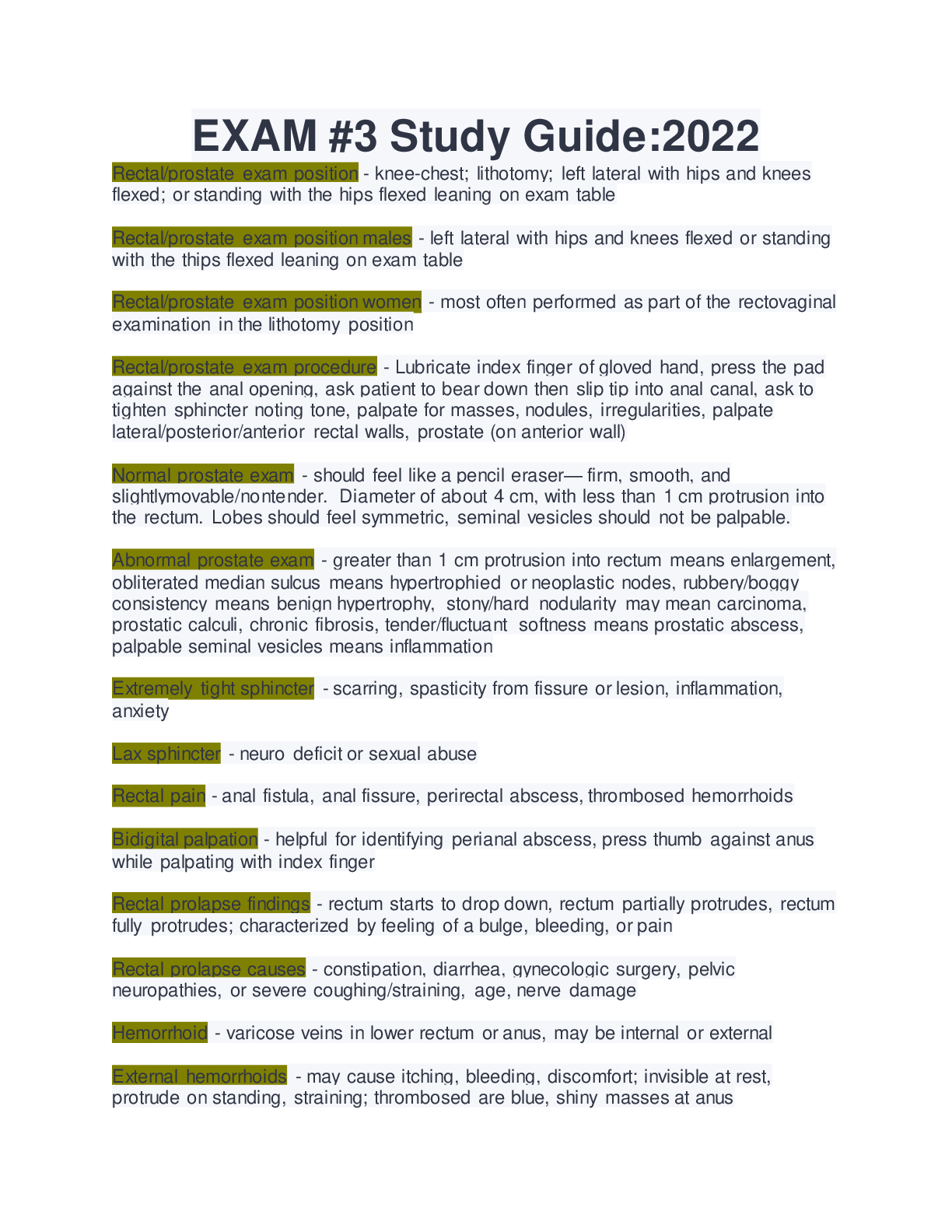
EXAM #3 Study Guide:2022
Rectal/prostate exam position - knee-chest; lithotomy; left lateral with hips and knees
flexed; or standing with the hips flexed leaning on exam table
Rectal/prostate exam position males - left lateral with hips and knees flexed or standing
with the thips flexed leaning on exam table
Rectal/prostate exam position women - most often performed as part of the rectovaginal
examination in the lithotomy position
Rectal/prostate exam procedure - Lubricate index finger of gloved hand, press the pad
against the anal opening, ask patient to bear down then slip tip into anal canal, ask to
tighten sphincter noting tone, palpate for masses, nodules, irregularities, palpate
lateral/posterior/anterior rectal walls, prostate (on anterior wall)
Normal prostate exam - should feel like a pencil eraser— firm, smooth, and
slightlymovable/nontender. Diameter of about 4 cm, with less than 1 cm protrusion into
the rectum. Lobes should feel symmetric, seminal vesicles should not be palpable.
Abnormal prostate exam - greater than 1 cm protrusion into rectum means enlargement,
obliterated median sulcus means hypertrophied or neoplastic nodes, rubbery/boggy
consistency means benign hypertrophy, stony/hard nodularity may mean carcinoma,
prostatic calculi, chronic fibrosis, tender/fluctuant softness means prostatic abscess,
palpable seminal vesicles means inflammation
Extremely tight sphincter - scarring, spasticity from fissure or lesion, inflammation,
anxiety
Lax sphincter - neuro deficit or sexual abuse
Rectal pain - anal fistula, anal fissure, perirectal abscess, thrombosed hemorrhoids
Bidigital palpation - helpful for identifying perianal abscess, press thumb against anus
while palpating with index finger
Rectal prolapse findings - rectum starts to drop down, rectum partially protrudes, rectum
fully protrudes; characterized by feeling of a bulge, bleeding, or pain
Rectal prolapse causes - constipation, diarrhea, gynecologic surgery, pelvic
neuropathies, or severe coughing/straining, age, nerve damage
Hemorrhoid - varicose veins in lower rectum or anus, may be internal or external
External hemorrhoids - may cause itching, bleeding, discomfort; invisible at rest,
protrude on standing, straining; thrombosed are blue, shiny masses at anusInternal hemorrhoids - may have no symptoms, are soft swellings not palpable on rectal
exam not visible unless prolapsed, dx w/ proctoscopy
Rectal bleeding causes - anal fissures, anaphylactoid purpura, aspirin use, bleeding &
coagulation disorders, colitis, dysentery, esophageal varices, familial telangiectasia,
foreign body trauma, hemorrhoids, hiatal hernia, hookworm, intussusception, iron
poisoning, Meckel diverticulum, neoplasms, oral steroids, peptic ulcers, polyps, regional
enteritis, strangulated hernia, swallowed blood, thrombocytopenia, volvulus
MS exam sequence - observe gait/posture as patient enters room, inspect (posture,
deformities, symmetry, alignment, hypertrophy), palpate (bones, joints, tendons,
muscles), evaluate ROM and muscle tone, muscle strength (hands, elbows, shoulders,
TMJ, cervical/thoracic/lumbar spine ROM, hips, legs and knees, feet and ankles
Limb measurement - asymmetry in limb size, normal is no more than 1 cm discrepancy
in length and circumference; athletes w/ dominant arm may have greater discrepancy in
circumferences
Leg length - measured from the anterior superior iliac spine to the medial malleolus of
the ankle, crossing the knee on the medial side
Arm length - measured from the acromion process through the olecranon process to the
distal ulnar prominence.
Neer test identifies - shoulder rotator cuff impingement or tear
Hawkins test identifies - shoulder rotator cuff impingement or tear
Katz hand diagram - median nerve integrity
Thumb abduction test - median nerve integrity; isolates strength of the abductor pollicis
brevis muscle, innervated only by median nerve. Place the hand palm up and raise the
thumb perpendicular to it. Apply downward pressure on the thumb to test muscle
strength; full resistance to pressure is expected; weakness associated CTS
Tinel sign - median nerve integrity; strike patient's wrist w/ index or middle finger where
the median nerve passes under the flexor retinaculum and volar carpal ligament;
tingling sensation radiating from the wrist to the hand in the distribution of the median
nerve is positive, suggests CTS
Phalen test - median nerve integrity; hold both wrists in a fully palmar-flexed position
with the dorsal surfaces pressed together for 1 minute, numbness/tingling = CTS
Reverse Phalen tests - hold hands together as if praying, press for 1 minuteLess likely CTS - Tinel and Phalen tests are ________ than Katz and Thumb test
Straight leg raising - L4, L5, S1 nerve root irritation
Femoral stretch test - L1, L2, L3, L4 nerve root irritation
Ballottement and Bulge sign - effusion in the knee
Ballottement - extend knee, push down on suprapatellar pouch with the web/thumb and
forefinger of one hand, push the patella quickly downward against the femur with other
hand; tapping or clicking will be sensed when the patella is pushed against the femur if
effusion present. Release pressure and keep your finger lightly touching patella, patella
will float out as if a fluid wave were pushing it if effusion present
Bulge sign - knee extended, milk the medial aspect of the knee upward two or three
times, and then milk the lateral side of the patella. Observe for a bulge of returning fluid
to the hollow area medial to the patella
McMurray test - supine, flex one knee, put thumb and fingers on either side of the joint
space. Hold the heel with your other hand, fully flexing the knee, and rotate the foot and
knee outward (valgus stress) to a lateral position. Extend and then flex the patient's
knee. Any palpable or audible click, pain, or limited extension of the knee is a positive
sign of a torn medial meniscus. Repeat while rotating the foot and knee inward (varus
stress) A palpable or audible click, pain, or lack of extension is a positive sign of a torn
lateral meniscus.
Varus stress - McMurray, foot rotated in, sign of torn lateral meniscus
Valgus stress - McMurray, foot rotated out, sign of torn medial meniscus
Varus - abduction
Valgus - adduction
Anterior and posterior drawer test - ACL/PCL instability; supine, knee flexed 45 to 90
degrees, foot flat on the table. Place both hands on the lower leg with the thumbs on the
ridge of the anterior tibia just distal to the tibial tuberosity. Draw the tibia forward, forcing
the tibia to slide forward of the femur. Then push the tibia backward. Knee movement
over 5 mm in either direction is an unexpected finding.
Varus-valgus stress test - medial or lateral collateral ligament instability in knee
Varus-valgus stress test how to - for lateral and medial collateral ligaments; pt supine,
knee extended, stabilize femur with one hand, hold the ankle with other. Apply varus
force against the ankle (toward the midline) and internal rotation. Excessive laxity is felt
as joint opening = injury to the lateral collateral ligament. Repeat w/ valgus force (awayfrom midline/external rotation), laxity = injury to medial collateral ligament. Repeat w/
knee flexed to 30 degrees, excessive movement not expected.
Lachman test - anterior cruciate ligament integrity; pt. supine, flex knee 10-15 degrees,
heel on table. One hand above knee to stabilize femur, other around proximal tibia, pull
tibia anteriorly while pt. relaxes hamstring; Increased laxity over 5 mm compared w/
uninjured side = ligament injury
Thomas test - pt supine; fully extend one leg flat, other leg knee to the chest. Observe if
pt can keep extended leg flat, if It lifts, = flexion contracture of hip of extended leg
Trendelenburg sign - have patient stand and balance on one foot and then the other,
note any asymmetry or change in the level of the iliac crests from behind; if iliac crest
drops on the side of the lifted leg, this indicates the weak hip abductor muscles on
weight-bearing side
MS age-related changes - may need slower exam, increased dorsal kyphosis w/ flexion
of the hips and knees; head may tilt backward d/t thoracic curvature, extremities may
appear long d/t vertebral collapse, feet more widely spaced, arms away from the body
to aid balancing; reduction in total muscle mass related to atrophy,
Osteoarthritis risk factors - obesity female, family hx of osteoarthritis, hypermobility
syndromes, age 40+, injury, high sports activities, peripheral neuropathy, job requiring
joint overuse
Osteoarthritis findings - pain (hands, feet, hips, knees, cervical/lumbar spine), onset
after 40, nearly 100% of people over 75, develops slowly, brief morning stiffness, pain
with use/relief with rest, enlarged joints d/t osteophytes, crepitus, limited, painful ROM,
non-inflammatory effusion, no heat, tender joints, heberden nodes, bouchard nodes
Rheumatoid findings - joint pain/stiffness, gradual onset, pain at rest, worse in morning
and after inactivity, constitutional sx (severe fatigue, myalgias, weight loss, low-grade
fever); involves hands, wrists, feet, ankles, hips, knees, cervical spine; synovitis w/ soft
tissue swelling and effusions present on exam, nodes and deformities may develop,
sometimes hot/red joint
Carpal tunnel assessment - Katz hand diagram, thumb abduction test, Tinel sign,
Phalen (all assess median nerve integrity)
Carpal tunnel findings - numbness, burning, tingling or pain, often at night; associated
with rheumatoid arthritis, gout, acromegaly, hypothyroidism, and pregnancy
Plantar fasciitis special tests - Tinel test along distal tibial nerve to r/o tarsal tunnel
syndrome, Calcaneus squeeze test to r/o calcaneal stress fracture.Plantar fasciitis findings - aching heel pain, worse w/ first step; better w/ activity, worse if
prolonged
Gout findings - Sudden onset, hot, swollen joint (usually proximal phalanx of great toe,
also wrists, hands, knees) d/t monosodium urate crystals, exquisite pain; limited ROM,
skin may be shiny red/purple, uric acid crystal tophi under skin when chronic; men over
40, postmenopausal women
Meningitis assessment - Nuchal rigidity (pain/rigidity when neck flexed in supine
position, possible swollen glands), Brudzinski's sign (involuntary hip flexion when neck
flexed), Kernig sign (flex knee at hip when supine, attempt to straighten leg, positive if
pain in lower back and resistance to straightening)
Jolt accentuation of headache - if fever/headache when meningitis suspected, pt rotate
head horizontally 2-3 times per second, increased headache over baseline positive
Meningitis findings - fever, stiff neck, and AMS; also headache, rash, nausea, vomiting,
chills, and myalgia. Nuchal rigidity, Brudzinski sign, and Kernig sign are diagnostic signs
Spinal stenosis signs - pain in buttocks/down legs w/ walking, standing; worsened w/
prolonged standing, walking, back hyperextension; pain relieved by bending forward;
normal early neuro exam, later lower extremity weakness, sensory loss, may be
stooped forward
OA - Insidious, over many years, few minutes of a.m. stiffness, pain on motion/w
prolonged activity, mild/localized weakness, fatigue is rare, depression/emotional
unusual, localized tenderness, non-inflammatory effusion common/little synovial
reaction, rare heat/effusion, course to medium crepitus on motion, mild joint
enlargement/bony consistency d/t osteophytes, heberden's and bouchard's nodes
RA - Gradual (typically weeks to months), sometimes 24-48 hours, several hours a.m.
stiffness, pain at rest, pronounced weakness, severe fatigue 4-5 hours after waking,
depression/emotional common, almost always tender/most sensitive indicator of
inflammation, fusiform soft tissue enlargement, inflammatory effusion common, synovial
proliferation/thickening, often symmetric, nodules; sometimes heat/effusion, medium to
find crepitus, moderate to severe joint enlargement if effusion present, ulnar deviation,
swan neck deformity, bouttoneire deformity
Rheumatoid - deviation of fingers to ulnar side, swan neck and boutonnière deformities,
spindle-shaped fingers
DDx for red, hot joint - septic arthritis, gonococcal arthritis, gout and pseudogout, and
systemic rheumatic disease manifesting in only one joint (RA, Lyme arthritis)
Neer test - forward flex arm up to 150 degrees while depressing the scapula. Increased
shoulder pain is associated with rotator cuff inflammation or a tearShoulder assessment - CN X1 accessory (shoulder shrug, Neer, Hawkins)
Hawkins test - abduct shoulder to 90 degrees, flexing the elbow to 90 degrees, and then
internally rotating the arm to its limit. Increased shoulder pain is associated with rotator
cuff inflammation or a tear
ROM positions - abduction, adduction, supination, pronation, extension, flexion
Abduction - toward body
Adduction - away from body
Supination - lying face up or ankle rolled out
Pronation - lying face down or ankle rolled in
Extension - extended out straight
Flexion - bent (knee, elbow)
Sports physical history - history of exertional symptoms (e.g., chest pain, dyspnea),
known heart murmur, unexplained syncope or near-syncope, symptoms of Marfan
syndrome, family hx of premature heart conditions or sudden death.
Sudden death sports - premature heart conditions, blunt chest and head trauma, drug
abuse, asthma, heat stroke, and drowning
14-step MS sports examination - eval positions/postures for asymmetries in ROM,
strength, muscle bulk
Sports physical components - H&P for neuro, cards, resp, vision, ortho, psych,
abdominal, GU, derm
Functional assessment of OA - sitting balance, arises, attempts to arise, immediate
standing balance, standing balance, score less than 21 indicates high risk for falls
Pediatric MS assessment - sitting, fetal, suspended. Kids may be observed playing.
Barlow-Ortolani maneuver - IDs hip dislocation or subluxation, all exams to age 1. Using
little force, test one hip at a time, stabilizing the pelvis with the other hand. By 3 months
of age, muscles and ligaments tighten, and limited abduction of the hips becomes the
most reliable sign of hip subluxation or dislocation
Barlow - infant supine, flex the hip and knee to 90 degrees; grasp the leg , adduct thigh
and gently apply downward pressure on the femur in an attempt to disengage thefemoral head from the acetabulum. A positive sign is when a clunk or sensation is felt
as femoral head exits the acetabulum posteriorly.
Ortolani maneuver - slowly abduct thigh while maintaining axial pressure. With the
fingertips on the greater trochanter, exert a lever movement in the opposite direction so
that your fingertips press the head of the femur back toward the acetabulum center. If
the head of the femur slips back into the acetabulum with a palpable clunk when
pressure is exerted, suspect hip subluxation or dislocation. High-pitched clicks are
common/expected.
Allis sign - detects hip dislocation or shortened femur. Supine infant, flex both knees,
keeping the feet flat on the table close to the buttocks and the femurs aligned with each
other. Observe knee height, if one higher, sign is positive.
Neuro exam sequence - Cranial nerves II through XII (only test taste if problem),
Proprioception and Cerebellar Function (rapid rhythmic alternating movements,
accuracy of movements, balance (Romberg test is given), and gait and heel-toe
walking), Sensory Function (superficial pain and touch at a distal point in each extremity
are tested; vibration and position senses are assessed by testing the great toe), Deep
Tendon Reflexes (all except plantar reflex and the test for clonus)
Normal neuro changes OA - decreased salty taste, diminished hearing/vision, reduced
tactile and temperature sensation, decreased touch perception and manual dexterity,
reduced balance, strength, proprioception; shuffling gait, Tactile, vibratory, position
sense may be reduced; DTRs become less brisk or absent (LE before UE), achilles and
tendon DTR may be absent or diminished, superficial reflexes may disappear;
development of benign essential tremor normal, fine motor coordination and agility may
be impaired
Tinetti Balance and Gait Assessment Tool - used for mobility assessment, falls risk
assessment
Parkinson disease - Tremors, muscular rigidity, cogwheel rigidity with jerks, stooped
posture, balance and postural instability, short steps, shuffling, freezing gait, gait may
accelerate to maintain upright posture, slow, slurred monotonous speech, voice
softening, impaired cognition, dementia
Dermatome levels - cervical, thoracic, sacral, lumbar
C3 Dermatome - Lateral Neck
C4 Dermatome - Over Clavicle
C5 Dermatome - Lateral upper arm near deltoid insertion
C6 Dermatome - thumb and lateral forearmC7 Dermatome - Middle finger
C8 Dermatome - Medial border of hand, little finger
T1 Dermatome - Medial forearm
T2 Dermatome - Medial upper arm close to axilla
L1 Dermatome - Anterior groin
L2 Dermatome - Middle to upper anterior thigh
L3 Dermatome - Middle to lower medial thigh
L4 Dermatome - Medial aspect of foot to great toe
L5 Dermatome - Central dorsum of foot to middle toe
S1 Dermatome - Lateral aspect of foot and lateral posterior thigh
S2 Dermatome - Medial of posterior thigh
S3 Dermatome - Groin, medial thigh to knee
Rectal prolapse - Protruding rectal mucosa. Thick concentric mucosal ring. Sulcus
noted between anal canal and rectum.
MS exam sequence - inspect, palpate, range of motion, muscle tone, muscle strength
Stereognosis - hold familiar object with eyes closed, identify it
MS changes OA - bone loss, boney prominences more apparent, deteriorating cartilage
around joints, tendon less elastic, reduced total muscle mass, tone and strength,
decrease in reaction time, speed of movement, agility and endurance occur
Tactile agnosia - inability to identify objects by touch, suggests parietal lobe lesion
Graphesthesia - draw letter or number on hand, ask pt to identify figure
Vibratory - touch bony prominence (usually toe or finger) w/ tuning fork, as them
when/where it is felt
2-point discrimination - touch pt with 1 or 2 ends of paperclip at same time, ask how
many points they feelProprioception - recognition of body parts and awareness of position (ask if toe/finger is
up or down, rapid alternating movements - on lap, finger to finger, finger to nose)
Proprioception examination - Romberg test, heel-to-toe walking, standing on one foot
and then on the other with eyes closed, hopping in place, and deep knee bends.
Equilibrium - perform Romberg test - Ask the patient (with eyes open and then closed)
to stand, feet together and arms at the sides, slight swaying is expected, but not almost
falling. Nudge standing patient, should recover/not fall. Stand on 1 foot (5 seconds),
Hop on 1 foot (5 seconds).
Positive Romberg sign - loss of balance, indicates cerebellar ataxia, vestibular
dysfunction, or sensory loss. If this happens, postpone other tests of cerebellar function
requiring balance.
Straight leg raising test - test for nerve root irritation or lumbar disk herniation (L4, L5,
and S1 levels). Supine w/ neck slightly flexed, ask to raise leg w/ knee extended; no
pain should be felt below knee; radicular pain below knee may = disk herniation.
Crossover pain in the affected leg may indicate sciatic nerve impingements.
Tendons - attach muscle to bone
Ligaments - attach bone to bone
Upper abdominal - superficial - T8, T9, and T10
Lower abdominal - superficial - T10, T11, and T12
Cremasteric - superficial - T12, L1, and L2
Plantar - superficial - L5, S1, and S2
Biceps - DTR - C5 and C6
Brachioradial - DTR - C5 and C6
Triceps - DTR - C6, C7, and C8
Patellar - DTR - L2, L3, and L4
Achilles - DTR - S1 and S2
DTR Grades - 0 No response, 1 + Sluggish or diminished, 2 + Active or expected
response, 3 + More brisk than expected, slightly hyperactive, 4 + Brisk, hyperactive,
with intermittent or transient clonusMuscle strength Grade 1: - Trace of contraction, but no movement at the joint.
Muscle strength Grade 2: - Movement at the joint with gravity eliminated.
Muscle strength Grade 3: - Movement against gravity, but not against added resistance.
Muscle strength Grade 4: - Movement against external resistance with less strength
than usual.
Goniometer - assesses ROM
Scoliosis findings - noticeable lateral curvature of the spine, or rib hump, as the patient
bends forward at the waist, waist crease, leg length discrepancy, S or C curve
Scoliometer reading - 7+ is positive at any level of spine
Babinski sign - present when dorsiflexion of the great toe with or without fanning of
other toes, indicates pyramidal tract upper motor neuron disorder, expected in children
younger than 2
Dementia - onset insidious, persistent, stable all day, consciousness not impaired,
minimal cognitive impairment initially, progresses to impaired abstract thinking,
judgment, memory, thought patterns, calculations, agnosia; no change in activity,
disordered, rambling, incoherent speech, depressed/apathetic mood, delusions, no
hallucinations, irreversible, r/t brain diseases
Delirium - acute onset (hours to days), fluctuates throughout day, altered
consciousness, impaired memory, attentiveness, increased or decreased activity,
rambling, irrelevant conversation/may fluctuate, rapid mood swings, fearful/suspicious,
illusions/delusions/hallucinations present, may be reversed, acute onset r/t
inflammation, electrolyte imbalance
Parkinson - tremors at rest, muscular rigidity, cogwheel rigidity with jerks, stooped
posture, balance and postural instability, short steps, shuffling, freezing gait, gait may
accelerate to maintain upright position, slow slurred monotonous speech, voice
softening, impaired cognition, dementia; Classic features: excessive sweating, drooling
with excess saliva, gait with rapid, shuffling steps and reduced arm swinging
MS findings - muscle weakness, ataxia, hyperactive deep tendon reflexes, paresthesia,
sensory loss, intention tremor, optic neuritis, cognitive changes, MRI reveals brain
lesions
Normal gait of OA - shorter steps with less lifting of the feet, shuffling may occur as
speed, balance, and grace decrease. Arms are more flexed, and legs may be flexed at
the hips and kneesRooting - at birth, gone 3-4 mos.
Palmar grasp - birth, strongest 1-2 mos., gone by 3
Plantar grasp - birth, strong until 8 mos.
Moro - birth, diminished 3-4 mos., gone by 6; semisitting position, allow the head and
trunk to drop back to a 30-degree angle; observe symmetric abduction and extension of
the arms; fingers fan out and thumb and index finger form a C; the arms then adduct in
an embracing motion followed by relaxed flexion; the legs may react similarly
Placing - 3-4 days, variable disappearance. Hold the infant upright under the arms next
to a table or chair; touch the dorsal side of the foot to the table or chair edge; observe
flexion of the hips and knees and lifting of the foot as if stepping up on the table
Stepping - birth, gone before voluntary walking; infant 'steps' when feet on flat surface
Fencing - 2-3 mos., dim by 3-4, gone by 6. Arm extends toward side child is facing
Comprehensive exam sequence - measurements, head/face, eyes, ears, nose,
mouth/pharynx, neck, UE, back/posterior chest & lungs, anterior chest/lungs/heart,
breasts, abdomen, inguinal, male genitals, feet/legs, hips, musculoskeltal, neuro, spine,
abdominal/hernia, gyne exam,
Clinical judgment - assess what you learn of patient, gather info; identify problem,
presume diagnosis; identify tests/procedures/studies
Sensitivity - ability of an observation to identify correctly those who have a disease
Specificity - ability of an observation to identify correctly those who do not have a
disease
True positive - expected observation that is found when the disease characterized by
that observation is present
True negative - an expected observation that is not found when the disease
characterized by that observation is not present
False positive - an observation made that suggests a disease when that disease is not
present
False negative - an observation that suggests a disease is not present when in fact it is
(e.g., absence of cough or respiratory findings when lung cancer is present)Positive predictive value - proportion of persons with an observation characteristic of a
disease who have it (observation is made 100 times, 95 of those occasions that
observation proves to be consistent with the ultimate diagnosis, ___ is 95%)
Negative predictive value - proportion of persons with an expected observation who
ultimately prove not to have the expected condition (100 observations are made
expecting a disease, 95 times that observation is not found and the condition proves not
to have dx, NPV is 95%
Emergencies - Rapid primary assessment, secondary assessment, definitive care
Life threatening situations - Airway obstruction, impaired ventilation and hypoxemia,
hypovolemic shock, hemorrhage; manage as soon as detected, repeat Q5m
ABCDE for ER - Airway is maintained and cervical spine control, Breathing assessed,
Circulation assessed/hemorrhage controlled, Disability assessed w/ patient's degree of
responsiveness, Exposure - undress to ID all injuries, maintain body temp
Secondary ER - in-depth exam for anatomic problems, additional potentially lifethreatening conditions, patient's previously diagnosed conditions; Check VS before
beginning HTT exam
SAMPLE abbreviated history - symptoms, allergies, current meds, past illnesses, last
meal, events preceding incident
Secondary ER exam - head/neck, chest, abdomen, extremities/back, rectum/perineum,
neuro exam, reevaluation
SER exam head/neck - inspect/palpate head/scalp for depressions, bone instability,
crepitus, lacs, penetrating injuries, ear/nose drainage; examine eyes for pupil size/light
response, retina/conjunctivae for hemorrhage, lens for dislocation, EOMs; ears inspect
TMs for blood in middle ear w/ otoscope; assess face for factures (racoon eyes, battle
sign); inspect neck for penetrating injuries, bruising, trachea deviation from midline;
palpate for deformity/crepitus, auscultate carotids for bruits, maintain neck in neutral
position until Xrays confirm no cervical injury
SER exam chest - Inspect anterior/posterior for bruises, obvious deformity; palpate
sternum, ribs, clavicle, auscultate breath sounds at apex, base, midaxillary, auscultate
heart for clarity of HS, chest Xrays
SER exam abdomen - inspect the abdomen for bruising/distention, gently palpate noting
guarding/pain (hollow organs may rupture w/ blunt trauma), peritoneal lavage or Xrays
may be performed
SER exam extremities - inspect and palpate for fractures, deformities, crepitus, pain,
lack of spontaneous movement, palpate peripheral pulses, inspect back, inspect forbruising and palpate for pelvic fractures, inspect perineum for bruising, lacs, urethral
bleeding, rectal and/or vaginal exam if needed
Log-roll - perform to inspect back
SER exam neuro - Total neuro exam performed after stabilized; Reassess GCS, pupil
size/reactivity, detailed motor and sensory eval noting paralysis or paresis,
Reevaluation - reevaluate frequently for new S&S, perform primary survey Q5m to
compare, monitor VS, LOC, maintain suspicion for early recognition/mgmt.
Acute med emergencies - Black/dark brown coffee grounds emesis
Upper GI bleed - coffee grounds emesis
Myocardial infarction - crushing pain in center of chest
Acute glaucoma - severe throbbing pain in/around a bloodshot eye
Retinal detachment - flashes of light in the field of vision of one eye
Acute abdomen - sudden and progressively severe abdominal pain
TIA/stroke - sudden weakness and unsteadiness possible momentary LOC
Pulmonary edema - sudden onset of difficulty breathing (often in the middle of the night)
and worsens rapidly
Injury Assessment - history of injury, ID mechanism determine severity
Injury mechanism - nature/force of energy, associated with injury patterns
Blunt trauma - MVC (most often), falls, struck by object, recreational/sports activities
Penetrating trauma - GSW, stabbings, impalement
Determine injury type & management - region of body/organs in path of penetrating
object, transfer of energy determined by force of impact (velocity of object, caliber,
distance from source)
Burns - possible airway inflammation d/t smoke, heat, toxic chemical inhalation, CO
poisoning
Patent airway - crying or talking child currently has aAVPU level of responsiveness assessment - helpful for children and adults - Alert,
Verbal stimuli (responsive to), Painful stimuli (responsive to), Unresponsive
Where does it hurt? - Assess child
Child approx. expected BP - 80 + 2x child's age in years
Over 2 seconds - abnormal capillary refill time for children and adults
Large relative BSA - exposure for assessment = significant heat loss
ER history taking for child - SAMPLE abbreviated history symptoms, allergies, current
meds, past illnesses, last meal, events preceding incident PLUS pregnancy/delivery info
Weight - get for calculating resuscitation medication dosages and fluid volumes
OA aspiration/obstruction risk - muscles in the upper airway weaken with age.
OA decreased vital capacity - ventilatory function may be less efficient.
OA cardiovascular changes - decrease in HR and cardiac output, increased risk of
CAD, arrhythmias
OA BP - increases with age, vasculature becomes stiff, less able to compensate quickly
for low perfusion states
OA peripheral pulses - may be difficult to palpate, vascular changes, poor circulation
OA Beta blockers - unable to compensate and increase their heart rate in cases of
shock or dehydration
OA anticoagulation therapy - experience increased bleeding
OA pain perception - may be reduced d/t deterioration of nerve endings
OA mental status - chronic MS changes may be present
OA skin - thinner sub-q fat, injures easily, hypothermia greater risk,
Meticulous record-keeping - essential bc memory is unreliable, record
obs/evals/orders/what was done/not done, must be thorough, concise, clear, and
accurate, chronological events, legible
Life-threatening situations - treat first, consent later whenForensic trauma - preserve evidence - save bullets/clothing for LE w/ documented chain
of possession by healthcare professionals
Advance Directives - formal statement of desired medical care in the event of a
catastrophic injury or illness, make conscientious effort to learn if they have one,
important if cognitive impairment preventing medical decision making
Living wills - formally IDs conditions where specific medical interventions desired,
utilized, limited, or forbidden if unable to make decisions
DPOA for healthcare - delegates a close relative/trusted person to make health care
decisions when the patient is unable to make health care decisions
Upper airway obstruction - compromise of the airway space, resulting in impaired
respiratory exchange
Hypoxemia - severely reduced blood oxygen levels in major organs
Ventilatory failure - compromised exhalation of carbon dioxide because of alveolar
hypoventilation
Shock state - abnormality of the circulatory system that results in inadequate organ
perfusion and tissue oxygenation (hypovolemic, septic, spinal cord injury, injury above
diaphragm e.g. myocardial contusion, tension pneumothorax)
Increased intracranial pressure - increase in volume of brain tissue, blood, or
cerebrospinal fluid (CSF) within the closed space of the skull that results in elevated
pressure
Pulmonary embolism - migration of a blood clot from the deep veins of the legs or pelvis
to the lung vasculature
Status asthmaticus - zcute severe asthma exacerbation that does not respond to usual
treatment
Status epilepticus - prolonged seizure or series of seizures that occur without recovery
of consciousness
Medulla oblongata CN IX to XII - Respiratory, circulatory, and vasomotor activities;
houses respiratory center Reflexes of swallowing, coughing, vomiting, sneezing, and
hiccupping Relay center for major ascending and descending spinal tracts that
decussate at the pyramid
Pons CN V to VIII - Reflexes of pupillary action and eye movement Regulates
respiration; houses a portion of the respiratory center Controls voluntary muscle action
with corticospinal tract pathwayMidbrain CN III and IV - Reflex center for eye and head movement Auditory relay
pathway Corticospinal tract pathway
Diencephalon CN I and II - Thalamus Relays impulses between cerebrum, cerebellum,
pons, and medulla Conveys all sensory impulses (except olfaction) to and from
cerebrum before their distribution to appropriate associative sensory areas Integrates
impulses between motor cortex and cerebrum, influencing voluntary movements and
motor response Controls state of consciousness, conscious perceptions of sensations,
and abstract feelings
Epithalamus - Houses the pineal body Sexual development and behavior
Hypothalamus - Major processing center of internal stimuli for autonomic nervous
system Maintains temperature control, water metabolism, body fluid osmolarity, feeding
behavior, and neuroendocrine activity
Pituitary gland - Hormonal control of growth, lactation, vasoconstriction, and metabolism
Olfactory (I) - Sensory: smell reception and interpretation
Optic (II) - Sensory: visual acuity and visual fields
Oculomotor (III) - Motor: raise eyelids, most extraocular movements Parasympathetic:
pupillary constriction, change lens shape
Trochlear (IV) - Motor: downward, inward eye movement
Trigeminal (V) - Motor: jaw opening and clenching, chewing, and mastication Sensory:
sensation to cornea, iris, lacrimal glands, conjunctiva, eyelids, forehead, nose, nasal
and mouth mucosa, teeth, tongue, ear, facial skin
Abducens (VI) - Motor: lateral eye movement
Facial (VII) - Motor: movement of facial expression muscles except jaw, close eyelids,
labial speech sounds (b, m, w, and rounded vowels) Sensory: taste— anterior two-thirds
of tongue, sensation to pharynx Parasympathetic: secretion of saliva and tears
Acoustic (VIII) - Sensory: hearing and equilibrium
Glossopharyngeal (IX) - Motor: voluntary muscles for swallowing and phonation
(guttural speech sounds) Sensory: sensation of nasopharynx, gag reflex, taste—
posterior one-third of tongue Parasympathetic: secretion of salivary glands, carotid
reflexVagus (X) - Sensory: sensation behind ear and part of external ear canal
Parasympathetic: secretion of digestive enzymes; peristalsis; carotid reflex; involuntary
action of heart, lungs, and digestive tract
Spinal accessory (XI) - Motor: turn head, shrug shoulders, some actions for phonation
Hypoglossal (XII) - Motor: tongue movement for speech sound articulation (l, t, d, n) and
swallowing
Ascending spinal tracts - (e.g., spinothalamic, spinocerebellar) mediate various
sensations; manage sensory signals necessary for complex discrimination tasks.
Posterior (dorsal) column spinal tract - (fasciculus gracilis and fasciculus cuneatus) -
fine touch, two-point discrimination, and proprioception.
Spinothalamic - light and crude touch, pressure, temperature, and pain.
Descending spinal tracts - (corticospinal, reticulospinal, vestibulospinal) convey
impulses from brain to muscle groups by inhibiting or exciting spinal activity. Also help
control muscle tone, posture, and precise motor movements.
Corticospinal (pyramidal) tract - skilled, delicate, and purposeful movements.
Vestibulospinal tract - causes the extensor muscles of the body to suddenly contract
when an individual starts to fall.
Corticobulbar tract arising from the brainstem - innervates motor functions of the cranial
nerves.
Upper motor neurons - nerve cell bodies for the motor pathways that all begin and end
within the central nervous system. Include descending pathways from brain to spinal
cord. Influence, direct, and modify spinal reflex arcs and circuits.
Upper motor neurons - affect movement only through the lower motor neurons.
Lower motor neurons, cranial and spinal motor neurons - originate in the anterior horn
of the spinal cord and extend into the peripheral nervous system; Transmit neural
signals directly to the muscles to permit movement.
Upper motor neurons - injury to _________results in initial paralysis followed by partial
recovery over an extended period.
Lower motor neurons - injury often results in permanent paralysis.
Afferent - sensoryEfferent - motor
CN I (olfactory) - Test ability to identify familiar aromatic odors, one naris at a time with
eyes closed
CN II (optic) - Test distant and near vision Perform ophthalmoscopic examination of
fundi; Test visual fields by confrontation and extinction of vision
CN III (oculomotor), CN IV (trochlear), and CN VI (abducens) - Inspect eyelids for
drooping Inspect pupils' size for equality and their direct and consensual response to
light and accommodation. Test extraocular eye movements
CN V (trigeminal) - Inspect face for muscle atrophy and tremors, Palpate jaw muscles
for tone and strength when patient clenches teeth, Test superficial pain and touch
sensation in each branch (test temperature sensation if there are unexpected findings to
pain or touch), Test corneal reflex
CN VII (facial) - Inspect symmetry of facial features with various expressions (e.g.,
smile, frown, puffed cheeks, wrinkled forehead), Test ability to identify sweet and salty
tastes on each side of tongue
CN VIII (acoustic) - Test sense of hearing with whisper screening tests or by
audiometry, Compare bone and air conduction of sound, Test for lateralization of sound
CN IX (glossopharyngeal), and X (vagus) - Test ability to identify sour and bitter tastes
on each side of tongue, Test gag reflex and ability to swallow Inspect palate and uvula
for symmetry with speech sounds and gag reflex, Observe for swallowing difficulty,
Evaluate quality of guttural speech sounds (presence of nasal or hoarse quality to
voice)
CN XI (spinal accessory) - Test trapezius muscle strength (shrug shoulders against
resistance), Test sternocleidomastoid muscle strength (turn head to each side against
resistance)
CN XII (hypoglossal) - Inspect tongue in mouth and while protruded for symmetry,
tremors, and atrophy, Inspect tongue movement toward nose and chin, Test tongue
strength with index finger when tongue is pressed against cheek, Evaluate quality of
lingual speech sounds (l, t, d, n)
Sensory (S), Motor (M), or Both (B) - Some Say Marry Money But My Brother Says Bad
Business Marry Money
Migraine hx findings - starts in childhood, unilateral or generalized, hours to days,
prodromes - vague neurologic changes, personality change, fluid retention, appetite
loss to well-defined neurologic event, scotoma, aphasia, hemianopsia, aura, precip
events - females, period, bcp, following stress, can cause nausea/vomiting,Tension headache hx findings - adulthood, uni- or bilateral, hours to days, any time,
bandlike/constricting, prodromes - none, precip - anger, bruxism, stress, daily, male or
female
Cluster headache hx findings - adulthood, unilateral, .5 to 2 hours, night,
intense/boring/searing/knifelike, prodromes - personality changes, ETOH use, several x
nightly, several days, then none, males, tearing/nasal discharge
[Show More]