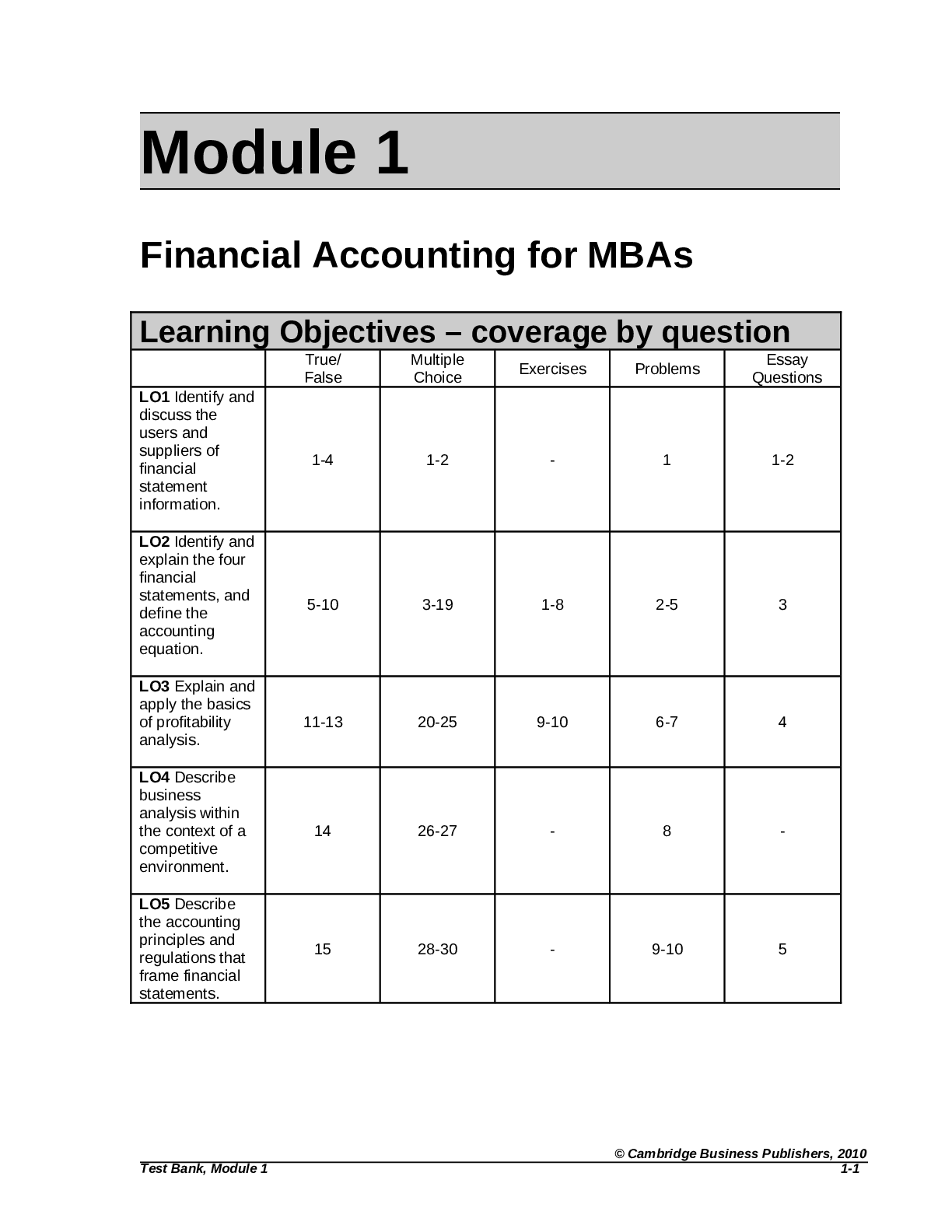
Learning Objectives – coverage by question
True/
False
Multiple
Choice Exercises Problems Questions Essay
LO1 Identify and
discuss the
users and
suppliers of
financial
statement
information.
LO2 Identify an
...
Learning Objectives – coverage by question
True/
False
Multiple
Choice Exercises Problems Questions Essay
LO1 Identify and
discuss the
users and
suppliers of
financial
statement
information.
LO2 Identify and
explain the four
financial
statements, and
define the
accounting
equation.
LO3 Explain and
apply the basics
of profitability
analysis.
LO4 Describe
business
analysis within
the context of a
competitive
environment.
LO5 Describe
the accounting
principles and
regulations that
frame financial
statements.
Module 1: Financial Accounting for MBAs
True/False
Topic: Users of Financial Statement Information
LO: 1
1. Shareholders demand financial information primarily to assess profitability and risk whereas
bankers demand information primarily to assess cash flows to repay loan interest and principle.
Answer: True
Rationale: While both shareholders and bankers are interested in all the information company’s
provide, shareholders care about more about a company’s profitability and bankers care more about
solvency and creditworthiness.
Topic: Publicly available financial reports
LO: 1
2. Publicly traded companies are required to provide quarterly financial reports directly to the public.
Answer: False
Rationale: Companies provide electronic versions of quarterly financial statements to the SEC that
posts them to the internet for the public to access them.
Topic: Users of Financial Statement Information
LO: 1
3. Publicly traded companies provide financial information primarily to satisfy the SEC and the tax
authorities (that is, the Internal Revenue Service).
Answer: False
Rationale: Demand for information extends to many users, the regulators such as the SEC and the
IRS are only one class of users.
Topic: SEC filings
LO: 1
4. Publicly traded companies must provide to the Securities Exchange Commission annual audited
financial statements (10K reports) and quarterly audited financial statements (10Q reports).
Answer: False
Rationale: Quarterly reports do not need to be audited.
Topic: Balance Sheet
LO: 2
5. If a company reports retained earnings of $175.3 million on its balance sheet, it must also report
$175.3 million in cash.
Answer: False
Rationale: The accounting equation requires total assets to equal total liabilities plus stockholders’
equity. That does not imply, however, that liability and equity accounts relate directly to specific
assets.
Cambridge Business Publishers, ©2010
1-2 Financial Accounting for MBAs, 4th EditionTopic: Balance Sheet
LO: 2
6. A balance sheet shows a company’s position over a period of time, whereas an income statement,
statement of stockholders’ equity, and statement of cash flows show its position at a point in time.
Answer: False
Rationale: The statement is reversed: A balance sheet shows a company’s position at a point in time,
whereas an income statement, statement of equity, and statement of cash flows show its position
over a period of time.
Topic: Accounting Equation
L: O2
7. Assets must always equal liabilities plus equity.
Answer: True
Rationale: The accounting equation is Assets = Liabilities + Equity. This relation must always hold.
Topic: Income Statement
LO: 2
8. The income statement reports net income which is defined as the company’s profit after all
expenses and dividends have been paid.
Answer: False
Rationale: The statement contains two errors. First, net income does not include any dividends
during the period; these are a distribution of profits and not part of its calculation. Second, the income
statement is prepared on an accrual basis and thus includes expenses incurred (as opposed to paid).
Topic: Statement of Cash Flows
LO: 2
9. A statement of cash flows reports on cash flows for operating, investing and financing activities at
a point in time.
Answer: False
Rationale: A statement of cash flows reports on cash flows for operating, investing, and financing
activities over a period of time.
Topic: Statement of Stockholders’ Equity
LO: 2
10. An increase in treasury stock would be reflected in the statement of stockholders’ equity.
Answer: True
Rationale: The statement of stockholders’ equity reports on changes in the accounts that make up
stockholders’ equity. This includes contributed capital, retained earnings, and treasury stock.
© Cambridge Business Publishers, 2010
Test Bank, Module 1 1-3Topic: Return on Assets
LO: 3
11. Return on Assets (ROA) measures the profit the company makes on each dollar of total assets it
uses.
Answer: True
Rationale: Return on Assets profitability metric that measures how much profit the company made for
each dollar of assets the company holds on average during the year.
Topic: Return on Assets
LO: 3
12. Return on Assets (ROA) = Net Income / Sales × Asset Turnover
Answer: True
Rationale: Return on Assets = Net income / Average Assets. The disaggregation of the ROA into its
components
Topic: Asset Turnover
LO: 3
13. Consider two companies (A and B) with equal profit margins of 15%. Company A has an asset
turnover of 1.2 and Company B has an asset turnover of 1.5. If all else is equal, Company B with its’
higher asset turnover, is less profitable because it is expensive to turn assets over.
Answer: False
Rationale: Asset turnover is an efficiency metric. The higher the turnover, the more efficient the
company is with its assets and thus, the more profitable. Algebraically, ROA = PM × AT. Company A
above is less profitable: 15% × 1.2 = 18% whereas Company B’s ROA is 15% × 1.2 = 22.5%.
Topic: Financial Accounting and Business Analysis
LO: 4
14. Financial statements are influenced by five important forces that determine a company’s
competitive intensity: (A) industry competition, (B) buyer power, (C) supplier power, (D) product
substitutes, and (E) threat of entry.
Answer: True
Rationale: By systematically considering these five business forces, we can gain better insights from
financial statements.
Topic: Audit Report
LO: 5
15. A “clean” audit report asserts – among other things – that (a) the auditor has prepared all
necessary financial statements and (b) management has expressed its opinion that they are prepared
in conformity with GAAP.
Answer: False
Rationale: The statement is reversed: A “clean” audit report asserts – among other things – that (a)
management has prepared all necessary financial statements and (b) the auditor has expressed its
opinion that they are prepared in conformity with GAAP.
Cambridge Business Publishers, ©2010
1-4 Financial Accounting for MBAs, 4th EditionMultiple Choice
Topic: Users of Financial Statement Information
LO: 1
1. Which of the following groups would likely not be interested in the financial statements of a large
public company such as Berkshire Hathaway?
a. Shareholders
b. Employees
c. Competitors
d. Taxing agencies
e. None of the above
Answer: e
Rationale: All of these parties would use the financial statements, albeit in different ways and for
different purposes.
Topic: Users of Financial Statement Information
LO: 1
2. The SEC adopted Regulation FD, to curb public companies practice of:
a. Routinely filing extensions for annual reports (Form 10-k)
b. Selectively disclosing information
c. Reporting pro forma (non-GAAP) numbers
d. Hiring auditors for non-audit services such as consulting engagements
e. None of the above
Answer: b
Rationale: Reg FD reads as follows: “Whenever an issuer discloses any material nonpublic
information regarding that issuer, the issuer shall make public disclosure of that information . . .
simultaneously, in the case of an intentional disclosure; and . . . promptly, in the case of a nonintentional disclosure.”
Topic: Components of the Balance Sheet
LO: 2
3. A list of assets, liabilities and equity can be found on which of the following?
a. Balance Sheet
b. Income Statement
c. Statement of Assets and Liabilities
d. Statement of Cash Flows
e. Statement of Stockholders’ Equity
Answer: a
Rationale: A balance sheet lists amounts for assets, liabilities and equity at a point in time.
© Cambridge Business Publishers, 2010
Test Bank, Module 1 1-5Topic: Balance Sheet
LO: 2
4. Which of the following items would not be found on a balance sheet? (Select all that apply)
a. Stockholders’ Equity
b. Property, plant and equipment
c. Nonowner financing
d. Sales
e. Cost of Goods Sold
Answer: d and e
Rationale: The balance sheet reports assets (including property, plant and equipment), liabilities
(including nonowner financing) and equity. Sales and Cost of Goods Sold appear on the income
statement.
Topic: Profit and Cash Flow
LO: 2
5. A company’s net cash flow will equal its net income …
a. Almost always
b. Rarely
c. Occasionally
d. Only when the company has no investing cash flow for the period
e. Only when the company has no investing or financing cash flow for the period
Answer: b
Rationale: Net income reflects the company’s revenue minus expenses for the given period. Net
cash flow represents the amount of money received (spent) on operating, investing and financing
activities for the given period. These values are rarely the same.
Topic: Financial Statement Information
LO: 2
6. Which of the following statements are correct (select all that apply):
a. A balance sheet reports on investing and financing activities.
b. An income statement reports on financing activities.
c. The statement of equity reports on changes in the accounts that make up equity.
d. The statement of cash flows reports on cash flows from operating, investing, and financing
activities over a period of time.
e. A balance sheet reports on a company’s assets and liabilities over a period of time.
Answer: a, c, and d
Rationale: Statement (b) is incorrect – the statement of cash flows reports on financing activities that
are reflected on the balance sheet. Statement (e) is incorrect – the balance sheet reports on a
company’s assets and liabilities at a point in time
Cambridge Business Publishers, ©2010
1-6 Financial Accounting for MBAs, 4th Editio
[Show More]



 MOD 01 QUIZ.png)
.png)