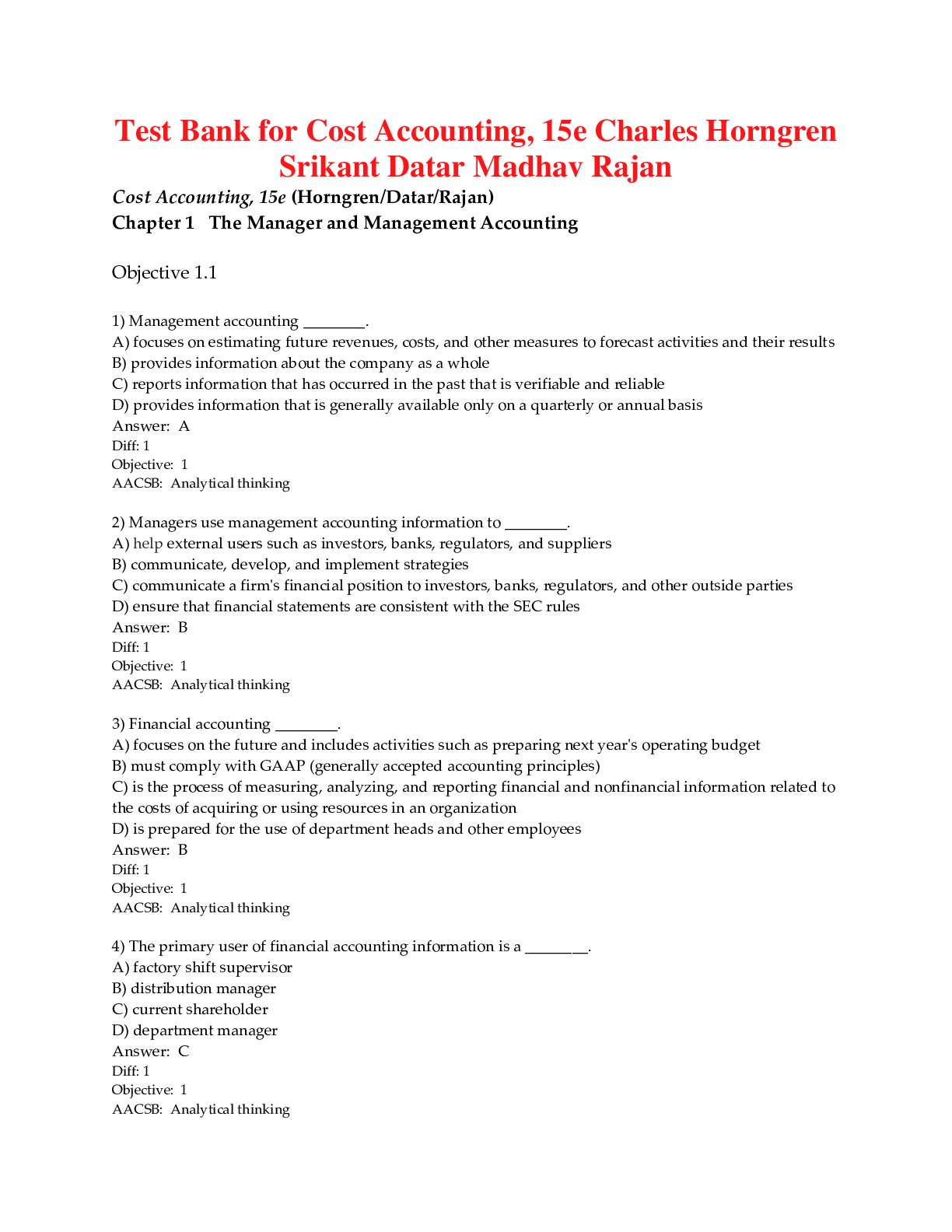
COST ACCOUNTING TEST BANK 14TH EDITION(Chapter 1 - 5)COST ACCOUNTING TESTBANK FOR ACCOUNTANCY STUDENTS
COST ACCOUNTING TEST BANK 14TH EDITION.
CHAPTER 1 (Cost-Volume-Profit Analysis)
Objective 1.1
1. Cost-volume-prof
...
COST ACCOUNTING TEST BANK 14TH EDITION(Chapter 1 - 5)COST ACCOUNTING TESTBANK FOR ACCOUNTANCY STUDENTS
COST ACCOUNTING TEST BANK 14TH EDITION.
CHAPTER 1 (Cost-Volume-Profit Analysis)
Objective 1.1
1. Cost-volume-profit analysis is used primarily by management:
A. As a planning tool
B. For control purposes
C. To prepare external financial statements
D. To attain accurate financial results
Answer: A
Diff: 1
Terms: cost-volume-profit (CVP)
Objective: 1
AACSB: Communication
2. One of the first steps to take when using CVP analysis to help make
decisions is:
A. Finding out where the total costs line intersects with the total revenues line on a
graph.
B. Identifying which costs are variable and which costs are fixed.
C. Calculation of the degree of operating leverage for the company.
D. Estimating how many products will have to be sold to make a decent profit.
Answer: B
Diff: 1
Terms: cost-volume-profit (CVP) analysis
Objective: 1
COST ACCOUNTING TESTBANK FOR ACCOUNTANCY STUDENTS
AACSB: Reflective thinking
3. Cost-volume-profit analysis assumes all of the following EXCEPT:
A. All costs are variable or fixed
B. Units manufactured equal units sold
C. Total variable costs remain the same over the relevant range
D. Total fixed costs remain the same over the relevant range
Answer: C
Diff: 2
Terms: cost-volume-profit (CVP)
Objective: 1
AACSB: Reflective thinking
4. Which of the following items is NOT an assumption of CVP analysis?
A. Total costs can be divided into a fixed component and a component that is
variable with respect to
the level of output.
B. When graphed, total costs curve upward.
C. The unit-selling price is known and constant.
D. All revenues and costs can be added and compared without taking into account
the time value of
money.
Answer: B
Diff: 3
Terms: cost-volume-profit (CVP)
Objective: 1
COST ACCOUNTING TESTBANK FOR ACCOUNTANCY STUDENTS
AACSB: Reflective thinking
5. Which of the following items is NOT an assumption of CVP analysis?
A. Costs may be separated into separate fixed and variable components.
B. Total revenues and total costs are linear in relation to output units.
C. Unit selling price, unit variable costs, and unit fixed costs are known and remain
constant.
D. Proportion of different products will remain constant when multiple products
are sold.
Answer: C
Diff: 3
Terms: cost-volume-profit (CVP)
Objective: 1
AACSB: Reflective thinking
6. A revenue driver is defined as:
A. Any factor that affects costs and revenues
B. Any factor that affects revenues
C. Only factors that can influence a change in selling price
D. Only factors that can influence a change in demand
Answer: B
Diff: 1
Terms: revenue driver
Objective: 1
AACSB: Reflective thinking
COST ACCOUNTING TESTBANK FOR ACCOUNTANCY STUDENTS
7. Operating income calculations use:
A. Net income
B. Income tax expense
C. Cost of goods sold and operating costs
D. Nonoperating revenues and nonoperating expenses
Answer: C
Diff: 2
Terms: revenue driver
Objective: 1
AACSB: Reflective thinking
8. Which of the following statements about net income (NI) is true?
A. NI = operating income plus nonoperating revenue.
B. NI = operating income plus operating costs.
C. NI = operating income less income taxes.
D. NI = operating income less cost of goods sold.
Answer: C
Diff: 1
Terms: net income
Objective: 1
AACSB: Reflective thinking
9. Which of the following is true about the assumptions underlying basic CVP
analysis?
A. Only selling price is known and constant.
B. Only selling price and variable cost per unit are known and constant.
COST ACCOUNTING TESTBANK FOR ACCOUNTANCY STUDENTS
C. Only selling price, variable cost per unit, and total fixed costs are known and
constant.
D. Selling price, variable cost per unit, fixed cost per unit, and total fixed costs are
known and constant.
Answer: C
Diff: 2
Terms: cost-volume-profit (CVP)
Objective: 1
AACSB: Reflective thinking
10.The contribution income statement:
A. Reports gross margin
B. Is allowed for external reporting to shareholders
C. Categorizes costs as either direct or indirect
D. Can be used to predict future profits at different levels of activity
Answer: D
Diff: 1
Terms: contribution income statement
Objective: 1
AACSB: Reflective thinking
11.Contribution margin equals:
A. Revenues minus period costs
B. Revenues minus product costs
C. Revenues minus variable costs
D. Revenues minus fixed costs
COST ACCOUNTING TESTBANK FOR ACCOUNTANCY STUDENTS
Answer: C
Diff: 1
Terms: contribution margin
Objective: 1
AACSB: Reflective thinking
Answer the following questions using the information below:
Sherry's Custom Jewelry sells a single product. 700 units were sold resulting in
$7,000 of sales revenue, $2,800 of variable costs, and $1,200 of fixed costs.
12.Contribution margin per unit is:
A. $4.00
B. $4.29
C. $6.00
D. None of these answers are correct.
Answer: C
Explanation: C. ($7,000 - $2,800) / 700 units = $6 per unit
Diff: 2
Terms: contribution margin per unit
Objective: 1
AACSB: Analytical skills
13.If sales increase by $25,000, operating income will increase by:
A. $10,000
B. $15,000
C. $22,200
D. None of these answers are correct.
COST ACCOUNTING TESTBANK FOR ACCOUNTANCY STUDENTS
Answer: B
Explanation: B. [($7,000 - $2,800) / $7,000] × $25,000 = $15,000
Diff: 2
Terms: cost-volume-profit (CVP) analysis
Objective: 1
AACSB: Analytical skills
Answer the following questions using the information below:
Holly's Ham, Inc. sells hams during the major holiday seasons. During the current
year 11,000 hams
were sold resulting in $220,000 of sales revenue, $55,000 of variable costs, and
$24,000 of fixed costs.
14.Contribution margin per ham is:
A. $5.00
B. $15.00
C. $20.00
D. None of these answers are correct.
Answer: B
Explanation: B. ($220,000 - $55,000) / 11,000 hams = $15 per ham
Diff: 2
Terms: contribution margin per unit
Objective: 1
AACSB: Analytical skills
15.If sales increase by $40,000, operating income will increase by:
A. $10,000
COST ACCOUNTING TESTBANK FOR ACCOUNTANCY STUDENTS
B. $20,000
C. $30,000
D. None of these answers are correct.
Answer: C
Explanation: C. Price = $220,000/11,000 = $20.00
Sales in hams = $40,000/$20.00 = 2,000 hams
Operating Income increase = 2,000 hams x $15.00 per = $30,000
Diff: 2
Terms: cost-volume-profit (CVP) analysis
Objective: 1
AACSB: Analytical skills
16.Kenefic Company sells its only product for $9 per unit, variable production
costs are $3 per unit, and
selling and administrative costs are $1.50 per unit. Fixed costs for 10,000 units are
$5,000. The
contribution margin is:
A. $6 per unit
B. $4.50 per unit
C. $5.50 per unit
D. $4 per unit
Answer: B
Explanation: B. $9 - $3 - $1.60 = $4.50
Diff: 2
Terms: cost-volume-profit (CVP) analysis
Objective: 1
COST ACCOUNTING TESTBANK FOR ACCOUNTANCY STUDENTS
AACSB: Analytical skills
17.The contribution income statement highlights:
A. Gross margin
B. Products costs and period costs
C. Different product lines
D. Variable and fixed costs
Answer: D
Diff: 2
Terms: contribution income statement
Objective: 1
AACSB: Communication
18.Fixed costs equal $12,000, unit contribution margin equals $20, and the
number of units sold equal
1,600. Operating income is:
A. $12,000
B. $20,000
C. $32,000
D. $40,000
Answer: B
Explanation: B. (1,600 × $20) - $12,000 = $20,000
Diff: 3
Terms: cost-volume-profit (CVP) analysis
Objective: 1
AACSB: Analytical skills
COST ACCOUNTING TESTBANK FOR ACCOUNTANCY STUDENTS
19.If selling price per unit is $30, variable costs per unit are $20, total fixed
costs are $10,000, the tax
rate is 30%, and the company sells 5,000 units, net income is:
A. $12,000
B. $14,000
C. $28,000
D. $40,000
Answer: C
Explanation: C. [(($30 - $20) × 5,000) - $10,000] × (1.0 - .3) = $28,000
Diff: 2
Terms: cost-volume-profit (CVP) analysis
Objective: 1
AACSB: Analytical skills
Answer the following questions using the information below:
Northenscold Company sells several products. Information of average revenue and
costs is as follows:
Selling price per unit $20.00
Variable costs per unit:
Direct material $4.00
Direct manufacturing labor $1.60
Manufacturing overhead $0.40
Selling costs $2.00
Annual fixed costs $96,000
COST ACCOUNTING TESTBANK FOR ACCOUNTANCY STUDENTS
20.The contribution margin per unit is:
A. $6
B. $8
C. $12
D. $14
Answer: C
Explanation: C. $20 - $4 - $1.60 - $0.40 - $2 = $12
Diff: 2
Terms: contribution margin per unit
Objective: 1
AACSB: Analytical skills
[Show More]
.png)

.png)


 Srikant Datar, Madhav Rajan.png)





 1e Gail Fayerman.png)
![Preview of Advanced Accounting 5th Edition By Susan Hamlen - TEST BANK [All Chapters 1-16]](https://scholarfriends.com/storage/TB 5e Susan Hamlen_Updated.png)


.png)