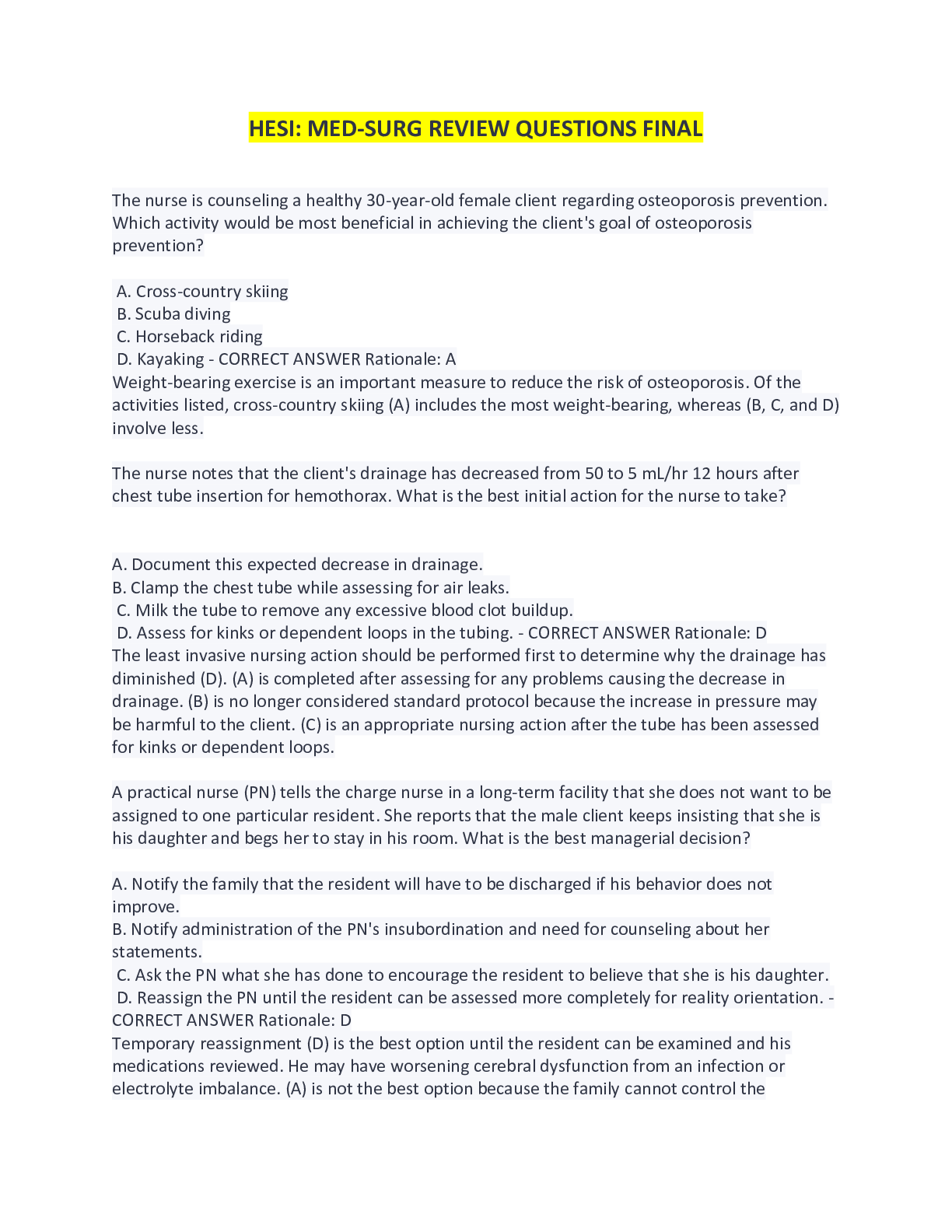
1. Carpal tunnel – assess
• Carpal tunnel is evaluated by the Tinel’s sign and Phalen test.
• Phalen test: client flex wrist 90° for 1 minute to see if the pain is elicited in this
position.
• Tinel’s Sign: tapping o
...
1. Carpal tunnel – assess
• Carpal tunnel is evaluated by the Tinel’s sign and Phalen test.
• Phalen test: client flex wrist 90° for 1 minute to see if the pain is elicited in this
position.
• Tinel’s Sign: tapping over the carpal tunnel and seeing numbness and tingling when
this nerve is tapped.
2. Inflammatory bowel disease – no enema
• Either Crohn’s disease or ulcerative colitis.
• Avoid Enemas – Notify the healthcare provider about the prescription of a barium
enema.
• Treatments
o Antimicrobials treat infection
o 5-aminosalicylates decrease GI inflammation
o Corticosteroids
o Immunomodulators
• Diet recommended is Low-fiber (low-residue) diet
o White bread
o Cooked cereals
o Cooked potatoes
o White rice
o Pasta
3. Diabetes Mellitus – weakness
• Feeling weak and jittery may indicate an adrenalin response to anxiety or to
hypoglycemia.
• The nurse should conduct an assessment. Changes in the client’s blood pressure
and glucose levels can cause weakness.
• Changes in the client’s skin temperature and moisture could be related to possible
changes in glucose levels or anxiety
4. Meniere’s disease – vertigo
• Antihistamines are often prescribed to reduce the symptoms of vertigo and tinnitus
that a client with Meniere’s disease experiences during and following an acute
attack.
2020 Hesi RN Medical Surgical Correct Rationales after taking the Hesi Medical Surgical Specialty Exam
2
5. Muscular Dystrophy – diminished breath sounds
• Due to diminished breath sounds, oxygenation assessment is the first priority
intervention
6. Cushing Syndrome – after surgery
• When assessing a client after surgery who has Cushing syndrome, an irregular
pulse may indicate an electrolyte imbalance, which can create capsular irritability
leading to life-threatening arrhythmias.
• Client’s diagnosed with Cushing Syndrome may experience serum irregularities with
potassium due to the cortisol effect.
7. Reflux-bed blocks
• Raising the head of the bed with blocks prevents an upright position for sleep that
reduces the risk of gastroesophageal reflux
8. Athlete’s foot- antifungal
• Athlete’s foot (tinea pedis) is an infection that affects the feet and causes cracking of
the skin between the toes and on the soles of the feet.
• The feet should be well ventilated, dried well after bathing, and clean socks should
be placed on the feet after bathing.
• Antibiotic ointment is the preferred treatment of a fungal infection.
9. Blurred vision – BP
• A client who is reporting blurred vision is likely experiencing complications related to
cardiovascular disease.
• The client’s daily blood pressure will be less than 140/80 mmHg this month is an
outcome statement in their plan of care that is client-centered, measurable, and has
a time frame.
10. Testicular cancer – AFP
• Alpha-fetoprotein (AFP) is elevated in testicular cancer, and a reduction indicates
that chemotherapy treatment has the desired effect.
• The normal range is <40 mcg/L with a half-life.
11. Lower Left Lobe Pulmonary Lung abscess – Left Lateral position
• The client should be positioned with the affected left lung down to prevent infection.
2020 Hesi RN Medical Surgical Correct Rationales after taking the Hesi Medical Surgical Specialty Exam
3
12. Altered Mental – respiratory
• A change in the mental status of a client being treated for respiratory illness such as
pneumonia is often a sign of hypoxia.
• Obtaining a new set of vital signs, oxygen saturation will give the healthcare provider
an idea of this is occurring.
13. Heberden’s Node – pain control
• Heberden’s nodes are one of the manifestations of the bony changes associated
with degenerative joint disease.
• If painful → chronic pain management → using analgesic therapy.
14. STEMI – postthrombolysis lidocaine
• Lidocaine is an antiarrhythmic that reduces myocardial and decreases ventricular
irritability.
• A therapeutic response to lidocaine is a decrease in premature ventricular
contractions and ventricular tachycardia.
15. Shingles – pain
• Herpes zoster may remain dormant along the dorsal root ganglia in individuals
previously exposed to the virus.
• The pain and itching along the path of the herpes zoster (shingles) lesions are most
likely affecting the client’s sleep patterns.
16. External Fixation device – perfusion
Damage to major vessels around a long bone fracture can compromise distal circulation.
The nurse should first assess perfusion by checking the peripheral pulses.
17. ALS – priority finding
• ALS results in progressive muscular atrophy, and as the muscle weakens, the
airway becomes compromised.
• A weakened cough is a critical sign that the weakness has progressed and is
affecting the airway.
• Weakened cough effort warrants immediate intervention by the nurse.
2020 Hesi RN Medical Surgical Correct Rationales after taking the Hesi Medical Surgical Specialty Exam
4
18. Pneumonia – HAP action
• Blood culture should be obtained before initiating antibiotic therapy to identify the
infectious organism and to evaluate the organism’s sensitivity to antibic therapy
[Show More]





![Preview of [2023 REAL] HESI MED SURG / MED SURG 55 QUESTIONS RN V1 (MOST ANSWER(S))](https://scholarfriends.com/storage/HESI_MED_SURG___MED_SURG_55_QUESTIONS_RN_V1__MOST_ANSWER_S__.png)