Bios 255 Final exam review
Be familiar with left and right sided heart failure and what the consequences are (remember the case
study that we did in lecture and lab?)
(698) Left side: One cause of mitral insufficiency
...
Bios 255 Final exam review
Be familiar with left and right sided heart failure and what the consequences are (remember the case
study that we did in lecture and lab?)
(698) Left side: One cause of mitral insufficiency, in which there is backflow of blood from the left
ventricle into the left atrium, is mitral valve prolapse (MVP). In MVP one or both cusps of the mitral valve
protrude into the left atrium during ventricular contraction. Mitral valve prolapse is one of the most
common valvular disorders, affecting as much as 30% of the population. It is more prevalent in women
than in men, and does not always pose a serious threat. The left side of the heart receives blood rich in
oxygen from the lungs and pumps it to the remainder of the body. As the ability to pump blood forward
from the left side of the heart is decreased, the remainder of the body does not receive enough oxygen
especially when exercising. This results in fatigue. In addition, the pressure in the veins of the lung
increases, which may cause fluid accumulation in the lung. This results in shortness of
breath and pulmonary edema.
Right side: In aortic stenosis the aortic valve is narrowed, and in aortic insufficiency there is backflow of
blood from the aorta into the left ventricle.
In right-sided heart failure, the right ventricle loses its pumping function, and blood may back up into
other areas of the body, producing congestion. Congestion affects the liver, the gastrointestinal tract, and
the limbs. In addition, the right ventricle may be unable to pump blood efficiently to the lungs and to the
left ventricle.
Causes of right-sided heart failure include left-sided heart failure and lung diseases such as chronic
bronchitis and emphysema. Other causes include congenital heart disease, clots in pulmonary
arteries, pulmonary hypertension, and heart valve disease.
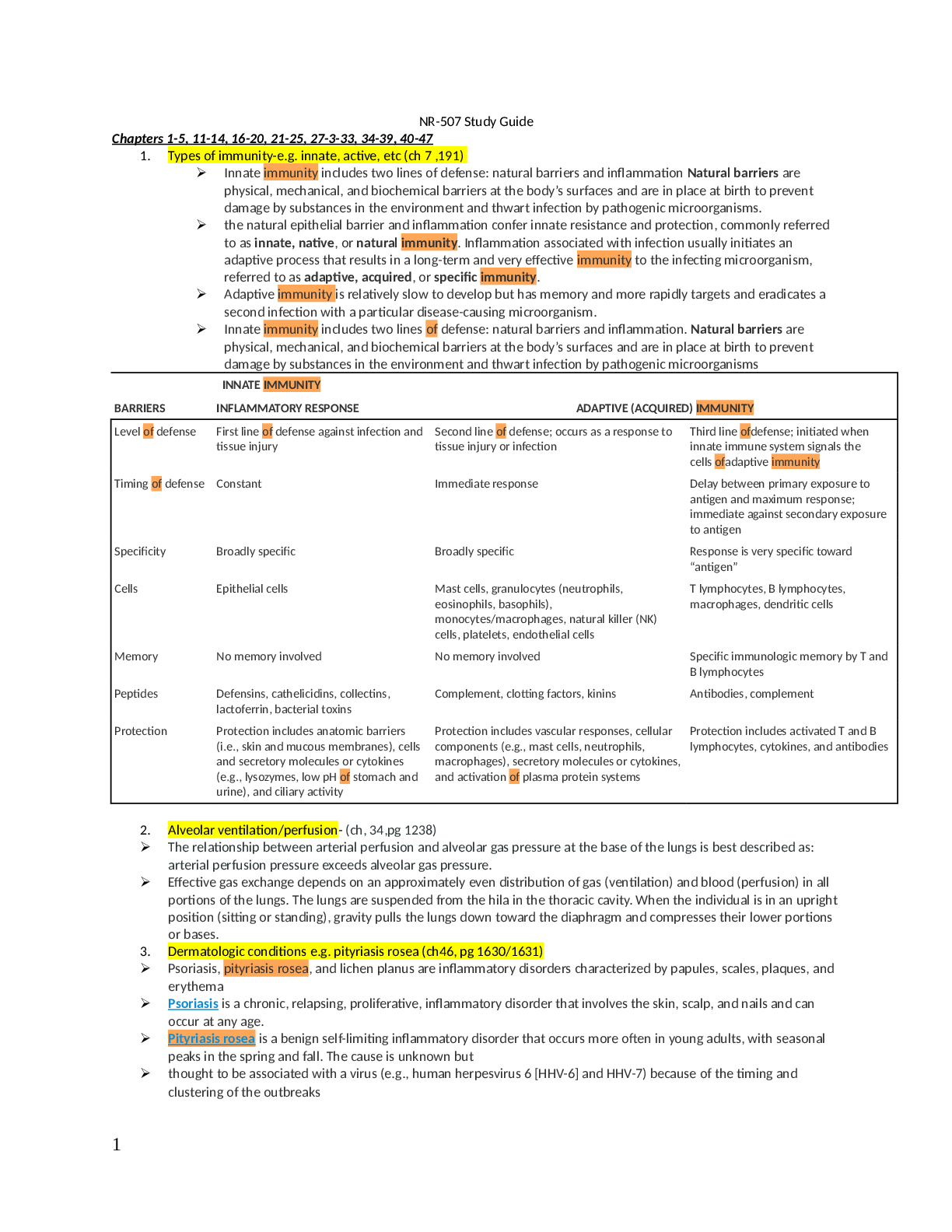
Know the different types of immunity – active vs passive, natural vs artificial.
First, let us define the following terms and then we can put them together. The term active generally
means that your body is producing antibodies by exposure. Passive is a term where the antibodies are
being transferred to you, i.e. breast milk IgA to infant. Natural terms the introduction of the antigen via
exposure. Artificial is the introduction of antigens/antibodies via an altered state of the microbe/
antibody.
Naturally Acquired Active Immunity- Following exposure to a microbe, antigen recognition by B cells and
T cells and costimulation lead to formation of antibody-secreting plasma cells, cytotoxic T cells, and B
and T memory cells.
Naturally Acquired Passive Immunity- IgG antibodies are transferred from mother to fetus across
placenta, or IgA antibodies are transferred from mother to baby in milk during breastfeeding.
Artificially Acquired Active Immunity- Antigens introduced during vaccination stimulate cell-mediated
and antibody-mediated immune responses, leading to production of memory cells. Antigens are
pretreated to be immunogenic but not pathogenic (they will trigger an immune response but not cause
significant illness.)
Artificially Acquired Passive Immunity- Intravenous injection of immunoglobulins.
*****Know the neural mechanisms of respiratory control including the DRG and PRG.
(872) Respiratory center- Neurons in the pons and medulla oblongata of the brain stem that regulate
breathing. It is divided into the medullary respiratory center and the pontine respiratory center.
Within the medullary respiratory center, you find two respiratory groups, the ventral respiratory group
(AKA expiratory area) and the dorsal respiratory group (AKA inspiratory area). The DRG generates
impulses to the diaphragm via the phrenic nerves and the external intercostals via the intercostal nerves.
These impulses trigger contraction of these muscles which in turn execute inhalation. When the nerves
are not firing, this passive relaxation allows recoil of the lungs and thoracic wall, passive exhalation. The
VRG is only activated during forceful inhalation and trigger the accessory muscles to work. An important
part of the VRG is the Pre-Botzinger Complex which is believed to be important in the generation of the
rhythm of breathing (Pacemaker cells)
.
PRG (Pontine Respiratory Group)- A collection of neurons in the pons that transmits nerve impulses to
the dorsal respiratory group, and may modify the basic rhythm of breathing. (AKA pneumotaxic area)
The PRG may play a role in both inhalation and exhalation by modifying the basic rhythm of breathing
generated by the VRG, as when exercising, speaking, or sleeping.
Know the process of inhalation and exhalation (the steps involved)
(FIG. 24.13) During Inhalation, the diaphragm contracts and the external intercostals contract. The chest
cavity expands, and the alveolar pressure drops below atmospheric pressure. Air flows into the lungs in
response to the pressure gradient and the lung volume expands. During deep inhalation, the scalene and
sternocleidomastoid muscles expand the chest further, thereby creating a greater drop in alveolar
pressure.
During exhalation, the diaphragm relaxes and the external intercostals relax. The chest and lungs recoil,
the chest cavity retracts, and the alveolar pressure increases above atmospheric pressure. Air flows out
of the lungs in response to the pressure gradient, and the lung volume decreases. During forced
exhalations, the internal intercostals and the abdominal muscles contract, thereby reducing the size of
the chest cavity further and creating a greater increase in alveolar pressure.
Inhalation:
• Diaphragm: contracts & moves down
• Intercostal muscles: contract, move ribs out
• Chest volume: increases
• Pressure in lungs: decreases
• Air Flow: higher percentage of oxygen
Exhalation:
• Diaphragm: relaxes & moves up
• Intercostals muscles: relax, move ribs in.
• Chest volume: lessens
• Pressure in lungs: increases
• Air flow: carbon dioxide out
*******Know the functions of the lymphatic and immune systems.
*****The primary functions of the lymphatic is system is to 1. Drain excess interstitial fluid, 2. Transport
dietary lipids and lipid-soluble vitamins, and 3. Carry out immune response.
Know the precursor cells for platelets, lymphocytes, etc.
The precursor cells for platelets are megakaryocytes.
Membranes surrounding the heart.
(690) The pericardium surrounds and protects the heart. Covers the heart muscle. The pericardium
consists of two main parts: (1) the fibrous pericardium (tough, inelastic, dense irregular connective
tissue) -- prevents overstretching of the heart, provides protection, and anchors the heart in the
mediastinum. and (2) the serous pericardium (double membrane of outer parietal layer and inner
visceral layer, fluid-lubricating part between these layers, reduces friction as the heart moves.)
(Walls of heart= 3= epicardium, myocardium, endocardium)
Function of type I and type II alveolar cells.
(854) The alveolar epithelium comprises two main cell types: the alveolar type I and alveolar type II
cell. The type I cell: simple squamous epithelial cells that form a nearly continuous lining of the alveolar
wall; main site of gas exchanges,
The type II cell, also called septal cells, are fewer in number and are found between type I alveolar cells;
rounded or cuboidal epithelial cells with free surfaces containing microvilli, secrete alveolar fluid, which
keeps the surface between the cells and the air moist. Type II cells act as the "caretaker" of the alveolar
compartment. It responds to damage of the vulnerable type I cell by dividing and acting as a progenitor
cell for both type I and type II cells. In addition, it syntheses, stores and releases pulmonary surfactant
into the alveolar hypophase, where it acts to optimize conditions for gas exchange.
Types of antigen presenting cells.
(Table 22.5) Macrophage- Processing and presentation of foreign antigens to T cells, secretion of
interleukin-1, which stimulates secretion of interleukin-2 by helper T cells and induces proliferation of B
cells; secretion of interferons that stimulate T cell growth.
Dendritic Cells- Processes and presents antigens to T cells and B cells; Found in mucous membranes,
skin, and lymph nodes.
B cell- Processes and presents antigen to helper T cells.
Path of blood through the heart.
A drop of blood enters the heart via the Vena Cava (Superior or inferior) or coronary sinus into the Right
Atrium. From the right atria, it flows into the Right ventricle. The right ventricle pumps the blood into
the pulmonary trunk where is branches into the left and right pulmonary arteries. The blood then
returns from the lungs via the pulmonary veins into the left atrium. It then leaves the left atria and goes
into the left ventricle where the blood is returned to the outlying tissues via the aorta.
[Show More]
.png)
.png)


.png)