Oncology Exam Study Guide
Document Content and Description Below
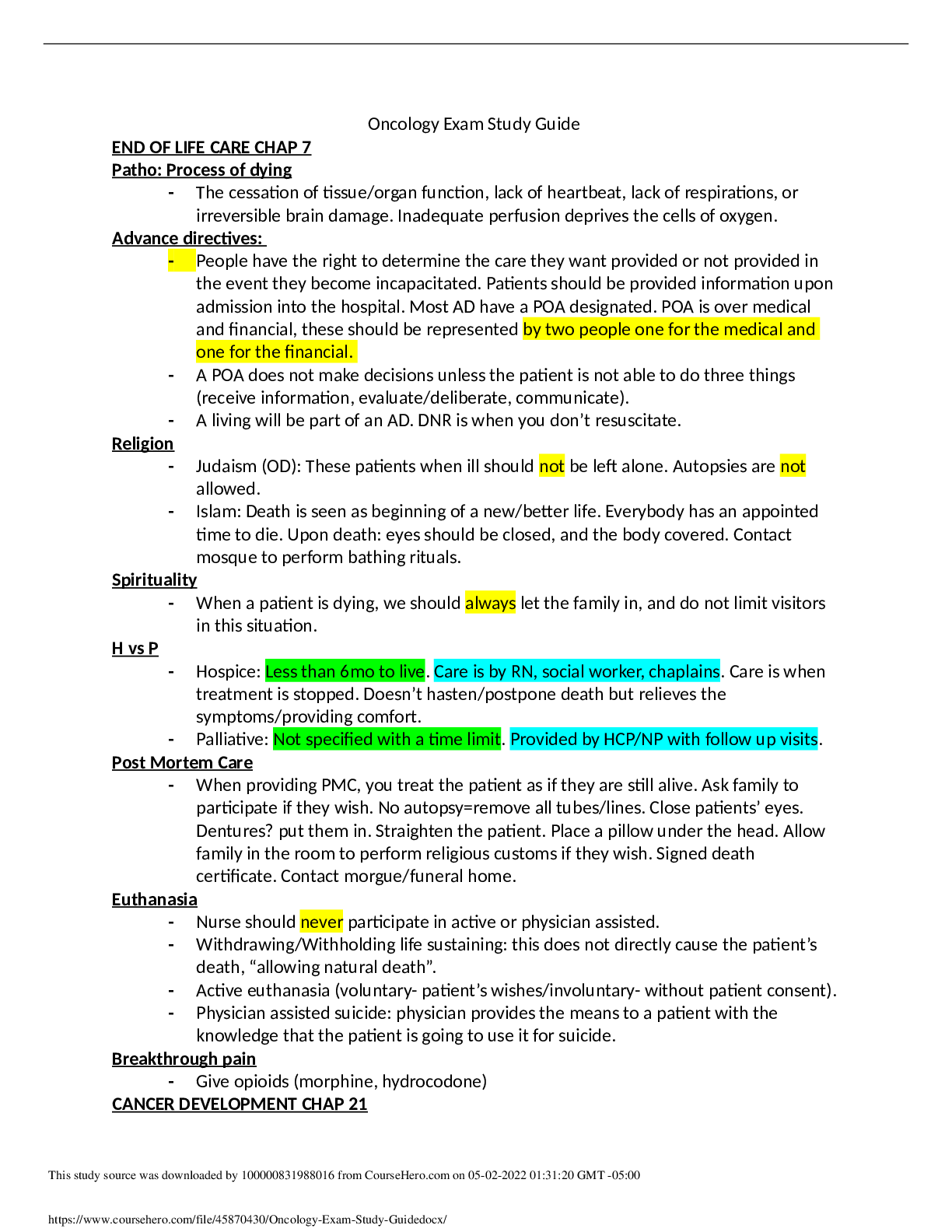
Oncology Exam Study Guide
END OF LIFE CARE CHAP 7
Patho: Process of dying
- The cessation of tissue/organ function, lack of heartbeat, lack of respirations, or
irreversible brain damage. Inadequat
...
e perfusion deprives the cells of oxygen.
Advance directives:
- People have the right to determine the care they want provided or not provided in
the event they become incapacitated. Patients should be provided information upon
admission into the hospital. Most AD have a POA designated. POA is over medical
and financial, these should be represented by two people one for the medical and
one for the financial.
- A POA does not make decisions unless the patient is not able to do three things
(receive information, evaluate/deliberate, communicate).
- A living will be part of an AD. DNR is when you don’t resuscitate.
Religion
- Judaism (OD): These patients when ill should not be left alone. Autopsies are not
allowed.
- Islam: Death is seen as beginning of a new/better life. Everybody has an appointed
time to die. Upon death: eyes should be closed, and the body covered. Contact
mosque to perform bathing rituals.
Spirituality
- When a patient is dying, we should always let the family in, and do not limit visitors
in this situation.
H vs P
- Hospice: Less than 6mo to live. Care is by RN, social worker, chaplains. Care is when
treatment is stopped. Doesn’t hasten/postpone death but relieves the
symptoms/providing comfort.
- Palliative: Not specified with a time limit. Provided by HCP/NP with follow up visits.
Post Mortem Care
- When providing PMC, you treat the patient as if they are still alive. Ask family to
participate if they wish. No autopsy=remove all tubes/lines. Close patients’ eyes.
Dentures? put them in. Straighten the patient. Place a pillow under the head. Allow
family in the room to perform religious customs if they wish. Signed death
certificate. Contact morgue/funeral home.
Euthanasia
- Nurse should never participate in active or physician assisted.
- Withdrawing/Withholding life sustaining: this does not directly cause the patient’s
death, “allowing natural death”.
- Active euthanasia (voluntary- patient’s wishes/involuntary- without patient consent).
- Physician assisted suicide: physician provides the means to a patient with the
knowledge that the patient is going to use it for suicide.
Breakthrough pain
- Give opioids (morphine, hydrocodone)
CANCER DEVELOPMENT CHAP 21
This study source was downloaded by 100000831988016 from CourseHero.com on 05-02-2022 01:31:20 GMT -05:00
https://www.coursehero.com/file/45870430/Oncology-Exam-Study-Guidedocx/
Patho(Stages):
- Benign: harmless (moles, skin tags, nasal polyps)
- Malignant: serious, will lead to death without intervention. ()
- Cancer can develop from one single cell.
- Initiation: change in gene expression, penetrates the nucleus and mutates the DNA.
- Promotion: promotors enhance the growth of the abnormal cell.
- Progression: This is when the cell gets its own blood supply which makes a tumor.
The cells clump together and stay together when they are multiplying, unlike a
normal cell that multiplies and divided.
- Metastasis: This is when cells break off the original group and move to another
location. Ex. Lungs is where it initially began but breaks off and moves to the brain;
however, when this happens what is the type of cancer? The cancer is still lung
cancer because that is the original place is what made. So, if you have lung cancer
that metastasis to the brain it wouldn’t be brain cancer it would still be lung cancer
even though it’s in the brain too. Bloodborne metastasis is most common it’s when
the cancer cells travel in the blood to another location.
Causes of carcinogenesis
- Single most preventable source is smoking.
- Others: radiation (UV-from the sun, tanning bed. Ionizing- found in natural
elements). Chronic irritation, dietary (low fiber, high red/animal meat intake).
- Aging (>60), immunosuppressed, AIDS.
- African Americans have a higher incidence than Caucasian people.
Caution
- C: change in bowel/bladder
- A: sore throat that don’t heal
- U: unusual bleeding/discharge
- T: thickening/lump in breast or anywhere
- I: indigestion/difficulty swallowing
- O: obvious change in wart/mole
- N: nagging cough/hoarseness
Primary Prevention
- Use sun protection while in the sun.
- Eliminate tobacco use and asbestos exposure.
- Modify diet, alcohol consumption, sexual partners.
- Remove “at risk” tissues ex. Moles, breasts
- Regular exercise
Secondary Prevention
- Mammogram every year after 40.
- Clinical breast exam yearly after 40. Every 3 years 20-39
- Colonoscopy at 50 then every 10 years.
- Yearly fecal occult for all adult ages.
- Digital rectal exam yearly for men over 50.
- Genetic screening if a family history or previous history of cancer.
CARE OF PATIENT WITH CANCER CHAPTER 22
This study source was downloaded by 100000831988016 from CourseHero.com on 05-02-2022 01:31:20 GMT -05:00
https://www.coursehero.com/file/45870430/Oncology-Exam-Study-Guidedocx/
Psychosocial
- Fear of the unknown, anxiety r/t to loss of wages, dying, surgery (disturbed body
image).
- Regardless of treatment type, cancer always affects a person’s physical and
psychological functioning and provides stress to the family.
- For cancer surgery, additional priority care needs are psychosocial support and
assisting the client to achieve maximum function.
Surgery
- Prophylactic: removes at risk tissue to prevent development of Ca.
- Diagnosis (biopsy): removal of all or part of a suspected lesion for
examination/testing.
- Curative: removal of all cancer tissue. Cure rate 30%, can increase with early
detection.
- Ca Control: removes part but not the entire tumor “debulking”. Decreases number of
Ca cells which increases the changes that therapies will work.
- Palliative: improving quality of life during survival time, not a cure.
- Second Look: repeat exam after a treatment to assess disease status in patients with
no s/s of remaining tumor.
- Reconstruction/Rehab: Increases function, enhances appearance or both.
Physical rehabilitation
- This is needed sometimes after surgery. Patient needs encouragement to perform
expected activities. Teach the patient about the importance of performing exercise
to regain as much function as possible.
Radiation therapy
- Gamma rays are used to penetrate deep tissue to destroy Ca cells or prevent them
from dividing, while having a minimal effect of damage to surrounding normal cells
and maintain a safe environment. This is a localized treatment.
External (Teletherapy) Internal (Brachytherapy)
Source of radiation is outside the body, patient is
not radioactive or hazardous to others.
Source of radiation is inside the body. Therefore,
they emit radiation and are a potential hazard to
others.
Ex. IMRT, SBRT Ex. Isotopes given PO or IV
Find exact location of tumor, decide position for
therapy, patient assumes that same position every
time for therapy. To ensure proper position then a
small permanent tattoo may be used.
Radioactive isotopes are given to the patient for the
therapy and are eventually expelled in waste
products. These are radioactive and should not be
directly touched.
There are also Implants that emit radiation: LDRpermanent implant that is placed near the tumor
with constant low dose rate radiation that
decreases over time.
HDR- Patient comes in several times a week and
high dose therapy is placed for about an hour, the
patient is only radioactive while is it in place.
SE: Skin changes/hair loss are localized, altered taste (thought to be caused by metabolites from dead cells,
many people develop an aversion to red meat). Extreme fatigue (increased energy demands).
Caring for Radioactive person: Assign a private room, Caution sign, dosimeter film badge, wear a lead
This study source was downloaded by 100000831988016 from CourseHero.com on 05-02-2022 01:31:20 GMT -05:00
https://www.coursehero.com/file/45870430/Oncology-Exam-Study-Guidedocx/
apron (never turn back on radiation), NO PREGO’s or kids UNDER 16 in the room, Visitor’s 30 min time limit
and 6 ft away from pt, never touch radioactive with bare hands (use forceps), save all dressings/linens until
radioactive material is removed.
Education: Wash irritated area gently with mild soap/water, use hand rather than washcloth, don’t remove
tattoo marker, dry with patting, don’t put anything on the skin unless prescribed, wear soft clothing, avoid
wearing anything that will constrict the site, avoid sun exposure (10am-7pm) for one yr following
treatment is completed. Skin care during radiation is priority intervention.
- Head/neck radiation causes xerostomia which increases tooth decay so teaching of
regular dentals visits are essential.
Chemotherapy
- Chemo + Radiation or Surgery = Adjuvant therapy
- 2 different chemo drugs given = Combination therapy (This is used to be more
effective in killing cancer rather than using just one drug). Usually given 2-8hrs per
day that is given.
- Treatment issues: How does doc determine drugs used? (sensitivity of cancer to the
drug, stage, extent of disease). How
[Show More]
Last updated: 3 years ago
Preview 1 out of 9 pages