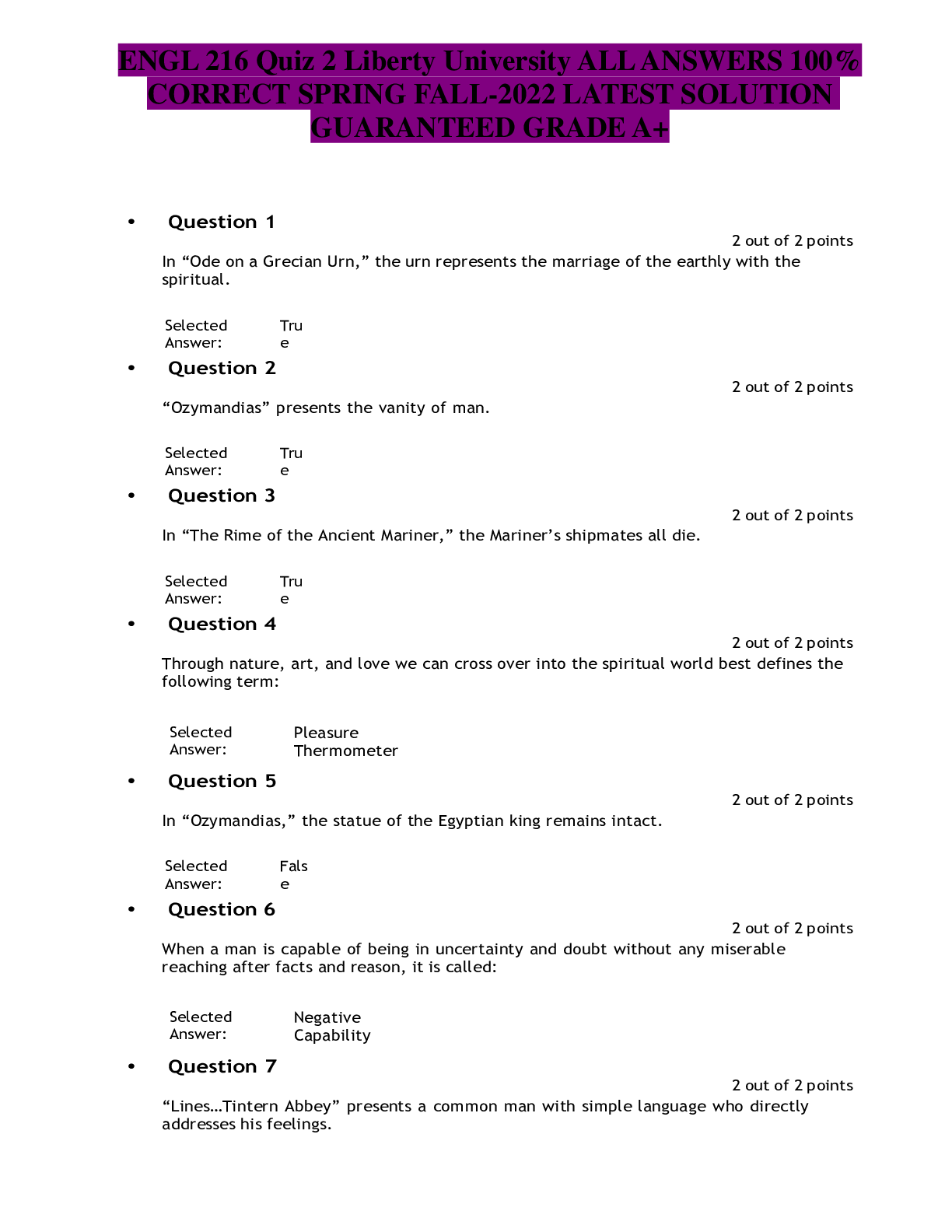
• Question 1
2 out of 2 points
In “Ode on a Grecian Urn,” the urn represents the marriage of the earthly with the spiritual.
Selected Answer:
• Question 2
Tru e
2 out of 2 points
“Ozyma
...
• Question 1
2 out of 2 points
In “Ode on a Grecian Urn,” the urn represents the marriage of the earthly with the spiritual.
Selected Answer:
• Question 2
Tru e
2 out of 2 points
“Ozymandias” presents the vanity of man.
Selected Answer:
• Question 3
Tru e
2 out of 2 points
In “The Rime of the Ancient Mariner,” the Mariner’s shipmates all die.
Selected Answer:
• Question 4
Tru e
2 out of 2 points
Through nature, art, and love we can cross over into the spiritual world best defines the following term:
Selected Answer:
• Question 5
Pleasure Thermometer
2 out of 2 points
In “Ozymandias,” the statue of the Egyptian king remains intact.
Selected Answer:
• Question 6
Fals e
2 out of 2 points
When a man is capable of being in uncertainty and doubt without any miserable reaching after facts and reason, it is called:
Selected Answer:
• Question 7
Negative Capability
2 out of 2 points
“Lines…Tintern Abbey” presents a common man with simple language who directly addresses his feelings.
Selected Answer:
Tru e
• Question 8
2 out of 2 points
According to this poet, poetry should be written in the common language of man.
Selected Answer:
• Question 9
Wordswort h
2 out of 2 points
In “The Eve of St. Agnes,” a strong contrast occurs between the following:
Selected Answer:
• Question 10
Cold and hot
2 out of 2 points
Wollstonecraft argues that women’s minds are in a healthy state.
Selected Answer:
Fals e
• Question 11
Pantheists worship the creator and not creation.
2 out of 2 points
Selected Answer:
Fals e
• Question 12
2 out of 2 points
Wollstonecraft evaluates the current attitudes of other authors, including:
Selected Answer:
• Question 13
All of the above
2 out of 2 points
In the beginning of “Ode to a Nightingale,” the speaker longs for:
Selected Answer:
• Question 14
Alcoh ol
2 out of 2 points
This poet said that poetry is the “spontaneous overflow” of feelings:
Selected Answer:
• Question 15
Wordswort h
2 out of 2 points
“Can tyrants but by tyrants conquered be” is from which poem:
Selected Answer:
• Question 16
Childe Harold’s Pilgrimage
2 out of 2 points
The following is not a Romantic author:
Selected Answer:
• Question 17
Pop e
2 out of 2 points
According to Wordsworth, poetry should not bring pleasure.
Selected Answer:
Fals e
• Question 18
2 out of 2 points
This work by Keats ends with the following lines: “’Beauty is truth, truth beauty,’ – that is all / Ye know on earth, and all ye need to know.”
Selected Answer:
• Question 19
“Ode on a Grecian Urn”
2 out of 2 points
Women in the Romantic period were provided only limited schooling, were subjected to a rigid code of sexual behavior, and were bereft of legal rights.
Selected Answer:
Tru e
• Question 20
In the first scene of “Ode on a Grecian Urn,” two lovers are about to kiss.
2 out of 2 points
Selected Answer:
Fals
[Show More]


 Block 1 to 7.png)

.png)
.png)