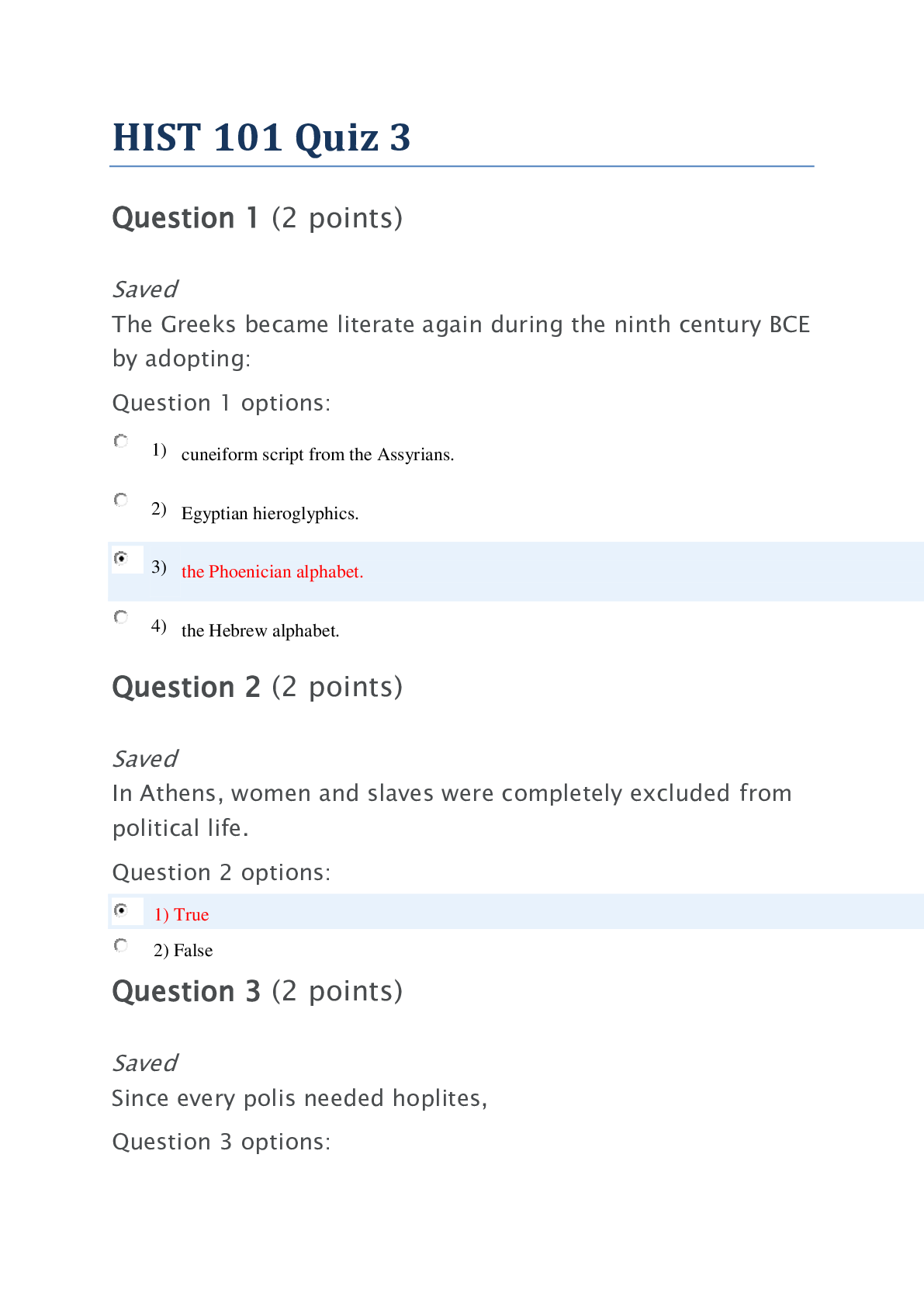
HIST 101 Quiz 3 Question 1 (2 points) Saved The Greeks became literate again during the ninth century BCE by adopting: Question 1 options: 1) cuneiform script from the Assyrians. 2) Egyptian hi ... eroglyphics. 3) the Phoenician alphabet. 4) the Hebrew alphabet. Question 2 (2 points) Saved In Athens, women and slaves were completely excluded from political life. Question 2 options: 1) True 2) False Question 3 (2 points) Saved Since every polis needed hoplites, Question 3 options:1) production increased dramatically. 2) more athletic contests and public spectacles were required. 3) poleis were forced to grant more political power to them. 4) farmers suffered losses at their expense. Question 4 (2 points) Saved The Iliad and the Odyssey: Question 4 options: 1) are epic poems with no foundation in historical events. 2) provide evidence about early Archaic Greece. 3) were composed in the Classical Period but were based on older, oral sources. 4) are the first examples of epic poetry from the ancient world. Question 5 (2 points) Saved The Greek polis was: Question 5 options: 1) a political unit centered on a city and including the surrounding lands. 2) a well-armed militia of all adult men aged 21-60. 3) a central marketplace close to the harbor.4) a protected area around the temple. Question 6 (2 points) Saved A Greek aristocrat who seized power and ruled outside the traditional constitutional framework was called a: Question 6 options: 1) monarch. 2) demagogue. 3) hoplite. 4) tyrant. Question 7 (2 points) Saved According to Greeks from outside of Sparta, free Spartan women were much less restricted than women elsewhere in Greece. Question 7 options: 1) True 2) False Question 8 (2 points) Saved Each year, in order to maintain order, the Spartans did which of the following? Question 8 options:1) Declared war on the helots 2) Sacrificed the oldest citizens in a religious ritual 3) Invaded a neighboring polis 4) Destroyed their temples Question 9 (2 points) Saved In the final stages of the Peloponnesian War, Sparta allied with Persia. Question 9 options: 1) True 2) False Question 10 (2 points) Saved The Delian League, a maritime union organized to defend the Aegean against Persia, soon became the ___________ Empire. Question 10 options: 1) Spartan 2) Egyptian 3) Athenian 4) Miletus Question 11 (2 points)Saved Unlike other rulers, Cyrus of Persia (559-529 BCE): Question 11 options: 1) took the Hebrew people into captivity in his capital city. 2) granted self-rule and religious freedom to conquered peoples. 3) granted self-rule to conquered peoples who accepted the Persian religion. 4) lost a great empire to the barbarian tribes of Central Asia. Question 12 (2 points) Saved Which of the following was not an advantage for Athens in the war with Sparta? Question 12 options: 1) the best land army in Greece 2) long walls protecting harbor and city 3) naval control of the Aegean 4) wealth and supplies from sea-borne trade Question 13 (2 points) Saved The decisive Greek military victory over the Persians at Salamis was won by the:Question 13 options: 1) Spartan phalanx. 2) Greek hoplites. 3) Athenian fleet. 4) diplomatic efforts of Themistocles. Question 14 (2 points) Saved During the Persian invasion of Greece in 480 b.c.e., Themistocles persuaded his fellow Athenians to: Question 14 options: 1) rely on the Spartans for their defense. 2) abandon the city of Athens and let the Persians burn it. 3) invade and attack Persian settlements deep within Anatolia. 4) abandon naval defensive schemes and rely on ground-based forces. Question 15 (2 points) Saved In 371 BCE the polis of Thebes defeated the Spartans three times in open battle. Question 15 options: 1) True 2) FalseQuestion 16 (2 points) Saved The accomplishments of King Darius of Persia included: Question 16 options: 1) extending Persian rule over Greece and the Aegean. 2) recruiting foreign mercenaries for his armies. 3) capturing the bandits that had terrorized Persepolis. 4) building roads for transport and postal service. Question 17 (2 points) Saved The founding figure of Greek history-writing was Question 17 options: 1) Herodotus 2) Zeno 3) Plato 4) Socrates Question 18 (2 points) Saved___________ wrote a history of the Peloponnesian War that remains the single most significant account of the war to this day. Question 18 options: 1) Plato 2) Thucydides 3) Aristotle 4) Herodotus Question 19 (2 points) Saved Legal power over a woman passed from the father to the husband, and in cases of divorce it passed back to the father. Question 19 options: 1) True 2) False Question 20 (2 points) Saved Slaves in ancient Greece could legally be killed, raped, or maimed by their masters, if they saw fit. Question 20 options: 1) True 2) False Question 21 (2 points)Saved Plato founded a school, __________, in Athens, which remained in existence until the early Middle Ages. Question 21 options: 1) the Academy 2) the Labyrinth 3) the Lyceum 4) the Agora Question 22 (2 points) Saved In Plato's work The Republic he wrote of an imaginary polis in which political leaders were raised from childhood to become Question 22 options: 1) philosopher- kings. 2) tyrants. 3) hoplites. 4) strategos. Question 23 (2 points) Saved The fundamental concept of Greek thought, as reflected in drama, literature, and philosophy, was Question 23 options:1) beauty 2) pleasure 3) humanism 4) equality Question 24 (2 points) Saved According to Stoicism, evil does not exist. Question 24 options: 1) True 2) False Question 25 (2 points) Saved Cynics advocated: Question 25 options: 1) conforming to social mores. 2) conservative values associated with civic virtue. 3) active engagement in politics. 4) a combination of asceticism and naturalism. Question 26 (2 points) SavedWithin a year of his death, Alexander's empire plunged into Civil War. Question 26 options: 1) True 2) False Question 27 (2 points) Saved Alexander the Great founded a great empire that might be described as a: Question 27 options: 1) cultural empire. 2) hereditary empire. 3) political empire. 4) scientific empire. Question 28 (2 points) Saved After Alexander seized and looted Persepolis, burning it to the ground, he: Question 28 options: 1) executed the Persian King Darius III. 2) established the site as the capital of his empire. 3) arranged for thousands of his Greek and Macedonian officers to marry Persian noblewomen.4) sent his army back to Macedonia. Question 29 (2 points) Saved Macedonian rule in Egypt was characterized by: Question 29 options: 1) a revival of ancient traditions associated with the pharaohs. 2) social welfare policies designed to improve the lot of the poor. 3) commercial isolation. 4) ethnic assimilation between Greeks and Egyptians. Question 30 (2 points) Saved The most important cultural center in the Hellenistic world was: Question 30 options: 1) Jerusalem. 2) Memphis. 3) Alexandria. 4) Athens. Submit Quiz30 of 30 questions saved [Show More]
Last updated: 3 years ago
Preview 1 out of 13 pages
Buy this document to get the full access instantly
Instant Download Access after purchase
Buy NowInstant download
We Accept:
Can't find what you want? Try our AI powered Search
Connected school, study & course
About the document
Uploaded On
Nov 06, 2020
Number of pages
13
Written in
All
This document has been written for:
Uploaded
Nov 06, 2020
Downloads
0
Views
187
Scholarfriends.com Online Platform by Browsegrades Inc. 651N South Broad St, Middletown DE. United States.
We're available through e-mail, Twitter, and live chat.
FAQ
Questions? Leave a message!
Copyright © Scholarfriends · High quality services·