Week 9 Quiz
Which of the following statements are true?
Selected
Answer:
d.
A & B
Answers: a.
First-generation (typical) antipsychotics are associated with a higher
incidence of EPS.
b.
Second-generation (at
...
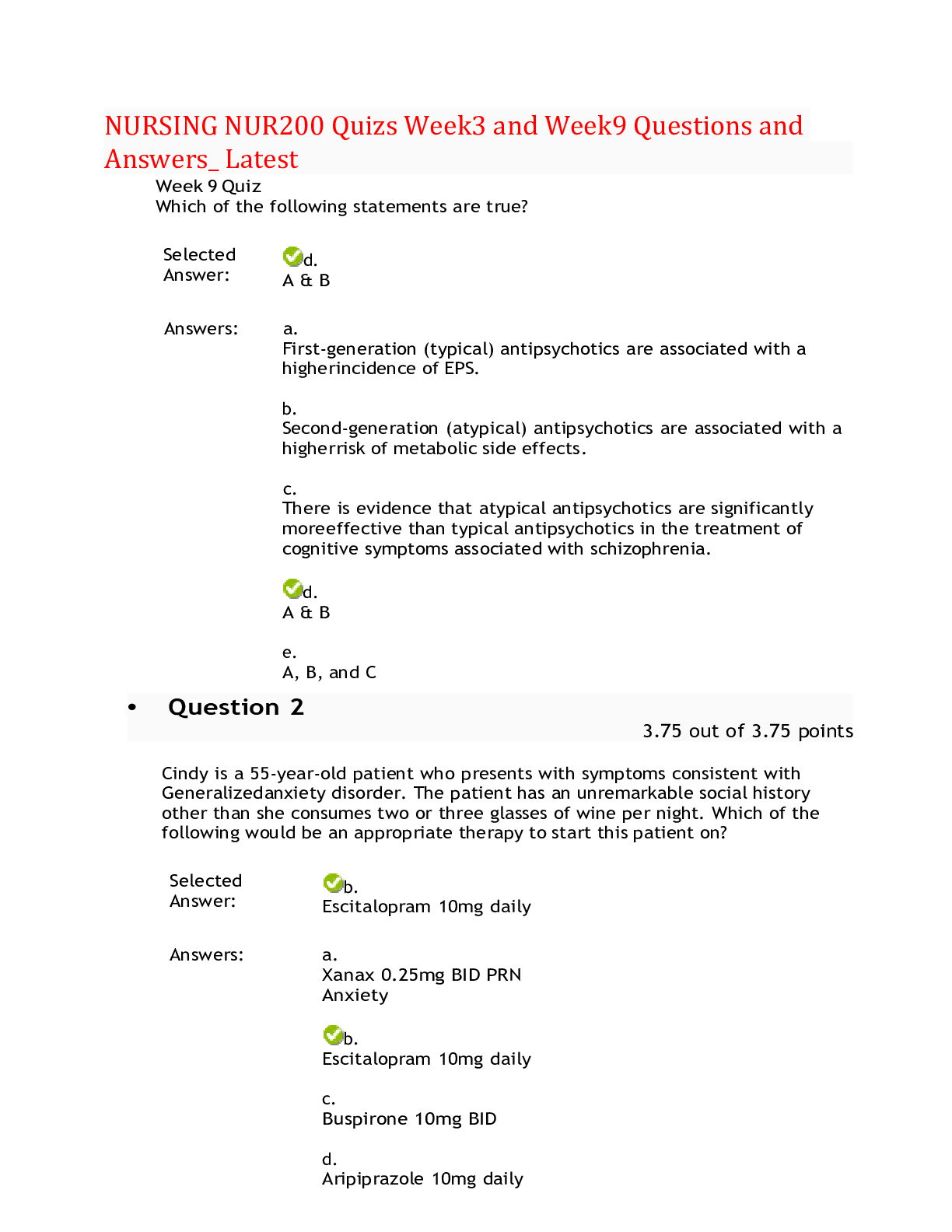
Week 9 Quiz
Which of the following statements are true?
Selected
Answer:
d.
A & B
Answers: a.
First-generation (typical) antipsychotics are associated with a higher
incidence of EPS.
b.
Second-generation (atypical) antipsychotics are associated with a higher
risk of metabolic side effects.
c.
There is evidence that atypical antipsychotics are significantly more
effective than typical antipsychotics in the treatment of cognitive
symptoms associated with schizophrenia.
d.
A & B
e.
A, B, and C
Question 2
3.75 out of 3.75 points
Cindy is a 55-year-old patient who presents with symptoms consistent with Generalized
anxiety disorder. The patient has an unremarkable social history other than she
consumes two or three glasses of wine per night. Which of the following would be an
appropriate therapy to start this patient on?
Selected
Answer:
b.
Escitalopram 10mg daily
Answers: a.
Xanax 0.25mg BID PRN
Anxiety
b.
Escitalopram 10mg daily
c.
Buspirone 10mg BID
d.
Aripiprazole 10mg daily
Question 3
3.75 out of 3.75 points
Richard is a 54-year-old male who suffers from schizophrenia. After exhausting various
medication options, you have decided to start him on Clozapine. Which of the
statements below is true regarding Clozapine?
Selected
Answer:
d.
A & B
Answers: a.
Regular blood monitoring must be performed to monitor for
neutropenia.
b.
Clozapine can only be filled by a pharmacy that participates in the
REMS program.
c.
Bradycardia is a common side effect of Clozapine.
d.
A & B
e.
All of the above
Question 4
0 out of 3.75 points
Jordyn is a 27-year-old patient who presents to the clinic with GAD. She is 30 weeks
pregnant and has been well controlled on a regimen of sertraline 50mg daily. Jordyn
says that "about once or twice a week my husband really gets on my nerves and I can't
take it." She is opposed to having the sertraline dose increased due to the risk of further
weight gain. You have decided to prescribe the patient a short-term course of
benzodiazepines for breakthrough anxiety. Which of the following is the LEAST
appropriate benzodiazepines to prescribe to this patient?
Selected
Answer:
b.
alprazola
m
Answers: a.
diazepam
b.
alprazola
m
c.
clonazepa
m
d.
lorazepa
m
Question 5
0 out of 3.75 points
Jason is a 6-year-old child whose mother presents to the clinic with him. The mother
says that “he's not himself lately." After a thorough workup, you diagnose the patient as
having GAD. Which of the following medications would be the LEAST appropriate to
prescribe to this child?
Selected
Answer:
b.
Paroxetin
e
Answers: a.
Sertraline
b.
Paroxetin
e
c.
Venlafaxi
ne
d.
Buspirone
Question 6
3.75 out of 3.75 points
John is a 41-year old-patient who presents to the clinic with diarrhea, fatigue, and
recently has been having tremors. He was diagnosed 19 years ago with bipolar disorder
and is currently managed on Lithium 300mg BID. As the PMHNP, you decide to order a
lithium level that comes back at 2.3mmol/l. What is the most appropriate course of
action?
Selected
Answer:
c.
Tell John he needs to go to the hospital and call an ambulance to
bring him.
Answers: a.
Investigate other differential diagnoses for his symptoms.
b.
Tell John to skip his next four Lithium doses and resume therapy.
c.
Tell John he needs to go to the hospital and call an ambulance to
bring him.
d.
Prescribe loperamide to treat the diarrhea and ropinirole to treat
the tremors
Question 7
0 out of 3.75 points
Mark is a 46-year-old male with treatment-resistant depression. He has tried various
medications, including SSRIs, SNRI, and TCAs. You have decided to initiate therapy with
phenelzine. Which of the following must the PMHNP take into consideration when
initiating therapy with phenelzine?
Selected
Answer:
d.
A & B
Answers: a.
There is a minimum 7-day washout period when switching from
another antidepressant to phenelzine.
b.
Patient must be counseled on dietary restrictions.
c.
MAOIs may be given as an adjunctive therapy with SSRIs.
d.
A & B
e.
All of the above
Question 8
3.75 out of 3.75 points
Rebecca is a 32-year-old female who was recently prescribed escitalopram for MDD. She
presents to the clinic today complaining of diaphoresis, tachycardia, and confusion. The
differential diagnosis for this patient, based on the symptoms presenting, is:
Selected
Answer:
d.
Serotonin
syndrome
Answers: a.
Panic disorder
b.
Gastroenteritis
c.
Abnormal gait
d.
Serotonin
syndrome
Question 9
3.75 out of 3.75 points
The patient in the previous question states, "I can't even last 1 more day without feeling
like my insides are going to explode with anxiety." The most appropriate course of action
would be:
Selected
Answer:
b.
Prescribe a short-term course of low dose benzodiazepine, such as
alprazolam.
Answers: a.
Inform the patient to try yoga or other natural remedies until the
vortioxetine takes effect.
b.
Prescribe a short-term course of low dose benzodiazepine, such as
alprazolam.
c.
Prescribe an SNRI, such as venlafaxine, in addition to the
vortioxetine.
d.
Recommend in-patient mental health for the foreseeable future.
Question 10
3.75 out of 3.75 points
Thomas is a 28-year-old male who presents to the clinic with signs and symptoms
consistent with MDD. He is concerned about starting antidepressant therapy, however,
because one of his friends recently experienced erectile dysfunction when he was put on
an antidepressant. Which of the following would be the most appropriate antidepressant
to start Thomas on?
Selected
Answer:
a.
Vilazodo
ne
Answers: a.
Vilazodo
ne
b.
Sertralin
e
c.
Paroxetin
e
d.
Citalopra
m
Question 11
3.75 out of 3.75 points
Amber is a 26-year-old female who presents to the clinic 6 weeks postpartum. The
patient states that she has been "feeling down" since the birth of her son. She is
currently breastfeeding her infant. You diagnose the patient with Postpartum depression.
Which of the following is the LEAST appropriate option in treating her PPD?
Selected
Answer:
b.
escitalopra
m
Answers: a.
paroxetine
b.
escitalopra
m
c.
citalopram
d.
sertraline
Question 12
3.75 out of 3.75 points
Stephanie is a 36-year-old female who presents to the clinic with a history of anxiety.
Social history is unremarkable. For the last 4 years, she has been well controlled on
paroxetine, however she feels “it just doesn't work anymore.” You have decided to
change her medication regimen to vortioxetine 5mg, titrating up to a max dose of 20mg
per day based on tolerability. The patient asks, “When can I expect this to start kicking
in?” The best response is:
Selected
Answer:
c.
3 or 4
weeks
Answers: a.
3 or 4
days
b.
1 or 2
weeks
c.
3 or 4
weeks
d.
10 weeks
Question 13
3.75 out of 3.75 points
Martin is a 92-year-old male who presents to the clinic with signs/symptoms consistent
with MDD. The patient suffers from glaucoma and just recently underwent surgery for a
cataract. Which of the following is the LEAST appropriate course of therapy when
treating the MDD?
Selected
Answer:
b.
amitriptyli
ne
Answers: a.
sertraline
b.
amitriptyli
ne
c.
duloxetine
d.
vilazodone
Question 14
3.75 out of 3.75 points
Mirza is a 75-year-old patient with a long history of schizophrenia. During the past 5
years, she has shown significant cognitive decline consistent with dementia. The patient
has been well controlled on a regimen of risperidone 1mg BID. As the PMHNP, the most
appropriate course of action for this patient is:
Selected
Answer:
b.
Discontinue risperidone and prescribe a long-acting injectable such
as Invega Sustenna.
Answers: a.
Increase the risperidone to 1mg QAM, 2mg QPM
b.
Discontinue risperidone and prescribe a long-acting injectable such
as Invega Sustenna.
c.
Discontinue risperidone and initiate therapy with clozapine.
d.
Augment the patient's risperidone with brexpiprazole.
Question 15
3.75 out of 3.75 points
Which of the following medications, when given intramuscularly, is most likely to cause
severe postural hypotension?
Selected
Answer:
d.
chlorpromazi
ne
Answers: a.
haloperidol
b.
lorazepam
c.
benztropine
d.
chlorpromazi
ne
Question 16
3.75 out of 3.75 points
Sam is a 48-year-old male who presents to the clinic with signs and symptoms
consistent with GAD & MDD. Which of the following medications would be the LEAST
appropriate choice when initiating pharmacotherapy?
Selected
Answer:
d.
buproprio
n
Answers: a.
duloxetin
e
b.
sertraline
c.
mirtazapi
ne
d.
buproprio
n
Question 17
3.75 out of 3.75 points
Melvin is an 89-year-old male who presents to the clinic with signs/symptoms consistent
with MDD. Which of the following would be the LEAST appropriate medication to
prescribe to this elderly patient?
Selected
Answer:
b.
amitriptyli
ne
Answers: a.
nortriptylin
e
b.
amitriptyli
ne
c.
desipramin
e
d.
trazodone
Question 18
0 out of 3.75 points
Steve is a 35-year-old male who presents to the primary care office complaining of
anxiety secondary to quitting smoking cold turkey 2 weeks ago. The patient has a 14-
year history of smoking two packs per day. The patient has an unremarkable social
history other than a recent divorce from his wife, Brittany. Which of the following would
be the LEAST effective medication to treat Steve's anxiety?
Selected
Answer:
d.
Alprazola
m
Answers: a.
Buproprio
n
b.
Sertraline
c.
Vareniclin
e
d.
Alprazola
m
Question 19
3.75 out of 3.75 points
Jane is a 17-year-old patient who presents to the office with signs consistent with
schizophrenia. She states multiple times that she is concerned about gaining weight, as
she has the perfect prom dress picked out and she finally got a date. Which of the
following is the least appropriate choice to prescribe Jane?
Selected
Answer:
b.
Olanzapine
Answers: a.
Aripiprazole
b.
Olanzapine
c.
Haloperidol
d.
Brexpiprazo
le
Question 20
3.75 out of 3.75 points
Earle is an 86-year-old patient who presents to the hospital with a Community Acquired
Pneumonia. During stay, you notice that the patient often seems agitated. He suffers
from cognitive decline and currently takes no mental health medications. Treatment for
the CAP include ceftriaxone and azithromycin. The LEAST appropriate medication to
treat Earle's anxiety is:
Selected
Answer:
c.
citalopra
m
Answers: a.
sertraline
b.
duloxetin
e
c.
citalopra
m
d.
venlafaxi
ne
Week 3 Quiz
Question 1
0 out of 3.75 points
Introducing adherence in facilitating treatment goals is something that would be
necessary in a patient who has previously displayed nonadherence patterns.
Selected
Answer:
A.
True
Answers: A.
True
B.
False
Response
Feedback:
It is introduced as early as possible in treatment to mitigate the
risks associated with nonadherence.
Question 2
3.75 out of 3.75 points
The human brain is subcategorized into four major structures. These structures include
the cerebral cortex, brainstem, subcortical structures, and the cerebellum. Of these
major categories, which one houses the area of the brain that has been found in some
neuropathological studies of patients with schizophrenia to be of smaller size?
Selected
Answer:
C.
Subcortical
structures
Answers: A.
Cerebral cortex
B.
Brainstem
C.
Subcortical
structures
D.
Cerebellum
Response
Feedback:
The area of the brain in question is part of the thalamus, which is
located in the subcortical structures. The other options are incorrect,
geographically speaking.
Question 3
3.75 out of 3.75 points
When dopamine (subtype 2) receptors are blocked in this pathway (system), it is evident
by EPS.
Selected
Answer:
C.
Nigrostriatal
Answers: A.
Mesocortical
B.
Tuberoinfundibul
ar
C.
Nigrostriatal
D.
Mesolimbic
Response
Feedback:
D is associated with positive symptoms in schizophrenia, B is
associated with lactation, A is associated with affect.
Question 4
3.75 out of 3.75 points
Which neurotransmitter is considered the major excitatory neurotransmitter?
Selected
Answer:
C.
Glutama
te
Answers: A.
Glycine
B.
GABA
C.
Glutama
te
D.
Serotoni
n
Response
Feedback:
A and B are inhibitory, and D is involved in
mood and sleep.
Question 5
3.75 out of 3.75 points
Serotonin (5HT) is a neurotransmitter associated with mood, sleep, and psychosis. There
are several serotonin receptors all over the human body. A unique aspect of the second
generation antipsychotics is their ability to block 5HT2a receptors. What is the effect of
this inhibition?
Selected
Answer:
A.
Stabilizes dopamine concentrations in
the CNS
Answers: A.
Stabilizes dopamine concentrations in
the CNS
B.
Induces anxiety
C.
Causes hallucinations
D.
Reduces platelet function
Response
Feedback:
B represents antagonism of 5HT1a, C represents a 5HT2a agonist,
and D represents what happens when you inhibit SERT.
Question 6
3.75 out of 3.75 points
Which of the following consists of all the known major neurotransmitters that are
relevant in psychiatry?
Selected
Answer:
B.
glutamate, GABA, dopamine, norepinephrine, serotonin, acetylcholine,
histamine, endogenous opioids, steroids, cannabinoids, nitric oxide
Answers: A.
glutamate, GABA, dopamine, serotonin, norepinephrine, histamine,
steroids, nitric oxide
B.
glutamate, GABA, dopamine, norepinephrine, serotonin, acetylcholine,
histamine, endogenous opioids, steroids, cannabinoids, nitric oxide
C.
glutamate, GABA, dopamine, serotonin, acetylcholine, endogenous
opioids, nitric oxide, cannabinoids, steroids
D.
glutamate, GABA, dopamine, serotonin, norepinephrine, endogenous
opioids, steroids, histamine, nitric oxide
Response
Feedback:
all the other options are missing neurotransmitters considered
important in psychiatry
Question 7
3.75 out of 3.75 points
Upon blocking a Serotonin reuptake pump, what happens in the synaptic cleft and on
the post synaptic cell membrane?
Selected
Answer:
B.
The result will be an increase in the available Serotonin in the synaptic
cleft causing the post synaptic neuron to reduce the number of
Serotonin receptors.
Answers: A.
The result will be an increase in available Serotonin in the synaptic
cleft causing the post synaptic cell to increase the number of Serotonin
receptors.
B.
The result will be an increase in the available Serotonin in the synaptic
cleft causing the post synaptic neuron to reduce the number of
Serotonin receptors.
C.
The result will be an increase in Serotonin in the synaptic cleft
resulting in an increase in reuptake pumps on the presynaptic neuron.
D.
The result will be an increase in Serotonin in the synaptic cleft
resulting in a decrease in reuptake pumps on the pre-synaptic neuron.
Response
Feedback:
A, C, and D are misrepresentations of what occurs when you increase
Serotonin in the synaptic cleft. There is no effect on the pre-synaptic
neuron, and the increases in Serotonin result in a reduction of receptor
concentration on the post-synaptic neuron.
Question 8
3.75 out of 3.75 points
Treatment adherence is affected by several different factors. Clinical factors include
mood, anxiety, psychosis, and substance misuse. There are also patient factors such as
knowledge, attitude, and beliefs; economic and racial/ethnic disparities, and clinical
encounters. A patient who presents hopeless, with decreased energy, and poor
concentration is affected by which factor?
Selected
Answer:
D.
Mood
Answers: A.
Substance misuse
B.
Knowledge deficits
C.
Attitude ad belief
system
D.
Mood
Response
Feedback:
These are signs of an
altered mood.
Question 9
0 out of 3.75 points
Receptors trigger one of two effector pathways resulting in changes in neuronal activity.
These changes will, ultimately, effect gene expression. Which effector pathway is
characterized by ion flux through transmitter-activated channels resulting in an altered
membrane potential and neuronal activity?
Selected
Answer:
D.
NMDA glutamate receptor
pathways
Answers: A.
Slow effector pathways
B.
Modulated effector pathways
C.
Rapid effector pathways
D.
NMDA glutamate receptor
pathways
Response
Feedback:
Answer B is fictitious, D is a type of rapid effector pathway, and A
represents G-protein coupled receptors.
Question 10
3.75 out of 3.75 points
Of the components of patient-focused interventions to enhance adherence, which
component includes the following strategies: adaptive thinking, use of cues, and
support?
Selected
Answer:
B.
Skills
Answers: A.
Motivatio
n
B.
Skills
C.
Logistics
D.
Educatio
n
Response
Feedback:
Skills include adaptive thinking, problem solving, use of
cues, and support.
Question 11
3.75 out of 3.75 points
G-protein coupled receptors are targets for several psychiatric medications. Given what
we know about these receptors, what is the ultimate result we will see when one of
them is activated in a way that would potentiate an action?
Selected
Answer:
C.
Modification of gene expression
Answers: A.
Intracellular activation of second
messengers
B.
Protein phosphorylation
C.
Modification of gene expression
Response
Feedback:
A and B are both steps in the activities seen leading up to
modification of gene expression.
Question 12
3.75 out of 3.75 points
A patient arrives in the ED via EMS having a grand mal seizure. The ED physician
instructs the RN to give 10 milligrams of Diazepam IV X1 dose STAT. The patient’s
seizure breaks within 2 minutes of the Diazepam being administered. The mechanism by
which this medication causes rapid resolution of seizure activity is via which receptor
type (effector pathway/receptor subtype)?
Selected
Answer:
D.
Rapid effector pathway/ion channel
Answers: A.
Slow effector pathways/G-protein coupled
receptor
B.
Slow effector pathway/ion channel
C.
Rapid effector pathways/G-protein coupled
receptor
D.
Rapid effector pathway/ion channel
Response
Feedback:
Options B and C are mismatched, and Option A shows effects
days to weeks after activation.
Question 13
3.75 out of 3.75 points
1Neurons are classified in several different ways. From the following statements, select
which ones are true.
i. The two structural classifications are projection neurons and local interneurons.
ii. Function classifications are made up of two subcategories: excitatory and
inhibitory.
iii. Histological classification includes bipolar, unipolar, and multipolar.
iv. Classifications using a combination of structural, functional, and
neurotransmitter type provide the most robust and useful description.
v. Classification by neurotransmitter type alone provides the most useful
description.
Selected
Answer:
E.
I, III, and IV
Answers: A.
I only
B.
III only
C.
I, II, and V
only
D.
I, II, III, IV, and V
E.
I, III, and IV
Response
Feedback:
Statement II would need to include modulatory function to be
correct, and Statement V does not include structural and functional
classification systems.
Question 14
3.75 out of 3.75 points
Glia cells play a supportive role to the neuron. A few of the functions of the glial cells
include providing nutrition, maintaining homeostasis, stabilizing synapses, and
myelinating axons. The glial cells are categorized as microglia and macroglia. Of these
two cell types, which one plays an active and critical role in glutamatergic
neurotransmission by providing a co-agonist required for glutamate receptor function?
Selected
Answer:
B.
macrogli
al
Answers: A.
microgli
al
B.
macrogli
al
Response
Feedback:
Microglial cells are small, phagocytic cells related to peripheral
macrophages.
Question 15
3.75 out of 3.75 points
Neurotransmission is unidirectional insofar as chemical and electrical conduction is
concerned within the individual neuron. Of the following descriptions, which best
characterizes the order of neurotransmitter/receptor interaction that results in an
electrical signal impulse and the release of another neurotransmitter for interaction in
the synaptic cleft (signal conduction through a neuron)?
Selected
Answer:
C.
Dendrites, Cell body, Axon, Axon
terminals
Answers: A.
Cell body, dendrites, Axon, Axon
terminals
B.
Dendrites, Axon, Cell body, Axon, Axon
terminals
C.
Dendrites, Cell body, Axon, Axon
terminals
D.
Axon terminals, Axon, Cell body,
Dendrites
Response
Feedback:
All of the other options are mis-sequenced in signal
conduction.
Question 16
0 out of 3.75 points
If a patient admits to taking his medication every other day (instead of daily, as
prescribed), a potential concern would be:
Selected
Answer:
A.
Sufficient understanding or acceptance of
the illness
Answers: A.
Sufficient understanding or acceptance of
the illness
B.
Abuse of the medication
C.
Expense
D.
Is the desired effect recognized at a lower
daily dose?
Response
Feedback:
A represents a patient taking his medication sporadically, B
represents a patient taking too much medication, and D represents a
patient taking a lower-than-prescribed dose but daily
Question 17
3.75 out of 3.75 points
Motivation is a component of patient-focused interventions to enhance adherence.
Based on the transtheoretical model, readiness to change can fluctuate across five
stages. Which stage is represented by the patient who is aware that a problem exists
and, while seriously thinking about overcoming it, has not yet committed to a plan of
action?
Selected
Answer:
C.
Contemplati
on
Answers: A.
Preparation
B.
Action
C.
Contemplati
on
D.
Maintenanc
e
Question 18
3.75 out of 3.75 points
Neurotransmitters are defined by four essential characteristics. These are:
Selected
Answer:
E.
A, C, and D only
Answers: A.
Neurotransmitters are synthesized within presynaptic neurons.
B.
Depolarization of a neuron results in the release of a neurotransmitter,
which exerts a multitude of actions on the postsynaptic neuron.
C.
Their action on postsynaptic neurons can be replicated by
administering a drug that mimics the activity of the endogenous
neurotransmitter.
D.
Their action in the synaptic cleft is terminated by a specific action.
E.
A, C, and D only
Response
Feedback:
Answer B should read a “discrete” (not multitude) action on the
post synaptic neuron.
Question 19
3.75 out of 3.75 points
The synaptic cleft is best characterized by which of the following statements?
Selected
Answer:
C.
The synaptic cleft is an area where dendrites and axon terminals are
within close proximity, allowing for the release of a neurotransmitter
from a presynaptic neuron that can interact with receptors on dendritic
cells of a post synaptic neuron, which is the main basis for intercellular
communication of neurons.
Answers: A.
The synaptic cleft is the space between a single neuron’s dendrites and
axon terminals in which intracellular communication occurs through the
release of neurotransmitters allowing for signal conduction throughout
the central nervous system.
B.
The synaptic cleft is the space between the cell body and axon terminals
that allows for release of neurotransmitters from the presynaptic neuron
for intercellular communication with an adjacent neuron (post synaptic
neuron).
C.
The synaptic cleft is an area where dendrites and axon terminals are
within close proximity, allowing for the release of a neurotransmitter
from a presynaptic neuron that can interact with receptors on dendritic
cells of a post synaptic neuron, which is the main basis for intercellular
communication of neurons.
Response
Feedback:
Answer A represents a neuron communicating with itself and Answer
B states that the synapse is the space between the cell body (not
dendrites) and axon terminals.
Question 20
3.75 out of 3.75 points
G-protein coupled receptors are examples of what type of effector pathway?
Selected
Answer:
A.
Slow effector pathways
Answers: A.
Slow effector pathways
B.
Rapid effector pathways
C.
NMDA glutamate receptor
pathways
D.
Modulated effector pathways
Response Answer D is fictitious, B represents ion channel receptors, and C
Feedback: is a type of rapid effector pathway.
[Show More]




.png)




.png)


