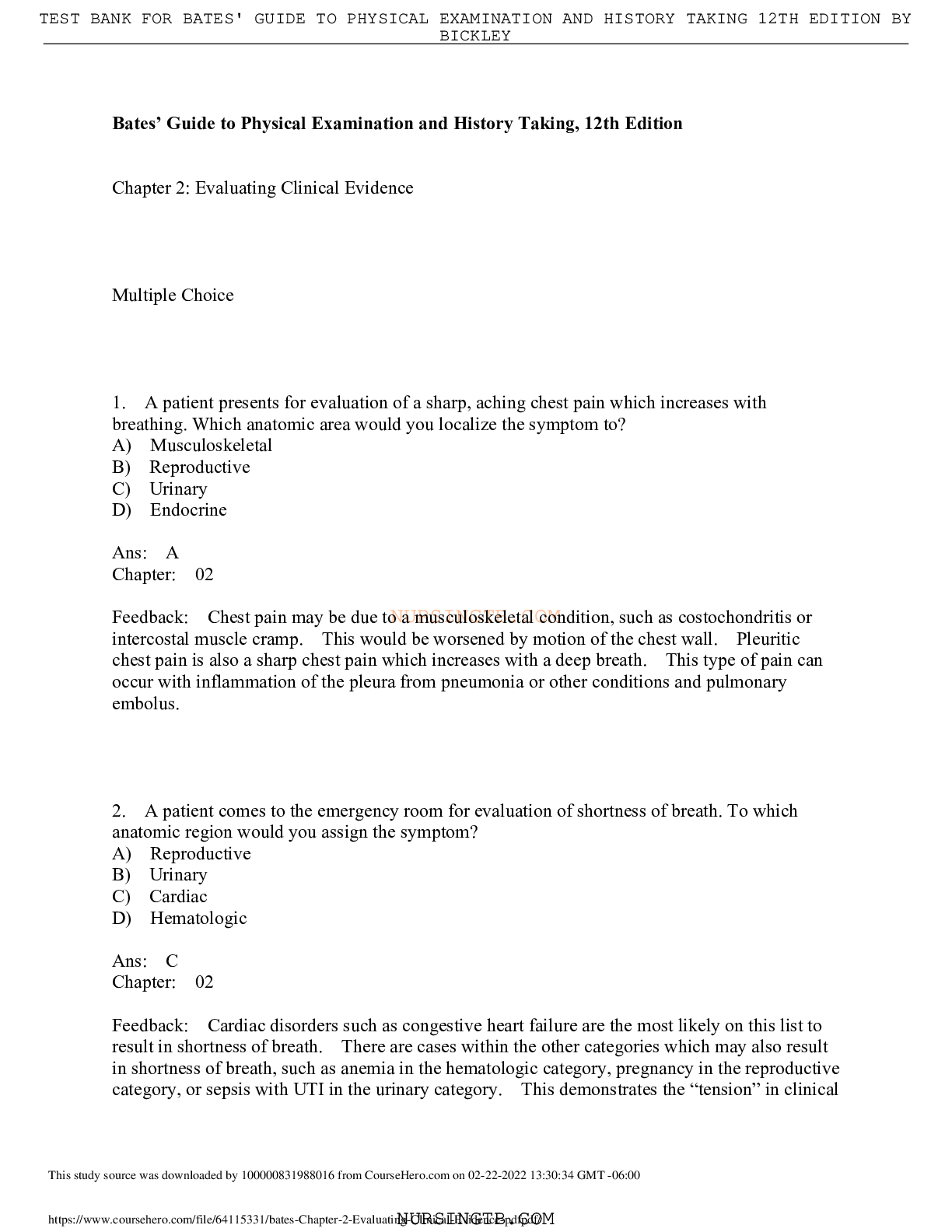
Bates’ Guide to Physical Examination and History Taking, 11th Edition
Chapter 15: The Anus, Rectum, and Prostate
Multiple Choice
1. A 36-year-old married bank teller comes to your office, complaining of pain with defe
...
Bates’ Guide to Physical Examination and History Taking, 11th Edition
Chapter 15: The Anus, Rectum, and Prostate
Multiple Choice
1. A 36-year-old married bank teller comes to your office, complaining of pain with defecation
and occasional blood on the toilet paper. She states that last week she had food poisoning with
nausea, vomiting, and diarrhea. She had runny stools but no black or bloody stools. Ever since
her illness, she has continued to have severe pain with bowel movements. She now tries to put
off defecation as long as possible. Although she is having constipation she denies any further
diarrhea or leakage of stool. She has a past medical history of hypothyroidism and two
spontaneous vaginal deliveries. She has had no other chronic illnesses or surgeries. She does not
smoke and rarely drinks. She has two children. There is no family history of breast or colon
cancer. She has had no weight gain, weight loss, fever, or night sweats. On examination she is
afebrile, with a blood pressure of 115/70 and a pulse of 80. On abdominal examination she has
active bowel sounds, is nontender in all quadrants, and has no hepatosplenomegaly. Inspection of
the anus reveals inflammation on the posterior side with erythema. Digital rectal examination is
painful for the patient but no abnormalities are palpated. Anoscopic examination reveals no
inflammation or bleeding. What is the anal disorder that best describes her symptoms?
A) Anorectal fistula
B) External hemorrhoids
C) Anal fissure
D) Anorectal cancer
Ans: C
Chapter: 15
Page and Header: 561, Techniques of Examination
Feedback: Anal fissures often occur after severe diarrhea or constipation. They cause bright
blood on the toilet paper and are extremely painful during defecation. A small ulceration or
fissure is observed proximal to the anus.
2. A 42-year-old house painter comes to your clinic, complaining of pain with defecation and
profuse bleeding in the toilet after a bowel movement. He was in his usual state of health until 2
weeks ago, when he was injured in a car accident. After the accident he began taking prescription
narcotics for the pain in his shoulder. Since then he has had very few bowel movements. His
stool is hard and pebble-like. He states he has always been “regular” in the past, with easy bowel
movements. His diet has not changed but he states that he is exercising less since the accident.
His past medical history includes hypertension and he is on a low-dose diuretic. He has had no
other chronic illnesses or surgeries. He has a family history of hypertension, coronary heart
disease, and diabetes but no cancer. He is divorced and has three children. He smokes two packs
of cigarettes per day and quit drinking more than 10 years ago. He has had no recent weight loss,
weight gain, fever, or night sweats. On examination he appears muscular and healthy; he is
afebrile. His blood pressure is 135/90 with a pulse of 80. His cardiac, lung, and abdominal
examinations are normal. He is wearing a sling on his left arm. On observation of his anus you
find a swollen bluish ovoid mass that appears to contain a blood clot. Digital rectal examination
is extremely painful for the patient. No other mass is palpated within the anus or rectum.
What disorder of the anus is this patient likely to have?
A) Anal fissure
B) External hemorrhoid
C) Anorectal cancer
D) Internal hemorrhoid
Ans: B
Chapter: 15
Page and Header: 568, Table 15–2
Feedback: A swollen, bluish ovoid mass is most likely a thrombosed external hemorrhoid. These
can cause brisk bleeding with defecation. Hemorrhoids are often caused by low-fiber diets,
dehydration, lack of exercise, and anything that causes constipation leading to increased straining
with defecation. Narcotics can cause severe constipation, leading to this disorder.
3. A 75-year-old retired construction worker comes to your clinic, complaining of bright red
blood in the toilet for the last several months. He has no pain with defecation but has occasional
constipation. He states he eats a healthy diet with fruits and vegetables and walks 2 miles a day.
He has had a 10-pound weight loss over the last 3 months. He denies fever or night sweats. His
medical history includes high blood pressure, coronary artery disease, and arthritis. He has also
had an appendectomy. He smoked for 40 years, two packs a day, but quit 15 years ago. He used
to drink alcohol but doesn't now. His father died in his 60s of a heart attack and his mother had
breast cancer in her 70s. On examination he appears his stated age and sits comfortably on the
examining table. His blood pressure is 150/85 and his pulse is 88. He is afebrile. His cardiac,
lung, and abdominal examinations are normal. Visualization of the anus shows no erythema,
masses, or inflammation. Digital rectal examination elicits an irregular, firm mass on the
posterior side of the rectum. After you remove your finger you notice frank blood on your glove.
What anal or rectal disorder is this patient most likely to have?
A) Anal fissure
B) Internal hemorrhoid
C) Prostate cancer
D) Anorectal cancer
Ans: D
Chapter: 15
Page and Header: 568, Table 15-2
Feedback: This patient has the common symptom of bright red blood in the toilet over time. He
also has had weight loss and has an irregular hard mass in the rectum. It is not uncommon for
these masses to be friable (bleed easily), even with gentle manipulation.
4. A 60-year-old coach comes to your clinic, complaining of difficulty starting to urinate for the
last several months. He believes the problem is steadily getting worse. When asked he says he
has a very weak stream and it feels like it takes 10 minutes to empty his bladder. He also has the
urge to go to the bathroom more often than he used to. He denies any blood or sediment in his
urine and any pain with urination. He has had no fever, weight gain, weight loss, or night sweats.
His medical history includes type 2 diabetes and high blood pressure treated with medications.
He does not smoke but drinks a six pack of beer weekly. He has been married for 35 years. His
mother died of a myocardial infarction in her 70s and his father is currently in his 80s with high
blood pressure and arthritis. On examination you see a mildly obese male who is alert and
cooperative. His blood pressure is 130/70 with a heart rate of 80. He is afebrile and his cardiac,
lung, and abdominal examinations are normal. On visualization of the anus you see no
inflammation, masses, or fissures. Digital rectal examination reveals a smooth, enlarged prostate.
No discrete masses are felt. There is no blood on the glove or on guaiac testing. An analysis of
the urine shows no red blood cells, white blood cells, or bacteria.
What disorder of the anus, rectum, or prostate is this most likely to be?
A) Benign prostatic hyperplasia (BPH)
B) Prostatitis
C) Prostate cancer
D) Anorectal cancer
Ans: A
Chapter: 15
Page and Header: 570, Table 15–3
Feedback: BPH becomes more prevalent during the fifth decade and is often associated with the
urinary symptoms of hesitancy in starting a stream, decreased strength of stream, nocturia, and
leaking of urine. On examination an enlarged, symmetric, firm prostate is palpated. The anterior
lobe cannot be felt. These patients may also develop UTIs secondary to the obstruction.
5. A 24-year-old graduate student comes to your clinic, complaining of burning during urination
and increased urinary frequency. He has had a low-grade fever (100.5 degrees) and does not feel
very well. He is very worried about sexu
[Show More]
.png)





.png)
.png)