Module 8
Equity Recognition and Owner
Financing
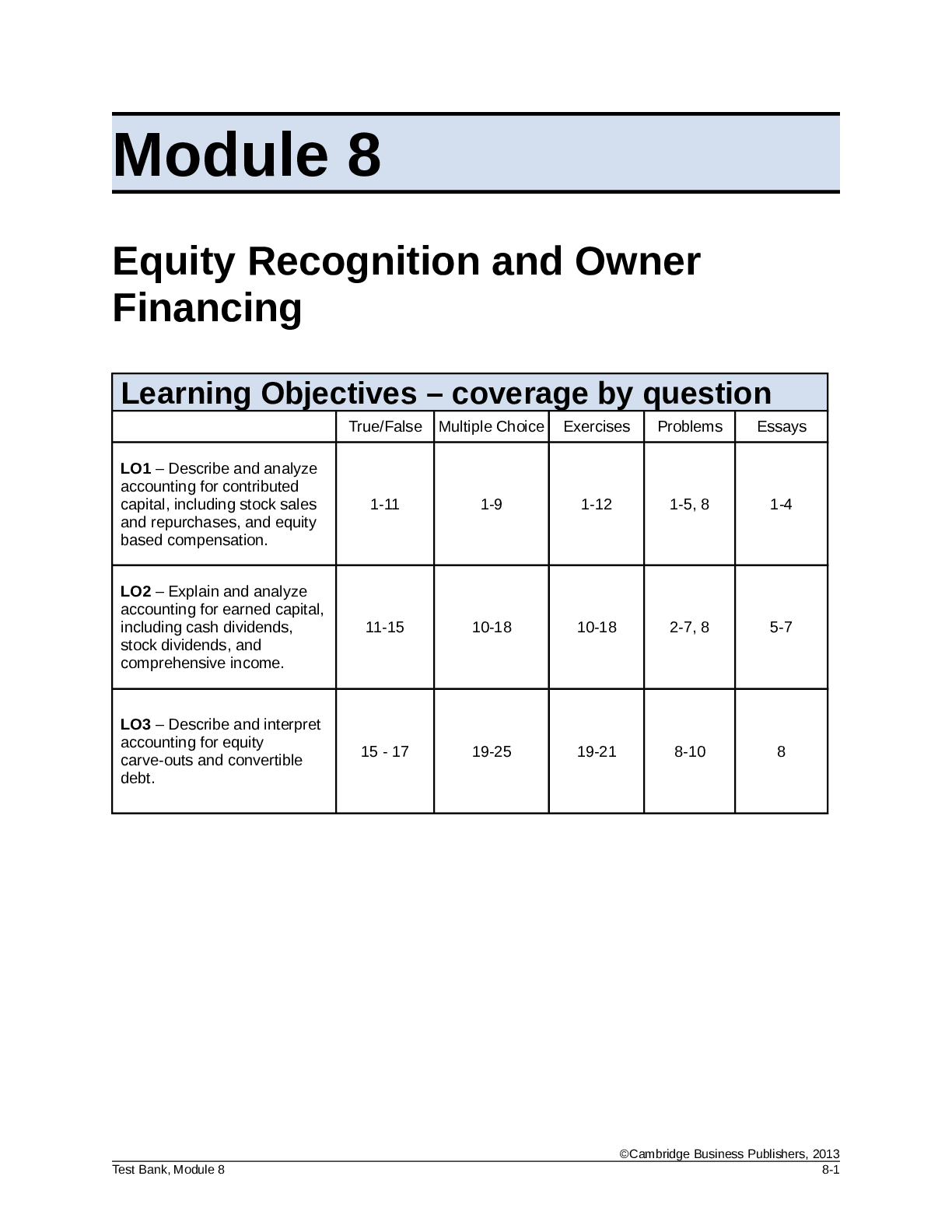
Learning Objectives – coverage by question
True/False Multiple Choice Exercises Problems Essays
LO1 – Describe and analyze
accounting for contributed
capital, incl
...
Module 8
Equity Recognition and Owner
Financing
Learning Objectives – coverage by question
True/False Multiple Choice Exercises Problems Essays
LO1 – Describe and analyze
accounting for contributed
capital, including stock sales
and repurchases, and equity
based compensation.
LO2 – Explain and analyze
accounting for earned capital,
including cash dividends,
stock dividends, and
comprehensive income.
LO3 – Describe and interpret
accounting for equity
carve-outs and convertible
debt.
Module 8: Equity Recognition and Owner Financing
True/False
Topic: Stock Splits
LO: 1
1. A stock split is a monetary transaction. Consequently, a company that splits its stock must make
several financial statement adjustments.
Answer: False
Rationale: A stock split is not a monetary transaction and, as such, there are no financial statement
adjustments needed.
Topic: Gains (Losses) on Stock Transactions
LO: 1
2. When there is a purchase and sale of stock, or a payment of dividends, there is never any gain or
loss recorded.
Answer: True
Rationale: Any “gains” or “losses” incurred due to the purchase and sale of stock are reflected as
increases (decreases) in the paid-in-capital component of stockholders’ equity. Dividends are
reflected as decreases in the retained earnings component of stockholders’ equity.
Topic: Stock Repurchase
LO: 1
3. Kimberly-Clark recently repurchased 5.6 million shares of common stock at a price of $43 per share.
One plausible reason for this is that the company feels that its stock is overvalued at the current
market price.
Answer: False
Rationale: Companies often repurchase their own stock to send a message to the investment
community that their stock is undervalued. If the company believed its stock was overvalued, there
would be no rationale to buy an overpriced security.
Topic: Stock Repurchase
LO: 1
4. When Kimberly-Clark recently repurchased its stock, this action “downsized” the company. This has
the opposite financial statement effects as stock issuance.
Answer: True
Rationale: The action of repurchasing stock has the opposite financial statement effects of stock
issuance – cash is reduced and shareholder equity is reduced.
©Cambridge Business Publishers, 2013
8-2 Financial Statement Analysis & Valuation, 3rd EditionTopic: Preferred Preference in Bankruptcy
LO: 1
5. If HJ Heinz loses its dominance in the ketchup market and eventually becomes bankrupt, its preferred
shareholders carry senior positions as claimants in bankruptcy vis-à-vis common shareholders.
Answer: True
Rationale: Preferred shareholders carry senior positions to common shareholders as claimants in
bankruptcy.
Topic: Paid-in Capital
LO: 1
6. Retained earnings and accumulated other comprehensive income (AOCI) can be found in the
contributed capital section of stockholders’ equity.
Answer: False
Rationale: Retained earnings and AOCI are found in the “earned capital” portion of the stockholders’
equity section of the balance sheet.
Topic: Employee Stock Options
LO: 1
7. When stock options are granted, the contributed capital increase is equal to the number of options
granted multiplied by the estimated fair-value of the stock on the grant date.
Answer: False
Rationale: It is the estimated fair-value of the option on the grant date and not that of the underlying
stock.
Topic: Employee Stock Options Grants (Numerical calculation required)
LO: 1
8. Vickery Inc. reports 3,969,000 stock options granted during fiscal 2012 at a weighted-average fairvalue of $13.67. The average vesting period for these options is three years. Vickery should record a
$54,256,230 expense on its income statement related to this option grant.
Answer: False
Rationale: Because the options have a three-year vesting period on average, Vickery should record
the expense over the vesting period, or $18,085,410 per year.
Topic: Employee Stock Options Exercises (Numerical calculation required)
LO: 1
9. Pfieffer and Company’s stock option footnote discloses before tax stock option expense of $518
million for fiscal 2012. The after tax stock option expense is disclosed as $337 million dollars. Dell
must increase its deferred tax assets by $181 million on its balance sheet for 2012.
Answer: True
Rationale: Pfieffer would record the difference between before and after tax stock option expense as
an increase to deferred tax assets on its books. The expense reduces book income but is not taxdeductible until the options are exercised.
©Cambridge Business Publishers, 2013
Test Bank, Module 8 8-3Topic: Sale of Treasury Stock
LO: 1
10. A re-issuance of treasury stock at a price lower than what it was repurchased for results in a loss on
the income statement.
Answer: False
Rationale: There is no gain or loss on the re-issuance of treasury stock in the income statement.
Instead, the difference between the proceeds received and the original repurchase price of the
treasury stock is reflected as an increase or decrease in additional paid-in capital component of
stockholders’ equity.
Topic: Cost vs. Market Value of Stockholders’ Equity
LO: 1 & 2
11. Stockholders’ equity is not accounted for at current fair value.
Answer: True
Rationale: Stockholders’ equity is accounted for at historical cost, just like assets and liabilities.
Topic: Income Statement Treatment of Dividends
LO: 2
12. A company is worse off by paying cash dividends because it must record a loss for this transaction in
its income statement.
Answer: False
Rationale: Payment of cash dividends reduces cash and retained earnings, and is not recorded as an
expense in the income statement.
Topic: Cash Dividends
LO: 2
13. In 2006, Target paid $750 million of cash dividends. These dividends reduced assets and reduced
retained earnings.
Answer: True
Rationale: Cash dividends result in a reduction in cash and retained earnings.
Topic: Large Stock Dividends
LO: 2
14. When a “large” stock dividend is paid out, retained earnings are reduced by the par value of the
stock.
Answer: True
Rationale: Since it is a large stock dividend, retained earnings is reduced by the par value of the
dividend. Retained earnings are reduced by the market value of the stock dividend only if this is a
“small” stock dividend (percentage of outstanding shares distributed is less than 20 – 25%).
©Cambridge Business Publishers, 2013
8-4 Financial Statement Analysis & Valuation, 3rd EditionTopic: Comprehensive Income
LO: 2
15. Net income is generally viewed as a more inclusive measure of performance than comprehensive
income.
Answer: False
Rationale: Comprehensive income is a more inclusive notion of company performance because it
includes all recognized changes in equity that occur during a period, except those resulting from
investments by owners and distribution to owners.
Topic: Equity Carve-Outs
LO: 3
16. Equity carve-outs make it easier to evaluate the individual business units of a conglomerate.
Answer: True
Rationale: By carving out the business unit, the assets, liabilities and equity due to that single
business unit are more apparent and not combined with the parent company and other subsidiaries.
Topic: Split-Offs
LO: 3
17. Pro rata distributions associated with split-offs, can result in the company reporting gains or losses on
the carve out.
Answer: False
Rationale: Only non pro rata split-offs can yield gains or losses. Pro rata distributions are recorded at
book value, thus, there is no possible gain or loss.
©Cambridge Business Publishers, 2013
Test Bank, Module 8 8-5Multiple Choice
Topic: Stock Repurchase
LO: 1
1. Why might a company repurchase its own stock?
A) It believes that the market undervalues its shares
B) To offset dilutive effects of employee stock options granted
C) To recognize an economic gain when the treasury shares are later sold for a profit
D) To improve earnings per share by reducing the denominator
E) All of the above
Answer: E
Rationale: Companies may repurchase shares to keep the outstanding shares constant in order to
reduce the dilutive effect on earnings per share that may occur when employees exercise stock
options.
Topic: Par Value
LO: 1
2. Which best describes par value for a stock?
A) An arbitrary amount set by the company for each share of stock
B) The value of the stock if it is not sold for a premium or discount
C) The current market value of the stock
D) The value at which stock shares were originally issued
E) None of the above
Answer: A
Rationale: The par value is an arbitrary amount specified in the corporate charter for each share of
stock. Generally it has no substance from a financial reporting or analysis perspective.
Topic: Paid-In Capital
LO: 1
3. Which one of the following items is not a component of contributed capital?
A) Preferred stock
B) Retained earnings
C) Common stock
D) Additional paid-in capital
E) All of the above
Answer: B
Rationale: Retained earnings is a separate component of stockholders’ equity section. It is typically
referred to as “earned” capital.
©Cambridge Business Publishers, 2013
8-6 Financial Statement Analysis & Valuation, 3rd EditionTopic: Stock Split
LO: 1
4. In May 2011, Cerner Corporation. announced a 2-for-1 stock split. On the split date, Cerner had about
83.25 million shares outstanding. After the split the number of shares outstanding was:
A) 124.875 million
B) 83.25 million
C) 41.625 million
D) 166.5 million
E) None of the above
Answer: D
Rationale: A 2-for-1 stock split means that the company distributes one additional share of stock for
every share owned by a current shareholder. 83.25 million × 2 = 166.5 million.
Topic: Accounting for Stock Issuance
LO: 1
5. If a company issues 1,000 shares of common stock at a market price of $40 per share, which of the
following is the correct balance sheet effect?
A) Increase cash by $40,000 and increase contributed capital by $40,000
B) Increase cash by $40,000 and increase earned capital by $40,000
C) Increase stock revenues by $40,000
D) Stock issuances are not reported on the balance sheet
E) None of the above
Answer: A
Rationale: Cash increases by the number of shares issued times the market price; contributed capital
also increases by the same amount. The latter is broken down into two segments: 1. common stock,
which increases by the original par value of the shares sold, and 2. additional paid-in capital, which
makes up the balance. Revenue is an Income Statement category and therefore irrelevant in this
case.
Topic: Accounting for Stock Option Grants (Numerical calculation required)
LO: 1
6. Ebay’s footnote regarding employee stock compensation details the grant of 8.418 million options
during the year of 2011, the fair-value of which was computed as $9.87. If the options have, on
average, a four-year vesting schedule and the company faces a 35% tax rate on income, what affect
would this option grant have on ebay’s accounts in 2011?
A) $ 7,269,995 increase to deferred tax asset, $7,269,995 decrease to tax expense
B) $29,079,981 increase to deferred tax asset, $29,079,981 decrease to tax expense
C) $ 7,269,995 decrease to deferred tax asset, $7,269,995 increase to tax expense
D) $29,079,981 decrease to deferred tax asset, $29,079,981 increase to tax expense
E) Indeterminable since the number of options exercised is unknown.
Answer: A
Rationale: To compute the expense for the current grant, we must multiply the value of the options by
the number granted and recognize this amount over the vesting period of the options.
8,418,000 × $9.87 = $83,085,660/4 = $20,771,415
We credit this amount to paid-in capital and debit wage expense.
In order to determine the deferred tax asset, we take the expense and multiply it by the tax rate:
$20,771,415 × 0.35 = $7,269,995
Because of the timing difference between the recognition of the expense and the tax deductibility of
the expense, we record a deferred tax asset on the balance sheet and a credit to tax expense.
©Cambridge Business Publishers, 2013
Test Bank, Module 8 8-7Topic: Accounting for Stock Option Exercises (Numerical calculation required)
LO: 1
7. During fiscal 2011, Abercrombie & Fitch reported the exercise of 1,573,351 shares at a weightedaverage exercise price of $29.62. If Abercrombie’s stock was trading at $59.64 in January and
$18.31 in December, which of the following details an impact of this transaction on Abercrombie’s
accounts?
A) A decrease of $46,602,657 to additional paid-in capital
B) An increase of $47,231,997 to cash
C) A decrease of $93,834,654 to additional paid-in capital
D) An increase of $46,602,657 to cash
E) None of the above
Answer: B
Rationale: The exercise of 1,573,351 shares at the price of $29.62 would imply:
1,573,351 × $29.62 = $46,602,657
This amount is credited to paid-in capital and debited to cash. The amount the stock is trading at
doesn’t impact the financial statements of the company.
Topic: Accounting for Restricted Stock (Numerical calculation required)
LO: 1
8. Redek’s Travel Co. compensates its executives with restricted stock. During 2012, the company
granted 8,000 shares of $1 par value restricted common stock that will vest over eight (8) years. The
market value of the shares was $5 at the time of the grant.
What is the impact of this transaction on additional paid-in capital?
A) Increase additional paid-in capital by $32,000
B) Increase additional paid-in capital by $6,000
C) Increase additional paid-in capital by $40,000
D) Increase additional paid-in capital by $8,000
E) Paid-in capital is not impacted by this transaction.
Answer: A
Rationale: Like a regular stock issuance, the compensation is split between common stock and paid
in capital. The vesting period doesn’t pertain to the impact on paid-in capital, but will be used to offset
deferred compensation over time.
8,000 × $1 par value = $8,000 increase to common stock
8,000 × $4 = $32,000 increase to additional paid-in capital
Topic: Treasury Stock Transaction (Numerical calculation required)
LO: 1
9. On its 2010 balance sheet, Walgreen Co, reports treasury stock at cost of $3,101 million. The
company has a total of 1,025,400,000 shares issued and 938,605,503 shares outstanding. What
average price did Walgreen pay for treasury shares?
A) $ 3.02
B) $ 3.30
C) $ 3.57
D) $35.73
E) None of the above
Answer: D
Rationale: Price per share is total treasury shares at cost divided by treasury shares.
$3,101,000,000 / (1,025,400,000 – 938,605,503) = $35.73 per share.
©Cambridge Business Publishers, 2013
8-8 Financial Statement Analysis & Valuation, 3rd Editio
[Show More]