A patient is brought to the emergency department with shortness of breath, a respiratory
rate of 30 breaths per minute, intercostal retractions, and frothy, pink sputum. The nurse
caring for this patient
will expect t
...
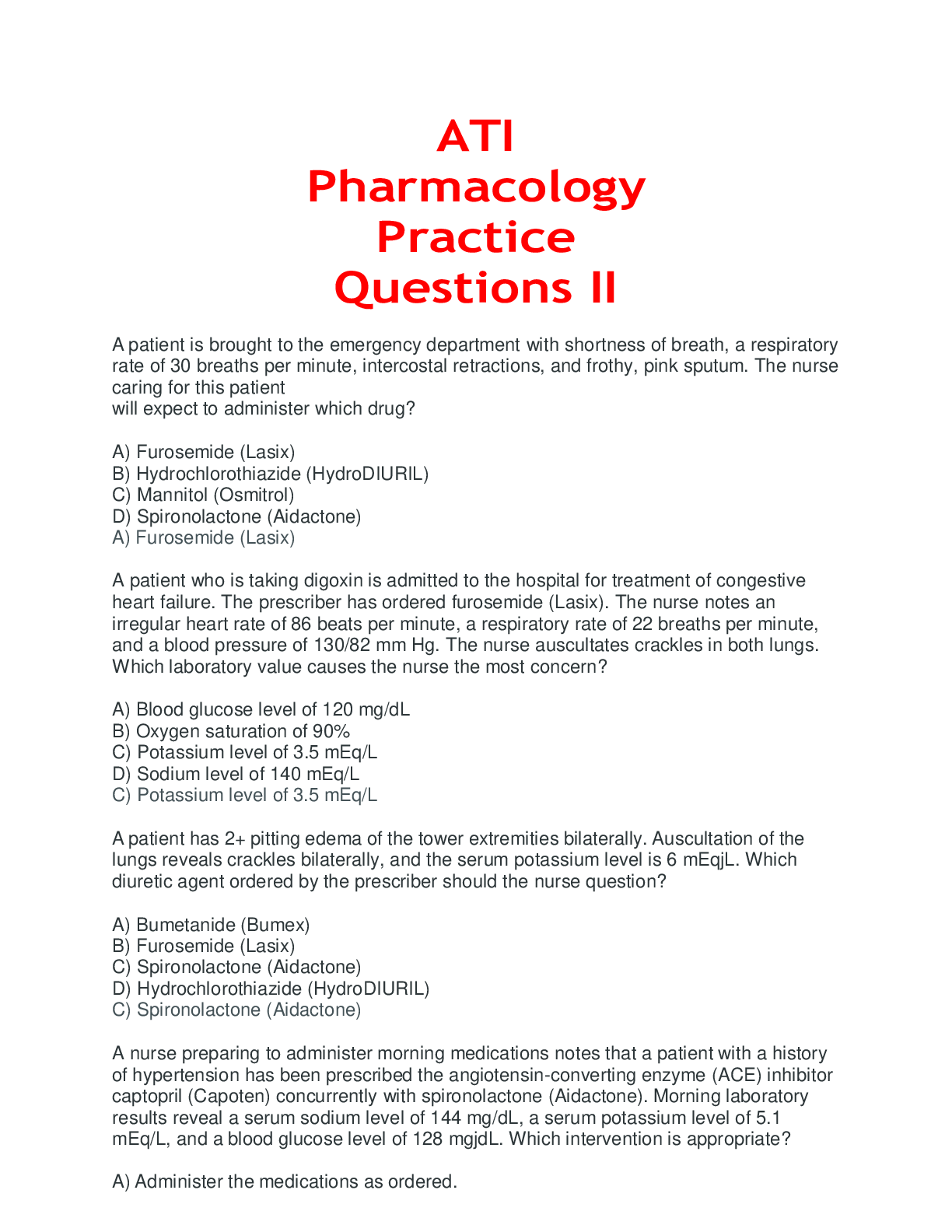
A patient is brought to the emergency department with shortness of breath, a respiratory
rate of 30 breaths per minute, intercostal retractions, and frothy, pink sputum. The nurse
caring for this patient
will expect to administer which drug?
A) Furosemide (Lasix)
B) Hydrochlorothiazide (HydroDIURIL)
C) Mannitol (Osmitrol)
D) Spironolactone (Aidactone)
A) Furosemide (Lasix)
A patient who is taking digoxin is admitted to the hospital for treatment of congestive
heart failure. The prescriber has ordered furosemide (Lasix). The nurse notes an
irregular heart rate of 86 beats per minute, a respiratory rate of 22 breaths per minute,
and a blood pressure of 130/82 mm Hg. The nurse auscultates crackles in both lungs.
Which laboratory value causes the nurse the most concern?
A) Blood glucose level of 120 mg/dL
B) Oxygen saturation of 90%
C) Potassium level of 3.5 mEq/L
D) Sodium level of 140 mEq/L
C) Potassium level of 3.5 mEq/L
A patient has 2+ pitting edema of the tower extremities bilaterally. Auscultation of the
lungs reveals crackles bilaterally, and the serum potassium level is 6 mEqjL. Which
diuretic agent ordered by the prescriber should the nurse question?
A) Bumetanide (Bumex)
B) Furosemide (Lasix)
C) Spironolactone (Aidactone)
D) Hydrochlorothiazide (HydroDIURIL)
C) Spironolactone (Aidactone)
A nurse preparing to administer morning medications notes that a patient with a history
of hypertension has been prescribed the angiotensin-converting enzyme (ACE) inhibitor
captopril (Capoten) concurrently with spironolactone (Aidactone). Morning laboratory
results reveal a serum sodium level of 144 mg/dL, a serum potassium level of 5.1
mEq/L, and a blood glucose level of 128 mgjdL. Which intervention is appropriate?
A) Administer the medications as ordered.
B) Ask the patient about the use of salt substitutes.
C) Contact the provider to report the laboratory values.
D) Request an order for furosemide (Lasix).
C) Contact the provider to report the laboratory values.
A patient with hypertension is taking furosemide {Lasix) for congestive heart failure. The
prescriber orders digoxin to help increase cardiac output. What other medication will the
nurse expect to be ordered for this patient?
A) Bumetanide (Bumex)
B) Chlorothiazide (Diuril)
C) Hydrochlorothiazide (HydroDIURjL)
D) Spironolactone (Aidactone)
D) Spironolactone (Aidactone)
A patient who was in a motor vehicle accident sustained a severe head injury and is
brought into the emergency department. The provider orders intravenous mannitol
(Osmitrol). The nurse knows that this is given to:
A) reduce intracranial pressure.
B) reduce renal perfusion.
C) reduce peripheral edema.
D) restore extracellular fluid.
A) reduce intracranial pressure.
A patient is taking gentamicin (Garamycin) and furosemide (Lasix). The nurse should
counsel this patient to report which symptom?
A) Frequent nocturia
B) Headaches
C) Ringing in the ears
D) Urinary retention
C) Ringing in the ears
An older adult patient with congestive heart failure develops crackles in both lungs and
pitting edema of all extremities. The physician orders hydrochlorothiazide
(HydroDIURIL). Before administering this medication, the nurse reviews the patient's
chart. Which laboratory value causes the nurse the most concern?
A) Elevated creatinine clearance
B) Elevated serum potassium level
C) Normal blood glucose level
D) Low levels of low-density lipoprotein (LDL) cholesterol
A) Elevated creatinine clearance
A patient with chronic congestive heart failure has repeated hospitalizations in spite of
ongoing treatment with hydrochlorothiazide (HydroDIURIL) and digoxin. The prescriber
has ordered spironolactone (Aidactone) to be added to this patient's drug regimen, and
the nurse provides education about this medication. Which statement by the patient
indicates understanding of the teaching?
A) "I can expect improvement within a few hours after taking this drug."
B) "I need to stop taking potassium supplements."
C) "I should use salt substitutes to prevent toxic side effects."
D) "I should watch closely for dehydration."
B) "I need to stop taking potassium supplements."
A patient with hypertension is prescribed an angiotensin-converting enzyme (ACE)
inhibitor. The nurse reviewing this patient's chart before administering the medication
will be most concerned about which other disease process?
A) Bronchial asthma
B) Coronary artery disease
C) Diabetes mellitus
D) Renal artery stenosis
D) Renal artery stenosis
A nurse administers an ACE inhibitor to a patient who is taking the drug for the first time.
What will the nurse do?
A) Instruct the patient not to get up without assistance.
B) Make sure the patient takes a potassium supplement.
C) Report the presence of a dry cough to the prescriber.
D) Request an order for a diuretic to counter the side effects of the ACE inhibitor.
A) Instruct the patient not to get up without assistance.
A patient who has been taking an antihypertensive medication for several years is
recovering from a myocardial infarction. The prescriber changes the patient's
medication to an ACE inhibitor. The patient asks the nurse why a new drug is necessary.
What is the nurse's response?
A) "ACE inhibitors can prevent or reverse pathologic changes in the heart's structure."
B) "ACE inhibitors help lower LDL cholesterol and raise HDL cholesterol."
C) "ACE inhibitors increase venous return to the heart, improving cardiac output."
D) "ACE inhibitors regulate electrolytes that affect the cardiac rhythm."
A) "ACE inhibitors can prevent or reverse pathologic changes in the heart's structure."
[Show More]