11/16/21, 7:50 PM Portage Learning A&P I Final Exam Flashcards | Quizlet
https://quizlet.com/505864223/portage-learning-ap-i-final-exam-flash-cards/ 1/26
Free trial
Portage Learning A&P I Final Exam
Terms in this set
...
11/16/21, 7:50 PM Portage Learning A&P I Final Exam Flashcards | Quizlet
https://quizlet.com/505864223/portage-learning-ap-i-final-exam-flash-cards/ 1/26
Free trial
Portage Learning A&P I Final Exam
Terms in this set (347)
List two organs contained in the
abdominal cavity.
The abdominal cavity contains the stomach, intestines,
spleen and liver
True or False?
a. Cellular respiration occurs in the
mitochondria. (T or F)
b. The purpose of cellular respiration
is to produce ATP. (T or F)
c. Integral proteins are only found on
the inner surface of a cell membrane.
(T or F)
d. Endocytosis is the process that
occurs to eject biomacromolecules
from the cell. (T or F)
e. Pinocytosis uses a signaling
molecule from another cell, binding to
the cell membrane to bring about
changes within the cell proteins. (T or
F)
a. True
b. True
c. False
d. False
e. False
Study sets, textbooks, questions
Portage Learning A&P I Final Exam
11/16/21, 7:50 PM Portage Learning A&P I Final Exam Flashcards | Quizlet
https://quizlet.com/505864223/portage-learning-ap-i-final-exam-flash-cards/ 2/26
You are observing two cells under the
microscope. They are the same type
of eukaryotic cell but one appears
much larger. Based on appearance
alone, which one would you expect to
be carrying out respiration at a more
active rate, the larger or smaller cell?
Explain why.
I believe it is the smaller cell that will breathe at a more active
rate because in order for respiration to occur efficiently and
more actively the surface area to volume ratio is very critical;
also, if the larger surface area is present then the diffusion of
gases occur at a higher rate; so, larger cells will have a smaller
surface to volume ratio and diffusion that will occur at a slower
rate creating a less active respiration; and, on the other hand
smaller cells will have a larger surface area to volume ratio and
an improved diffusion rate, so the higher rate and more active
respiration.
The smaller cell. Cells need to remain relatively small
because as a cell expands the amount of surface area
relative to the volume of the cell decreases. The smaller cell
is more active because relative to its volume, its surface area
is larger than a bigger cell. With a larger surface area
(relative to its volume) this allows the metabolic processes to
occur faster.
Note: Essay answers must clearly be
in your own words.
Explain what happens to the epiglottis
during swallowing. Why?
During swallowing the epiglottis moves inferiorly to close off
and prevent aspiration by covering the trachea and creating a
passage for liquid, food, or bolus into the esophagus; and,
preventing these things from entering into the lungs.
Air and food pass in which one of the
following areas:
Oropharynx
Label the following five items from
the diagram:
Label B- ___________
Label D- __________
Label E- __________
Label F- __________
Label G- __________
B - Oral Cavity
D - Epiglottis
E - Glottis
F - Trachea
G - Esophagus
From widest to narrowest, the
branches of the bronchial tree are:
Primary bronchi, secondary bronchi, tertiary bronchi,
bronchioles
Portage Learning A&P I Final Exam
11/16/21, 7:50 PM Portage Learning A&P I Final Exam Flashcards | Quizlet
https://quizlet.com/505864223/portage-learning-ap-i-final-exam-flash-cards/ 3/26
Explain why someone who has
hypergastrinemia (excessive secretion
of gastrin) might develop
gastric/stomach ulcers.
Hypergastrinemia leads to excess secretion of the gastrin
hormone, which induces excess secretion of hydrochloric acid
in the stomach; and, the excess acid then acts as a protective
mucousa layer causing disruption that can lead to those ulcers.
Gastrin stimulates the secretions of pepsinogens and
hydrochloric acid. Excess amounts would lead to erosion of
the stomach lining.
Look carefully at the diagram below.
Label the following 5 organs of the
digestive system.
To receive credit for the intestines you
must label the specific region.
3: ___________
4: ___________
7: ___________
9: ___________
10: ___________
3. Stomach
4. Gallbladder
7. Jejunum
9. Appendix
10. Rectum
Note: Essay answers must clearly be
in your own words.
Answer the following essay question:
Describe parietal cells and chief cells:
name their location, secretions and
purposes.
Parietal and chief cells are located in the stomach wall and
they secrete gastric juices and mucous, secrete hormones that
regulate digestive activity; also, parietal cells produce HCl in
the stomach; and, chief cells secrete te enzymes pepsinogen,
rennin, and gastric lipase.
The parietal cells (located in the wall of the stomach body)
secrete hydrochloric acid, generating a pH of 1.3-3.5. This
very acidic pH kills many of the bacteria ingested along with
food. In addition, the low pH stops the activity of salivary
amylase. The secretion of hydrochloric acid is essential in
the activation of pepsin.
Chief cells: secrete pepsinogen. Pepsinogen (a pre-enzyme)
is secreted by the chief cells in the stomach. Hydrochloric
acid converts the inactive pepsinogen (secreted by the chief
cells) into the active enzyme pepsin which begins the
breakdown of proteins.
Portage Learning A&P I Final Exam
11/16/21, 7:50 PM Portage Learning A&P I Final Exam Flashcards | Quizlet
https://quizlet.com/505864223/portage-learning-ap-i-final-exam-flash-cards/ 4/26
Upgrade to remove ads Only $35.99/year
Label the following bones of the
skeleton from the figure below:
1: ____________
3:____________
5:____________
7: ____________
8: ____________
1: Frontal bone/frontal sinuses
3: Maxilla
5: Vomer
7: Maxilla
8: Mandible
Label the bones in the figure below:
A: ____________
B: ____________
C: ____________
D: ____________
E: _____________
A. Pisiform
B. Hamate
C. Capitate
D. Trapezoid
E. Trapezium
A patient has a diagnosis of
osteoporosis. (1) In your own words,
describe this diagnosis and (2) What
type of bone cell would they be
lacking? Explain your answer.
(1) The textbook states that osteoporosis is a bone tissue
disease where the bone tissue degenerates faster than it is
replaced making the bones weak, causing increased pain,
and more likely to fracture due to them being brittle.
(2) Furthermore, there would be a decreased number of
osteoblasts, which are responsible for bone repair; also, the
bone repair would be unable to keep up with the ongoing
breakdown of the bone which is responsible in the process
that included the osteoblasts that take the calcium from the
blood.
Portage Learning A&P I Final Exam
11/16/21, 7:50 PM Portage Learning A&P I Final Exam Flashcards | Quizlet
https://quizlet.com/505864223/portage-learning-ap-i-final-exam-flash-cards/ 5/26
Label the following five muscles:
B: _____________
C: _____________
E: _____________
G: _____________
J: ______________
B: Temporalis
C: Orbicularis oculi
E: Zygomaticus major
G: Buccinator
J: Depressor labii inferioris
When extensor digitorum contracts,
what action(s) occurs?
A. Elbow extension
B. Wrist extension
C. Extension of digit 1
D. Extension of digits 2-5
E. A&C
F. B&D
F. B&D
Would you expect a male to have
estrogen in their bloodstream?
Explain why or why not.
Yes, the textbook stated that both the male and female
bodies produce “all” the sex hormones; however, the ratios
are different; also, the adrenal glands are largely
responsible for producing this “opposite” hormone that the
gonads of the person does not.
List the hormone(s) that best
describes the statement below:
I promote the reabsorption of water at
the collecting ducts of the kidneys.
ADH
List the hormone(s) that best
describes the statement below:
I am secreted by the beta cells of the
pancreas.
Insulin
Portage Learning A&P I Final Exam
11/16/21, 7:50 PM Portage Learning A&P I Final Exam Flashcards | Quizlet
https://quizlet.com/505864223/portage-learning-ap-i-final-exam-flash-cards/ 6/26
Upgrade to remove ads Only $35.99/year
Explain in detail why the thyroid
becomes enlarged during an iodine
deficiency?
When there is a low level of thyroxin in the blood, the
anterior pituitary gland continues to produce TSH; so, the
thyroid reacts by increasing in size and producing a goiter,
but this increase in size is ineffective because active thyroxin
cannot be produced without iodine.
A- Identify the sensory cell receptor
highlighted in blue, below, also
indicated by the arrow.
B- What sensory information is
detected by this type of receptor?
A) Pacinian corpuscle
B) Detects pressure (mechanoreceptor)
Match the cell with its single best
description, using each description
only once.
Fibroblasts
Produces collagen
Keratinocytes
Produces a protein to protect the skin
Langerhans cells
Assists in immune responses
Melanocytes
Produces a pigment that absorbs UV
rays
Fibroblasts
Produces collagen
Keratinocytes
Produces a protein to protect the skin
Langerhans cells
Assists in immune responses
Melanocytes
Produces a pigment that absorbs UV rays
Other Incorrect Match Options:
Detects pain
Detects light touch
What is the name and function of the
structure below? (Highlighted in blue,
also indicated by the arrow)
Sebaceous gland (oil gland) produces oil (sebum) to protect
the skin and hair from drying.
Portage Learning A&P I Final Exam
11/16/21, 7:50 PM Portage Learning A&P I Final Exam Flashcards | Quizlet
https://quizlet.com/505864223/portage-learning-ap-i-final-exam-flash-cards/ 7/26
What is the study of the function of
the human body?
Physiology
Epithelium is an example of what level
of organization in the human body?
Tissue
What is the breakdown of nutrients? Catabolism
List the four basic types of tissues. Epithelium, Muscle, Connective, and Nervous tissues.
List the three layers of the skin in order
from superficial to deep. The most
superficial layer of the skin should be
at the top of your list. To receive credit
the layers must be in this order.
Epidermis (Outer Layer), Dermis (Middle Layer), and
Hypodermis (Subcutaneous and Inner Layer)
Note: Essay answers must clearly be
in your own words.
Glucagon stimulates the breakdown
of glycogen in the liver. Based upon
your learning of metabolism, would
this be considered an anabolic or
catabolic hormone? Explain why.
Catabolic hormone because it is breaking down of a larger
substance, glycogen, into their simpler, smaller building blocks
within the liver (releasing energy in the process).
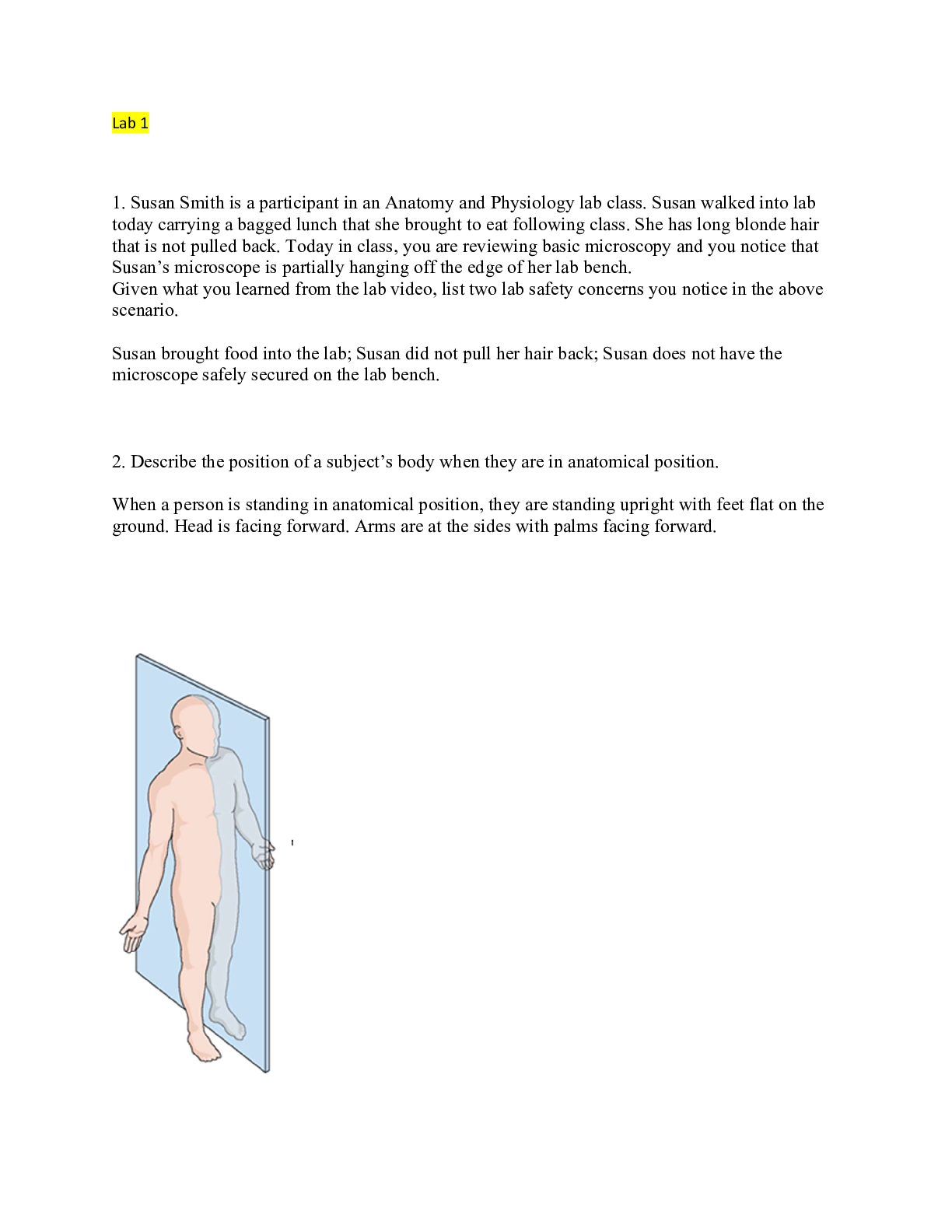
What anatomical orientation term is
used to indicate "toward the back of
the body"?
Dorsal
What anatomical orientation term is
used to indicate "toward the upper
part of a structure"?
Superior
What anatomical orientation term is
used to indicate "toward the body
surface"?
Superficial (External)
What anatomical orientation term is
used to indicate "further from the
origin of the body part"?
Distal
Portage Learning A&P I Final Exam
11/16/21, 7:50 PM Portage Learning A&P I Final Exam Flashcards | Quizlet
https://quizlet.com/505864223/portage-learning-ap-i-final-exam-flash-cards/ 8/26
You are looking at a diagram of a
patient standing in anatomical
position. On the sheet of paper
containing the diagram, which thumb
points to the left side of the paper,
right or left?
Right
Is the spine part of the axial or
appendicular region of the body?
Axial region
A patient is standing in anatomical
position. The patient moves his hand
to scratch his nose. What anatomical
action term is best used to indicate
the motion occurring at his elbow?
Flexion
What anatomical action term is used
to indicate "movement away from
midline"?
Abduction
Describe the position of the
diaphragm in relation to the thoracic
cavity in anatomical position terms.
Use a full sentence for your
description.
The diaphragm (muscle) assists in dividing the abdominopelvic
region of the thoracic cavity by being superior to the organs
(stomach, intestines, spleen, liver) of the abdominal cavity.
Which anatomical action is occurring
at the elbow joint, in the direction of
the arrow?
(Photo of arrow going down humerus
pointing toward hand)
Elbow Extension (Mod ule 1)
Look at the figure below. The right
femur is moved in the direction of the
arrow. What anatomical action term
best describes this movement?
Adduction (Femur is moving towards the midline).
Portage Learning A&P I Final Exam
11/16/21, 7:50 PM Portage Learning A&P I Final Exam Flashcards | Quizlet
https://quizlet.com/505864223/portage-learning-ap-i-final-exam-flash-cards/ 9/26
True or False: The ventral body cavity
contains the cranial cavity, the thoracic
cavity, and the abdominal cavity. If
your answer is false, rephrase the
statement to make it a true statement.
False
The body is divided into anterior and
posterior sections by what type of
plane?
Frontal (Coronal)
A section that is diagonal between
horizontal and vertical planes is called
what?
Oblique sections
Look at the diagram below. What type
of plane is shown?
(Red plane cutting the body
anteriorly/posterioly)
Frontal (Coronal)
Using the letters given, match the cell
with the type of solution it has been
placed in:
A cell beginning to swell = Hypotonic
A red blood cell placed in ocean water = Hypertonic
A cell containing an equal amount of solute as the solution =
Isotonic
Using the letters given, match each
molecule/item with its typical means
of entering a cell. You may need to
use some means of entry more than
once.
Lipid insoluble molecules
= Facilitated diffusion
Other cells = Endocytosis
Water = Diffusion
Which one of the following is not true
of active transport?
Active transport moves particles with the concentration
gradient
List the three organelles, in order,
involved in the synthesis, transport
and shipping of proteins.
ribosomes, rough ER, Golgi complex
Portage Learning A&P I Final Exam
11/16/21, 7:50 PM Portage Learning A&P I Final Exam Flashcards | Quizlet
https://quizlet.com/505864223/portage-learning-ap-i-final-exam-flash-cards/ 10/26
Label the 5 organelles listed below:
3: ___________
4: ___________
5: ___________
7: ___________
8: ___________
3: Nucleolus
4: Nuclear Envelope
5: Mitochondria
7: Lysosome
8: Endoplasmic Reticulum
Note: Essay answers must clearly be
in your own words.
In your own words, discuss Tay-Sachs
disease. What organelle within the cell
is impacted? What are the symptoms
of the disease and why do they
occur?
Tay-Sachs disease is a result from a lack of an enzyme that
degrades another specific type of glycolipid; and, these
glycolipids build up in the lysosomes (organelle within the
cells that is impacted) of the brain, leading to progressive
neural dysfunction and typically death by age 4 or 5 years;
furthermore, other symptoms include seizures, muscle,
weakness, vision and hearing loss, etc.
1. Lysosomes
2. Build up of toxic lipids inside the cell (biomacromolecules)
3. Disability or death
Note: Essay answers must clearly be
in your own words.
You are observing two cells under the
microscope. They are the same type
of eukaryotic cell but one appears
much larger. Based on appearance
alone, which one would you expect to
be carrying out respiration at a more
active rate, the larger or smaller cell?
Explain why.
The smaller cell. Cell needs to remain relatively small because
as a cell expands the amount of surface area relative to the
volume of the cell decreases. The smaller cell is more active
because relative to its volume, its surface area is larger than a
bigger cell. With a larger surface area (relative to its volume)
this allows metabolic processes to occur faster.
How many lobes does the left human
lung have?
Left lung has 2 lobes in a human.
Rings of cartilage line much of the
respiratory tract. In which of one the
following would cartilage NOT be
found?
Alveoli
Portage Learning A&P I Final Exam
11/16/21, 7:50 PM Portage Learning A&P I Final Exam Flashcards | Quizlet
https://quizlet.com/505864223/portage-learning-ap-i-final-exam-flash-cards/ 11/26
Label the following five items from
the diagram:
Label A- __________
Label C- __________
Label E- __________
Label F- __________
Label H- __________
A - Nasal Cavity
C - Soft Palate
E - Glottis
F - Trachea
H- Tongue
Note: Essay answers must clearly be
in your own words.
Explain what happens to the soft
palate during swallowing. Why?
The soft palate elevates in an upward movement during
swallowing to prevent food or liquid from entering the nasal
passages.
Note: Essay answers must clearly be
in your own words.
Explain at least two differences
between Type I and Type II alveolar
cells.
Type I forms the very thin simple squamous epithelium of the
alveoli within the junction of the capillaries; also, Type II
produce and secrete pulmonary surfactant which is needed
throughout the alveolar surface; and, Type II cells can divide
to replace damaged Type I cells.
True/False: Negative pressure is used
to move air into the lungs.
True
True/False: During exhalation the
diaphragm contracts to actively push
air out of the lungs.
False
True/False: During inhalation the rib
cage lifts in an upward motion to
open and expand the lungs.
True
True/False: As the thoracic cavity
expands and lung volume increases,
the density of the gases filling the
lungs decreases.
True
Portage Learning A&P I Final Exam
11/16/21, 7:50 PM Portage Learning A&P I Final Exam Flashcards | Quizlet
https://quizlet.com/505864223/portage-learning-ap-i-final-exam-flash-cards/ 12/26
True/False: When the diaphragm rises,
thoracic pressure increases and air
naturally flows out of the lungs.
True
Boyle's law states that gas volume is:
A. Directly proportional to
temperature
B. Inversely proportional to
temperature
C. Directly proportional to pressure
D. Inversely proportional to pressure
E. Both A and B
D. Inversely proportional to pressure
Typical respiratory epithelium contains
all of the following, except which
one?
layers
Which one of the following is not true
of the pleurae?
Visceral pleurae cover the diaphragm
Which one of the following is not true
of the bronchioles?
Bronchioles can contain fossae and mucus
Which one of the following is true of
the respiratory physiology
calculations? (You may find it helpful
to draw the respiratory physiology
diagram on a piece of scratch paper
to help you answer this question.)
Functional Residual Capacity (FRC) = RV+ERV
True/False:
Typical respiratory epithelium contains
cells where only some of the
pseudostratified columnar cells touch
the basement membrane.
False
True/False:
During inhalation, negative pressure
draws air into the lungs.
True
Portage Learning A&P I Final Exam
11/16/21, 7:50 PM Portage Learning A&P I Final Exam Flashcards | Quizlet
https://quizlet.com/505864223/portage-learning-ap-i-final-exam-flash-cards/ 13/26
True/False:
The vestibule is lined with typical
respiratory epithelium.
False
True/False:
The fossae is another name for the
pleural cavities.
False
True/False:
Each red blood cell contains from 10-
100 molecules of hemoglobin.
False
Matching:
-Smoking is often the cause of this
disease. A. Emphysema
-With this disease, mucus clogs the
respiratory tract. B. Pleurisy
-This condition results in fluid-filled
alveoli. C. Pulmonary edema
-This is inflammation of the pleurae. D.
Cystic Fibrosis
Smoking is often the cause of this disease.
A. Emphysema
With this disease, mucus clogs the respiratory tract. D. Cystic
Fibrosis
This condition results in fluid-filled alveoli. C. Pulmonary
edema
This is inflammation of the pleurae. B. Pleurisy
The pressure of three gases equals 1
atmosphere. What is the partial
pressure of oxygen (in mmHG) if
nitrogen is 300 mmHg and carbon
dioxide is 350 mmHg? To receive full
credit you must show your work.
X = 110 mmHg
1 atm = 760 mmHg
300 mmHg + 350 mmHg + X = 760 mmHg
Why would warming air be beneficial
to gas exchange?
It would expand the air to make it more available for gas
exchange; also, based on Charles's law.
In gas exchange (external respiration):
Oxygen diffuses from alveoli into capillaries, carbon dioxide
diffuses from capillaries into alveoli
The purpose of these cells are the
primary immune defense of the
alveoli:
Alveolar macrophages
Portage Learning A&P I Final Exam
11/16/21, 7:50 PM Portage Learning A&P I Final Exam Flashcards | Quizlet
https://quizlet.com/505864223/portage-learning-ap-i-final-exam-flash-cards/ 14/26
Answer the following essay question
(10 points):
1. Muscular dystrophy is a
neuromuscular disease which restricts
the lungs from fully expanding due to
muscular weakness. If a person is
diagnosed with muscular dystrophy:
1) Which of the following statements
regarding pulmonary function would
be true?
2) Explain your answer.
A. Inspiratory capacity would be
abnormally low
B. Vital capacity would abnormally
high
C. Total lung capacity would remain
the same
1. A. Inspiratory capacity would be abnormally low
2. Due to the muscular dystrophy muscles that would be
responsible for inspiration would most likely be damaged; and,
this accounts for progressive weakness and degeneration of
skeletal muscles surrounding the lungs; so, the breathing
process would be impaired because the muscles that help in
expanding the lungs are at a weakened state; and, they would
be unable to expand for inhalation; therefore, the "inspiratory
capacity would be abnormally low" possibly leading to other
issues.
Which of the following statements is
FALSE regarding the muscle pictured
above depicted by the lab instructor?
It protracts the scapula
It stabilizes the scapula
It works with the pectoralis minor to
draw the scapula forward and laterally
All of the above statements are true
All of the above statements are false
All of the above statements are true
Identify the muscle in the picture
above, specified by the lab instructor,
and list its actions.
Identified is the latissmus dorsi muscle and its actions are
extension, adduction, and medial rotation at the shoulder.
Portage Learning A&P I Final Exam
11/16/21, 7:50 PM Portage Learning A&P I Final Exam Flashcards | Quizlet
https://quizlet.com/505864223/portage-learning-ap-i-final-exam-flash-cards/ 15/26
Which of the following statements is
FALSE regarding the muscle pictured
(highlighted in blue and specified by
the arrow)?
It is innervated by the lower scapular
nerve
It abducts the humerus
It flexes the humerus
It extends the humerus
All of the above statements are true
All of the above statements are false
It is innervated by the lower scapular nerve
(the deltoid is innervated by the axillary nerve.)
Your patient has sustained a rotator
cuff injury. It is determined that the
axillary nerve was damaged as a
result. Given this information, which of
the muscles pictured above would
you expect to be affected?
b.
Teres Minor:
a. Internally rotates the humerus
b. prevents upward slippage of the
humerus during abduction
c. innervated by the subscapular
nerve
d. prevents upward slippage of the
humerus when the arm is at rest
e. a. and b.
f. c. and d.
b. prevents upward slippage of the humerus during abduction
Brachialis: (mark all that apply)
Primary action is supination of the
forearm
Primary action is flexion of the elbow
Innervated by the musculocutaneous
nerve
Innervated by the ulnar nerve
Primary action is flexion of the elbow
Innervated by the musculocutaneous nerve
Portage Learning A&P I Final Exam
11/16/21, 7:50 PM Portage Learning A&P I Final Exam Flashcards | Quizlet
https://quizlet.com/505864223/portage-learning-ap-i-final-exam-flash-cards/ 16/26
Triceps Brachii: (mark all that apply)
Extends elbow
Adducts humerus
Innervated by radial nerve
Innervated by axillary nerve
Extends elbow
Adducts humerus
Innervated by radial nerve
Flexor Carpi Radialis: (mark all that
apply)
Flexes the wrist
Innervated by the radial nerve
Ulnar deviation of the wrist
Innervated by the median nerve
Flexes the wrist
Innervated by the median nerve
Extensor Carpi Ulnaris: (mark all that
apply)
Extends the wrist
Extends the fifth digit
Innervated by the posterior
interosseous nerve
Located on the dorsal forearm
Extends the wrist
Innervated by the posterior interosseous nerve
Located on the dorsal forearm
Abductor Pollicis Longus: (mark all
that apply)
Located on the dorsal forearm
Abducts the 1st digit
Extends the wrist
Innervated by the median nerve
Located on the dorsal forearm
Abducts the 1st digit
List the 3 gluteal muscles in order
from superficial to deep.
Most superficial is the Gluteus Maximus, followed by the
Gluteus Medius, and the deepest is the Gluteus Minimus.
Tensor Fasciae Latea: (mark all that
apply)
Hip abduction
lateral rotation of the tibia
medial rotation of the tibia
Attaches to the IT tract
Innervated by the inferior gluteal
nerve
Hip abduction
lateral rotation of the tibia
Attaches to the IT tract
Portage Learning A&P I Final Exam
11/16/21, 7:50 PM Portage Learning A&P I Final Exam Flashcards | Quizlet
https://quizlet.com/505864223/portage-learning-ap-i-final-exam-flash-cards/ 17/26
Adductor Magnus: (mark all that
apply)
Hip adduction
Hip medial rotation
Innervated by the obturator nerve
Innervated by the tibial nerve
Hip adduction
Hip medial rotation
Innervated by the obturator nerve
Innervated by the tibial nerve
Which of the muscles pictured above
acts to flex the hip joint?
a
Identify the muscle pictured above
(highlighted in blue and specified by
the arrow) and give its actions (to
receive full credit, all actions must be
listed.)
Identified is the satorius muscle and its actions include flexion,
lateral rotation, and abduction of the hip.
Identify the muscle in the picture
above, specified by the lab instructor,
and list its innervation.
Identified is the biceps femoris muscle and its innervation is
the tibial nerve.
Identify the muscle in the picture
above, specified by the lab instructor,
and its actions.(Dissection of the lower
leg)
Identified is the tibialis anterior muscle and its innervation is
the deep peroneal nerve that acts as both an antagonist and a
synergist for the tibialis posterior.
Extensor Digitorum Longus: (mark all
that apply)
Extends toes
Plantarflexes ankle
Innervated by peroneal nerve
Extends toes
Innervated by peroneal nerve
Soleus: (mark all that apply)
Plantarflexes ankle
Flexes the knee
Innervated by tibial nerve
Superficial muscle
Deep muscle
Plantarflexes ankle
Innervated by tibial nerve
Deep muscle
Portage Learning A&P I Final Exam
11/16/21, 7:50 PM Portage Learning A&P I Final Exam Flashcards | Quizlet
https://quizlet.com/505864223/portage-learning-ap-i-final-exam-flash-cards/ 18/26
Fill in the four blanks:Food enters the
stomach from the ____A_______ via the
____B______ sphincter.Food exits the
stomach via the ______C______ sphincter
into the____D_______.
A. esophagus
B. cardiac sphincter (LES)
C. pyloric sphincter
D. small intestine
Look carefully at the diagram below.
Label the following 5 organs of the
digestive system.To receive credit for
the intestines you must label the
specific region.
1: ___________
2: ___________
5: ___________
6: ___________
8: ___________
1: Liver
2: Pancreas
5: Duodenum
6: Ileum
8: Ascending colon
A doctor is looking to prescribe a
larger dose of a vitamin that would not
easily cause vitamin toxicity. What
type of vitamin would be the best to
prescribe? Explain your answer.A.
Water soluble vitaminB. Fat soluble
vitaminC. All of the above
A. Water soluble vitamin; excess amounts of water soluble
vitamin will not be stored in the body, so the body uses what it
needs and secretes the remain; also, on the other hand, the
body uses what it needs from the fat soluble vitamins and then
stores it within the tissues and organs, and taking too many fat
soluble vitamins regularly can cause vitamin toxicity along with
other side effects.
Explain which digestive system
functions are carried out by the large
intestine.
Propels wastes from the body, reabsorbs water and
electrolytes, and producing/absorbing of Vitamin K and
certain B vitamins.
Note: Essay answers must clearly be
in your own words.
Answer the following essay question:
Name and explain the four main
functions performed by the digestive
system.
The 4 main functions performed by the digestion system are
ingestion (through the mouth), digestion (mechanical and
chemical), absorption (food/nutrients for circulation), and
defecation (excretion of waste products).
Portage Learning A&P I Final Exam
11/16/21, 7:50 PM Portage Learning A&P I Final Exam Flashcards | Quizlet
https://quizlet.com/505864223/portage-learning-ap-i-final-exam-flash-cards/ 19/26
Match the digestive organ with the
one substance it produces:
Large intestine Vitamin K
Stomach Pepsinogen
Small intestine Bile (Wrong)
Large intestine Vitamin K
Stomach Pepsinogen
Small intestine Secretin
Other Incorrect Match Options:
Salivary amylase
Trypsin
Bile
What is the purpose of the hormone
Leptin?
Decrease hunger, increase satiety
Which of the following statements is
false?
The stomach is located along the right side of the abdomen
below the diaphragm.
True/False: Lipids can be divided into
three categories: saturated fat,
unsaturated fat, and cholesterol.
True
True/False: Catabolism combines
smaller molecules to make larger
molecules.
False
True/False: The oropharynx is the
most superior region of the pharynx.
False
True/False: The pharynx has three
types of skeletal muscle:
circumferential, longitudinal and
oblique.
False
True/False: The oblique layer of the
stomach churning food into smaller
pieces is an example of mechanical
digestion.
True
Portage Learning A&P I Final Exam
11/16/21, 7:50 PM Portage Learning A&P I Final Exam Flashcards | Quizlet
https://quizlet.com/505864223/portage-learning-ap-i-final-exam-flash-cards/ 20/26
Label the following three types of
raised bumps on the tongue. Describe
the purpose of type C.
A: _____________________
B: _____________________
C: _____________________
Describe C:
A: Filiform Papillae
B: Circumvallate Papillae
C: Fungiform Papillae
Describe C: The papillae are raised bumps on the tongue.
The three types of papillae help to grip food on the tongue:
circumvallate, fungiform and filiform. Fungiform papillae
contain taste buds.
Which of the following statements is
true concerning glycolysis?
Glucose is broken down into two pyruvate molecules.
Which of the following statements is
true concerning the second stage of
glucose breakdown?
Two additional ATP are formed along with other electron
carriers.
Which of the following statements is
false concerning the Electron
Transport System?
Anaerobic respiration is more efficient than aerobic respiration.
Label the diagram below, including
left or right. Describe tooth (A).
A: Central Incisor
C: Canine (cuspid)
E: Mollar
F: Maxilla (Hard Palate)
Describe tooth type A: They are flat and thin, and their
primary function is cutting food
Match the structure with the best
description:
Uvula:
Attached to the soft palate
Portage Learning A&P I Final Exam
11/16/21, 7:50 PM Portage Learning A&P I Final Exam Flashcards | Quizlet
https://quizlet.com/505864223/portage-learning-ap-i-final-exam-flash-cards/ 21/26
Match the structure with the best
description:
Small Intestine:
Pancreas secretions enter here via Hepatopancreatic ampulla
Match the structure with the best
description:
Submucosal (layer of tissue):
Contains blood and lymph vessels
Match the structure with the best
description:
Enamel:
Located on the surface of the crown
Match the structure with the best
description:
Common Bile Duct
Contains secretions from the gallbladder
Which of the following statements is
TRUE concerning the function of
bones?
The carpals are an example of short bones.
Which of the following statements is
FALSE concerning bones?
A foramen is a projection for a tendon or ligament attachment.
Which of the following statements is
FALSE about the skeletal system?
A. The two main divisions of the
skeletal system are: axial and
appendicular.
B. The two main divisions of the
skeletal system are: vertebral and
thoracic.
C. The axial skeleton lies along the
midline of the body.
D. The vertebral division of the
skeleton is included in the
appendicular skeleton.
E. B. and D. are false
F. A. and C are false
E. B. and D. are false
Portage Learning A&P I Final Exam
11/16/21, 7:50 PM Portage Learning A&P I Final Exam Flashcards | Quizlet
https://quizlet.com/505864223/portage-learning-ap-i-final-exam-flash-cards/ 22/26
The cranium is formed by _____ bones;
the facial skeleton contains _____ bones.
8; 14
What bone is highlighted in blue in the
figure below? (superior/internal view)
Sphenoid bone
Label the following vertebrae as: C= Lumbar
Label the following vertebrae as:
B= Thoracic
What is the name of the foramina in
the figure below?
1: _____________
2: _____________
3: _____________
1: Carotid Canal
2: External Acoustic Meatus
3: Stylomastoid Foramen
Label the following bone landmarks:
B: ____________
D: ____________
E: _____________
H: _____________
I: ______________
B: Supraspinatus Fossa
D: Acromion Process
E: Neck
H: Lateral Border
I: Inferior Angle
Portage Learning A&P I Final Exam
11/16/21, 7:50 PM Portage Learning A&P I Final Exam Flashcards | Quizlet
https://quizlet.com/505864223/portage-learning-ap-i-final-exam-flash-cards/ 23/26
Which of the following statements is
FALSE about the scapula?
The clavicle connects to the coracoid
process of the scapula. The clavicle
connects to the scapula via the
coracoid process.
The lateral border of the scapula
connects to the neck of the scapula.
The supraspinatus fossa is located on
the posterior side of the scapula.
The clavicle articulates with the
scapula.
The clavicle connects to the coracoid process of the scapula.
Which of the following statements is
TRUE about the humerus?
A. The lateral epicondyle of the
humerus articulates with the ulna.
B. The capitulum articulates with the
ulna.
C. The lateral epicondyle is the
prominent bone landmark of the
medial side of the elbow (in
anatomical position).
D. The head of the humerus articulates
with the scapula.
E. B. and D. are true
D. The head of the humerus articulates with the scapula.
The glenohumeral joint is prone to
dislocation. In your own words, (1)
Describe dislocation and (2) What
happens in dislocation of the
glenohumeral joint?
1. Dislocation of a joint means that the bone is removed from
its socket.
2. Dislocation of the shoulder occurs when the head of the
humerus is removed from the glenoid cavity in any direction.
Label the bones in the figure below:
A: ___________
C: ___________
D: ___________
F: ____________
G: ___________
A: Cuboid
C: Intermediate Cuneiform
D: Medial Cuneiform
F: Navicular
G: Calcaneus
Red bone marrow: is found primarily in short and flat bones. Portage Learning A&P I Final Exam
11/16/21, 7:50 PM Portage Learning A&P I Final Exam Flashcards | Quizlet
https://quizlet.com/505864223/portage-learning-ap-i-final-exam-flash-cards/ 24/26
The diaphysis of a bone:
A. is found at the ends of long bones.
B. contains the articular cartilage at
joint articulations.
C. contains the proximal epiphysis.
D. is the center length of a bone.
E. both A. and C.
D. is the center length of a bone.
Compact bone:
A. forms the exterior of bones.
B. forms the interior of bones.
C. is lighter than spongy bone.
D. contains numerous bars and plates
with irregular spaces.
E. both B. and D.
A. forms the exterior of bones.
Intramembranous ossification is the
formation of _______ from ________:
C. flat bones; connective tissue.
What term best describes the type of
fracture pictured below?
Open (Compound) Fracture
A patient has a diagnosis of
osteoporosis. (1) In your own words,
describe this diagnosis and (2) What
type of bone cell would they be
lacking? Explain your answer.
1. Osteoporosis is a bone tissue disease that occurs when bone
tissue degenerates faster than it is replaced making the bones
become weak; furthermore, brittle bones cause increased pain
and are more likely to fracture.
2. They would have decreased osteoblasts which are
responsible for bone repair; also, the bone repair would be
unable to keep up with the ongoing breakdown of bone which
is done by work of the osteoblasts.
Your patient has back pain due to a
herniated disc. (1) In your own words
explain what it means to have a
herniated disc. (2) As reviewed in the
module, discuss one treatment option
to address your patient's pain.
1. A herniated disc is an injury to the intervertebral disc, which is
the center portion of the disc bulging into the vertebral
foramen, causing pain.
2. Physical therapy for strengthening to support the back
ligaments is a treatment option to address the bone.
Portage Learning A&P I Final Exam
11/16/21, 7:50 PM Portage Learning A&P I Final Exam Flashcards | Quizlet
https://quizlet.com/505864223/portage-learning-ap-i-final-exam-flash-cards/ 25/26
Matching: Match the joint with the
correct joint classification (A-F).
*NOTE: Some joints may fall into more
than one category. Mark all that
apply.
A= Fibrous, B= Cartilaginous, C=
Synovial, D= Hinge, E= Ball-andSocket, F=Saddle
1. Knee joint
2. Thumb joint
3. Shoulder joint
4. Vertebral joint
5. Cranial joints
1. Knee joint: C= Synovial, D= Hinge
2. Thumb joint: C= Synovial, F=Saddle
3. Shoulder joint: C= Synovial, E= Ball-and-Socket
4. Vertebral joint: B= Cartilaginous
5. Cranial joints: A= Fibrous
Name the ligament highlighted in blue
in the figure below:
Anterior Sacroiliac Ligament (Mod 4)
Name the ligament highlighted in blue
in the figure below:
PCL or posterior cruciate ligament
Name the ligament highlighted in blue
in the figure below:
Coracohumeral Ligament
There are five types of muscle tissue
found in the body.
False
Smooth and cardiac muscle tissue are
both under voluntary control.
False
The musculocutaneous nerve is part
of the central nervous system.
False
Portage Learning A&P I Final Exam
11/16/21, 7:50 PM Portage Learning A&P I Final Exam Flashcards | Quizlet
https://quizlet.com/505864223/portage-learning-ap-i-final-exam-flash-cards/ 26/26
A sensory signal is a signal that is sent
from a muscle to the central nervous
system.
True
The cervical plexus contains nerves
that innervate the thigh.
False
Answer the following short-answer
question:
Tendons connect which types of
tissue?
Tendons connect muscle to bone.
Answer the following short-answer
question:
Acetylcholine is what type of
substance?
Neurotransmitter
Answer the following short-answer
question:
During a muscle contraction which
protein myofilament is pulled along?
Actin
[Show More]








.png)



.png)


