IDEA 2004 regulations made a significant change from the 1997 language in regard to use of the "discrepancy model" in identifying a student as having a learning disability. Which of the following statements correctly ide
...
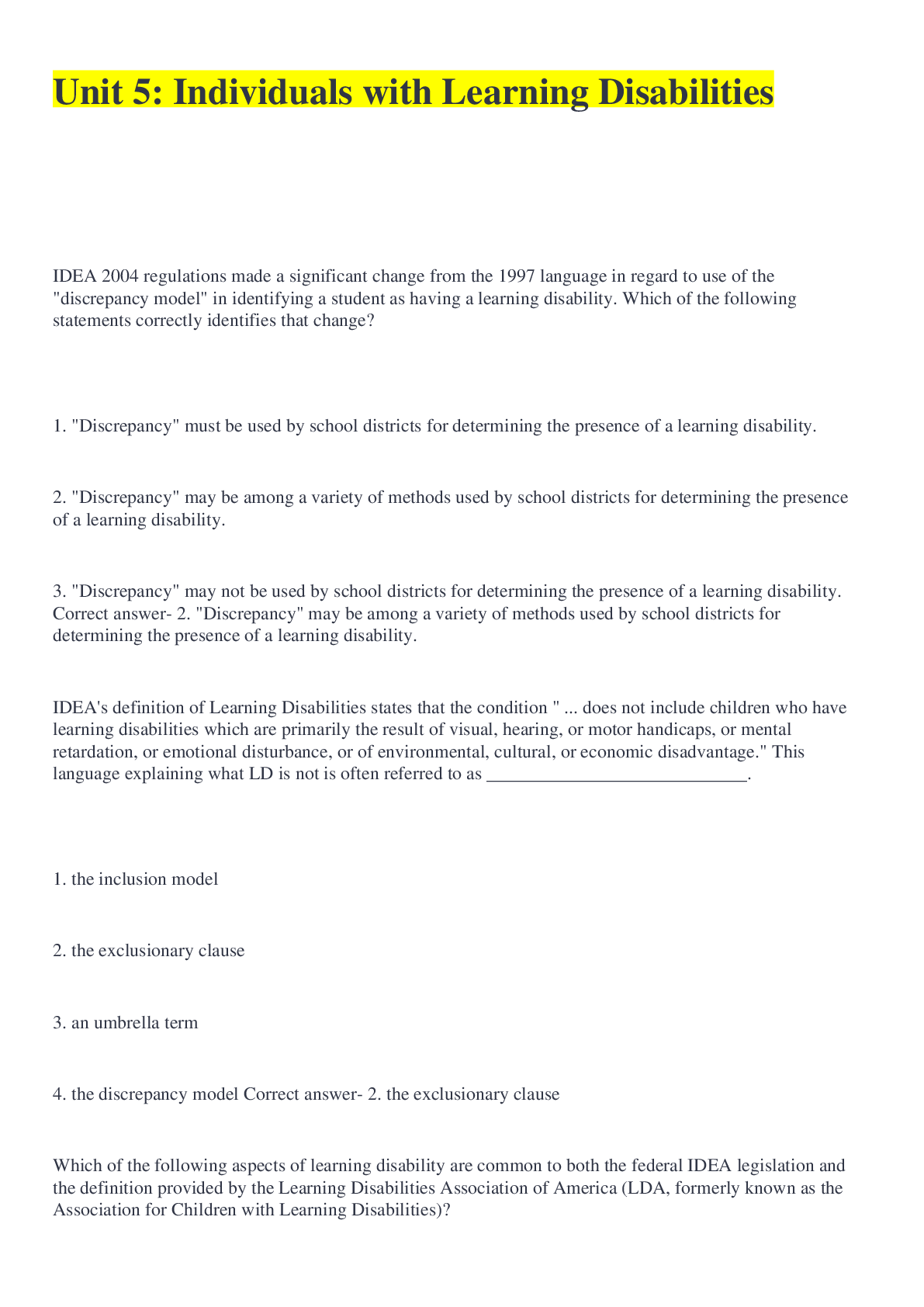
IDEA 2004 regulations made a significant change from the 1997 language in regard to use of the "discrepancy model" in identifying a student as having a learning disability. Which of the following statements correctly identifies that change?
1. "Discrepancy" must be used by school districts for determining the presence of a learning disability.
2. "Discrepancy" may be among a variety of methods used by school districts for determining the presence of a learning disability.
3. "Discrepancy" may not be used by school districts for determining the presence of a learning disability. Correct answer- 2. "Discrepancy" may be among a variety of methods used by school districts for determining the presence of a learning disability.
IDEA's definition of Learning Disabilities states that the condition " ... does not include children who have learning disabilities which are primarily the result of visual, hearing, or motor handicaps, or mental retardation, or emotional disturbance, or of environmental, cultural, or economic disadvantage." This language explaining what LD is not is often referred to as ____________________________.
1. the inclusion model
2. the exclusionary clause
3. an umbrella term
4. the discrepancy model Correct answer- 2. the exclusionary clause
Which of the following aspects of learning disability are common to both the federal IDEA legislation and the definition provided by the Learning Disabilities Association of America (LDA, formerly known as the Association for Children with Learning Disabilities)?
1. that classification for LD does not include individuals whose learning disabilities are primarily the result of sensory impairment, physical handicaps, mental retardation, or emotional disturbance
2. that LD is a chronic, lifelong condition
3. that LD interferes with an individual's ability in verbal and/or non-verbal communication (i.e., reading, writing, speaking, listening) and in mathematics
4. that LD can affect self-esteem and socialization of the individual Correct answer- 3. that LD interferes with an individual's ability in verbal and/or non-verbal communication (i.e., reading, writing, speaking, listening) and in mathematics
ADHD is a learning disability.
True
False Correct answer- False
Measure overall academic achievement
1. Achievement Tests
2. Cognitive Ability/Intelligence Test Correct answer- 1. Achievement Tests
Measure assumed ability
1. Achievement Tests
2. Cognitive Ability/Intelligence Test Correct answer- 2. Cognitive Ability/Intelligence Test
Which statement below best describes the term "Response to Intervention ( RTI)"?
1. It is a strategy for making eligibility decisions on the basis of how a pupil responds to scientific, research-based educational interventions.
2. It is the frequent and systematic assessment of the individual's performance.
3. It leads to the inference that learning disabilities are not primarily caused by other handicapping conditions or extrinsic factors.
4. It is used for comparing a student's performance on a standardized achievement test with a measure of cognitive abilities or intelligence. Correct answer- 1. It is a strategy for making eligibility decisions on the basis of how a pupil responds to scientific, research-based educational interventions.
Reflects the student's local curriculum
1. Curriculum-based measurement
2. Norm-referenced tests
3. Portfolio assessment
4. Criterion-referenced tests Correct answer- 1. Curriculum-based measurement
Measures student ability against mastery level performance by other students
1. Curriculum-based measurement
2. Norm-referenced tests
3. Portfolio assessment
4. Criterion-referenced tests Correct answer- 2. Norm-referenced tests
A collection of student work
1. Curriculum-based measurement
2. Norm-referenced tests
3. Portfolio assessment
4. Criterion-referenced tests Correct answer- 3. Portfolio assessment
Teacher-made tests for specific skills
1. Curriculum-based measurement
2. Norm-referenced tests
3. Portfolio assessment
4. Criterion-referenced tests Correct answer- 4. Criterion-referenced tests
Cents I knt reed, u fink I have a box of rox for a bran
knt rite eher From Joseph 9 yes old
The scenario above describes a number of strengths and deficits for Joseph. What are they?
1. His strengths are behavior, social and fine motor skills, with deficits in gross motor, reading and writing skills.
2. His strengths are gross motor and reading skills, with deficits in writing and fine motor skills.
3. His strengths are behavior, social and gross motor skills, with deficits in fine motor, reading and spelling skills.
4. His strengths are social and reading skills, with deficits in behavior, writing skills and spelling. Correct answer- 3. His strengths are behavior, social and gross motor skills, with deficits in fine motor, reading and spelling skills.
A common component of the definition of learning disability is that it is a lifelong condition.
True
False Correct answer- True
In defining learning disability, the difference between a student's actual academic performance and his or her estimated ability is described as a __________.
1. discrepancy
2. familiality study
3. learned helplessness
4. response to intervention Correct answer- 1. discrepancy
In some schools, RTI has now become a way to both identify students with potential learning disabilities as well as a way to pre-refer all students for an LD screening. True or False?
True
False Correct answer- True
A student with a learning disability who has difficulty conversing and picking up social cues has problems with ________________________.
1. semantics
2. short-term memory
3. pragmatics
[Show More]