Problem Set 4.1
1. A convenience store sells between five and twelve boxes of sugar each week. The probabilities
are given as follows:
Find the number of boxes of sugar that the convenience store should expect to sell
...
Problem Set 4.1
1. A convenience store sells between five and twelve boxes of sugar each week. The probabilities
are given as follows:
Find the number of boxes of sugar that the convenience store should expect to sell per week.
Also, find the variance and standard deviation of this data.
2. A barber expects to get between zero and six customers per hour in his barber shop. The
probability of these is given as follows:
Find the number of expected customers that the barber will get per hour. Also, find the variance
and standard deviation of this data.
3. A company makes bulbs for Christmas trees. Unfortunately, the boxes that contain the bulbs
have been mishandled and many of the boxes contain one or more broken bulbs. The number of
broken bulbs per box, along with the related probabilities are given as:
Find the expected number of broken bulbs per box.
number of expected value = E(X)
E(X)=μ= x1 P(X=x1 ) + x2 P(X=x2 ) + …. + xn P(X=xn ))
=( 0*0.23 ) + (1*0.19) + (2*0.33) + (3*0.15) + (4*0.1)
= 0+0.19+0.66+0.45+0.4
= 1.7
EXPECTED NUMBER OF BROKEN BOLB PER BOX= 1.7
Problem Set 4.2
1 . A basketball player makes foul shots 75 % of the time. If she takes 9 shots, what is the
probability that she will make exactly 7 shots.
This is a binominal experiment since the outcome is either the player will make shots or not
make shots.
2. A baseball player has a batting average of .211 (in other words, he gets a hit 21.1 % of the time
that he goes up to bat). If he goes up to bat 13 times, what is the probability that he will get
exactly 4 hits?
here, p =0.211, n =13 and x =4
This is a bio nominal experiment since the outcome is wither he will get the 4 hits or not.
3. A large shipment of light bulbs has just arrived at a store. It has been revealed that 17 % of the
light bulbs are defective (the other light bulbs are good). Suppose that you choose 6 light bulbs at
random. What is the probability that 2 or less of the bulbs are defective.
this is a bionomical probability since the outcome is either defective or not defective
4. Your factory has seven safety systems. During an emergency, the probability of any one of the
safety systems failing is .06. The factory will be in danger if more than four safety systems fail.
What is the probability of your factory being in danger during an emergency?
here , p = 0.06 , n = 7 , x = 5 and x =6 and x= 7 since factory will be in danger situation if more
than four system fail. this is a bionomical probability since the outcome can be factory being in
danger or not.
Problem Set 4.4
1. Suppose that for a normal random variable X, we have a mean of µ=10 and a standard
deviation of σ=3.
a) What is the probability that X will be less than 13?
first step Is to covert normal random variable to std normal random variable ,
2. A farmer harvests several heads of iceberg lettuce. The weight of the heads of lettuce are
normally distributed with a mean weight of 2.2 pounds and a standard deviation of .55 pounds. If
you choose a head of lettuce at random, what is the probability that the head you chose will
weigh:
a) Less than 2 pounds?
b) Greater than 2.5 pounds?
c) Between 1.8 pounds and 2.7 pounds?
3. Suppose that the scores of a history test are normally distributed with a mean of 565 and a
standard deviation of 113.
a) What percentage of the scores are less than 450?
b) What percentage of the scores are greater than 500?
c) What percentage of the scores are between 550 and 600?
d) Suppose you pick an individual history test at random, what is the probability that the score on
the test is between 575 and 625?
4. The time that people stand in the waiting line at a particular fast food restaurant is normally
distributed with a mean time of 130 seconds and a standard deviation of 25 seconds. If you go to
that fast food restaurant, what is the probability that you will stand in the waiting line for:
a) More than 150 seconds?
b) Less than 120 seconds?
c) Between 110 seconds and 150 seconds?
Solutions 4.3
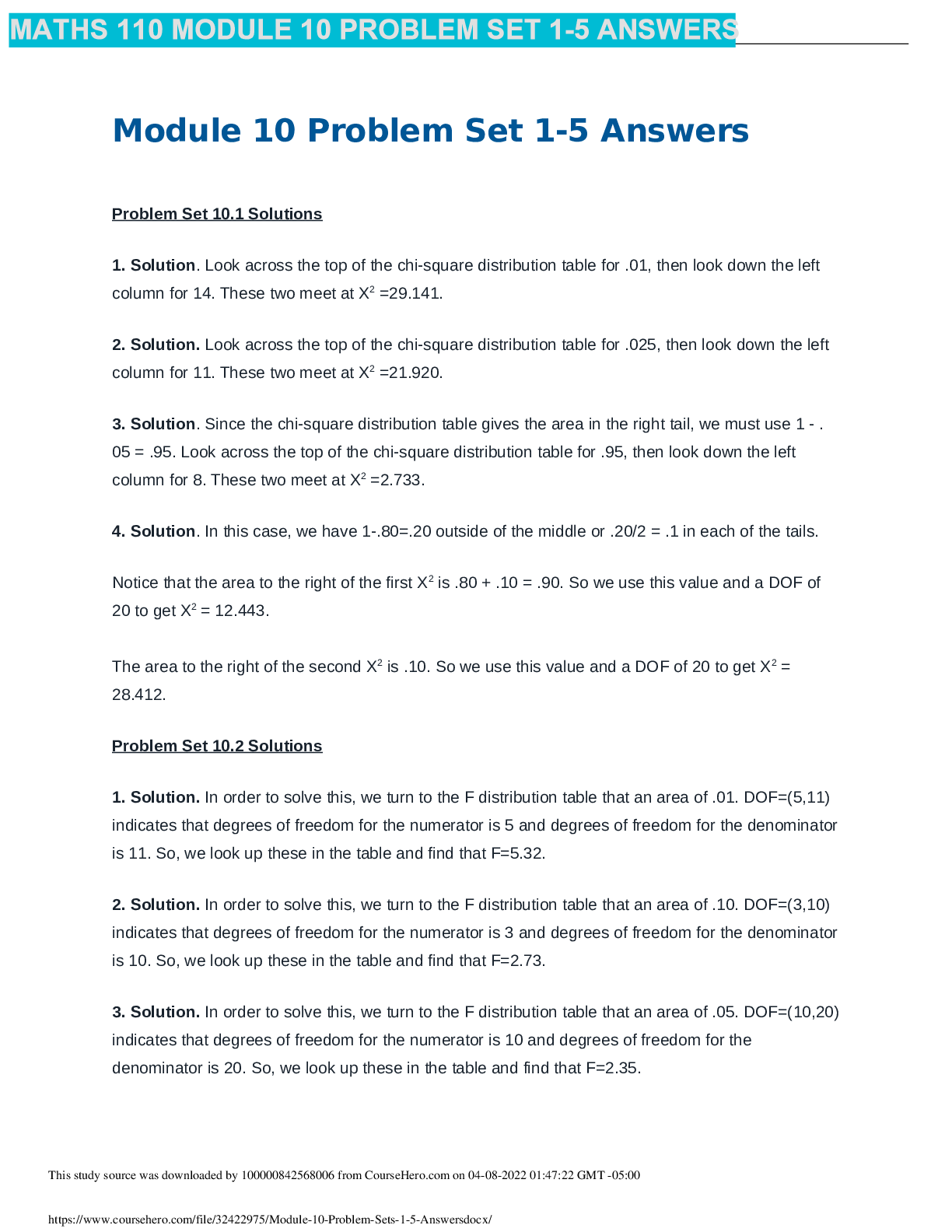
Problem Set 4.3 Solutions
1. Find P(Z ≤ .35). This is asking for the probability that the standard normal random variable,
Z, is less than .35.
Recall that the standard normal distribution table gives us values to the left of the z value, so that
is exactly what we want. From the table, we get P(Z ≤ .35) = .63683.
2. Find P(Z ≤ 1.04) . This is asking for th
[Show More]
.png)


.png)




.png)