University of Texas Arlington
NURS 3325
Module 2 Quiz Study Guide
Score for this quiz: 100 out of 100
Submitted Nov 13 at 8:02am
This attempt took 20 minutes.
Question 1
5 / 5 pts
The nurse discusses dent
...
University of Texas Arlington
NURS 3325
Module 2 Quiz Study Guide
Score for this quiz: 100 out of 100
Submitted Nov 13 at 8:02am
This attempt took 20 minutes.
Question 1
5 / 5 pts
The nurse discusses dental health with an 81-year-old client. Which client statement would the nurse identify as accurate?
Question 2
5 / 5 pts
A potential early sign of pneumonia in an older adult that is different from those typically seen in younger patients is:
Question 3
5 / 5 pts
The client tells the nurse that she is generally enjoying good health, but that she has been having occasional episodes of constipation over the past 6 months. What intervention should the nurse first suggest?
Question 4
5 / 5 pts
The nurse is well aware that heart disease is the leading cause of death in the aged. What is an age-related physiologic change that contributes to this trend?
Question 5
5 / 5 pts
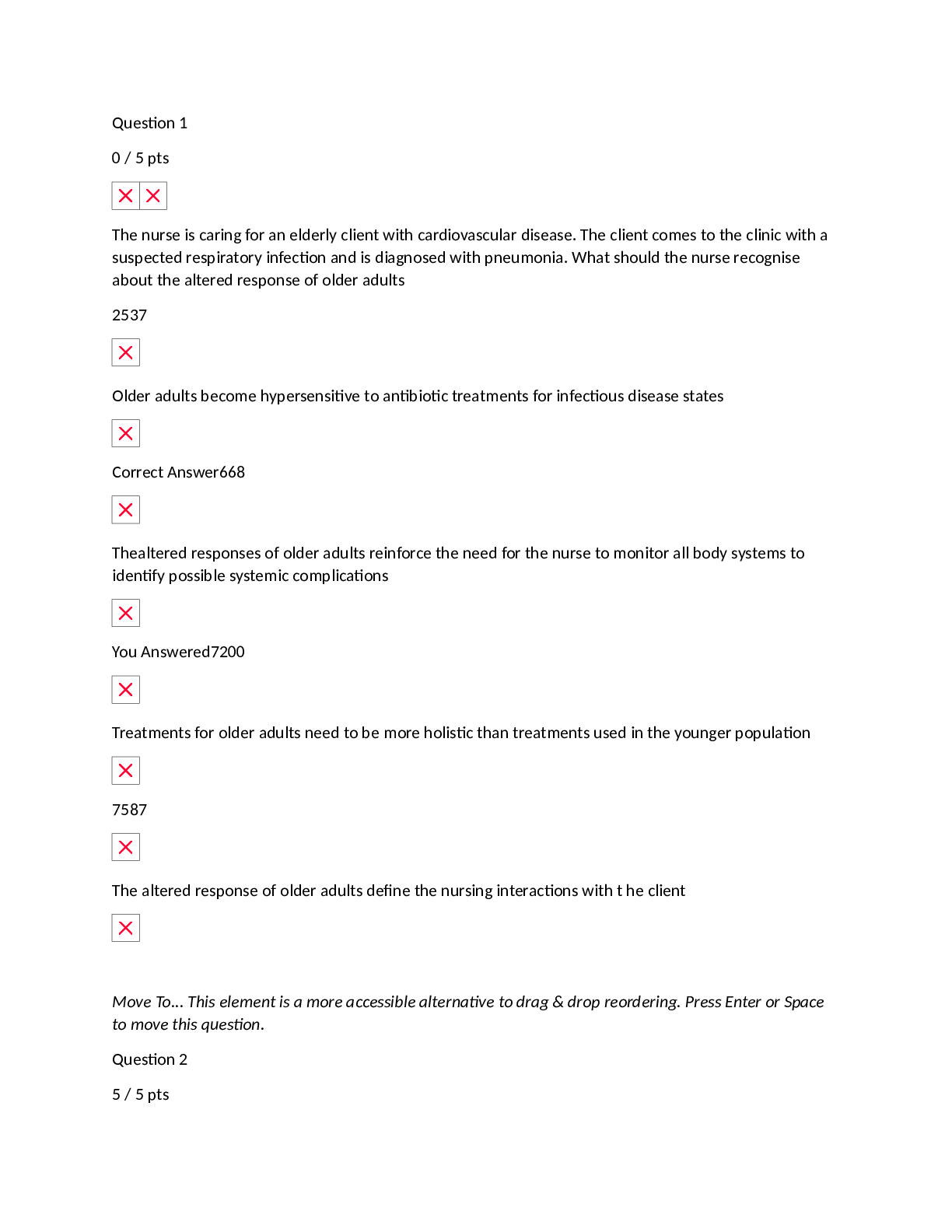
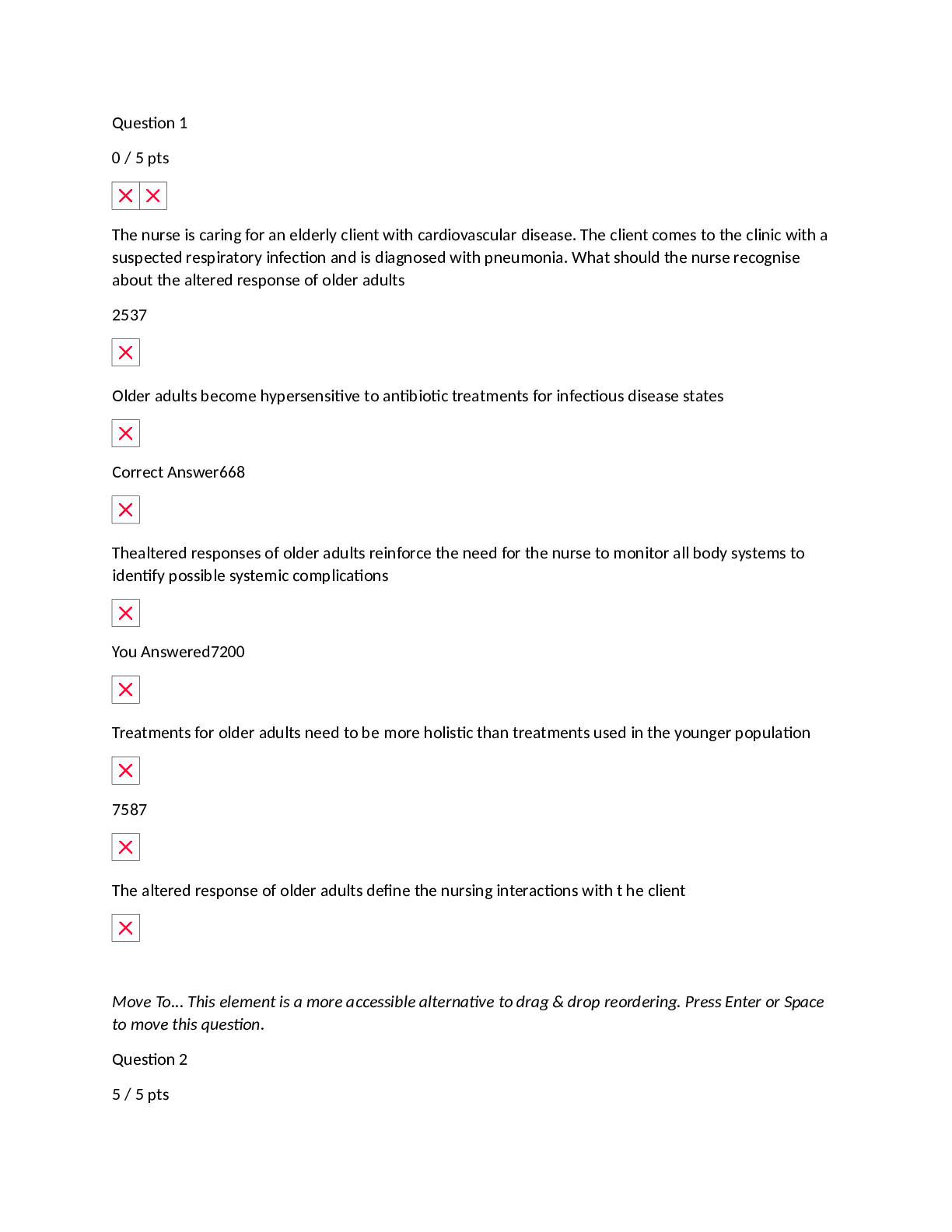
The nurse is caring for an elderly client with cardiovascular disease. The client comes to the clinic with a suspected respiratory infection and is diagnosed with pneumonia. What should the nurse recognise about the altered response of older adults
Question 6
5 / 5 pts
An older adult taking medication for hypertension asks what else can be done to reduce blood pressure. Which action would the nurse most likely recommend?
Question 7
5 / 5 pts
In older adults, a sign of worsening heart failure is:
Question 8
5 / 5 pts
A nurse will conduct an influenza vaccination campaign at an extended care facility. The nurse will be administering intramuscular (IM) doses of the vaccine. Of what age-related change should the nurse be aware when planning the appropriate administration of this drug?
Question 9
5 / 5 pts
An older client with asthma is prescribed an inhaler. The nurse is assessing the client for possible factors that might impact the client's ability to comply with this treatment. Which condition would the nurse identify as most likely to impact the client's compliance?
Question 10
5 / 5 pts
A nurse assessing an older client who reports a sudden onset of urinary incontinence. The nurse should recognize which of the following conditions can cause incontinence in the older adult client?
Question 11
5 / 5 pts
Nurses and members of other health disciplines at the state's public health division are planning programs for the next 5 years. The group has made the decision to focus on diseases that are experiencing the sharpest increases in their contributions to the overall death rate in the state. This team should plan promotion and disease prevention activities to address what health problem?
Question 12
5 / 5 pts
The nurse is discussing nutritional health with an 89-year-old client. The client's total protein is 5 (abnormally low). A decrease in which factor would the nurse interpret as a potential pathological process rather than a normal age-related change?
Question 13
5 / 5 pts
A 47-year-old client who has come to the physician's office for his annual physical is being assessed by the office nurse, The nurse who is performing routine health screening for this client should be aware that one of the first physical signs of aging is what?
Question 14
5 / 5 pts
As a normal effect of aging, what percent decrease in renal function would we expect to see in the older adults.
Question 15
5 / 5 pts
The decreased muscle mass of older adults predisposes them to:
Question 16
5 / 5 pts
Postural hypotension in an older adult can result from
Question 17
5 / 5 pts
Geriatric syndromes are not specific to older adults but become a problem because older adults have less physiological reserve. Which of the following conditions is not generally considered a geriatric syndrome?
Question 18
5 / 5 pts
The nurse is assisting an aging client with osteoarthritis to ambulate. Which of the following instructions is most appropriate for the nurse to give the client?
Question 19
5 / 5 pts
Falls are the leading cause of injury in older adults. For those over age 75 who suffer a hip fracture from falling, what percent will die within one year?
Question 20
5 / 5 pts
Which one is NOT a contributing factor to healthcare providers having problems making accurate diagnoses in the older adult?
[Show More]