1. A nurse is administering an otic medication to an older adult client. Which of the following actions should the nurse take to ensure that the medication reaches the inner ear?
A) Press gently on the tragus of the cli
...
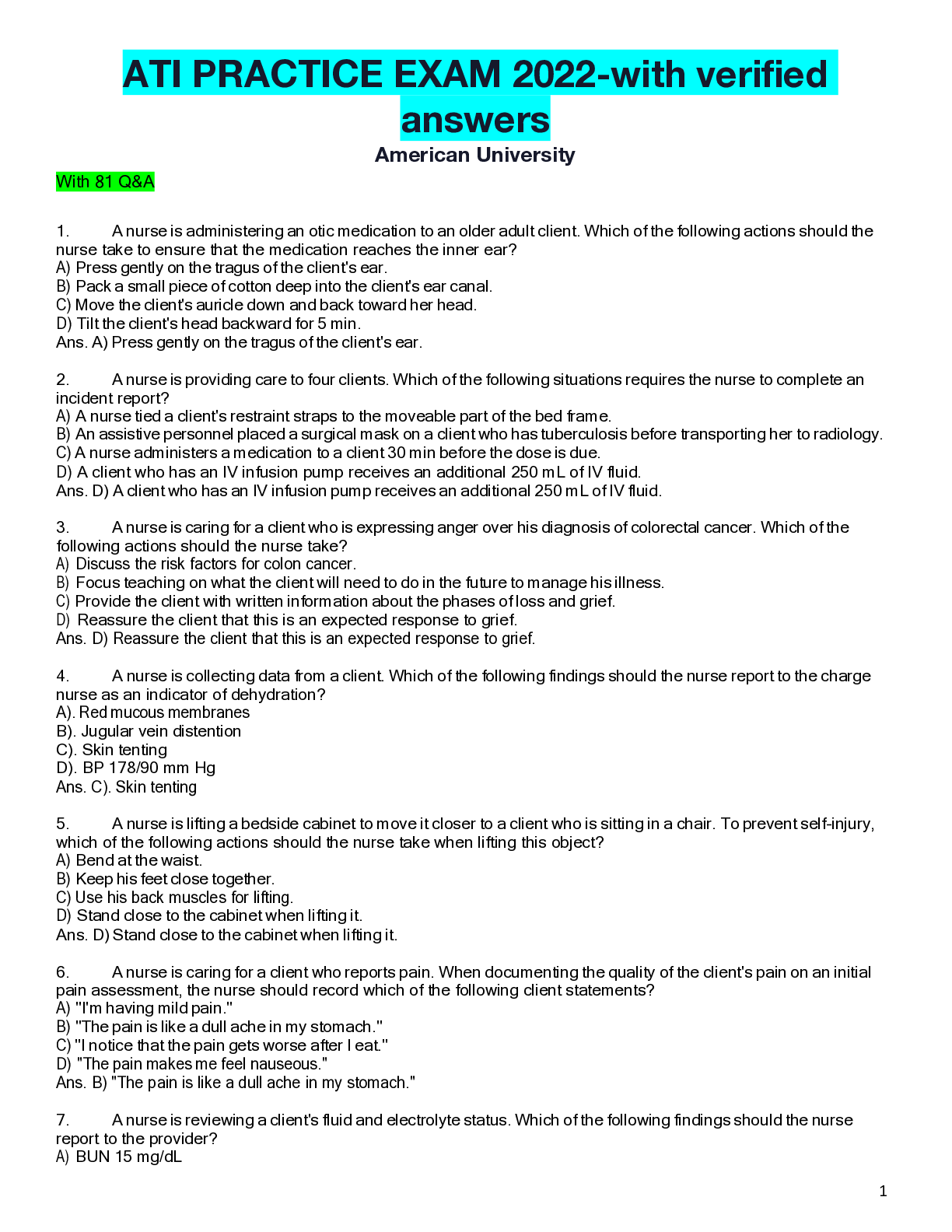
1. A nurse is administering an otic medication to an older adult client. Which of the following actions should the nurse take to ensure that the medication reaches the inner ear?
A) Press gently on the tragus of the client's ear.
B) Pack a small piece of cotton deep into the client's ear canal.
C) Move the client's auricle down and back toward her head.
D) Tilt the client's head backward for 5 min.
Ans. A) Press gently on the tragus of the client's ear.
2. A nurse is providing care to four clients. Which of the following situations requires the nurse to complete an incident report?
A) A nurse tied a client's restraint straps to the moveable part of the bed frame.
B) An assistive personnel placed a surgical mask on a client who has tuberculosis before transporting her to radiology.
C) A nurse administers a medication to a client 30 min before the dose is due.
D) A client who has an IV infusion pump receives an additional 250 mL of IV fluid. Ans. D) A client who has an IV infusion pump receives an additional 250 mL of IV fluid.
3. A nurse is caring for a client who is expressing anger over his diagnosis of colorectal cancer. Which of the following actions should the nurse take?
A) Discuss the risk factors for colon cancer.
B) Focus teaching on what the client will need to do in the future to manage his illness.
C) Provide the client with written information about the phases of loss and grief.
D) Reassure the client that this is an expected response to grief. Ans. D) Reassure the client that this is an expected response to grief.
4. A nurse is collecting data from a client. Which of the following findings should the nurse report to the charge nurse as an indicator of dehydration?
A). Red mucous membranes B). Jugular vein distention C). Skin tenting
D). BP 178/90 mm Hg
Ans. C). Skin tenting
5. A nurse is lifting a bedside cabinet to move it closer to a client who is sitting in a chair. To prevent self-injury, which of the following actions should the nurse take when lifting this object?
A) Bend at the waist.
B) Keep his feet close together.
C) Use his back muscles for lifting.
D) Stand close to the cabinet when lifting it.
Ans. D) Stand close to the cabinet when lifting it.
6. A nurse is caring for a client who reports pain. When documenting the quality of the client's pain on an initial pain assessment, the nurse should record which of the following client statements?
A) "I'm having mild pain."
B) "The pain is like a dull ache in my stomach."
C) "I notice that the pain gets worse after I eat."
D) "The pain makes me feel nauseous."
Ans. B) "The pain is like a dull ache in my stomach."
7. A nurse is reviewing a client's fluid and electrolyte status. Which of the following findings should the nurse report to the provider?
A) BUN 15 mg/dL
B) Creatinine 0.8 mg/dL
C) Sodium 143 mEq/L
D) Potassium 5.4 mEq/L
Ans. D) Potassium 5.4 mEq/L
8. When auscultating a client’s lungs, the nurse identifies crackles in the left posterior base. Which of the following actions should the nurse take?
CONTINUED..........
[Show More]