ISYE6501 HOMEWORK 10
Question 14.1
The breast cancer data set breast-cancer-wisconsin.data.txt from http://archive.ics.uci.edu/ml/
machine-learning-databases/breast-cancer-wisconsin/ (description at http://archive.ics
...
ISYE6501 HOMEWORK 10
Question 14.1
The breast cancer data set breast-cancer-wisconsin.data.txt from http://archive.ics.uci.edu/ml/
machine-learning-databases/breast-cancer-wisconsin/ (description at http://archive.ics.uci.edu/ml/
datasets/Breast+Cancer+Wisconsin+%28Original%29 ) has missing values. 1. Use the mean/mode
imputation method to impute values for the missing data.
2. Use regression to impute values for the missing data.
3. Use regression with perturbation to impute values for the missing data.
4. (Optional) Compare the results and quality of classification models (e.g., SVM, KNN) build using
(1) the data sets from questions 1,2,3;
(2) the data that remains after data points with missing values are removed; and (3) the data set when a
binary variable is introduced to indicate missing values.
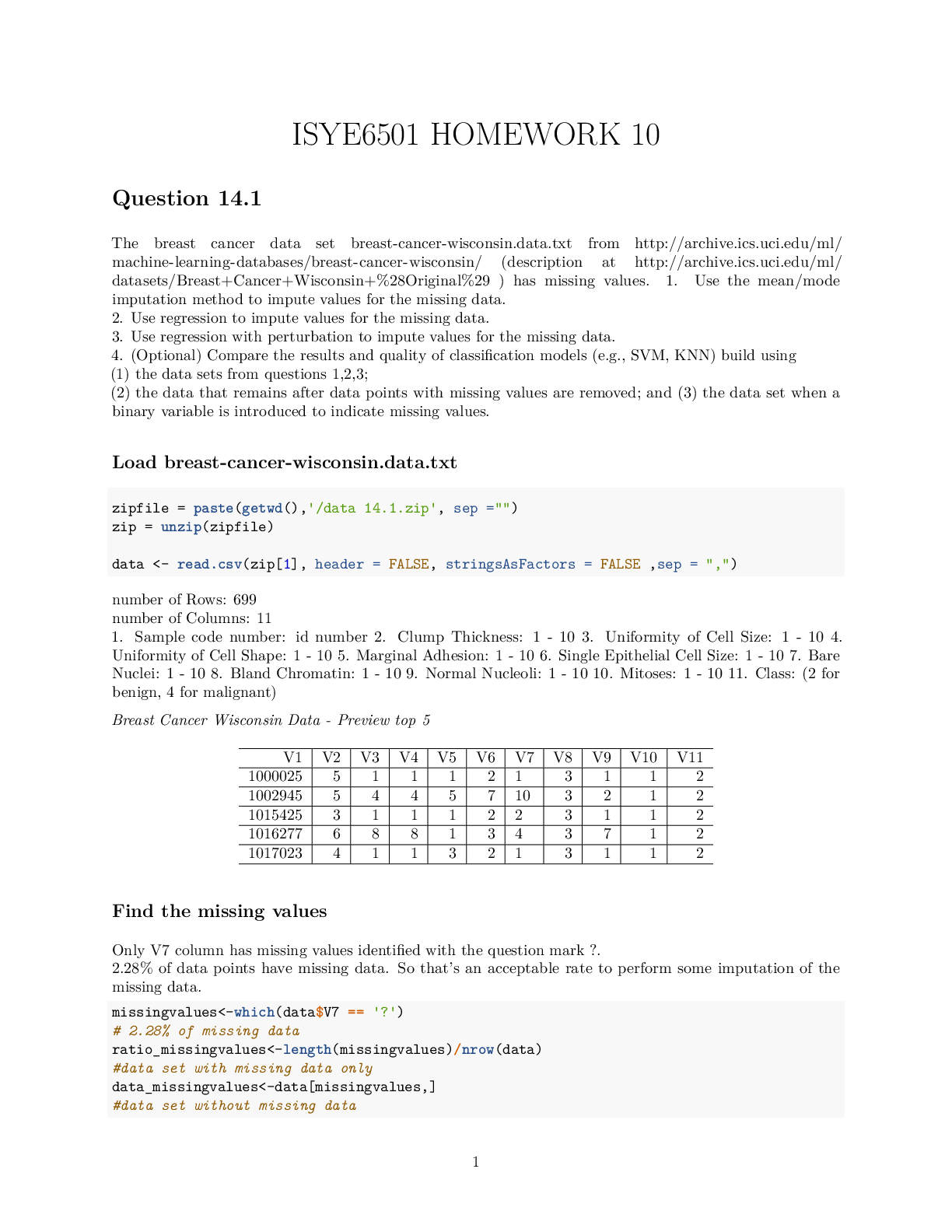
Load breast-cancer-wisconsin.data.txt
zipfile = paste(getwd(),'/data 14.1.zip', sep ="")
zip = unzip(zipfile)
data <- read.csv(zip[1], header = FALSE, stringsAsFactors = FALSE ,sep = ",")
number of Rows: 699
number of Columns: 11
1. Sample code number: id number 2. Clump Thickness: 1 - 10 3. Uniformity of Cell Size: 1 - 10 4.
Uniformity of Cell Shape: 1 - 10 5. Marginal Adhesion: 1 - 10 6. Single Epithelial Cell Size: 1 - 10 7. Bare
Nuclei: 1 - 10 8. Bland Chromatin: 1 - 10 9. Normal Nucleoli: 1 - 10 10. Mitoses: 1 - 10 11. Class: (2 for
benign, 4 for malignant)
Breast Cancer Wisconsin Data - Preview top 5
V1 V2 V3 V4 V5 V6 V7 V8 V9 V10 V11
1000025 5 1 1 1 2 1 3 1 1 2
1002945 5 4 4 5 7 10 3 2 1 2
1015425 3 1 1 1 2 2 3 1 1 2
1016277 6 8 8 1 3 4 3 7 1 2
1017023 4 1 1 3 2 1 3 1 1 2
Find the missing values
Only V7 column has missing values identified with the question mark ?.
2.28% of data points have missing data. So that’s an acceptable rate to perform some imputation of the
missing data.
missingvalues<-which(data$V7 == '?')
# 2.28% of missing data
ratio_missingvalues<-length(missingvalues)/nrow(data)
#data set with missing data only
data_missingvalues<-data[missingvalues,]
#data set without missing data
1
data_no_missingvalues<-data[-missingvalues,]
data_no_missingvalues$V7 = as.integer(data_no_missingvalues$V7)
Does the missing values have any bias?
Since the goal is to predict V11, One quick way to verify whether the missing values are carrying any bias, is
to compare the distribution of V11’s values in the population with missing values and the distribution in the
population without missing values.
V11 = 2 represent 87.5% of the missing value data set versus 65% in the data set without missing value. So
we might conclude that the missing value population might have some bias.
#0.6552217
sum(data$V11 == 2)/nrow(data)
## [1] 0.6552217
#0.875
sum(data_missingvalues$V11 == 2)/nrow(data_missingvalues)
## [1] 0.875
#0.6500732
sum(data_no_missingvalues$V11 == 2)/nrow(data_no_missingvalues)
## [1] 0.6500732
1. Use the mean/mode imputation method to impute values for
the missing data.
Mode imputation is prefered for categorical variables. In our case, V7 is apparently an ordinal variable so we
might consider to treat it as a categorical or continuous variable. I will use both methods mean and mode
imputations, and I will create one column for the mean imputation and one column for the mode imputation
to imputethe missing values of V7.
One quick comment: taking the mean might give us a float; I arbitrary rounding the value to the nearest
integer.
# Compute the mean on the non missing values of V7
mean_V7<-round(mean(as.integer(data_no_missingvalues$V7)))
#mean: 3.544656 => mean_V7: 4
new_data<-data
new_data$mean<-new_data$V7
new_data$mean[new_data$mean== "?"] <- round(mean_V7)
new_data$mean<-as.numeric(new_data$mean)
# Create the function.
getmode <- function(v) {
uniqv <- unique(v)
uniqv[which.max(tabulate(match(v, uniqv)))]
}
# Calculate the mode using the user function.
#mode_V7 = 1
mode_V7 <- getmode(as.integer(data_no_missingvalues$V7))
[Show More]