Database Management  >  QUESTIONS & ANSWERS  >  WGU C170 Data Management – Applications (All)

WGU C170 Data Management – Applications

Document Content and Description Below

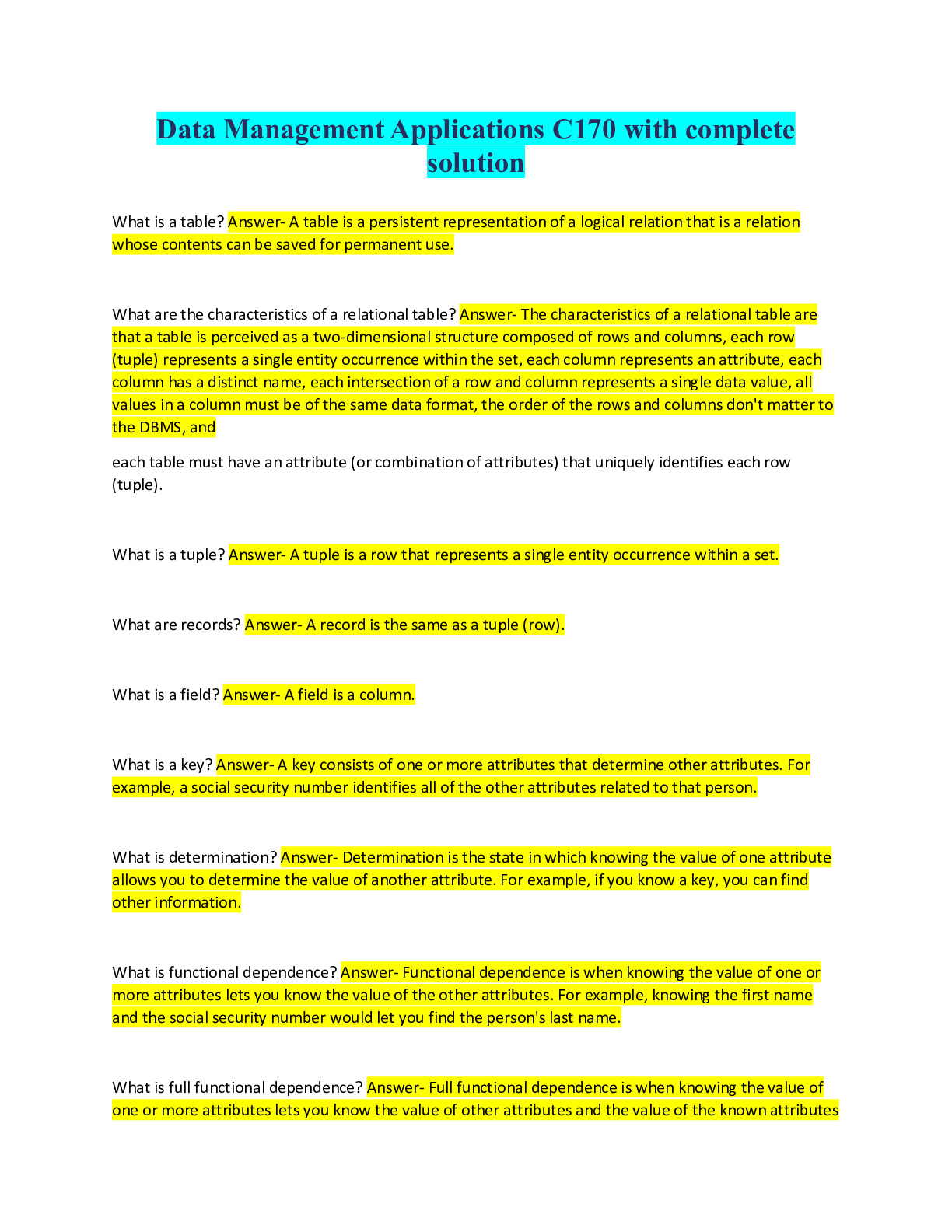
WGU C170 Data Management – Applications domain Answer- In data modeling, the construct used to organize and describe an attribute's set of possible values superkey Answer- An attribute or attribute ... s that uniquely identify each entity in a table. Any composite key with this is also this. candidate key Answer- A minimal superkey; that is, a key that does not contain a subset of attributes that is itself a superkey entity integrity Answer- The property of a relational table that guarantees each entity has a unique value in a primary key and that the key has no null values referential integrity Answer- A condition by which a dependent table's foreign key must have either a null entry or a matching entry in the related table data dictionary Answer- A DBMS component that stores metadata. It contains the data definition & their characteristics and relationships; may also include data external to the DBMS system catalog Answer- A detailed system data dictionary that describes all objects in a database homonym Answer- The use of the same name to label different attributes, much like similar-sounding words with different meanings synonym Answer- The use of different names to identify the same object, such as an entity, an attribute, or a relationship. These should generally be avoided. not null and unique Answer- Any candidate key must have these two constraints enforced cardinality Answer- Term for how many instances of one object are related to instances of another object (maximum) modality Answer- Term for whether an instance of a specific entity is optional or mandatory in a relationship (minimum) connectivity Answer- Term for the classification of the relationship between entities. Classifications include 1:1, 1:M, and M:N CREATE SCHEMA AUTHORIZATION Answer- SQL command to create a database schema DEFAULT Answer- SQL option to define a default value for a column (when no value is given) CHECK Answer- SQL command to validate data in an attribute, used during table column creation CREATE TABLE AS Answer- SQL command to create a new table based on a query in the user's database schema HAVING Answer- SQL option that restricts a selection of grouped rows based on a condition EXISTS Answer- SQL option that checks whether a subquery returns any rows DECIMAL Answer- SQL data type like the NUMBER specification, but the storage length is a minimum specification True Answer- True or false: if an INSERT or SELECT command is embedded inside a program for later use, the attribute list should always be used, as the table may change over time inner join Answer- A join operation in which only rows that meet a given criterion are selected. The most common type of join outer join Answer- A join operation that produces a table in which all unmatched pairs are retained; unmatched values in the related table are left null cross join Answer- A join operation that returns the Cartesian product of two sets or tables natural join Answer- Join type that returns only the rows with matching values in the matching columns; the matching columns must have the same names and similar data types left, right, full Answer- Name the three types of outer joins ALL Answer- This operator can be used to compare something to every returned row of a subquery ANY Answer- This operator can be used to compare something to a list of values and return any rows that satisfy the criteria correlated subquery Answer- A subquery that executes once for each row in the outer query UNION Answer- SQL statement that combines rows from two or more queries without including duplicate rows, as long as the queries return the same # of attributes and similar data types UNION ALL Answer- SQL statement similar to UNION but retaining duplicate rows INTERSECT Answer- SQL statement used to combine rows from two queries, returning only the rows that appear in both sets EXCEPT (MINUS) Answer- SQL statement that combines rows from two queries and returns only the rows that appear in the first set but not in the second view Answer- A virtual table based on a SELECT query that is saved as an object in the database base table Answer- The table on which a view is based batch update routine Answer- A routine that pools transactions into a single group to update a master table in a single operation updatable view Answer- A view that can update attributes in [Show More]

Last updated: 3 years ago

Preview 1 out of 6 pages

Buy Now

Instant download

We Accept:

Payment methods accepted on Scholarfriends (We Accept)
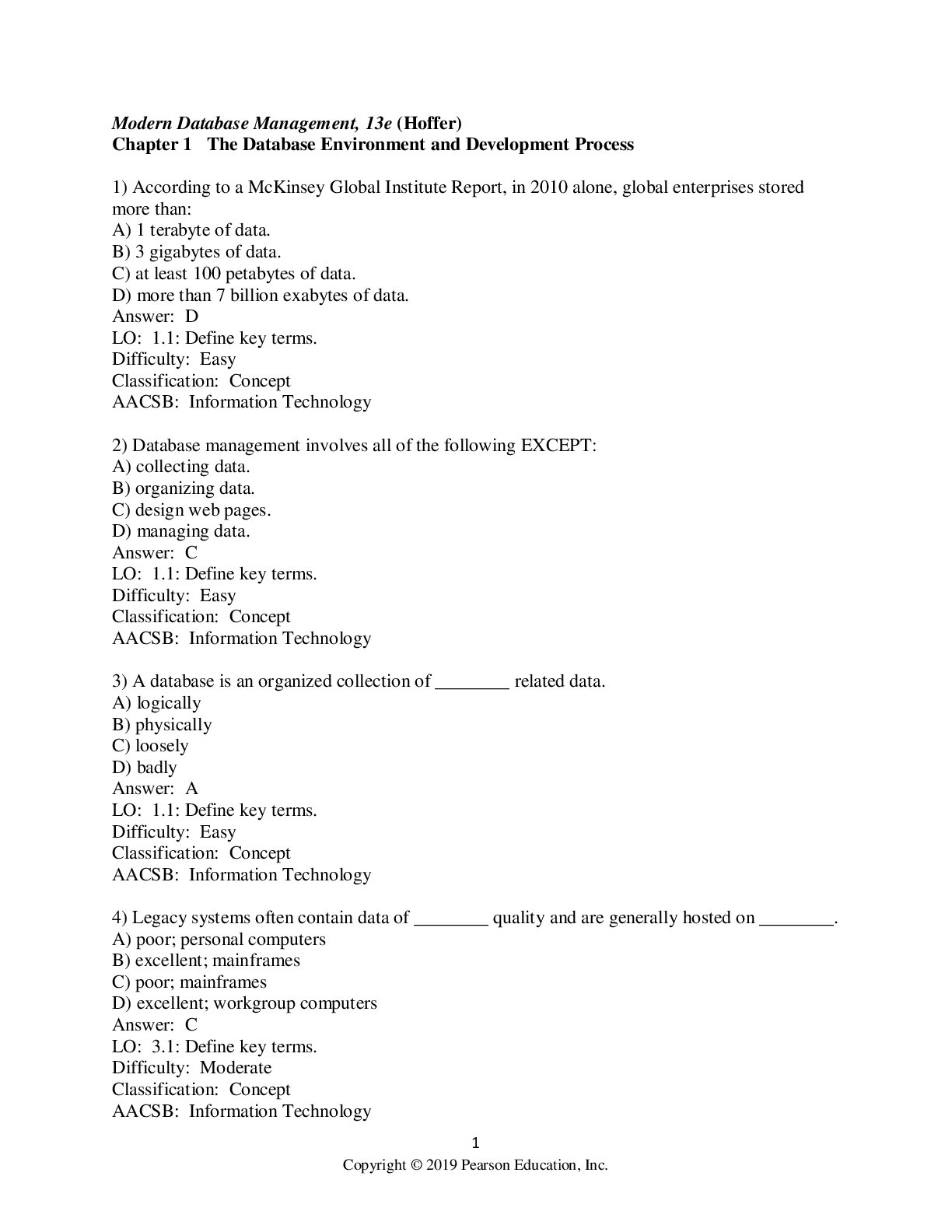
Preview image of WGU C170 Data Management – Applications document

Buy this document to get the full access instantly

Instant Download Access after purchase

Buy Now

Instant download

We Accept:

Payment methods accepted on Scholarfriends (We Accept)

Also available in bundle (1)

Click Below to Access Bundle(s)

WGU C170 FULL SOLUTION PACK FLASHCARD(Over 12 different exams with complete solution)

C170 - Data Management Applications V4.0 - Quiz 3 - WGU WGU C170 - PRE-ASSESSMENT LATEST 2021 GRADED A+ Data Management Applications C170 with complete solution WGU C170 Terms With Complete Solution W...

By Nutmegs 3 years ago

$13

14  

Reviews( 0 )

$9.00

Buy Now

We Accept:

Payment methods accepted on Scholarfriends (We Accept)

Instant download

Can't find what you want? Try our AI powered Search

215
0

Document information


Connected school, study & course


About the document


Uploaded On

May 20, 2022

Number of pages

6

Written in

All

Seller


Profile illustration for Nutmegs
Nutmegs

Member since 4 years

607 Documents Sold

Reviews Received
77
14
8
2
21
Additional information

This document has been written for:

Uploaded

May 20, 2022

Downloads

 0

Views

 215

Document Keyword Tags


$9.00
What is Scholarfriends

Scholarfriends.com Online Platform by Browsegrades Inc. 651N South Broad St, Middletown DE. United States.

We are here to help

We're available through e-mail, Twitter, and live chat.
 FAQ
 Questions? Leave a message!


Copyright © Scholarfriends · High quality services·